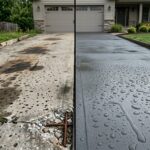
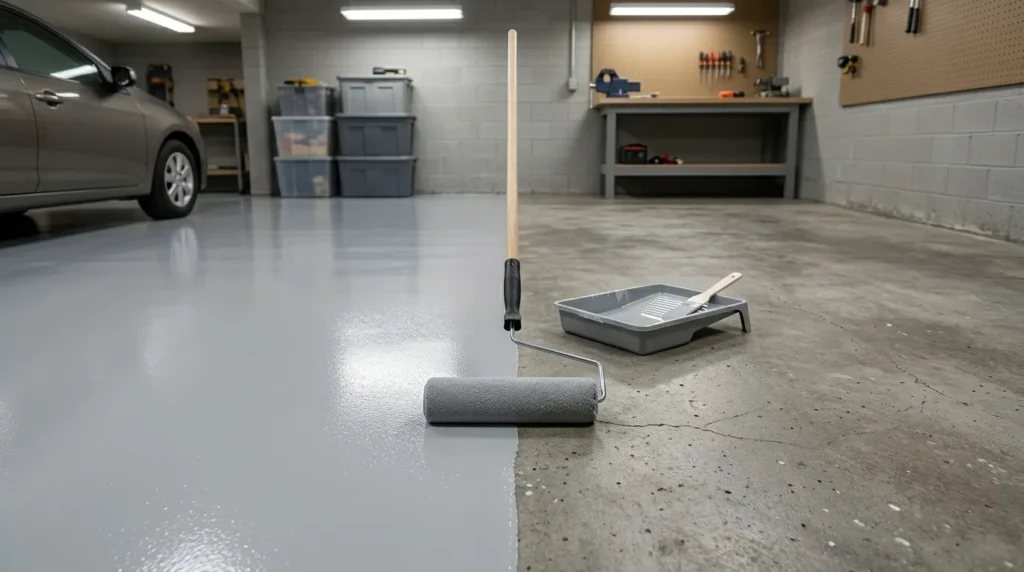

Painting concrete sounds simple — it is just paint, applied to a surface. But concrete is one of the most demanding painting substrates in construction. It is alkaline, porous, and often damp — three properties that cause standard interior or exterior house paint to peel, blister, and fail within months. The wrong paint on concrete is not just money wasted; it is a messy stripping job before you can start again with the right product.
Understanding what type of paint for concrete your specific surface needs is the decision that determines whether your painted concrete surface looks good for years or peels within a season. A garage floor needs epoxy. A basement wall needs alkali-resistant masonry paint or elastomeric. An outdoor patio needs UV-stable acrylic. A concrete block boundary wall needs a breathable exterior masonry coating. None of these products are interchangeable.
This guide covers every concrete paint type with uses, limitations, surface-by-surface selection guidance, and a complete preparation sequence that is the foundation of any paint job that lasts.
For the concrete beneath any paint or coating, use our free concrete calculator at ConcreteCal to accurately calculate material requirements before any surface treatment project.
Table of Contents
- Can You Use Regular Paint on Concrete?
- Concrete Paint vs. Concrete Stain — Key Difference
- What Type of Paint for Concrete — The Main Options
- Acrylic Latex Concrete Paint
- Epoxy Floor Paint
- Masonry Paint
- Elastomeric Paint
- Anti-Slip and Specialty Concrete Paints
- Paint Type by Surface — Quick Selection Guide
- How to Prepare Concrete for Painting — Step by Step
- Paint for Concrete — Comparison Table
- How Long Does Concrete Paint Last?
- Frequently Asked Questions
Can You Use Regular Paint on Concrete?
Technically, regular latex or oil-based house paint will go onto concrete — it will cover the surface and look acceptable for a few weeks. Then it will start to peel.
Regular paint fails on concrete for three reasons:
Alkalinity: Fresh and relatively new concrete is highly alkaline (pH 12–13). Standard paints are formulated for neutral or slightly acidic surfaces — wood, drywall, plaster. Concrete’s alkalinity attacks the paint binder, causing saponification — a chemical breakdown that makes the paint soft and causes it to lose adhesion.
Porosity and moisture: Concrete absorbs moisture from the ground below and from the air. Moisture vapor migrating through concrete pushes paint off the surface from below — a process called hydrostatic failure or osmotic blistering. House paint has no mechanism to handle this.
Surface hardness: Concrete is hard and non-absorbent in a way that prevents standard paint from mechanically keying into the surface. Without proper etching or profiling, paint sits on top of a concrete surface rather than bonding to it.
The answer is simple: use paint specifically formulated for concrete. The products exist, they are widely available, and they solve all three problems that regular paint cannot handle.
Concrete Paint vs. Concrete Stain — Key Difference
Before selecting a paint type, it helps to understand what separates paint from stain — because both are used on concrete and both change the surface appearance, but they work completely differently.
Concrete paint sits on top of the concrete surface as an opaque or semi-opaque coating. It hides the concrete beneath and provides a solid, uniform color. It can peel or chip over time as it wears from the surface.
Concrete stain penetrates into the concrete pore structure and changes the color of the concrete itself — either through chemical reaction (acid stain) or through dye absorption (water-based stain). Stain cannot peel because it is part of the concrete, not a coating on top. But it cannot hide surface imperfections the way paint can.
| Factor | Concrete Paint | Concrete Stain |
|---|---|---|
| Appearance | Opaque, uniform color | Translucent, shows concrete texture |
| Hides defects | ✅ Yes | ❌ No — shows everything |
| Can peel | ✅ Yes (coating) | ❌ No (penetrates) |
| Color range | Unlimited | Earth tones (acid), wider (water-based) |
| Maintenance | Repainting required | Resealing required |
| Best for | Floors, walls needing uniform color | Decorative surfaces, natural look |
For decorative concrete where natural texture and organic color variation is the goal — see our types of concrete finishes guide which covers staining in detail. This guide focuses on paint products.
What Type of Paint for Concrete — The Main Options
Four paint categories cover the vast majority of concrete painting applications:
| Paint Type | Key Property | Indoor/Outdoor | Best Surface |
|---|---|---|---|
| Acrylic latex | UV stable, flexible, easy apply | Both | Patios, walkways, outdoor slabs |
| Epoxy | Chemical resistant, hard, durable | Indoor | Garage floors, industrial floors |
| Masonry paint | Alkali resistant, breathable | Both | Walls, block, rendered surfaces |
| Elastomeric | Flexible, crack-bridging, waterproof | Exterior | Walls, foundations, block |
| Anti-slip | Textured, high traction | Both | Ramps, steps, wet areas |
| Pool paint | Chemical resistant, waterproof | Submerged | Pools, water features |
Acrylic Latex Concrete Paint
Acrylic latex concrete paint is the most versatile concrete paint — water-based, low VOC, easy to apply, and suitable for a wide range of concrete surfaces both indoors and outdoors.
How it works: Acrylic polymers in the paint formulation are specially modified for adhesion to alkaline, porous concrete surfaces. Unlike regular latex paint, concrete-grade acrylic includes alkali-resistant binders that withstand concrete’s high pH without saponification.
Key properties:
- UV stable — does not yellow or chalk in sunlight
- Flexible film — accommodates minor concrete movement without cracking
- Breathable — allows some moisture vapor transmission, reducing blistering risk
- Wide color range — any color available
- Low VOC — safe for indoor use without special ventilation
- Easy application — roller, brush, or sprayer
- Recoat time: 2–4 hours
- Cure time: 24–72 hours before light foot traffic
Interior vs. Exterior Acrylic
Interior acrylic concrete paint is formulated for lower moisture vapor and no UV exposure. It typically has higher sheen options (semi-gloss, gloss) and is not formulated to resist outdoor weather.
Exterior acrylic concrete paint includes UV stabilisers, mold/mildew inhibitors, and greater weather resistance. Always use exterior-grade for any outdoor application — indoor paint will chalk and fade within one season outdoors.
Worked Example — Covered Patio Floor: A 200 sq ft covered patio concrete floor. Exterior acrylic concrete paint in charcoal grey. Surface prepared (cleaned, etched, dried). One coat primer, two finish coats. Coverage: 300 sq ft per gallon = 0.67 gallons per coat × 2 coats = 1.33 gallons of finish coat. Add primer: 1 gallon. Total paint purchase: 1 gallon primer + 2 gallons finish = 3 gallons.
When to Choose Acrylic
- Outdoor patios, walkways, paths, and steps
- Indoor concrete floors with light foot traffic
- Concrete block walls (interior and exterior)
- Decorative concrete requiring specific color
- Budget-conscious applications where epoxy cost is not justified
- Any surface where easy DIY application is a priority
Limitation: Acrylic concrete paint is not suitable for surfaces subject to vehicle traffic or chemical spills — it lacks the hardness and chemical resistance of epoxy. On garage floors with vehicles, acrylic paint will wear through within 1–2 years.
Epoxy Floor Paint
Epoxy is the benchmark concrete floor coating for any surface that needs to survive vehicle traffic, chemical spills, abrasion, and heavy use. It is significantly harder and more chemical-resistant than acrylic paint — but also more demanding to apply correctly.
Two types:
Single-component epoxy paint (1K epoxy): Pre-mixed, moisture-cured epoxy. Easier to apply than two-component systems — no mixing required, longer pot life. Significantly less chemical resistant and less hard than true two-component epoxy. Better described as “epoxy-modified paint” than true epoxy.
Two-component epoxy (2K epoxy): Part A (resin) + Part B (hardener) mixed immediately before application. True cross-linking epoxy chemistry — produces a hard, chemically resistant film with genuine industrial performance. Requires careful mixing (ratio is critical), has a limited pot life (typically 30–60 minutes after mixing), and must be applied to properly prepared, dry concrete.
“Two-component epoxy coatings for concrete floors must meet the adhesion requirements specified in ASTM D4259 — the standard practice for abrading concrete — which defines the minimum surface preparation (concrete surface profile CSP 2–3) required before any high-performance floor coating application.”
Single-Component vs. Two-Component Epoxy
| Factor | 1K Epoxy Paint | 2K Epoxy Coating |
|---|---|---|
| Mixing | None required | Must mix precisely |
| Pot life | Extended (full can) | 30–60 minutes |
| Hardness | Moderate | Very High |
| Chemical resistance | Moderate | Excellent |
| Adhesion | Good | Excellent (on prepared surface) |
| Cost | $30–$60/gallon | $60–$120/gallon |
| DIY suitability | Easy | Moderate — timing critical |
| Durability | 2–5 years | 5–10 years |
Worked Example — Garage Floor Epoxy: A 576 sq ft two-car garage floor. Two-component epoxy system. Surface prepared: acid etched, neutralised, rinsed, dried 48 hours. Mixed Part A and Part B in correct ratio per manufacturer. Applied within 45-minute pot life. Coverage: 200–250 sq ft per gallon = 2.5 gallons for one coat. Two coats: 5 gallons of mixed epoxy. Total cost: 5 gallons × $80/gallon = $400 in materials plus broadcast decorative chips if desired.
When to Choose Epoxy Paint
- Indoor garage floors with vehicle traffic
- Workshop and industrial floors with oil/chemical exposure
- Commercial kitchens and food processing areas
- Any indoor floor where maximum durability and cleanability are required
- Surfaces that will be polished (epoxy base coat under polyurethane topcoat)
What NOT to use epoxy for:
- Outdoor surfaces in UV exposure — epoxy yellows and chalks
- Surfaces with active moisture or hydrostatic pressure from below — epoxy blisters and delaminates
- Concrete that has not been fully cured (minimum 28 days)
Masonry Paint
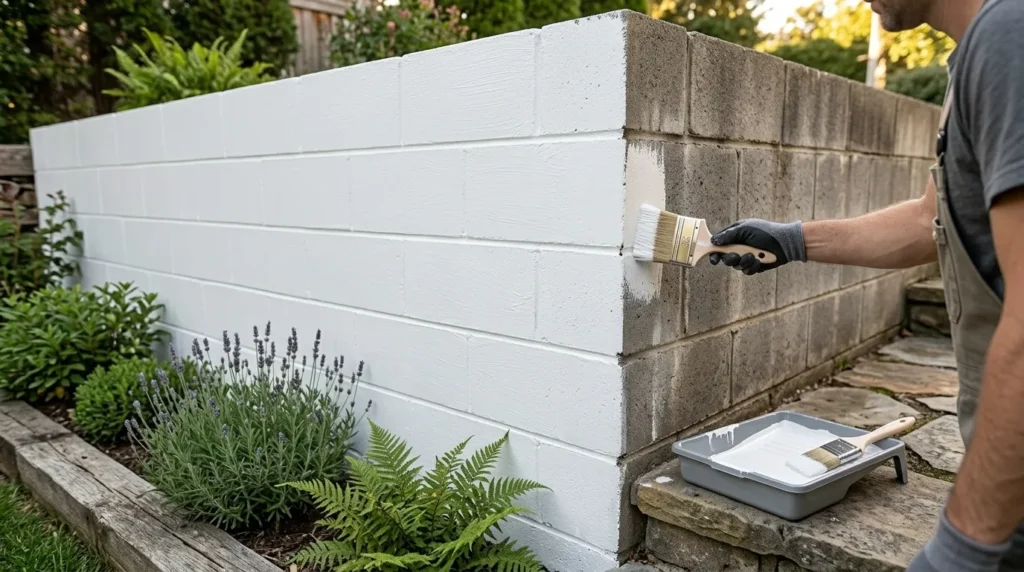
Masonry paint is specifically formulated for porous, alkaline surfaces — concrete, concrete block, brick, render, and stone. Unlike acrylic floor paint designed for horizontal traffic surfaces, masonry paint is engineered for vertical exterior and interior walls where breathability and weather resistance are the primary requirements.
Key properties:
- Alkali resistant — does not saponify on high-pH concrete
- Breathable — allows moisture vapor to pass through without blistering
- Microporous formulation — water repellent at the surface but vapor-permeable
- Weather resistant — resists rain, UV, frost
- Available in smooth and textured finishes
Breathability is the critical property: Concrete walls — particularly below grade or in contact with soil — release moisture vapor from within. A non-breathable coating traps this vapor, which builds up pressure and causes blistering and peeling. Masonry paint’s microporous structure allows vapor to escape while repelling liquid water at the surface.
Smooth vs. Textured Masonry Paint
Smooth masonry paint: Flat film finish — reveals the surface texture of the concrete or block beneath. Best on smooth rendered or poured concrete walls where a clean, contemporary finish is desired.
Textured masonry paint: Contains fine aggregate (sand, polymer particles) — creates a slightly rough, tactile surface finish. Hides minor surface imperfections and cracks better than smooth paint. More commonly used on rough concrete block or textured render.
Worked Example — Concrete Block Boundary Wall: A 40 linear ft × 5 ft boundary wall (200 sq ft). Smooth concrete block surface. Two coats of exterior smooth masonry paint in off-white. Coverage: 60–80 sq ft per litre (5.6–7.4 sq ft per oz). At 70 sq ft/litre: 200 sq ft × 2 coats = 400 sq ft total coverage = 6 litres (1.6 gallons) of masonry paint. Plus one coat alkali-resistant primer on new concrete: 1.4 litres. Total: approximately 7.5 litres (2 gallons).
When to Choose Masonry Paint
- Exterior concrete block, brick, or rendered walls
- Interior basement concrete walls (breathable formulation)
- Garden walls, retaining wall faces, foundation walls above grade
- Any vertical concrete surface requiring color and weather protection
- Surfaces where vapor breathability is essential (damp walls, below-grade transitions)
Elastomeric Paint
Elastomeric paint is a thick, highly flexible coating that can bridge surface cracks and provide waterproof protection on exterior concrete surfaces. It is significantly thicker than standard masonry paint — applied at 10–20 mil DFT (dry film thickness) versus 2–4 mil for standard paint.
How Elastomeric Paint Works
The elastomeric polymer binder can stretch and recover — accommodating concrete surface movement from thermal expansion, minor structural flexing, and surface cracking without the film cracking or losing adhesion. On a surface with hairline cracks or surfaces prone to seasonal movement, elastomeric paint bridges and seals those cracks rather than cracking over them.
Crack bridging capacity: Most elastomeric paints can bridge cracks up to 1/16 inch (1.5mm) wide — sealing them against water infiltration even as the crack opens and closes with temperature.
Worked Example — Basement Exterior Waterproofing: An above-grade basement foundation wall showing hairline cracks and surface staining from water infiltration. Two coats of elastomeric masonry paint applied to the exterior face. The flexible film bridges the hairline cracks, the thick film (12 mil DFT) provides a waterproof membrane, and the vapor-permeable formulation allows any interior moisture to exit. Result: dry interior wall without excavation or membrane installation.
When to Choose Elastomeric
- Exterior foundation walls with hairline cracking
- Concrete block or tilt-up panel buildings requiring waterproofing
- Any surface with thermal movement causing paint cracking
- Surfaces with minor surface defects requiring crack bridging
- Commercial or industrial building envelopes
Limitation: Elastomeric paint cannot bridge structural cracks (over 1/16 inch) or active moving cracks — these require crack repair before painting. Elastomeric is also not suitable for horizontal surfaces subject to foot or vehicle traffic — the thick, flexible film wears quickly under abrasion.
Anti-Slip and Specialty Concrete Paints
Anti-Slip Additive Paints
Anti-slip concrete paint either contains aggregate particles pre-mixed into the paint, or uses a broadcast aggregate (typically aluminum oxide or fine quartz sand) applied into wet paint while it is still tacky.
Best for: Concrete steps, ramps, pool surrounds, workshop floors, and any surface where wet traction is a safety requirement. The surface feels rough underfoot — comfortable for foot traffic, effective at preventing slips.
Application note: Anti-slip additives can be added to standard acrylic concrete paint by the user — a useful approach if you want the color options of standard paint with the traction of anti-slip formulations.
Pool and Wet Area Paint
Pool paint is formulated for continuous water immersion — a far more aggressive environment than rain exposure. Standard exterior concrete paint fails within one season in a pool.
Types of pool paint:
- Epoxy pool paint: Two-component, very durable, 5–7 year service life. Best performance but requires meticulous surface preparation and specific recoating procedures.
- Chlorinated rubber pool paint: Traditional pool paint, still widely used. Single-component, easier application. 2–3 year service life.
- Water-based acrylic pool paint: Easiest application, 1–2 year service life. Good for pool owners who prefer frequent color refreshes.
High-Temperature Paint
Concrete surfaces adjacent to fire pits, outdoor kitchens, barbecues, or industrial heat sources need heat-resistant coatings — standard concrete paint blisters and discolors above approximately 200°F (93°C).
High-temperature masonry coatings withstand temperatures to 500°F–1,200°F depending on formulation — specified for chimney bases, fire surround concrete, and industrial kiln surrounds.
Paint Type by Surface — Quick Selection Guide
Garage Floor Paint
Best choice: Two-component epoxy (indoor, vehicle traffic) → aliphatic polyurethane or polyaspartic topcoat for UV stability and abrasion resistance.
Budget choice: Single-component epoxy paint — lower performance but significantly easier application. Expect 2–5 year service life versus 5–10 for two-component systems.
What to avoid: Standard acrylic floor paint — it will not withstand vehicle traffic or oil spills. Standard house paint — will peel within weeks.
Specification: Minimum 4,000 PSI concrete, fully cured (28 days minimum), acid etched or mechanically profiled, moisture tested before application.
Basement Wall Paint
Best choice: Breathable exterior masonry paint or elastomeric paint on interior walls. Crystalline waterproofing for walls with active water pressure.
Important: Identify the moisture source before painting. If water is coming through the wall under hydrostatic pressure — visible wet patches, active seeping — paint alone will not solve it. Address the drainage issue first.
What to avoid: Non-breathable paints (epoxy, oil-based enamel) — they trap moisture vapor and blister.
Driveway Paint
Driveway paint is one of the most commonly requested concrete painting applications — and one of the least successful when done incorrectly.
The honest truth about driveway paint: Any painted driveway surface subject to vehicle traffic will wear significantly faster than the same product on a foot-traffic-only surface. Tyre scrubbing, vehicle weight, and oil/fuel drips all attack paint aggressively.
Best realistic option: Two-component epoxy or polyaspartic — these are the hardest concrete coatings and will last longest under vehicle use. Expect 3–5 years on a residential driveway with proper preparation and quality product.
Maintenance reality: Painted driveways require repainting on a cycle — budget for this when choosing paint over exposed aggregate or stamped concrete, which require no repainting.
Alternative to consider: Our guide on types of concrete driveways covers driveway finish options including colored concrete and exposed aggregate — both of which provide permanent color without the maintenance cycle of paint.
Patio and Outdoor Slab Paint
Best choice: UV-stable exterior acrylic concrete paint. Flexible film, breathable, available in wide color range, suitable for DIY application.
Anti-slip consideration: Patios that get wet (rain, outdoor dining spills) should use anti-slip additive in the topcoat — especially on steps and near water features.
Reapplication: Expect 3–5 years before the surface shows significant wear and requires repainting in high-traffic zones.
Concrete Block Wall Paint
Best choice: Exterior masonry paint (breathable) for all above-grade block walls. Elastomeric for block walls with movement or hairline cracking.
Application note: Concrete block is very porous — it absorbs significant amounts of first coat. Always apply a block filler or alkali-resistant primer as the first coat to seal the block surface and reduce the amount of finish coat absorbed.
How to Prepare Concrete for Painting — Step by Step
Surface preparation is the most critical factor in concrete paint success. Professional painters estimate that 80% of paint failures are caused by inadequate preparation — not poor product quality.
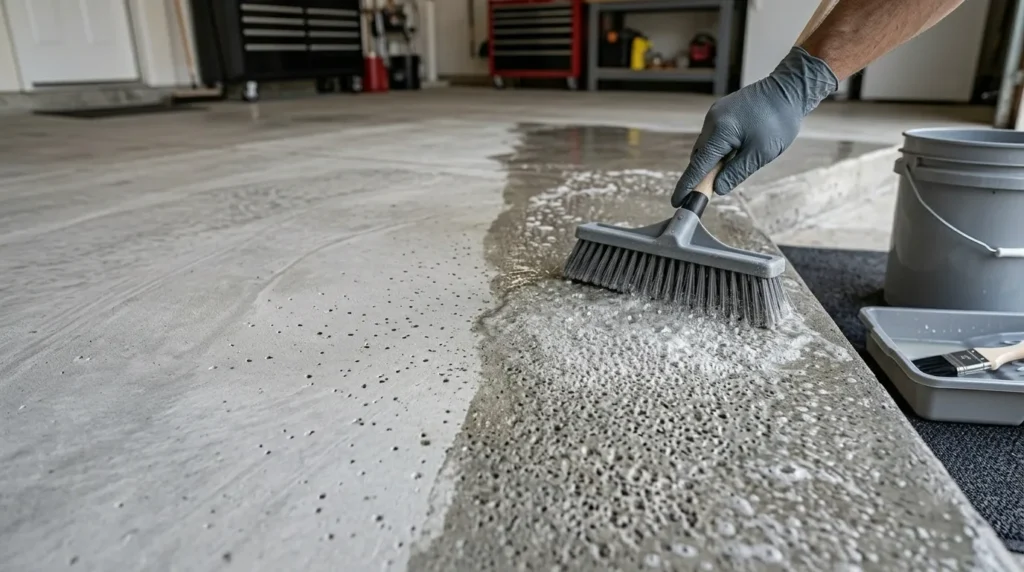
Step 1 — Clean the surface completely. Remove all oil, grease, dirt, algae, mold, and any previous paint that is failing or peeling. Pressure wash at 2,000–3,000 PSI. For oil stains: apply degreaser, scrub, rinse. For algae: bleach solution (1:4 bleach:water), scrub, rinse thoroughly.
Step 2 — Repair surface defects. Fill cracks wider than 1/16 inch with concrete filler or repair mortar before painting. For our complete guide on crack types and repair methods, see types of cracks in concrete. Allow repairs to cure fully before painting.
Step 3 — Etch the surface (for smooth concrete). Smooth troweled concrete has too low a surface profile for paint to mechanically key into. Acid etching (muriatic acid solution) or mechanical grinding creates a surface profile that dramatically improves paint adhesion.
Acid etching: dilute muriatic acid 1:10 in water (always add acid to water, never water to acid). Apply to damp concrete, allow to bubble for 5–10 minutes, rinse thoroughly with clean water, and neutralise with baking soda solution. Allow to dry completely.
Step 4 — Test for moisture. Tape a 600mm × 600mm sheet of clear plastic to the concrete. Seal all four edges with tape. Wait 24–48 hours. Moisture condensation on the underside of the plastic indicates that moisture vapor is migrating through the concrete — a breathable paint must be used, or the moisture source addressed before painting.
Step 5 — Apply primer (where required). New concrete, high-pH surfaces, and porous block all benefit from an alkali-resistant concrete primer before the finish coat. Epoxy systems require an epoxy primer. Masonry paint on block typically requires a block-filling primer.
Step 6 — Apply in correct conditions.
- Temperature: 50°F–85°F (10°C–29°C)
- No rain forecast for 24 hours
- Surface not in direct hot sun
- Relative humidity below 85%
Step 7 — Apply in thin, even coats. Two thin coats are always better than one thick coat. Thick coats trap solvent, form bubbles, and produce uneven gloss. Follow manufacturer’s specified coverage rate — over-application is the second most common cause of paint failure after inadequate preparation.
Paint for Concrete — Comparison Table
| Paint Type | Indoor/Outdoor | Traffic Level | Chemical Resistance | UV Stable | Reapplication | Cost/Gallon |
|---|---|---|---|---|---|---|
| Acrylic latex | Both | Foot only | Low | ✅ Yes | 3–5 years | $25–$50 |
| 1K Epoxy paint | Indoor | Light vehicle | Moderate | ❌ No | 2–5 years | $30–$60 |
| 2K Epoxy coating | Indoor | Heavy vehicle | Excellent | ❌ No | 5–10 years | $60–$120 |
| Masonry paint | Both | Foot only | Low | ✅ Yes | 5–8 years | $20–$45 |
| Elastomeric | Exterior | Foot only | Low | ✅ Yes | 7–10 years | $30–$60 |
| Aliphatic polyurethane | Both | Vehicle | High | ✅ Yes | 3–5 years | $50–$100 |
| Polyaspartic | Both | Heavy vehicle | Excellent | ✅ Yes | 5–10 years | $80–$150 |
| Anti-slip acrylic | Both | Foot | Low-Moderate | ✅ Yes | 2–4 years | $30–$55 |
| Epoxy pool paint | Submerged | Water only | Excellent | Variable | 5–7 years | $50–$100 |
How Long Does Concrete Paint Last?
Paint durability depends on product type, surface preparation quality, traffic level, and climate exposure. Preparation quality is the most variable factor — correctly prepared surfaces with the right product can last at the high end of these ranges; poor preparation on the right product lasts at the low end.
| Surface | Paint Type | Expected Lifespan |
|---|---|---|
| Garage floor | 2K Epoxy + polyurethane | 7–12 years |
| Garage floor | 1K Epoxy paint | 3–5 years |
| Outdoor patio | Exterior acrylic | 4–6 years |
| Driveway | Polyaspartic | 4–7 years |
| Basement wall | Masonry paint | 8–12 years |
| Block wall | Elastomeric | 10–15 years |
| Concrete steps | Anti-slip acrylic | 3–5 years |
| Swimming pool | Epoxy pool paint | 5–7 years |
Signs that repainting is needed:
- Paint peeling or flaking at edges or high-traffic areas
- Color fading significantly beyond fresh coat appearance
- Surface feels rough or chalky under hand
- Water no longer beads on surface (acrylic) — absorbs instead
- Staining penetrating through worn areas
Frequently Asked Questions
What type of paint is best for concrete floors?
For indoor garage floors with vehicle traffic: two-component epoxy (or epoxy base + polyaspartic topcoat) — the hardest, most chemical-resistant concrete floor coating. For indoor floors with foot traffic only: acrylic concrete floor paint. For outdoor patios and walkways: UV-stable exterior acrylic concrete paint.
Can you use regular paint on concrete?
No — regular interior or exterior house paint fails on concrete due to the surface’s alkalinity, porosity, and moisture vapor transmission. Standard paint saponifies on high-pH concrete and blisters when moisture vapor pushes through from below. Always use paint specifically formulated for concrete.
What is the difference between epoxy paint and regular concrete paint?
Epoxy paint (particularly two-component epoxy) forms a cross-linked polymer film that is significantly harder, more chemical-resistant, and more durable than acrylic latex concrete paint. The trade-off: epoxy cannot be used outdoors (UV yellowing), requires more careful surface preparation, and has a limited pot life after mixing. Regular concrete acrylic paint is easier to apply and UV stable but wears faster under vehicle traffic.
What type of paint do you use on concrete block walls?
Masonry paint — specifically formulated to be alkali-resistant (concrete block is highly alkaline) and breathable (allows moisture vapor to exit through the wall without blistering). Apply a block-filling primer first to seal the porous block surface before the finish masonry paint coat.
What is the best paint for an outdoor concrete driveway?
Two-component epoxy with an aliphatic polyurethane or polyaspartic topcoat provides the most durable result — 4–7 years before repainting. Standard acrylic concrete paint will wear significantly faster under vehicle traffic. However, any painted driveway requires repainting on a cycle — consider whether stamped or exposed aggregate concrete might be a better long-term choice.
Do I need to prime concrete before painting?
Almost always yes. New concrete: alkali-resistant primer required to neutralise surface pH and improve adhesion. Epoxy systems: epoxy primer specific to the system. Porous concrete block: block-filling primer to reduce absorption. Smooth troweled concrete: acid etch instead of primer for mechanical surface profile. Priming is not optional — skipping it is the most common reason paint fails prematurely.
How long does paint last on concrete?
Correctly applied two-component epoxy on a properly prepared garage floor: 7–12 years. Exterior acrylic on an outdoor patio: 4–6 years. Masonry paint on a block wall: 8–12 years. Polyaspartic on a driveway: 4–7 years. Surface preparation quality is the biggest variable — a premium product on a poorly prepared surface will fail as quickly as a budget product.
What paint is waterproof for concrete?
Elastomeric masonry paint provides waterproof protection on exterior walls with crack-bridging capability. For below-grade surfaces with hydrostatic water pressure, paint alone is insufficient — crystalline waterproofing compounds or cavity drain systems are required. Two-component epoxy provides excellent moisture resistance indoors but cannot resist hydrostatic pressure from below.
Conclusion
Concrete paint is not a single product — it is a family of products matched to specific surfaces, traffic levels, and exposure conditions. Acrylic latex handles most outdoor concrete surfaces with UV stability and flexibility. Epoxy delivers chemical resistance and hardness for indoor floors. Masonry paint protects and beautifies concrete block and rendered walls with the breathability those surfaces require. Elastomeric bridges cracks and waterproofs exterior wall surfaces. Match the paint type to the surface, prepare the concrete correctly, and apply in appropriate conditions — and a painted concrete surface will last years rather than months. For the concrete itself, calculate your project’s requirements with the ConcreteCal free concrete calculator before any pour or surface treatment project begins.