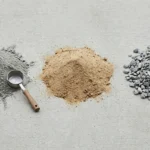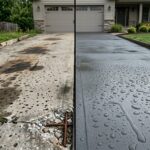
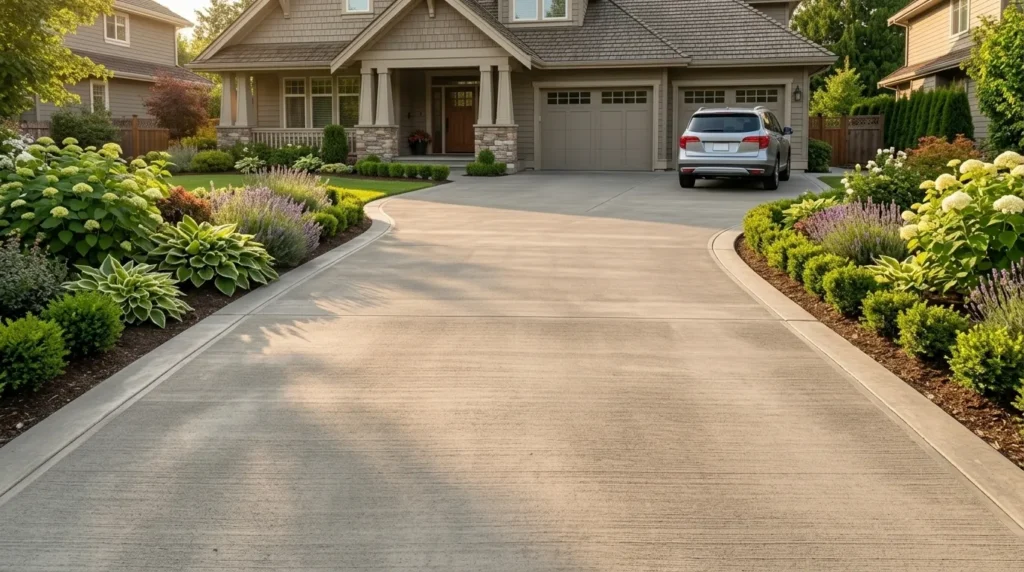

A concrete driveway is one of the highest-return investments in residential outdoor construction. It lasts 25–50 years with minimal maintenance, handles everything from daily commuter cars to loaded delivery trucks, and — depending on which type you choose — can look like natural stone, cobblestone, timber, or high-end architectural pavers at a fraction of the cost.
The types of concrete driveways available today go far beyond the plain grey slab most people imagine when they hear “concrete driveway.” From brushed finishes that provide traction at a low cost, to stamped patterns that mimic flagstone or brick, to exposed aggregate surfaces with natural stone texture, the range of options suits every architectural style, climate, and budget.
This guide covers every concrete driveway type — how each is made, what it costs, what it looks like after ten years, and which type is right for your specific property, climate, and maintenance tolerance.
Once you have chosen your driveway type, calculate your exact concrete volume with our free concrete calculator at ConcreteCal before requesting contractor quotes.
Table of Contents
- What Makes a Good Concrete Driveway?
- The Main Types of Concrete Driveways
- Plain Concrete Driveway
- Brushed (Broom Finish) Concrete Driveway
- Stamped and Imprinted Concrete Driveway
- Exposed Aggregate Concrete Driveway
- Colored Concrete Driveway
- Stenciled Concrete Driveway
- Permeable Concrete Driveway
- Types of Concrete Driveways — Comparison Table
- How Much Does a Concrete Driveway Cost by Type?
- How to Choose the Right Type
- Concrete Driveway Installation — What to Expect
- Frequently Asked Questions
What Makes a Good Concrete Driveway?
Before comparing types, it helps to understand what any concrete driveway must do well — because the performance requirements are more demanding than most other concrete applications.
Key Performance Requirements
Load capacity: A residential driveway must support passenger vehicles (3,000–6,000 lbs), fully loaded pickup trucks (8,000–10,000 lbs), and occasional delivery vehicles (up to 26,000 lbs). The minimum specification for any concrete driveway is 4,000 PSI with 5–6 inch thickness and adequate reinforcement.
Slip resistance: Driveways get wet — rain, snow, morning dew. The surface must provide adequate traction for both vehicles (tires gripping the surface) and pedestrians (safe walking surface). Smooth finishes are a safety risk on driveways; textured finishes are standard for this reason.
Durability: A driveway is a 25–50 year investment. It must resist freeze-thaw cycling (in cold climates), deicer chemical attack, oil and fuel stains, UV degradation of any color or sealer, and the constant abrasion of tire traffic.
Drainage: Water must drain off the driveway surface efficiently — either through surface slope (minimum 1–2% cross slope) or through the concrete itself (permeable concrete). Standing water accelerates surface deterioration and creates ice hazards in winter.
What Separates Driveway Concrete from Other Applications
Concrete driveways need a higher specification than patios or sidewalks:
| Specification | Patio | Sidewalk | Driveway |
|---|---|---|---|
| Minimum PSI | 3,000–3,500 | 3,000 | 4,000–4,500 |
| Minimum thickness | 4 inches | 4 inches | 5–6 inches |
| Air entrainment | Recommended | Recommended | Required in freeze-thaw climates |
| Reinforcement | Wire mesh | Wire mesh | #4 rebar on 18-inch centres |
| Control joint spacing | 8–10 ft | 4–5 ft | 10–12 ft |
These specifications apply regardless of which driveway type you choose — the decorative finish sits on top of structurally sound concrete, not instead of it.
The Main Types of Concrete Driveways
Every concrete driveway starts with the same structural base — poured concrete on a prepared subbase. The type is defined by what happens to the surface during or after the pour:
| Type | When Applied | Visual Result | Cost Range |
|---|---|---|---|
| Plain (standard) | During pour | Grey, uniform | $4–$8/sq ft |
| Brushed (broom finish) | During pour | Textured parallel grooves | $4–$8/sq ft |
| Stamped / imprinted | During pour | Stone, brick, cobble pattern | $10–$18/sq ft |
| Exposed aggregate | During pour | Natural stone surface | $6–$12/sq ft |
| Colored | During or after pour | Any color, various finishes | $6–$14/sq ft |
| Stenciled | During pour | 2D pattern, flat | $5–$10/sq ft |
| Permeable | During pour | Porous, natural | $8–$16/sq ft |
Plain Concrete Driveway
Plain concrete — sometimes called standard or grey concrete — is the base specification from which every other type derives. No color, no pattern, no decorative treatment. Concrete poured, leveled, and finished with a basic trowel or float.
This sounds unexciting, and it is — but plain concrete has practical advantages that make it the right choice for a significant number of projects.
Benefits of Plain Concrete
Lowest cost: Without color additives, stamps, or specialty finishing labor, plain concrete is the most affordable poured concrete option. At $4–$8 per square foot installed, it undercuts every decorative alternative significantly.
Maximum durability at the base level: No sealer to reapply, no pattern edges to chip, no color to fade. Plain grey concrete in a correctly specified mix is the most maintenance-free driveway surface available — occasional cleaning and optional sealing every 5–10 years.
Clean, architectural aesthetic: Plain concrete is not universally unfashionable. In contemporary and modernist architecture, a clean grey concrete driveway is a deliberate design choice — minimalist, industrial, sophisticated. It complements dark cladding, steel framing, and architectural glazing in ways that decorative patterns cannot.
Easiest to repair: When plain concrete cracks or spalls, patching is straightforward — matched grey concrete without color or pattern to align. Decorative finishes are significantly harder to repair invisibly.
Drawbacks of Plain Concrete
Aesthetics (in some contexts): On traditional or heritage homes, plain grey concrete can look utilitarian or out of place. The lack of visual interest is the primary reason homeowners upgrade to decorative finishes.
Shows stains clearly: Tyre marks, oil, and rust staining are highly visible on grey concrete. Regular cleaning and sealing mitigate this — but a plain surface has no texture or pattern to visually break up or disguise staining.
Slippery if over-troweled: A steel-troweled smooth plain concrete surface is dangerously slippery when wet. Plain driveways should always receive a broom finish over the standard trowel — not left as a smooth surface.
Ideal Use Case
Plain concrete with a broom finish is ideal for:
- Budget-conscious homeowners who prioritise durability over aesthetics
- Contemporary or modernist architectural styles
- Properties where the driveway is functional rather than decorative
- Any project where long-term maintenance minimisation is the priority
Worked Example: A 16 ft × 40 ft standard residential driveway in a suburban neighbourhood. Plain concrete, 5-inch slab, 4,000 PSI, #4 rebar on 18-inch centres, medium broom finish. Concrete volume: 9.9 cubic yards. Installed cost: $5.50/sq ft × 640 sq ft = $3,520 total. Compare this to the same driveway in stamped concrete at $12/sq ft = $7,680 — a $4,160 difference for a finish choice.
Brushed (Broom Finish) Concrete Driveway
The broom finish is not a separate concrete type — it is a finishing technique applied to plain concrete that is so universally specified for residential driveways that it deserves its own section. A stiff-bristled broom is dragged across the fresh concrete surface, creating parallel grooves that provide traction.
In practice, when a contractor says “plain concrete driveway,” they almost always mean plain concrete with a broom finish. The two are standard together.
Why Brushed Concrete Dominates Residential Driveways
Slip resistance: The parallel grooves create texture that grips both vehicle tyres and shoe soles when wet. This is the primary functional reason broom finish is standard for driveways — the safety benefit is real and measurable.
No additional cost: A broom costs nothing. The broom finish adds approximately zero material cost and 15 minutes of labour to a standard pour. It is the free upgrade that every driveway should receive.
Consistent appearance: Broom marks create a uniform, professional appearance that conceals minor surface imperfections — tool marks, trowel lines, and slight colour variations — that would be visible on a smooth finish.
Texture Variations and Their Uses
| Broom Type | Texture Depth | Best For |
|---|---|---|
| Fine bristle | Very light | Covered driveways, mild climates |
| Medium bristle | Standard residential | Most residential driveways |
| Coarse bristle | Deep grooves | Steep driveways, high traction requirement |
| Diagonal broom | Same as medium, angled | Decorative variation, more visual interest |
Direction matters: Broom marks should run perpendicular to the primary direction of vehicle travel — across the driveway width, not along its length. This maximises traction resistance as vehicles accelerate, brake, and turn.
Stamped and Imprinted Concrete Driveway
Stamped concrete is the most popular decorative driveway upgrade — rubber or polyurethane stamps pressed into fresh concrete create texture patterns that mimic natural stone, brick, cobblestone, slate, or wood. Combined with color hardener and antiquing release, the result can be extraordinarily realistic at a fraction of the cost of natural materials.
For the complete guide to stamped patterns and colors, see our dedicated post on types of stamped concrete — this section focuses specifically on driveway applications.
Popular Stamp Patterns for Driveways
Ashlar slate: The most popular driveway pattern — clean rectangular stone layout with straight joint lines. Suits modern and transitional architectural styles. Durable under tyre traffic because the relatively flat pattern has minimal raised edges to chip.
Cobblestone: Round or rectangular cobble patterns with deep joint lines. Traditional, European aesthetic. Best for lower-traffic portions of the driveway — the raised edges of cobble patterns can chip under repeated heavy vehicle loads.
Brick running bond: Classic brick pattern that complements traditional brick homes. Moderate raised edges — more durable than cobblestone but less so than ashlar slate for heavy traffic zones.
Random flagstone: Organic, irregular stone shapes with natural-looking joint lines. Works well on curved or informal driveways where geometric precision is not required.
Worked Example — Stamped Driveway Decision: A 16×40 ft driveway in front of a traditional brick colonial. Options considered: plain broom ($3,520) vs. stamped cobblestone ($7,680). Decision: stamped ashlar slate rather than cobblestone — same decorative effect with better durability under vehicle loads, at $11/sq ft × 640 sq ft = $7,040. Cobblestone is reserved for the pedestrian walkway from driveway to front door where vehicle loads do not apply.
Benefits and Drawbacks
Benefits:
- Natural stone aesthetics at concrete cost — flagstone at $18–$30/sq ft vs. stamped at $10–$18/sq ft
- Wide pattern selection suits any architectural style
- Color combinations create depth and realism
- Adds measurable property value and curb appeal
Drawbacks:
- Requires resealing every 1–3 years to maintain color and surface protection
- Pattern edges can chip under heavy vehicle loads — pattern selection matters
- Difficult to repair invisibly — matching existing color and pattern is challenging
- Higher initial cost than plain or brushed alternatives
Exposed Aggregate Concrete Driveway
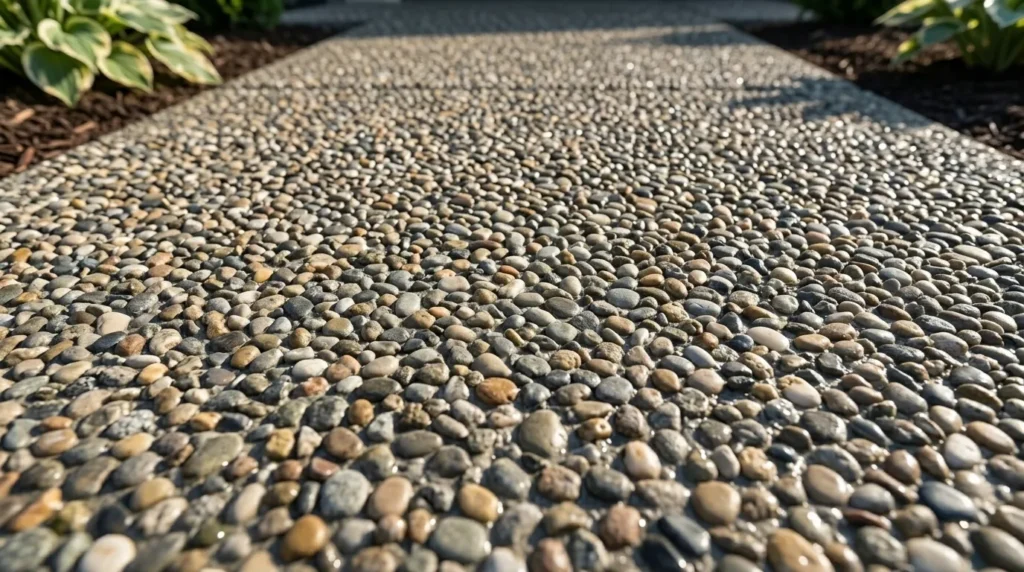
Exposed aggregate removes the surface cement paste to reveal the decorative stone aggregate beneath — creating a permanently textured surface that looks like natural gravel or stone.
How Exposed Aggregate Is Made
Method 1 — Surface retarder: A chemical retarder is sprayed on the fresh concrete surface immediately after finishing. The retarder slows surface cement set while the interior continues to harden. The next day, the soft surface paste is washed away with a pressure washer, revealing the aggregate beneath.
Method 2 — Seeded aggregate: Decorative stone is broadcast (seeded) onto the fresh concrete surface after screeding and pressed in. Retarder is applied, and the surface is washed after curing to expose the decorative stone.
The aggregate exposed can be the standard concrete mix aggregate (economical, variable appearance) or selected decorative stone — river pebbles, coloured quartz, basalt, granite chips — for premium visual results.
Benefits and Drawbacks
Benefits:
- Permanent texture — the aggregate surface is not a coating, it cannot peel or wear off
- Excellent slip resistance — the exposed stone provides outstanding wet traction
- Natural, organic appearance integrates well with garden settings
- Low long-term maintenance — sealing is optional, not structural
- Cost-effective premium appearance ($6–$12/sq ft vs. $18–$30+ for natural stone)
Drawbacks:
- Surface can be uncomfortable for barefoot use (less relevant for driveways than pool decks)
- Aggregate type and colour are largely fixed by local stone supply unless decorative seeding is used
- Deep aggregate exposure can be harsh on thin tyre sidewalls over time (minor concern)
- Requires professional installation for consistent results — DIY exposure timing is difficult
Ideal for: Driveways where traction, natural appearance, and low maintenance are the priorities. Particularly effective in garden settings, rural properties, and homes with natural timber or stone exterior cladding.
Colored Concrete Driveway
Color transforms a grey driveway into one that coordinates with the home’s exterior, landscaping, and boundary walls. Three methods produce different results at different price points.
Coloring Methods
Integral color: Iron oxide pigment mixed into the concrete before pouring. Color runs throughout the full depth of the slab — surface wear never exposes uncolored concrete. The most durable coloring method, cannot fade the way surface treatments can.
Color hardener (dry shake): Dry pigmented powder broadcast on the fresh concrete surface and floated in. Creates a stronger, more intensely colored surface than integral — the color hardener actually strengthens the surface layer while adding color. Standard for stamped concrete coloring.
Acid stain: Applied to hardened concrete. Reacts chemically with minerals in the concrete to produce mottled, organic color variation. Permanent if sealed — unique, natural appearance that cannot be replicated with any other method. Limited to earth tones (brown, tan, terracotta, blue-green, black).
Surface dye / water-based stain: Applied to hardened concrete. Wider color range than acid stain. Penetrates without chemical reaction — more uniform application. Requires sealing for durability.
Benefits and Drawbacks
Benefits:
- Wide color range from natural earth tones to bold contemporary colors
- Integral color requires no maintenance beyond optional sealing
- Coordinates driveway appearance with home exterior color scheme
- Significantly more affordable than natural stone or brick at equivalent visual quality
Drawbacks:
- Surface-applied color (hardener, stain) requires sealing and renewal
- Color matching for repairs is challenging — new concrete weathers to a different tone
- UV fading is real over years without UV-stable sealer on surface treatments
- Integral color adds $2–$4 per cubic yard to concrete cost
Stenciled Concrete Driveway
Stenciled concrete uses paper or plastic stencils laid on fresh concrete before the release agent is applied — creating sharp-edged pattern boundaries that produce geometric designs, medallions, or custom layouts when the stencil is removed.
How it differs from stamping: Stamping creates three-dimensional texture (depth into the surface). Stenciling creates two-dimensional color boundaries — the pattern is flat but visually defined by color contrast between the stenciled and unstenciled areas.
Best for: Decorative borders, geometric patterns at driveway aprons, custom medallions at entrance features, and any design that requires precision geometry that stamps cannot produce.
Limitations: Flat surface without the tactile texture of stamping — purely visual pattern. Less durable pattern definition than stamped finishes because it relies on color contrast rather than physical relief.
Cost: $5–$10/sq ft — less than full stamping, more than plain broom finish.
Permeable Concrete Driveway
Permeable concrete — also called pervious concrete — is engineered to allow water to drain directly through the surface rather than running off. It achieves this by using little or no fine aggregate (sand), leaving interconnected voids of 15–25% of the total volume.
How Permeable Concrete Works
Standard concrete is dense and impermeable — water runs off its surface. Permeable concrete has an open, porous matrix through which water flows at rates of 3–8 gallons per minute per square foot — during most rainfall events, permeable concrete allows all precipitation to drain through rather than running off.
This has significant implications for stormwater management — permeable driveways can eliminate or reduce the need for separate drainage infrastructure, reduce downstream flooding risk, and recharge groundwater rather than directing runoff to storm sewers.
When to Choose Permeable
Environmental requirements: Many municipalities now mandate permeable surfaces for new or replacement driveways above a certain size — particularly in areas with combined sewer systems prone to overflow. A permeable concrete driveway can satisfy these requirements while providing a durable, attractive surface.
Sites with drainage challenges: If your property has poor surface drainage — low-lying areas, impermeable clay soil — a permeable driveway reduces the volume of runoff that must be managed by other means.
Environmental preference: Homeowners who want to reduce their property’s environmental impact choose permeable concrete for its groundwater recharge and reduced heat island effect (lighter-colored, porous surfaces are cooler than dark impermeable ones).
Limitations:
- Requires annual vacuum sweeping to prevent pore clogging from sediment and organic debris
- Not suitable for sites with high sediment loads (adjacent to dirt areas, planting beds)
- Freeze-thaw performance requires specific mix design and drainage planning
- Not available from all concrete suppliers — requires specialist mix design
Cost: $8–$16/sq ft installed — premium over standard concrete justified by drainage benefits and potential infrastructure savings.
Types of Concrete Driveways — Comparison Table
| Type | Initial Cost | Maintenance | Durability | Slip Resistance | Aesthetics | Best Climate |
|---|---|---|---|---|---|---|
| Plain + broom | $4–$8 | Very Low | Excellent | ✅ Good | Functional | All |
| Stamped | $10–$18 | Medium | Good | ✅ Good (textured stamp) | Excellent | All (seal annually in freeze-thaw) |
| Exposed aggregate | $6–$12 | Low | Excellent | ✅ Excellent | Very Good | All |
| Integral colored | $6–$10 | Low | Excellent | ✅ Good | Good | All |
| Surface stained | $7–$14 | Medium | Good | ✅ Good | Very Good | Warm climates (resealing) |
| Stenciled | $5–$10 | Low-Medium | Good | ⚠️ Moderate | Good | All |
| Permeable | $8–$16 | Medium (cleaning) | Good | ✅ Good | Natural | All (with correct mix) |
How Much Does a Concrete Driveway Cost by Type?
Project basis: Standard 2-car driveway, 16 ft × 40 ft = 640 sq ft.
| Type | Cost Per Sq Ft | Total Installed | 10-Year Maintenance | 10-Year Total |
|---|---|---|---|---|
| Plain + broom | $5.50 | $3,520 | $200 | $3,720 |
| Brushed (colored) | $7.00 | $4,480 | $300 | $4,780 |
| Exposed aggregate | $9.00 | $5,760 | $400 | $6,160 |
| Stamped (basic) | $11.00 | $7,040 | $1,500 | $8,540 |
| Stamped (premium) | $16.00 | $10,240 | $1,500 | $11,740 |
| Colored (integral) | $8.00 | $5,120 | $400 | $5,520 |
| Permeable | $12.00 | $7,680 | $800 | $8,480 |
Maintenance costs are estimates for resealing (stamped/colored) and cleaning (permeable). Plain and exposed aggregate maintenance is optional and minimal.
The 10-year total cost reveals an important insight: stamped concrete’s higher maintenance cost (resealing every 1–3 years) significantly narrows its cost advantage over exposed aggregate, which is cheaper initially and requires almost no ongoing maintenance.
According to the American Concrete Institute (ACI), properly designed and constructed concrete pavements achieve service lives of 30–40 years in residential applications — making the choice of surface type a long-term decision where 10-year maintenance costs matter as much as initial installation cost.
How to Choose the Right Type of Concrete Driveway
Three questions narrow the field significantly:
1. What is your budget?
- Under $6,000 total: plain or brushed — the most cost-effective choice
- $6,000–$8,000: exposed aggregate or integral color — premium appearance without stamp maintenance
- $8,000–$12,000: stamped or permeable — decorative or environmental premium
- Over $12,000: premium stamped or complex multi-color — showpiece entrance
2. What is your maintenance commitment?
- Minimal (seal once or never): plain, brushed, exposed aggregate
- Moderate (reseal every 2–3 years): colored, stenciled
- Regular (reseal every 1–2 years + annual cleaning): stamped, permeable
3. What is your architectural style?
- Contemporary/modern: plain broom finish or exposed aggregate with dark stone
- Traditional/colonial: stamped brick or cobble, integral warm earth tones
- Cottage/garden: exposed aggregate with river pebble or stamped random flagstone
- Mediterranean/Spanish: stamped terracotta tile or imprinted cobblestone
Concrete Driveway Installation — What to Expect
Understanding the installation process helps you work effectively with your contractor and know what to inspect at each stage.
Stage 1 — Subbase preparation (Day 1–2): Excavation to 11–12 inches below finished grade (5–6 inch slab + 4–6 inch gravel base). Subbase graded, compacted, and verified level. For the gravel base specification, see our guide on what type of gravel under concrete.
Stage 2 — Form setting (Day 2): Timber or steel forms set at finished driveway elevation. Checked for level, slope (1–2% for drainage), and square. Expansion joints placed at garage apron and at any fixed boundaries.
Stage 3 — Reinforcement (Day 2): #4 rebar on 18-inch centres elevated on chairs at the lower third of the slab depth. For driveway applications, rebar is standard — wire mesh is insufficient for vehicle load applications.
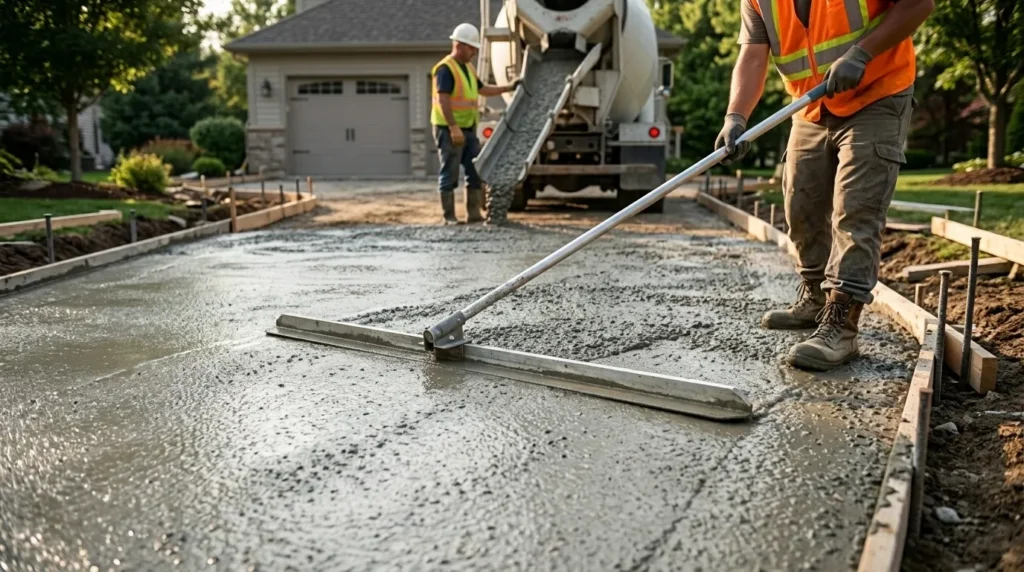
Stage 4 — Concrete pour (Day 3): Ready mix arrives — typically 10–11 cubic yards for a standard 2-car driveway. Placed, screeded, and bull-floated. For decorative types: color hardener applied, stamps pressed, aggregate exposed, or stencils removed at this stage.
Stage 5 — Finishing and curing (Day 3–10): Surface finished (broom, trowel, or decorative treatment). Control joints cut or tooled. Curing compound applied or surface covered with plastic. No vehicle traffic for minimum 7 days, heavy vehicles for 28 days.
Frequently Asked Questions
What are the different types of concrete driveways?
The main types are plain (standard grey), brushed (broom finish for traction), stamped (imprinted pattern mimicking stone or brick), exposed aggregate (natural stone surface revealed by washing), colored (integral pigment, acid stain, or color hardener), stenciled (geometric patterns in two dimensions), and permeable (porous for water drainage). Each suits different budgets, aesthetic preferences, and maintenance commitments.
What is the most durable type of concrete driveway?
Plain and exposed aggregate concrete driveways are the most durable — both use standard structural concrete without coatings that can peel or patterns that can chip. Correctly specified at 4,000–4,500 PSI with adequate thickness and reinforcement, either type lasts 30–40+ years with minimal maintenance. Stamped concrete is equally durable structurally but requires more maintenance to preserve the decorative surface.
Is a stamped concrete driveway worth it?
For homeowners who value curb appeal and are committed to resealing every 1–3 years, yes — stamped concrete delivers natural stone aesthetics at half the cost of real stone. For homeowners who want minimal maintenance, exposed aggregate or plain concrete are better long-term choices at lower total cost.
How long does a concrete driveway last?
A correctly specified concrete driveway — 4,000+ PSI, 5–6 inch thickness, reinforced, air-entrained in freeze-thaw climates — lasts 30–50 years. The concrete itself does not wear out; surface deterioration (spalling, scaling, crack widening) is almost always preventable with correct specification and maintenance.
Can a concrete driveway be painted or colored?
Yes — both integral coloring (before the pour) and surface treatments (acid stain, water-based dye) after curing produce permanent or long-lasting color. Surface treatments require sealing and periodic renewal. Integral color does not require resealing for color preservation — the pigment is throughout the full slab depth.
What is imprinted vs. stamped concrete?
The terms are used interchangeably — both refer to pressing pattern stamps into fresh concrete to create textured patterns. “Imprinted” is the more common term in the UK and Australia; “stamped” is standard in the US. The process and result are identical.
How much does a concrete driveway cost in 2026?
A plain or brushed concrete driveway runs $4–$8 per square foot installed. Exposed aggregate costs $6–$12/sq ft. Stamped concrete is $10–$18/sq ft depending on pattern complexity. Permeable concrete ranges $8–$16/sq ft. For a standard 640 sq ft 2-car driveway, total costs range from approximately $3,500 (plain) to $10,000+ (premium stamped). Regional labor rates significantly affect these figures — always get three local quotes.
How is coloured concrete made?
Colored concrete uses iron oxide pigments — natural or synthetic — added either to the concrete batch before mixing (integral color) or broadcast onto the fresh surface (color hardener). Iron oxide pigments are chemically stable and UV-resistant — they do not fade the way organic dyes do. The color range is limited primarily to earth tones for integral color; surface treatments offer wider color options.
How long does a concrete driveway take to install?
Subbase preparation and forming: 1–2 days. Pour and finishing: 1 day. Curing: 7 days minimum before foot traffic, 28 days before heavy vehicle use. Total project duration including cure time: 10–14 days from start to full use. Decorative types (stamped, exposed aggregate) add no significant time to the pour day — the decorative work is part of the finishing process.
Conclusion
The type of concrete driveway you choose determines how your home presents from the street for the next three decades — and how much time and money you spend maintaining it. Plain and brushed concrete offer maximum durability at minimum cost and maintenance. Exposed aggregate adds natural stone aesthetics with equally low maintenance. Stamped concrete delivers the widest design range at a premium cost that includes ongoing resealing. Colored concrete bridges function and aesthetics at moderate cost. Permeable concrete solves drainage challenges while meeting increasing municipal requirements. Match the type to your budget, architectural style, and realistic maintenance commitment — then calculate your concrete volume accurately with the ConcreteCal free concrete calculator before requesting contractor quotes.