
Walk into any builders’ merchant or aggregate supplier and ask for “gravel for under concrete” and you will get a different answer depending on who is behind the counter. Some will hand you #57 crushed limestone. Others will point you toward crusher run. A few might suggest pea gravel — which, as you will learn in this guide, is actually one of the worst choices you can make for a concrete subbase.
The question of what type of gravel under concrete is the right choice matters more than most DIYers realise. Two slabs with identical concrete mix, identical thickness, and identical reinforcement can have completely different service lives based solely on what is sitting beneath them. The right subbase gravel drains water, compacts into a stable load-bearing layer, and stays put. The wrong one shifts, retains moisture, and sets up the conditions for cracking before the concrete is a year old.
This guide covers every gravel type used under concrete — what makes each one suitable or unsuitable, which soil conditions demand which material, and a complete application-by-application selection table.
Once you know your gravel type, calculate how much you need with our companion guide on how much gravel under a concrete slab — and use our concrete slab calculator to calculate the concrete volume on top.
Table of Contents
- Why Gravel Type Matters as Much as Gravel Depth
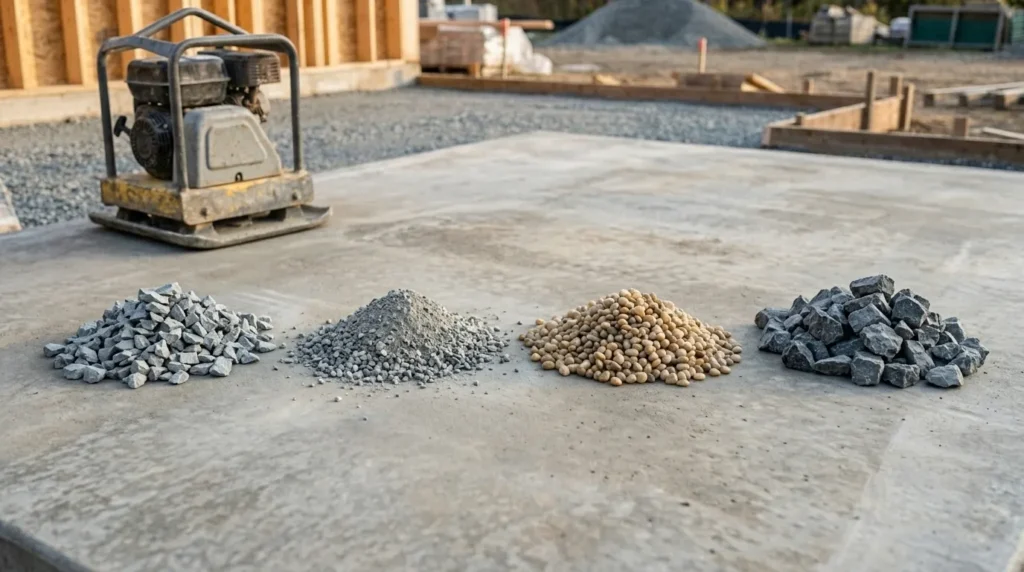
- The Main Types of Gravel Used Under Concrete
- #57 Crushed Stone — The Industry Standard
- Crusher Run (Dense-Grade Aggregate / Road Base)
- #4 Crushed Stone and Larger Open-Grade Aggregates
- Pea Gravel — Why It Fails Under Concrete
- Sand Under Concrete — Useful but Limited
- Recycled Concrete Aggregate (RCA)
- Gravel Selection by Soil Type
- Gravel Selection by Application
- Gravel Type Comparison Table
- Frequently Asked Questions
Why Gravel Type Matters as Much as Gravel Depth
Most people who think about subbase preparation focus on depth — 4 inches, 6 inches, 8 inches. Depth matters. But the type of gravel doing those inches of work determines whether the subbase actually performs.
A 6-inch layer of the wrong gravel can be worse than 4 inches of the right material. Rounded pea gravel 6 inches deep is a layer of ball bearings under your slab — it moves under load rather than distributing it. Fine sand 6 inches deep saturates and loses strength when wet. Even crushed stone of the wrong gradation can fail to compact into a stable, load-bearing surface.
What Good Subbase Gravel Must Do
Every concrete subbase has three jobs. The gravel type you choose determines how well it does each one:
1. Drain freely: Water that collects beneath a concrete slab has nowhere to go — it saturates the subgrade soil (reducing its bearing capacity), it freezes in winter (causing frost heave), and it wicks upward through the concrete (causing efflorescence and moisture damage to floor coverings above). The subbase must allow water to move through it and away from the slab.
2. Compact into a stable base: Loose aggregate that shifts under load allows the slab above to deflect and crack. The subbase must compact under a plate compactor into a dense, stable layer that does not move when the slab is loaded.
3. Distribute load to the subgrade: The slab transfers loads downward through the subbase to the native soil below. The subbase acts as a transition layer — spreading the point loads from the slab over a larger soil area and reducing peak bearing pressure.
The One Property That Separates Good from Bad Subbase
The single most important physical property of subbase gravel is angularity — whether the aggregate particles have flat, angular faces or rounded surfaces.
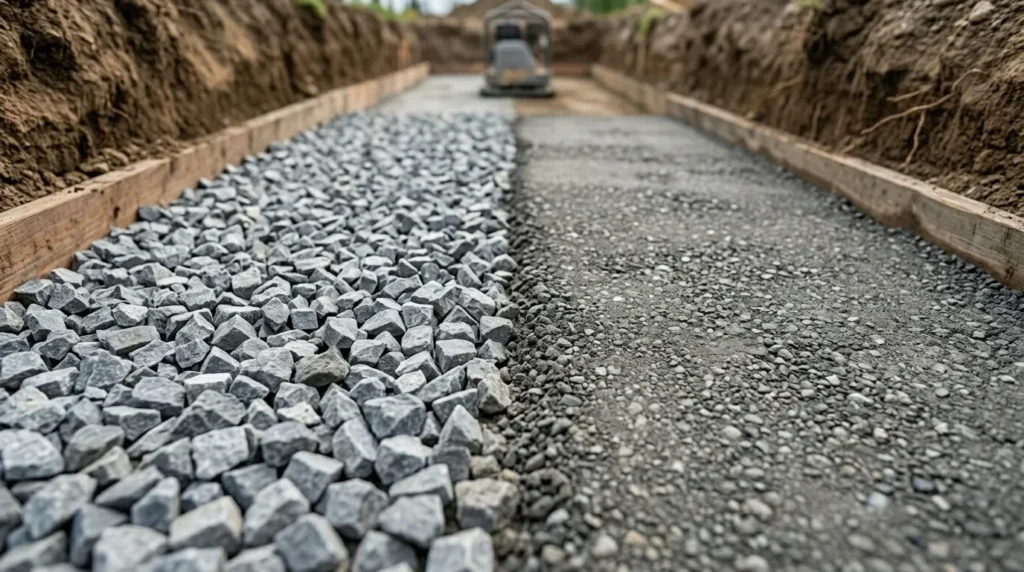
Angular particles interlock. When you compact angular crushed stone, the flat faces of adjacent particles lock against each other — creating mechanical friction that resists movement under load. The more angular and varied the particle shape, the more stable the compacted layer.
Rounded particles roll. Smooth, rounded aggregate (river gravel, pea gravel) has no flat faces to interlock. Under load, particles roll against each other rather than locking — the layer deforms rather than distributes load. A layer of rounded gravel under a slab behaves structurally more like a liquid than a solid support.
This one distinction — angular vs. rounded — explains most of the gravel type recommendations in this guide.
The Main Types of Gravel Used Under Concrete
| Gravel Type | Angularity | Drainage | Compaction | Load Bearing | Overall Rating |
|---|---|---|---|---|---|
| #57 crushed stone | ✅ Excellent | ✅ Excellent | ✅ Good | ✅ Good | ⭐⭐⭐⭐⭐ |
| Crusher run / road base | ✅ Excellent | ⚠️ Moderate | ✅ Excellent | ✅ Excellent | ⭐⭐⭐⭐ |
| #4 crushed stone | ✅ Excellent | ✅ Excellent | ✅ Good | ✅ Good | ⭐⭐⭐⭐ |
| Recycled concrete (RCA) | ✅ Good | ✅ Good | ✅ Good | ✅ Good | ⭐⭐⭐⭐ |
| Sand (coarse) | ⚠️ None | ⚠️ Moderate | ⚠️ Limited | ⚠️ Limited | ⭐⭐⭐ |
| Pea gravel | ❌ Rounded | ✅ Good | ❌ Poor | ❌ Poor | ⭐ |
| Bank run / river gravel | ❌ Variable | ✅ Good | ❌ Poor | ❌ Poor | ⭐⭐ |
#57 Crushed Stone — The Industry Standard
If you ask a concrete contractor what goes under a slab and they give you a one-word answer, it is almost always “#57.” This designation refers to a specific aggregate gradation — stone crushed and screened to the 3/4-inch to 1-inch size range — defined by ASTM D448, the standard classification for sizes of aggregate for road and bridge construction.
The stone itself is typically limestone, granite, trap rock, or basalt — whatever is quarried locally. The gradation (size range) is what the number designates, not the rock type.
What Makes #57 Stone the Default Choice
Angular, varied particle shape: Quarrying and crushing creates particles with multiple flat faces and irregular geometry. When compacted, these faces lock together into a stable matrix that resists movement under dynamic loads.
Clean — no fines: #57 stone is washed and screened to remove dust and fine particles. The absence of fines means water drains freely through the voids between particles — there is no fine-grained material to clog the drainage pathways. This free-draining property is critical for frost resistance and long-term subgrade moisture control.
Proven track record: #57 crushed stone has been used as concrete subbase in US construction for decades. Its performance in every climate zone, soil type, and application from residential patios to airport aprons is well-documented.
Widely available: Every aggregate supplier in the US carries #57 stone. It is not a specialty product — it is a commodity. That means competitive pricing, consistent quality (governed by ASTM D448 gradation requirements), and no sourcing delays.
Worked Example — Why #57 Works on Clay: A garage floor poured on clay subgrade in Ohio. Without gravel: clay absorbs winter moisture, freezes, heaves the slab. Spring thaw creates voids as ice melts. Slab loses support in thawed zones and cracks under vehicle loads.
With 6 inches of #57 limestone: water drains through the stone layer before it can saturate the clay beneath. Clay stays drier — less frost heave. The stone layer bridges minor clay softening in spring — load is distributed across the full stone layer rather than concentrated at soft spots. Slab performs correctly.
When to Choose #57 Over Other Options
Choose #57 crushed stone when:
- Drainage is a priority — wet climate, high water table, clay soil
- The application is a patio, walkway, garage floor, or residential driveway
- You want the lowest-risk, most widely available option
- The soil beneath is clay, silt, or any moisture-retaining material
#57 is rarely the wrong choice. The question is usually whether a different material might be better for a specific application — not whether #57 is adequate.
Crusher Run (Dense-Grade Aggregate / Road Base)
Crusher run — also called dense-grade aggregate (DGA), road base, or processed aggregate — is fundamentally different from #57 stone despite coming from the same quarry.
Where #57 is screened to remove all fine particles, crusher run intentionally retains them. It is a blend of crushed stone in various sizes (from 1.5 inches down to dust) that compacts into an extremely dense, tight surface.
How Crusher Run Differs from Clean Crushed Stone
The fines are the key difference. Those fine particles — stone dust and small fragments — fill the voids between larger particles during compaction. The result is a much denser, tighter compacted layer than you can achieve with clean stone.
Compaction performance: Crusher run compacts harder than #57. Under a plate compactor with adequate passes, a crusher run surface approaches the density of a weak concrete — it resists surface deflection and point loads extremely well.
Drainage performance: The same fines that make crusher run compact so well also reduce its drainage capacity. Water moves through crusher run slowly — it is not a free-draining material. In areas with heavy rainfall, high water tables, or clay subgrade, this can be a significant limitation.
Worked Example — Crusher Run on a Driveway: A 60-foot residential driveway in Tennessee. Soil: red clay with moderate drainage. Application: 5-inch concrete driveway for two cars plus occasional delivery trucks.
Choice: crusher run rather than #57 for two reasons. First, the driveway will be used before concrete is poured — construction vehicles tracking across the subbase. Crusher run resists rutting from vehicle traffic much better than clean stone. Second, the high vehicle loads demand maximum stability — the dense crusher run surface distributes point loads more effectively than open-graded #57.
Trade-off: drainage is reduced — managed by grading the driveway to slope 1–2% toward the edges, directing surface water away from the concrete before it can penetrate.
When Crusher Run Is the Better Choice
Choose crusher run when:
- Maximum subbase stability is required — heavy vehicle traffic, forklifts, loaded trucks
- The subbase will be driven on during construction before the concrete pour
- The local climate is moderate with good surface drainage (not waterlogged sites)
- Commercial or industrial floor applications where point loads from equipment exceed residential norms
Do not use crusher run when:
- The site has poor drainage or a high water table
- The subgrade is clay in a cold climate with significant frost heave risk
- Maximum drainage through the subbase layer is critical
#4 Crushed Stone and Larger Open-Grade Aggregates
#4 crushed stone is similar to #57 but slightly larger — particles in the 1–1.5 inch range. It is less commonly specified than #57 but performs comparably for most residential subbase applications.
When #4 is specified:
- When local suppliers do not carry #57 in adequate quantities
- When drainage capacity needs to be maximised (larger voids between particles = better drainage)
- When the subgrade has extreme moisture issues requiring the most permeable possible subbase
#3 crushed stone (1.5–2 inch range) is occasionally used as a base for very wet sites or where a drainage layer beneath the slab is the primary goal. It does not compact as tightly as #57 or #4 and is less common for residential concrete subbase.
Worked Example — Drainage-First Application: A pool deck around an inground pool in Florida. The deck abuts the pool coping and sits over sandy soil — drainage is excellent but any standing water under the deck accelerates erosion. Specification: 4 inches of #4 crushed limestone for maximum drainage. The slightly larger void structure ensures any water from pool splash or rain moves out of the subbase immediately.
Pea Gravel — Why It Fails Under Concrete
Pea gravel is everywhere — hardware stores carry it, landscaping suppliers have it in bulk, and it is priced attractively. It also looks harmless — small, clean, smooth stones that seem like they should work fine as a base material.
They do not. And understanding why matters because the failure is not immediate — it happens progressively, which means people sometimes attribute the eventual cracking to the concrete rather than the subbase.
The mechanics of pea gravel failure:
When you pour concrete onto a layer of pea gravel and apply load — a vehicle, a person, a piece of equipment — the smooth rounded stones have no interlocking resistance. They roll against each other, allowing the concrete above to flex slightly. Concrete cannot flex without cracking. The more load cycles, the more the pea gravel layer redistributes, the more the slab flexes, the more cracks develop.
It is not about strength — it is about stability. Pea gravel particles are individually strong — they are stone, after all. The problem is the layer behaviour under load. A loose layer of ball bearings is not a structural base regardless of how strong each ball is.
One legitimate use for pea gravel in concrete construction: As a drainage layer in a French drain system alongside a foundation or retaining wall — not under a concrete slab. Its rounded shape and consistent size make it excellent for drainage trenches where it will not be subjected to compressive load.
Sand Under Concrete — Useful but Limited
Coarse sand is sometimes used as a leveling layer between the compacted gravel subbase and the concrete — not as the primary subbase itself. This is a valid practice with specific limitations.
Where sand is appropriate:
- As a 1–2 inch leveling layer on top of compacted crushed stone — providing a fine, flat working surface
- In warm climates with excellent drainage where frost heave is not a concern
- For lightweight applications (garden paths, stepping stone bases)
Where sand is not appropriate:
- As the sole subbase material under any structural slab (driveway, garage, foundation)
- In cold climates where frost heave is possible — sand retains moisture
- On clay subgrade — sand over clay creates a drainage trap (water drains into the sand layer but cannot exit through the clay below)
The sand trap on clay: This is a specific failure mode worth understanding. If you place sand directly on clay, rainwater drains through the sand and saturates the clay beneath. The saturated clay softens dramatically. The sand layer, now sitting on liquid clay, loses its stability. The concrete above loses its support.
The solution: always place a layer of free-draining crushed stone (not sand) between clay subgrade and the concrete slab. Sand, if used at all, goes on top of the crushed stone as a leveling layer — never between the clay and the stone.
Recycled Concrete Aggregate (RCA)
Recycled concrete aggregate is crushed demolition concrete — the rubble from demolished buildings, roads, and structures — processed through a crusher and screened to gradations similar to virgin crushed stone.
Performance characteristics: RCA is angular (crushing creates angular particles), drains reasonably well (depending on gradation and fines content), and compacts into a stable subbase for most residential applications. Its performance is slightly less consistent than virgin crushed stone because the source material varies.
Cost advantage: RCA typically costs 20–40% less than virgin crushed stone in markets where it is available. In urban areas near demolition activity, it is often the most economical aggregate option.
Limitations:
- Quality varies by source — some RCA contains contamination (asphalt, brick, reinforcing steel fragments) that affects performance
- Higher fines content than virgin #57 — slightly less drainage capacity
- Not recommended for structural or heavily loaded applications without testing
- Availability varies significantly by region
Best for: Non-structural residential applications where cost matters — garden path bases, shed floor subbase, small patio subbase. Not the first choice for garage floors or driveways where long-term performance under vehicle loads is critical.
Gravel Selection by Soil Type
The subgrade soil beneath your gravel determines which gravel type performs best — because the gravel has to manage whatever the soil does.
Clay and Expansive Soil
Clay is the most challenging subgrade for concrete. It holds moisture, shrinks when dry, swells when wet, and softens dramatically when saturated.
Best gravel type: #57 crushed stone — its free-draining property keeps the clay beneath drier, reducing the swelling-shrinking cycle that causes differential movement beneath the slab.
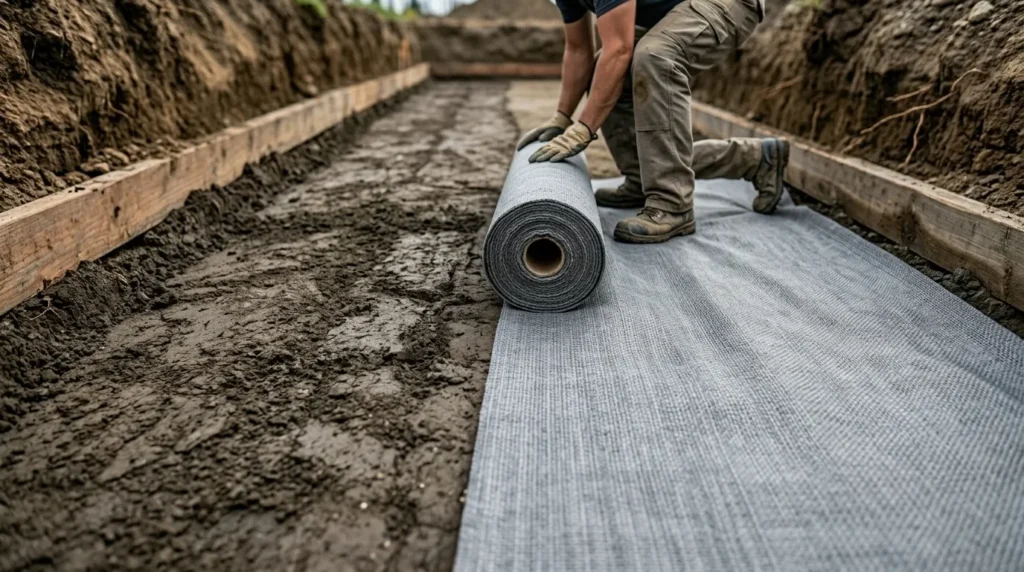
Key addition: Install a woven geotextile fabric (not lightweight garden fabric — use a separation-grade woven geotextile) between the clay and the gravel. Over time, clay fines migrate upward into gravel under traffic-induced water pressure — a process called pumping. The geotextile stops this migration, preserving the drainage and structural properties of the gravel layer for the life of the slab.
Gravel depth on clay: Minimum 6 inches. On highly expansive clay in drought-prone climates (Texas, Oklahoma, parts of California): 8 inches with engineering guidance.
Sandy and Well-Drained Soil
Sandy soil is the easiest subgrade — it is already free-draining and relatively stable. The gravel requirement is less demanding.
Best gravel type: #57 crushed stone or crusher run — both work well on sandy soil. If the sandy subgrade is already stable and uniform, a thinner gravel layer (3–4 inches) may be adequate for light applications.
What to watch for: Not all sandy soils are equal. Loose, fine sand can be unstable under load — proof-roll before placing gravel to identify any soft zones. Dense, well-graded sandy soil is typically the most straightforward subgrade you will encounter.
Fill or Disturbed Soil
Any area that has been previously excavated and backfilled — or where fill has been placed to raise grade — is a high-risk subgrade for concrete. Fill settles. It settles unevenly. And it continues settling for years after placement.
Best approach: Deep compacted fill plus 6 inches of crushed stone. The fill must be compacted in lifts (not dumped and graded) before the gravel subbase is placed. If fill settlement is suspected, a geotechnical assessment before pouring is worthwhile — a soil probe can identify fill depth and density.
Best gravel type: Crusher run for maximum stability over uncertain subgrade, with geotextile fabric at the fill/gravel interface.
Rocky or Dense Native Soil
Solid bedrock or dense native gravel/rock is the best possible subgrade — stable, strong, and free-draining.
Gravel requirement: Minimal. A 2–3 inch leveling layer of #57 stone or coarse sand is adequate for residential slabs. For some applications on solid rock, concrete can be poured directly with only a thin sand layer for leveling.
What to watch for: Even rock subgrades can have soft pockets, clay-filled joints, or transition zones to softer material. Probe the excavation before assuming uniform rock conditions.
Gravel Selection by Application
Residential Patio and Walkway
Recommended: 4 inches of #57 crushed stone Rationale: Light foot traffic only — maximum drainage priority, no heavy load requirement. #57 provides excellent frost resistance and drainage at the lowest cost.
Alternatives: 4 inches of recycled concrete aggregate on budget-conscious projects in warm climates.
Worked Example: A 12×16 ft flagstone patio in Minnesota (frost-prone climate). Subgrade: clay.
- Geotextile fabric on clay
- 6 inches of #57 crushed limestone (deeper for frost protection on clay)
- No vapor barrier (exterior application)
- Concrete poured directly on stone
Garage Floor and Driveway
Recommended: 4–6 inches of #57 crushed stone (general) or crusher run (heavy vehicle traffic)
Driveway choice depends on use:
- Passenger vehicles only → #57 crushed stone
- Regular delivery trucks, heavy pickups → crusher run for maximum stability
- Both applications → crusher run with geotextile on clay subgrade
Worked Example: A 24×24 ft two-car garage floor in Michigan (clay subgrade, significant frost).
- Woven geotextile on clay
- 6 inches of #57 crushed limestone (compacted in two 3-inch lifts)
- 10-mil polyethylene vapor barrier
- 5-inch concrete slab with #4 rebar on 18-inch centers
Commercial and Industrial Floor
Recommended: 6–8 inches of crusher run or engineer-specified aggregate
Commercial floors are subject to forklift loads, point loads from racking, and dynamic loads from vehicle traffic that far exceed residential applications. The subbase specification should be engineered — not estimated from a general guide.
Key consideration: For warehouse floors, a geotechnical engineer’s soil report and a structural engineer’s floor specification are standard practice. The subbase depth and material is part of the structural design, not a field decision.
Pool Deck
Recommended: 4 inches of #57 crushed stone with careful attention to drainage
Pool decks are unique because they get wet constantly — splash, rain, and humidity. Drainage is the dominant design criterion. #57 crushed stone’s free-draining property makes it the clear choice.
Additional consideration: Pool decks often slope to drain (1–2% minimum) — the gravel subbase must follow this slope precisely so the concrete thickness remains consistent. Use string lines and grade stakes to verify the gravel surface slope before pouring.
Gravel Type Comparison Table
| Gravel Type | Best For | Avoid When | Drainage | Stability | Cost |
|---|---|---|---|---|---|
| #57 Crushed stone | Patios, garage floors, general residential | Heavy commercial loads | ⭐⭐⭐⭐⭐ | ⭐⭐⭐⭐ | Medium |
| #4 Crushed stone | High drainage priority, wet sites | Not widely available everywhere | ⭐⭐⭐⭐⭐ | ⭐⭐⭐⭐ | Medium |
| Crusher run / road base | Driveways, heavy traffic, commercial | High water table, clay frost zones | ⭐⭐⭐ | ⭐⭐⭐⭐⭐ | Low-Medium |
| Recycled concrete (RCA) | Budget residential, light applications | Structural or heavy load applications | ⭐⭐⭐⭐ | ⭐⭐⭐ | Low |
| Coarse sand (leveling only) | Thin leveling layer on top of stone | As sole subbase, clay subgrade, frost | ⭐⭐⭐ | ⭐⭐ | Low |
| Pea gravel | Drainage trenches, landscaping | Under any concrete slab | ⭐⭐⭐⭐ | ⭐ | Low |
| Bank run / river gravel | Non-structural landscaping | Under concrete (rounded = no interlock) | ⭐⭐⭐ | ⭐ | Low |
Frequently Asked Questions
What type of gravel is best under a concrete slab?
#57 crushed stone — angular, clean-washed crushed limestone or granite in the 3/4 to 1-inch size range — is the industry standard for concrete slab subbase in the US. It compacts well, drains freely, and its angular particles interlock under compaction to create a stable, load-bearing surface. For heavy vehicle applications, crusher run provides better stability but less drainage.
What is #57 stone and why is it used under concrete?
#57 refers to the ASTM D448 gradation designation for aggregate in the 3/4 to 1-inch size range. It is typically crushed limestone, granite, or trap rock. Under concrete, it is specified because it has three key properties: angular particles that interlock under compaction, clean gradation with no fines that allows free drainage, and proven performance across every climate zone and application type.
Can I use pea gravel under a concrete slab?
No. Pea gravel is rounded, smooth aggregate that does not interlock when compacted. Under load, it shifts rather than distributing the load — causing the concrete above to flex and crack. Pea gravel is appropriate for drainage trenches and landscaping but not for load-bearing concrete subbase.
What is the difference between crusher run and crushed stone for concrete base?
Crushed stone (#57) is screened to remove fine particles — it is clean, open-graded, and free-draining. Crusher run retains fine particles (stone dust) — it compacts into a very dense, stable surface but drains more slowly. Use #57 where drainage is a priority (most residential applications). Use crusher run where maximum stability matters more than drainage (driveways, heavy vehicle areas).
Can I use sand under a concrete slab?
Coarse sand can be used as a thin (1–2 inch) leveling layer on top of compacted crushed stone — it is not suitable as the primary subbase material. Sand retains more moisture than crushed stone, does not compact into a stable load-bearing layer, and on clay subgrade creates a drainage trap that can saturate and weaken the clay beneath.
Is recycled concrete aggregate (RCA) OK under a concrete slab?
For light residential applications — garden paths, shed bases, small patios — RCA is a cost-effective and environmentally responsible choice. For driveways, garage floors, and any structural application, virgin #57 crushed stone is preferred because its quality is more consistent and its performance under vehicle loads is better documented.
What goes under gravel before concrete?
On clay or silty soil: a woven geotextile (separation fabric) goes directly on the subgrade before the gravel. This prevents clay fines from migrating into the gravel over time. On top of the compacted gravel and before the concrete: a vapor barrier (10-mil polyethylene sheet) for any interior slab. For exterior slabs: no vapor barrier needed, geotextile on clay subgrade only.
Does gravel type affect concrete performance?
Yes — indirectly but significantly. The gravel subbase determines how uniformly the concrete is supported. Non-uniform support from a shifting or poorly draining subbase causes differential settlement, frost heave, and flexural cracking in the concrete above. The concrete itself may be perfect — but if it loses subgrade support, it cracks. Choosing the right gravel type is as important as choosing the right concrete mix.
Conclusion
The gravel under your concrete slab is doing structural work — and it can only do that work if it is the right material. Angular crushed stone interlocks. Rounded gravel shifts. Clean stone drains. Crusher run stabilises. Sand levels but does not support. The right choice comes from matching the gravel’s properties — drainage capacity, compaction behaviour, angular interlocking — to your soil conditions, climate, and the loads the slab will carry. For most residential applications, 4–6 inches of #57 crushed stone is the correct answer. For driveways and heavy-traffic areas, crusher run earns its premium stability. Once your subbase type and depth are confirmed, calculate the volume with our how much gravel under concrete slab guide, then calculate your concrete on top with our concrete slab calculator.