
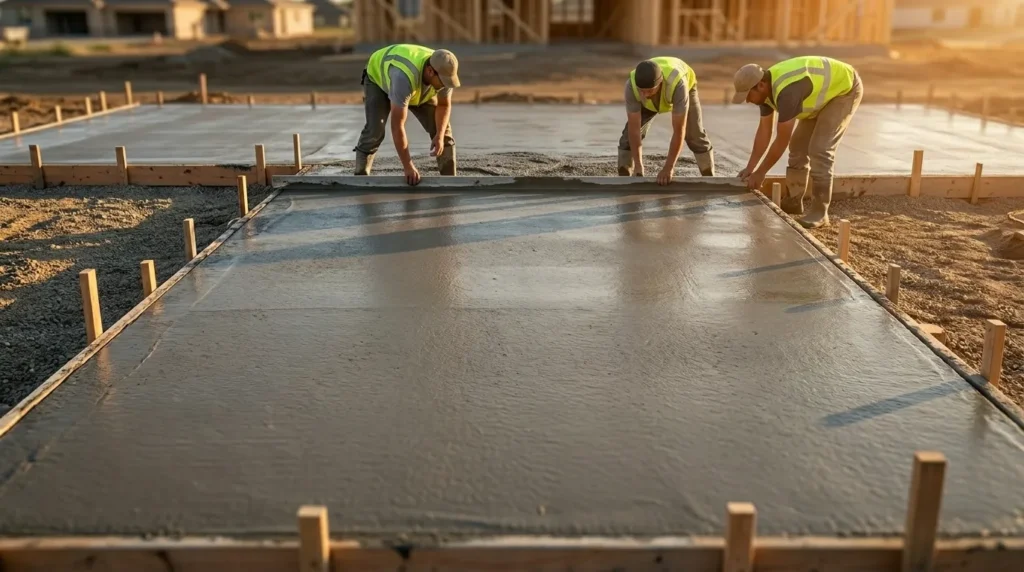

Pouring a concrete slab without an accurate material estimate is one of the most expensive mistakes in residential construction. Order too little and you face a cold joint — a visible, structurally weak seam where fresh concrete meets a hardened edge. Order too much and you’re paying for waste. A concrete slab calculator takes the guesswork out of the process, turning your dimensions into a precise cubic yardage figure, a bag count, and a realistic cost estimate — before you spend a dollar on materials.
Whether you’re planning a backyard patio, a driveway, a garage floor, or a simple shed base, the calculation method is the same. This guide walks you through every step: the formula, the thickness decisions, the bags-versus-ready-mix question, reinforcement basics, and the cost factors that actually move the needle on your project budget.
What Is a Concrete Slab Calculator?
A concrete slab calculator is a planning tool that converts your slab’s length, width, and thickness into a concrete volume — expressed in cubic yards, cubic feet, or cubic meters — and then translates that volume into a number of bags or a ready-mix order quantity.
Most online calculators also factor in a standard waste allowance (typically 5–10%) to account for spillage, uneven subgrades, and slight over-pours. Without this buffer, you risk running short on a pour.
“The best calculators — like ConcreteCal’s free slab calculator — also let you compare the cost of bagged concrete versus ordering from a ready-mix supplier…”
Concrete Slab Volume Formula — How the Math Works
The core formula is straightforward:
Volume = Length × Width × Thickness
The challenge is unit consistency. All three dimensions must be in the same unit before you multiply.
Working in Cubic Yards
Since ready-mix concrete in the US is sold by the cubic yard, this is the most practical unit for larger pours.
Formula:
Volume (yd³) = (Length in ft × Width in ft × Thickness in ft) ÷ 27
There are 27 cubic feet in one cubic yard, hence the division.
Worked Example:
You want a 12 ft × 20 ft patio slab, 4 inches thick.
- Convert thickness: 4 inches ÷ 12 = 0.333 ft
- Volume: 12 × 20 × 0.333 = 80 cubic feet
- Convert to yards: 80 ÷ 27 = 2.96 cubic yards
- Add 10% waste: 2.96 × 1.10 = 3.26 cubic yards → order 3.5 yards
Working in Cubic Meters
Outside the US, concrete volume is measured in cubic meters.
Formula:
Volume (m³) = Length (m) × Width (m) × Thickness (m)
Worked Example:
A 4 m × 6 m slab at 100 mm (0.1 m) thick:
4 × 6 × 0.1 = 2.4 m³ → with 10% waste = 2.64 m³
Converting Between Units
| From | To | Multiply By |
|---|---|---|
| Cubic feet | Cubic yards | ÷ 27 |
| Cubic yards | Cubic feet | × 27 |
| Cubic meters | Cubic yards | × 1.308 |
| Cubic yards | Cubic meters | × 0.7646 |
How to Calculate Concrete for a Slab (Step-by-Step)
Knowing the formula is one thing — applying it correctly on a real project is another. Here’s the full process from measurement to material order.
Step 1 — Measure Your Slab Dimensions
Use a tape measure to record length, width, and planned thickness. For irregular shapes, break the area into rectangles, calculate each volume separately, and add them together.
For projects on sloped ground, measure thickness at multiple points and use the average. A slab that varies from 3.5 to 4.5 inches should be calculated at 4 inches.
Step 2 — Apply the Waste Factor
Never order exactly what the math says. Concrete poured on an uneven or slightly soft subgrade will consume more material than your calculation assumes. Standard industry practice is to add a waste factor of 5–10%:
- Smooth, level substrate with precise formwork: 5%
- Average residential pour: 8–10%
- Rough terrain or complex forms: 10–15%
This is consistent with guidance from organizations like the Portland Cement Association, which recommends accounting for placement variability in all residential concrete projects.
Step 3 — Choose Bags or Ready-Mix
Once you have your volume with waste, convert to the appropriate format:
For bagged concrete:
| Bag Weight | Yield per Bag |
|---|---|
| 40 lb bag | ~0.30 cubic feet |
| 60 lb bag | ~0.45 cubic feet |
| 80 lb bag | ~0.60 cubic feet |
Formula: Number of bags = Total cubic feet ÷ Yield per bag
Worked Example — continuing from the patio above:
3.5 yd³ × 27 = 94.5 cubic feet total needed
Using 80 lb bags: 94.5 ÷ 0.60 = 158 bags
At roughly $6–$8 per 80 lb bag, that’s $950–$1,265 just for materials — which quickly illustrates why ready-mix is often more economical at this volume.
Concrete Slab Thickness Guide
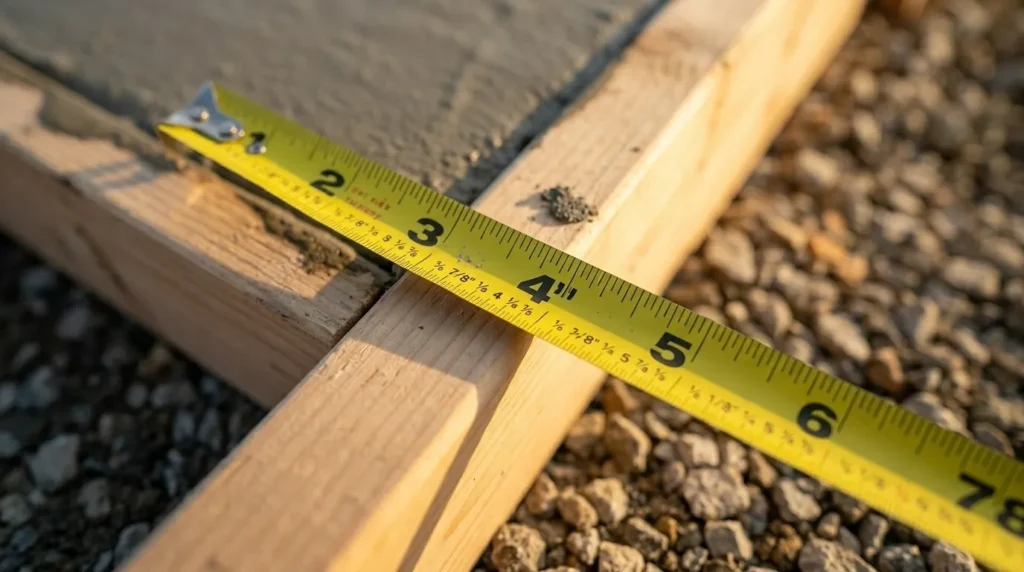
Thickness is the single most consequential decision in slab design. Too thin and the slab cracks under load; too thick and you’ve over-spent on concrete and extended your cure time unnecessarily.
Recommended Thickness by Application
| Application | Minimum Thickness | Typical Thickness | Notes |
|---|---|---|---|
| Sidewalk / walkway | 3 inches | 4 inches | Light foot traffic |
| Patio slab | 3.5 inches | 4 inches | Furniture, foot traffic |
| Shed base / small pad | 3.5 inches | 4 inches | Light equipment |
| Residential driveway | 4 inches | 5–6 inches | Passenger vehicles |
| Garage floor | 4 inches | 5–6 inches | Vehicles + stored weight |
| Foundation slab | 4 inches | 6+ inches | Structural — engineer sign-off required |
Design note: For driveways and garage floors that will support larger vehicles (SUVs, trucks, RVs), 6 inches with proper rebar is the professional standard. Undersized slabs in these applications almost always crack within a few years.
For a deeper look at residential slab standards, the American Concrete Institute (ACI) publishes residential flatwork guidelines that most local building codes reference directly.
Concrete Bags vs. Ready-Mix Concrete
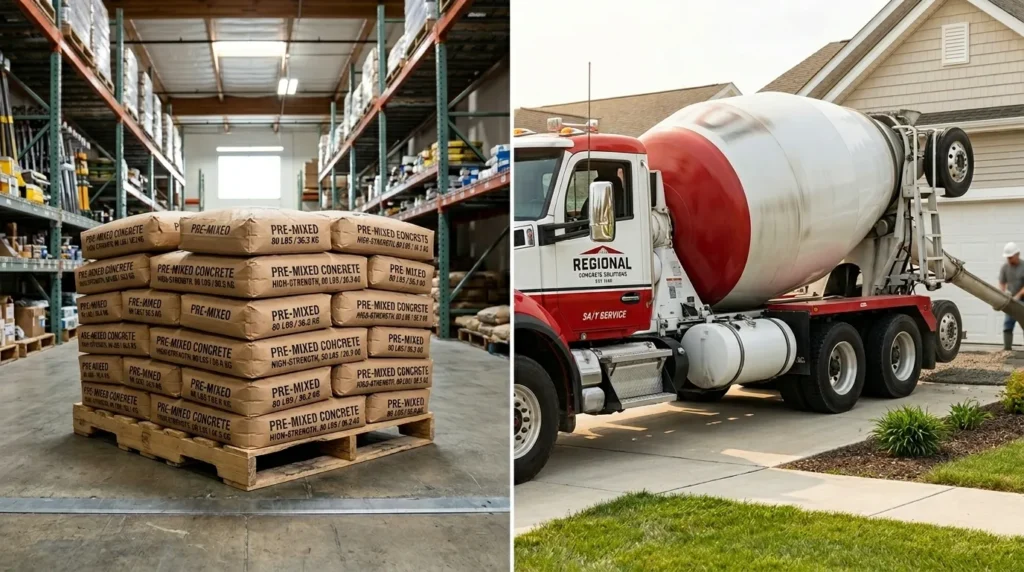
The choice between bagged concrete and ready-mix delivery depends on three things: volume, labor, and access.
When Bags Make Sense
Bagged concrete (premixed dry ingredients — add water and mix) is the right choice when:
- Total volume is under 1 cubic yard (~27 cubic feet)
- Site access is tight and a ready-mix truck can’t maneuver
- The project is a simple repair, small pad, or fence post
Small projects like a 3 ft × 4 ft shed base or a garden path section work perfectly with 60 lb or 80 lb concrete bags. The cost per cubic yard is higher, but the convenience and no-minimum-order flexibility offset that.
When to Order Ready-Mix Delivery
Ready-mix concrete is batched at a plant and delivered in a truck. It’s the standard choice when:
- Total volume exceeds 1 cubic yard
- You need a consistent mix design (specific PSI, fiber reinforcement, admixtures)
- The pour needs to happen fast to avoid cold joints
Most ready-mix suppliers have a minimum order of 1 cubic yard, and short-load fees apply if you order under 3–4 yards. Factor this into your cost planning — sometimes slightly increasing your slab size to hit the minimum threshold makes financial sense.
Concrete Cost Estimation Guide
Factors That Affect Concrete Cost
Concrete pricing isn’t just about volume. Here’s what actually drives your total cost:
Ready-mix concrete: $120–$200 per cubic yard depending on region, mix design, and fuel surcharges.
Bagged concrete: $5–$8 per 80 lb bag (yields ~0.6 cubic feet). Equivalent cost per yard: $225–$360 — significantly more than ready-mix at scale.
Delivery and short-load fees: $50–$200+ depending on distance and volume shortfall.
Reinforcement: Wire mesh typically $0.15–$0.25 per square foot; #4 rebar runs $0.50–$0.80 per linear foot.
Finishing and labor: If you’re hiring a concrete contractor, expect $2–$8 per square foot for placement and finishing, depending on local rates and slab complexity.
Sample Cost Breakdown
Project: 20 ft × 24 ft Garage Floor, 5-inch slab
| Item | Quantity | Unit Cost | Total |
|---|---|---|---|
| Ready-mix concrete | 7.5 yd³ | $160/yd³ | $1,200 |
| Wire mesh reinforcement | 480 sq ft | $0.20/sq ft | $96 |
| Delivery fee | 1 | $75 | $75 |
| Concrete finishing (labor) | 480 sq ft | $3.50/sq ft | $1,680 |
| Total | $3,051 |
This is a ballpark figure. For accurate local pricing, get at least three quotes from concrete suppliers and contractors in your area. Tools like HomeAdvisor’s cost estimator can provide regional labor benchmarks to sanity-check contractor quotes.
Common Concrete Slab Applications
Patio Slabs
A standard residential patio slab is typically 4 inches thick and ranges from 200 to 400 square feet. At 4 inches thick, a 16 × 20 ft patio requires approximately 3.95 cubic yards of concrete — round to 4.4 with a 10% waste allowance.
Patios rarely require rebar; a layer of 6×6 W1.4×W1.4 wire mesh laid mid-slab provides adequate crack control for decorative flatwork.
Driveway Slabs
Driveways see more stress than any other residential flatwork. Passenger vehicles, delivery trucks, and seasonal freeze-thaw cycles demand a minimum 4-inch slab with 3,500–4,000 PSI concrete and rebar on 18-inch centers (or wire mesh at minimum).
For a standard two-car driveway (16 ft × 40 ft at 5 inches thick), expect to need approximately 9.9 cubic yards before the waste factor.
Garage Floors
Garage floor slabs carry sustained point loads from parked vehicles, tool storage, and shelving — often on all four corners simultaneously. A 5–6 inch slab is standard. Post-tensioned or fiber-reinforced mixes are growing in popularity for garage applications because they reduce crack width significantly.
For a 24 × 24 ft two-car garage at 5 inches thick: 8.9 cubic yards base volume, approximately 9.8 yards with a 10% waste factor.
Shed Bases and Small Pads
A shed base is one of the most common DIY concrete projects. A 10 × 12 ft shed base at 4 inches thick requires just 1.48 cubic yards — squarely in the bagged concrete zone if you’re comfortable mixing. Use 80 lb bags for efficiency; you’ll need approximately 66–67 bags.
Concrete Reinforcement Requirements
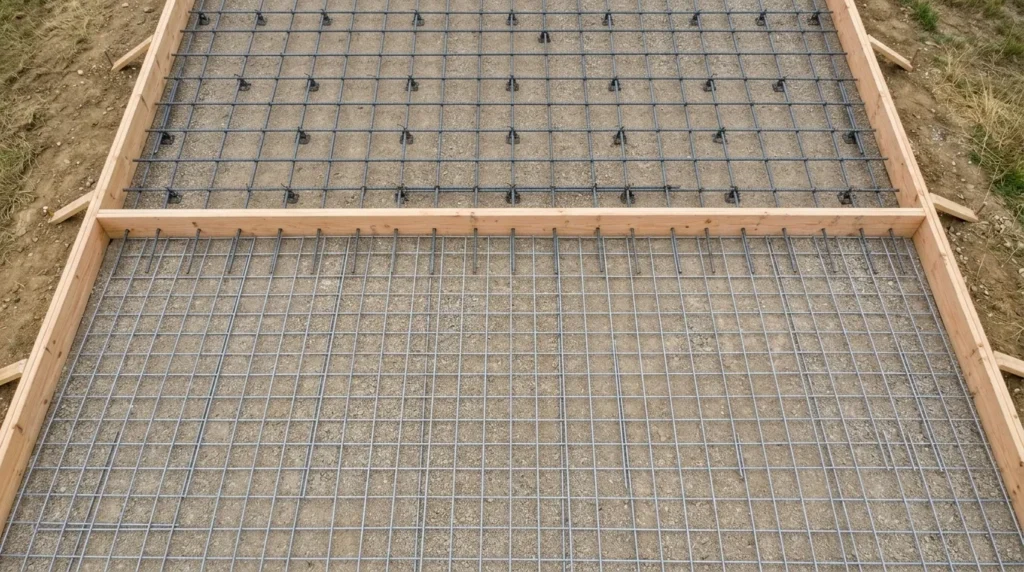
Unreinforced concrete slabs crack. Concrete is strong in compression but weak in tension, and ground movement, temperature changes, and load shifting all introduce tensile stress. Reinforcement doesn’t prevent cracks — it controls where they occur and prevents them from widening.
Wire Mesh vs. Rebar
| Factor | Wire Mesh | Rebar |
|---|---|---|
| Cost | Lower ($0.15–$0.25/sq ft) | Higher ($0.50–$0.80/LF) |
| Best for | Patios, walkways, shed bases | Driveways, garage floors, foundations |
| Placement | Center of slab thickness | Lower third of slab thickness |
| Crack control | Good (crack distribution) | Better (crack limitation) |
| Labor | Simple — roll and cut | More involved — tie and position |
Placement matters more than choice of material. Wire mesh sitting on the ground at the bottom of the slab provides almost no structural benefit. It must be elevated to the center of the slab using concrete chairs or bar supports. The same applies to rebar — it should sit at the lower third of the slab depth, not on the subgrade.
The Concrete Reinforcing Steel Institute (CRSI) provides free residential reinforcement guidelines that specify bar sizes, spacing, and placement depth for common slab applications.
Tips for Accurate Concrete Ordering
1. Confirm your subgrade before ordering. If the subgrade is soft or the base has settled unevenly, you may need more concrete than your measurements suggest. Probe the base with a rod; soft spots should be filled and compacted before you pour.
2. Check the concrete PSI spec. Most residential slabs use 3,000–4,000 PSI concrete. Driveways and garage floors exposed to deicers should use 4,000–4,500 PSI with air entrainment. Specify this when you call your ready-mix supplier — the wrong mix can compromise durability regardless of volume accuracy.
3. Order in whole yards, not fractions. Ready-mix trucks can’t deliver 3.3 yards. You’ll order 3.5 or 4. Plan your project so the rounding works in your favor.
4. Schedule your delivery for early morning. Concrete cures faster in heat. Pouring in the morning gives you more working time, especially in summer. Coordinate with your supplier on slump (workability) if you’re in a hot climate — a water reducer can help maintain workability without adding water and weakening the mix.
5. Have one extra bag on site. Even with a perfect ready-mix order, having two or three 80 lb bags of fast-setting concrete on hand helps fill any small shortfalls at form edges or corners.
6. Never add excess water at the truck. This is the most common mistake on residential pours. Excess water increases slump (makes the mix more workable) but reduces compressive strength and increases shrinkage cracking. Stick to the specified water-cement ratio.
Frequently Asked Questions About Concrete Slabs
How do I calculate concrete for a slab?
Multiply the length (ft) × width (ft) × thickness (ft), divide by 27 to get cubic yards, then add 5–10% for waste. For example, a 10 × 10 ft slab at 4 inches thick = 10 × 10 × 0.333 ÷ 27 = 1.23 yd³, plus 10% = 1.35 yards.
How do you calculate a concrete slab in cubic meters?
Multiply length (m) × width (m) × thickness (m). A 3 m × 5 m slab at 100 mm (0.1 m) thick = 3 × 5 × 0.1 = 1.5 m³. Add your waste factor after.
How do I calculate concrete slab materials?
Start with volume (cubic yards or meters), then convert to bags using the yield per bag (0.60 cu ft per 80 lb bag), or use the volume directly to order ready-mix. Also calculate reinforcement square footage separately for wire mesh or linear footage for rebar.
How do I calculate concrete slab thickness?
Thickness is determined by the load the slab must carry, not by calculation — it’s a design decision guided by building standards. Use the thickness table above as a starting point, and consult a structural engineer for any foundation or load-bearing application.
How do I calculate concrete quantity for a slab with odd dimensions?
Break the area into rectangles. Calculate each volume separately, add them together, and apply your waste factor to the total. This works for L-shaped patios, irregular driveways, and any non-rectangular slab.
How to calculate foundation concrete?
For a slab-on-grade foundation, use the same formula: length × width × thickness ÷ 27 for cubic yards. However, foundation slabs typically require a licensed engineer to specify thickness, reinforcement, and PSI — local building departments will require permitted drawings for any habitable structure.
Conclusion
Accurate concrete estimation protects your budget and your pour. Use the volume formula, add your waste factor, pick the right delivery method for your project scale, and match your slab thickness to the actual load it needs to carry. A concrete slab calculator gives you a number — this guide gives you the context to trust it and act on it.
“Use the volume formula, add your waste factor, pick the right delivery method for your project scale, and match your slab thickness to the actual load it needs to carry. ConcreteCal’s concrete slab calculator gives you a number — this guide gives you the context to trust it and act on it.”