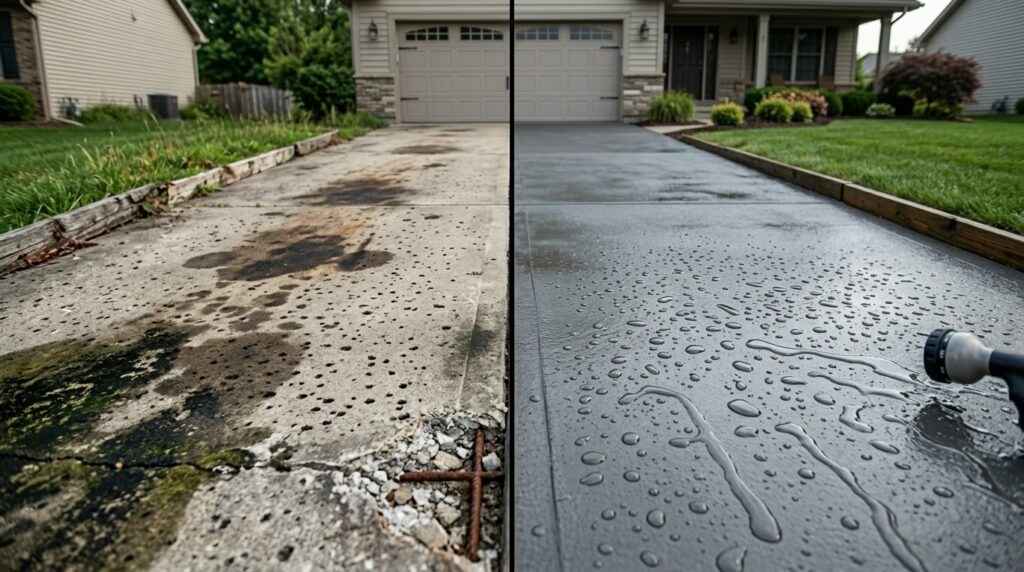

Concrete is strong — but it is not impermeable. Left unsealed, concrete absorbs water, oil, de-icing chemicals, and biological growth like a sponge. The water freezes in winter and expands, spalling the surface. Oil and fuel stain permanently. Salt attacks reinforcement steel from within. Algae colonises shaded surfaces. None of this is inevitable — the right sealer, correctly applied, prevents all of it.
The challenge is that there are multiple types of concrete sealers, each designed for a different surface, exposure condition, and aesthetic requirement. A silane penetrating sealer that protects a driveway brilliantly would be completely wrong on a polished garage floor. An epoxy floor coating that transforms an indoor garage is the wrong product for an outdoor patio. Getting the sealer type right matters as much as applying it at all.
This guide covers every concrete sealer type — penetrating and film-forming, from silane sealers to polyaspartic coatings — with a complete application-by-application selection framework, step-by-step application guidance, and a maintenance schedule.
For the concrete beneath the sealer, use our free concrete calculator at ConcreteCal to calculate your project’s material requirements accurately before any surface treatment work begins.
Table of Contents
- Why Concrete Needs Sealing
- Types of Concrete Sealers — Complete Overview
- Penetrating Sealers (Reactive Sealers)
- Film-Forming Sealers
- Concrete Sealer Comparison Table
- Types of Concrete Sealers by Application
- How to Choose the Right Concrete Sealer
- How to Apply Concrete Sealer — Step by Step
- How Often Should Concrete Be Sealed?
- Common Concrete Sealing Mistakes to Avoid
- Frequently Asked Questions
Why Concrete Needs Sealing — And Why Sealer Type Matters
Concrete is porous. Every concrete surface — no matter how dense or well-cured — has a network of capillary pores through which water, chemicals, and contaminants can migrate. These pores are the primary pathway for every form of concrete deterioration.
What Happens to Unsealed Concrete
Water damage: Water penetrates concrete pores and, in cold climates, freezes and expands — a process that fractures the surrounding paste and causes surface spalling. Over multiple freeze-thaw cycles, surface scaling becomes progressively worse. This is the most common cause of residential driveway and patio surface deterioration in northern climates.
Staining: Oil, fuel, rust, and biological staining penetrate unsealed concrete permanently. Once absorbed into the pore structure, these stains cannot be removed — only obscured by coatings or ground away.
Chemical attack: De-icing salts (sodium chloride, calcium chloride, magnesium chloride) penetrate concrete and attack both the cement paste and the reinforcing steel within. Salt-induced corrosion is responsible for significant infrastructure damage annually.
Biological growth: Algae, mold, and lichen colonise the surface of unsealed concrete in shaded or moist areas — causing staining, surface degradation, and slip hazards.
The Two Fundamental Sealer Categories
Every concrete sealer belongs to one of two fundamentally different categories — and understanding this distinction is the starting point for every sealer selection decision.
Penetrating sealers (reactive sealers): These sealers penetrate into the concrete pore structure and react chemically with the concrete minerals — forming a hydrophobic barrier or crystalline blockage within the concrete itself. The surface appearance does not change. No film forms on top of the concrete.
Film-forming sealers: These sealers form a protective film on the concrete surface — a continuous coating that physically blocks water, chemicals, and contaminants from reaching the concrete beneath. They change the surface appearance (gloss, sheen, or colour enhancement) and eventually wear away, requiring periodic renewal.
The choice between these two categories governs every specific sealer decision that follows.
Types of Concrete Sealers — Complete Overview
| Sealer Type | Category | Appearance Change | Reapplication | Best Use |
|---|---|---|---|---|
| Silane | Penetrating | None | 5–10 years | Exterior slabs, bridges |
| Siloxane | Penetrating | None | 5–10 years | Vertical surfaces, masonry |
| Silane-siloxane blend | Penetrating | None | 5–10 years | General exterior concrete |
| Lithium silicate | Penetrating (reactive) | Slight sheen | Permanent | Densifying, warehouse floors |
| Acrylic (solvent-based) | Film-forming | Wet look / gloss | 1–3 years | Stamped, decorative |
| Acrylic (water-based) | Film-forming | Low gloss | 1–3 years | Patios, walkways |
| Epoxy | Film-forming | High gloss | 5–10 years | Indoor garage floors |
| Polyurethane | Film-forming | High gloss / matte | 3–5 years | Indoor/outdoor floors |
| Polyaspartic | Film-forming | High gloss | 5–10 years | Garage floors, fast cure |
Penetrating Sealers (Reactive Sealers)
Penetrating sealers do not sit on top of the concrete — they go into it. Applied to the surface, they are absorbed into the capillary pore network, where they react with moisture and concrete minerals to form a hydrophobic (water-repelling) barrier or crystalline structure within the pore system itself.
The result is concrete that repels water from within — water beads on the surface and runs off rather than absorbing. But the concrete surface looks and feels exactly the same as before. No gloss, no colour change, no visible film.
Silane Sealers
Silane is the smallest penetrating sealer molecule — it penetrates deepest into concrete, making it the most effective penetrating sealer for dense, low-permeability concrete where larger molecules cannot penetrate as effectively.
“The performance requirements for concrete sealers used on bridge decks and highway pavements — including chloride ion penetration resistance — are defined by ASTM C1202, the standard test method for electrical indication of concrete’s ability to resist chloride ion penetration, which specifies maximum acceptable penetration values for sealed concrete in aggressive environments.”
How it works: Silane molecules react with moisture in the concrete pores to form silanol, which then reacts with the concrete surface minerals to form a chemically bonded, hydrophobic siloxane polymer within the pore structure.
Key properties:
- Deepest penetration of any penetrating sealer
- Completely invisible — no surface appearance change
- Excellent chloride ion resistance — the primary protection mechanism against deicer and marine salt damage
- Service life: 5–10 years before reapplication
- Best on dense, hard concrete (bridge decks, driveways, exterior slabs)
Worked Example — Bridge Deck Protection: A concrete bridge deck in a northern climate with heavy deicer use. The primary damage mechanism is chloride ion penetration from road salt — chlorides reach the reinforcing steel and initiate corrosion. A 100% silane sealer applied to the bridge deck surface penetrates 3–5mm into the dense concrete and creates a hydrophobic barrier that reduces chloride ion uptake by 85–95%. Service life before reapplication: 7–10 years.
Siloxane Sealers
Siloxane molecules are larger than silane — they penetrate less deeply but form a more robust hydrophobic network near the surface. They are particularly effective on porous masonry, brick, and lighter concrete.
Key properties:
- Good penetration in porous concrete and masonry
- Excellent water repellency near the surface
- Better performance than silane on porous, rough-textured surfaces
- Common on vertical surfaces (concrete block walls, tilt-up panels)
- Service life: 5–8 years
Silane-Siloxane Blends
The most commonly specified penetrating sealer for general residential and commercial concrete — combines the deep penetration of silane with the surface-near hydrophobic network of siloxane.
Best for: Most exterior residential concrete applications — driveways, patios, walkways, concrete block walls, exposed aggregate. The go-to penetrating sealer when one product must address varied concrete porosity across a project.
Cost: $0.15–$0.40 per square foot per application. At 5–10 year reapplication intervals, this is the lowest-cost long-term sealing solution for exterior concrete.
Silicate and Lithium Silicate Sealers
Silicate sealers react differently from silane and siloxane — instead of creating a hydrophobic barrier, they react with free calcium hydroxide in the concrete to form calcium silicate hydrate crystals that fill and block pore spaces.
Effect: Densify and harden the concrete surface rather than waterproofing it. Reduces porosity, increases surface hardness, and reduces dusting.
Lithium silicate is the preferred form — smaller molecules penetrate deeper than sodium or potassium silicate, and lithium doesn’t contribute to alkali-aggregate reaction risk.
Best for: Concrete floors that will be polished — the densifier is a standard step in the diamond polishing process. Also used as a standalone sealer for warehouse and industrial floors where dust control and surface hardening are the primary goals.
Not a waterproofer: Silicate sealers are densifiers, not waterproofing sealers. They do not repel water — they fill pores and harden the surface. Do not use a silicate sealer where chloride resistance or freeze-thaw protection is the goal.
When to Choose a Penetrating Sealer
| Condition | Choose Penetrating Sealer |
|---|---|
| Exterior surface exposed to rain and freeze-thaw | ✅ Yes |
| Chloride/deicer exposure (driveways, bridge decks) | ✅ Yes |
| Appearance must not change | ✅ Yes |
| Surface is rough/textured (exposed aggregate, broom finish) | ✅ Yes |
| Long reapplication interval preferred | ✅ Yes |
| Surface hardening / densification needed (industrial floor) | ✅ Silicate |
| Surface needs gloss or colour enhancement | ❌ No — use film-forming |
| Indoor surface needing stain resistance | ❌ No — use film-forming |
Film-Forming Sealers
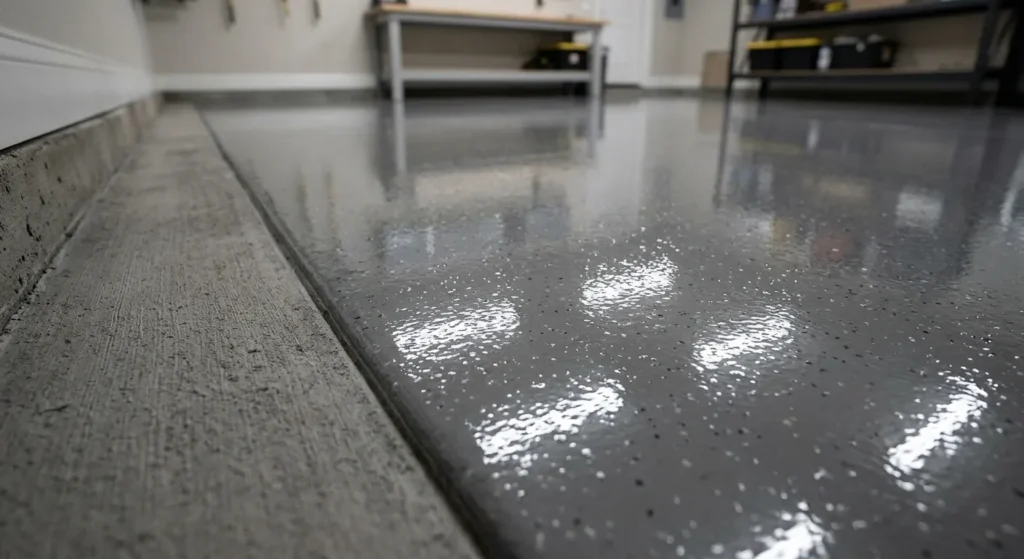
Film-forming sealers create a continuous protective layer on the concrete surface. Unlike penetrating sealers that work within the concrete, film-forming products work on top of it — physically preventing contaminants from reaching the concrete below.
The trade-off: film-forming sealers wear away over time (from UV, abrasion, and chemical exposure), require periodic stripping and reapplication, and can peel or delaminate if applied incorrectly or to concrete that is too wet.
Acrylic Sealers
Acrylic sealers are the most widely used film-forming concrete sealers for residential and decorative applications — available in solvent-based and water-based formulations.
Solvent-based acrylic: Penetrates slightly deeper than water-based, produces a richer “wet look” gloss, and enhances colour more dramatically. Better performance in cold weather application. Higher VOC content — requires ventilation and has environmental restrictions in some areas.
Water-based acrylic: Lower VOC, easier clean-up, and safer application. Slightly less gloss enhancement than solvent-based. Adequate performance for most residential applications and increasingly the preferred option due to environmental regulations.
Key properties:
- Gloss range: low to high depending on formulation
- UV resistant (resists yellowing in sun exposure)
- Good colour enhancement for stamped and coloured concrete
- Reapplication: every 1–3 years depending on traffic and sun exposure
- Easy DIY application — roller or pump sprayer
Best for: Stamped concrete driveways and patios, coloured concrete, exposed aggregate, any decorative concrete where colour enhancement and gloss are desired.
Cost: $0.10–$0.25 per square foot per application.
Worked Example — Stamped Patio Maintenance: A 300 sq ft stamped concrete patio resealed every 2 years with water-based acrylic:
- Cost per application: 300 × $0.15 = $45 material + $0 DIY labour
- Annual cost: $22.50
- Over 10 years: $225 total sealing cost This makes acrylic resealing one of the lowest-cost maintenance tasks for decorative concrete.
Epoxy Sealers
Epoxy concrete sealers are two-component systems — Part A (resin) and Part B (hardener) — that cure through chemical reaction rather than solvent evaporation. The cured epoxy film is extremely hard, chemical-resistant, and durable.
Key properties:
- Extremely high chemical resistance (oils, fuels, solvents)
- Very high gloss — mirror finish achievable
- Excellent abrasion resistance under vehicle and forklift traffic
- Bonds strongly to properly prepared concrete
- Not UV stable — yellows with prolonged sun exposure
- Reapplication: 5–10 years (significantly longer than acrylic)
Critical limitation: Epoxy is not suitable for exterior surfaces exposed to UV radiation — it yellows and chalks within 12–18 months of sun exposure. Epoxy is an indoor floor product.
Best for: Indoor garage floors, warehouse floors, commercial kitchens, industrial facilities — any indoor surface requiring chemical resistance, high gloss, and long service intervals.
Cost: $0.30–$0.80 per square foot for two-component epoxy systems — higher initial cost but lower annual cost due to long service life.
Polyurethane Sealers
Polyurethane sealers offer the durability of epoxy with better UV resistance — making them suitable for both indoor and outdoor applications. They are single or two-component systems that cure to a hard, flexible film.
Key properties:
- Better UV resistance than epoxy — can be used outdoors
- High abrasion resistance
- Available in matte, satin, and high-gloss finishes
- More flexible than epoxy — better resistance to substrate movement and cracking
- Reapplication: 3–5 years depending on exposure
Best for: Garage floors (as a topcoat over epoxy base, or standalone), outdoor decorative concrete in sunny climates, commercial floors requiring UV-stable protection.
Aliphatic polyurethane is the UV-stable version — specify “aliphatic” for any outdoor or UV-exposed application. Aromatic polyurethane yellows like epoxy and must not be used outdoors.
Polyaspartic Sealers
Polyaspartic is a newer generation coating — a modified polyurea that combines the UV resistance of aliphatic polyurethane with a dramatically faster cure time. A full coating system (base coat + topcoat) can be applied and returned to service within a single working day.
Key properties:
- UV stable — suitable for indoor and outdoor use
- Cure time: typically 2–4 hours between coats, return to service in 24 hours
- Excellent abrasion and chemical resistance
- Wide temperature application range — can be applied in cold and hot conditions
- Higher cost than epoxy or standard polyurethane
Best for: Garage floors where one-day installation is required, commercial floors where downtime must be minimised, any application where fast return to service justifies the premium cost.
Cost: $0.50–$1.20 per square foot — the most expensive sealer type, justified by performance and speed.
When to Choose a Film-Forming Sealer
| Condition | Choose Film-Forming Sealer |
|---|---|
| Decorative/stamped concrete needing colour enhancement | ✅ Acrylic |
| Indoor garage floor requiring chemical resistance | ✅ Epoxy or polyaspartic |
| Outdoor decorative concrete in sunny climate | ✅ Aliphatic polyurethane |
| Maximum abrasion resistance (forklifts) | ✅ Epoxy + polyurethane topcoat |
| Fast cure, return to service in one day | ✅ Polyaspartic |
| Surface appearance must not change | ❌ No — use penetrating |
| Exterior surface in freeze-thaw climate (non-decorative) | ❌ No — use penetrating |
Concrete Sealer Comparison Table
| Sealer | Indoor/Outdoor | Gloss | Durability | UV Stable | Reapplication | Cost/sq ft |
|---|---|---|---|---|---|---|
| Silane | Outdoor | None | 5–10 yr | N/A | 5–10 yr | $0.15–$0.40 |
| Siloxane | Both | None | 5–8 yr | N/A | 5–8 yr | $0.15–$0.35 |
| Silane-siloxane | Both | None | 5–10 yr | N/A | 5–10 yr | $0.15–$0.40 |
| Lithium silicate | Indoor | Slight | Permanent | N/A | Once | $0.10–$0.30 |
| Acrylic (water-based) | Both | Low-Med | 1–3 yr | ✅ Yes | 1–3 yr | $0.10–$0.25 |
| Acrylic (solvent-based) | Both | Med-High | 1–3 yr | ✅ Yes | 1–3 yr | $0.15–$0.30 |
| Epoxy | Indoor only | High | 5–10 yr | ❌ No | 5–10 yr | $0.30–$0.80 |
| Polyurethane (aliphatic) | Both | Med-High | 3–5 yr | ✅ Yes | 3–5 yr | $0.25–$0.60 |
| Polyaspartic | Both | High | 5–10 yr | ✅ Yes | 5–10 yr | $0.50–$1.20 |
Types of Concrete Sealers by Application
Driveway Sealers
Driveways face the harshest conditions of any residential concrete surface — vehicle loads, deicer chemicals, fuel and oil spills, freeze-thaw cycling, and UV exposure.
Recommended:
- Penetrating silane-siloxane blend — for standard grey or brushed driveways where appearance is not a priority. Best long-term protection, lowest maintenance.
- Solvent-based acrylic — for stamped or coloured driveways requiring colour enhancement and wet-look gloss. Requires resealing every 1–2 years in vehicle traffic areas.
What not to use on driveways:
- Epoxy — UV yellowing makes it unsuitable outdoors
- Aromatic polyurethane — same UV limitation
- Lithium silicate — densifier only, not a deicer or waterproof sealer
For more on driveway concrete types and specifications, see our guide on types of concrete driveways.
Patio and Outdoor Slab Sealers
Patios see foot traffic, outdoor furniture, food and drink spills, and weathering — without the chemical severity of vehicle use.
Recommended:
- Water-based acrylic — for decorative patios requiring colour enhancement. Lower VOC than solvent-based, adequate gloss for residential use, UV stable.
- Penetrating silane-siloxane — for plain or exposed aggregate patios where appearance must not change. Maximum freeze-thaw protection.
- Aliphatic polyurethane — for patios requiring maximum durability and UV-stable gloss without frequent reapplication.
Garage Floor Sealers
Indoor garage floors experience vehicle traffic, chemical spills (oil, fuel, brake fluid), and thermal cycling from hot vehicles on cold concrete.
Recommended sequence for maximum performance:
- Lithium silicate densifier — applied first to harden and densify the surface, improving the bond for subsequent coatings
- Epoxy base coat — 100% solids epoxy for chemical resistance and adhesion
- Aliphatic polyurethane or polyaspartic topcoat — UV-stable topcoat to prevent epoxy yellowing and add abrasion resistance
For simple garage floor sealing without a full coating system:
- Single-component polyurethane or polyaspartic — good chemical resistance, UV stable, single product simplicity
Decorative and Stamped Concrete Sealers
Stamped concrete requires a sealer that enhances the colour depth and pattern appearance while providing surface protection.
Recommended: Solvent-based acrylic sealer for maximum colour enhancement (the “wet look” effect) and pattern definition. Reapplication every 1–2 years for driveways, 2–3 years for patios.
Sheen options: Most acrylic sealers for decorative concrete are available in matte, satin, and gloss — match sheen level to the design intent and the amount of foot/vehicle traffic (higher traffic = lower sheen to hide wear marks).
For complete guidance on decorative concrete finishes and their sealer requirements, see our types of concrete finishes guide.
Basement and Below-Grade Sealers
Below-grade concrete faces hydrostatic water pressure, which is fundamentally different from surface water exposure — water is being pushed into the concrete from outside by soil and groundwater pressure.
Critical distinction: Most sealers — including all penetrating sealers and most film-forming products — are designed to repel surface water, not resist hydrostatic pressure. For below-grade waterproofing, specialist products are required:
- Crystalline waterproofing (e.g., Xypex, Penetron): Penetrates into the concrete and forms crystals that block pore pathways. Can withstand positive and negative hydrostatic pressure. Applied to the concrete surface, it becomes a permanent part of the structure.
- Cementitious waterproofing: Brush-applied to basement walls and floors — forms a rigid waterproof barrier. Less flexible than membrane systems.
For surface dampness without hydrostatic pressure: A penetrating silane-siloxane sealer on the interior face of a basement wall can reduce moisture vapour transmission — but it will not stop active water infiltration under pressure.
How to Choose the Right Concrete Sealer
Surface Type and Location
| Surface | Location | Recommended Sealer |
|---|---|---|
| Brushed driveway | Outdoor | Silane-siloxane penetrating |
| Stamped driveway | Outdoor | Solvent-based acrylic |
| Exposed aggregate patio | Outdoor | Silane-siloxane or water-based acrylic |
| Plain concrete patio | Outdoor | Silane-siloxane penetrating |
| Garage floor | Indoor | Epoxy + polyurethane topcoat |
| Warehouse floor | Indoor | Lithium silicate + polyurethane |
| Basement wall | Below-grade | Crystalline waterproofing |
| Stamped patio | Outdoor | Solvent-based acrylic |
| Pool deck | Outdoor, wet | Water-based acrylic (anti-slip additive) |
| Sidewalk / walkway | Outdoor | Silane-siloxane penetrating |
Desired Appearance — Wet Look vs. Natural vs. Matte
| Desired Appearance | Sealer Choice |
|---|---|
| No change — natural concrete look | Penetrating sealer (silane/siloxane/silicate) |
| Slight sheen, colour enhancement | Water-based acrylic (low sheen) |
| Wet look — rich colour, moderate gloss | Solvent-based acrylic |
| High gloss — mirror-like | Epoxy or polyaspartic |
| Satin / semi-gloss | Aliphatic polyurethane (satin finish) |
| Matte with protection | Water-based polyurethane (matte formulation) |
Traffic and Load Requirements
Higher traffic and heavier loads demand harder, more abrasion-resistant sealers:
- Light foot traffic only: Acrylic sealers adequate
- Vehicle traffic: Penetrating sealer (outdoor) or polyurethane (indoor)
- Forklift and heavy equipment: Epoxy base + polyurethane or polyaspartic topcoat
- Chemical spills frequent: Epoxy or polyaspartic
Climate and Exposure Conditions
How to Apply Concrete Sealer — Step by Step
Correct application is as important as correct sealer selection. The most common sealer failures — peeling, whitening, uneven coverage — are almost always caused by application errors, not product failures.
Step 1 — Ensure correct cure time. New concrete must cure a minimum of 28 days before sealing. Sealing too early traps moisture in the concrete, which causes the sealer to whiten and delaminate. For new stamped or coloured concrete: wait the full 28 days regardless of how the surface looks.
Step 2 — Clean the surface thoroughly. Remove all oil, grease, stains, algae, and any existing sealer residue. Pressure wash at 2,000–3,000 PSI for general cleaning. For oil stains: degrease before washing. For existing sealer: strip with chemical stripper or grind mechanically before resealing.
Step 3 — Allow the surface to dry completely. Penetrating sealers need 24–48 hours of dry surface before application. Film-forming sealers need completely dry surface — any moisture trapped under a film-forming sealer causes whitening. Check with a plastic sheet test: tape a 600mm × 600mm sheet of plastic to the surface and check for condensation after 24 hours.
Step 4 — Apply in correct conditions.
- Temperature: 50°F–90°F (10°C–32°C) — do not apply in direct hot sun or below 50°F
- No rain forecast for 24 hours after application
- Low humidity preferred for film-forming sealers
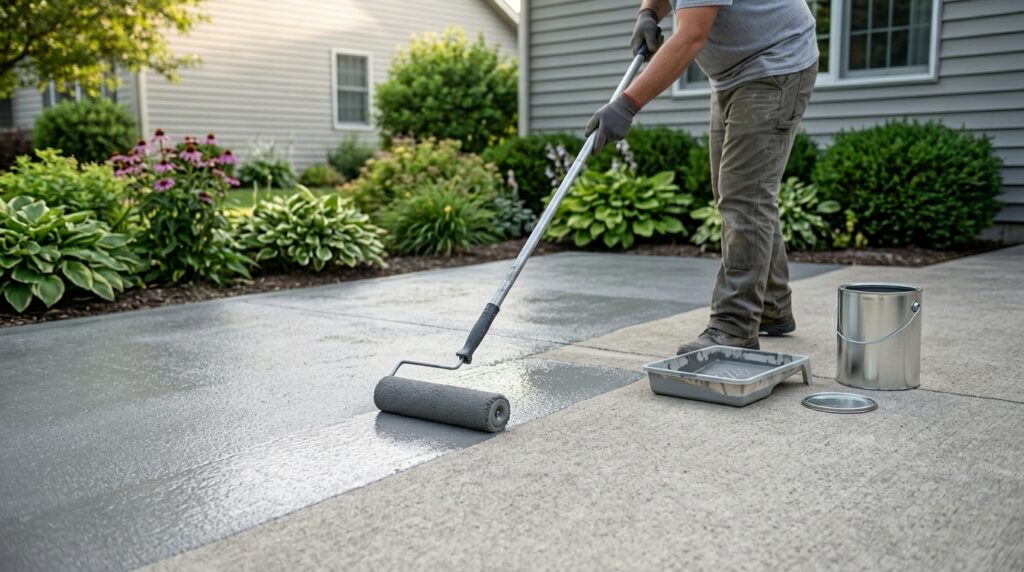
Step 5 — Apply in thin coats. Apply penetrating sealers: flood coat, allow 5–10 minutes to absorb, wipe or back-roll any puddling. Apply film-forming sealers in thin, even coats — two thin coats are always better than one thick coat. Thick coats cause solvent entrapment and bubbling.
Step 6 — Allow full cure before traffic. Penetrating sealers: foot traffic in 24 hours, vehicle traffic in 72 hours. Film-forming sealers: foot traffic in 24–48 hours, vehicle traffic in 72 hours to 7 days depending on product.
How Often Should Concrete Be Sealed?
Reapplication frequency depends on sealer type, traffic level, and climate exposure.
| Sealer Type | Low Traffic (Patio) | Medium Traffic (Driveway) | High Traffic (Commercial) |
|---|---|---|---|
| Penetrating silane-siloxane | 7–10 years | 5–7 years | 3–5 years |
| Water-based acrylic | 2–3 years | 1–2 years | Annually |
| Solvent-based acrylic | 2–3 years | 1–2 years | Annually |
| Epoxy | 8–12 years | Not recommended outdoors | 5–10 years |
| Polyurethane | 4–6 years | 3–5 years | 2–3 years |
| Polyaspartic | 7–10 years | 5–7 years | 3–5 years |
Signs that resealing is needed:
- Water no longer beads on the surface (penetrating sealers)
- Surface looks dull or faded (acrylic sealers)
- Staining appears where it previously did not
- Surface feels rough or shows wear marks (film-forming sealers)
- The plastic sheet test shows moisture under the sheet
Common Concrete Sealing Mistakes to Avoid
Mistake 1 — Sealing new concrete too early. Concrete must cure for 28 days minimum. Sealing at 7 days is the most common DIY mistake — trapped moisture whitens the sealer and prevents proper adhesion. Wait the full 28 days.
Mistake 2 — Applying too thick. One thick coat does not equal two thin coats. Over-application traps solvent, creates bubbles, and produces an uneven finish. Follow manufacturer’s specified coverage rate — typically 200–300 sq ft per gallon for film-forming sealers.
Mistake 3 — Applying in hot, direct sun. Solvent evaporates too rapidly, preventing proper film formation. The sealer dries before it can level and bond correctly. Apply in the morning or evening, or work in shaded sections.
Mistake 4 — Using epoxy outdoors. Epoxy without a UV-stable topcoat yellows within months of sun exposure. If you see an epoxy-coated outdoor concrete surface that looks yellow-orange, this is the reason. Always specify aliphatic polyurethane or polyaspartic for outdoor applications.
Mistake 5 — Not stripping old sealer before reapplication. Applying a new coat of sealer over a failing old coat seals in the problem. The new coat will fail at the same rate as the old one. Strip failing sealer with chemical stripper or mechanical grinding before any new application.
Mistake 6 — Using a penetrating sealer where hydrostatic pressure exists. Penetrating sealers repel surface water — they do not resist water being pushed through concrete under pressure from the soil side. For basement walls and below-grade applications with active water pressure, crystalline waterproofing is the correct product.
Frequently Asked Questions
What are the types of concrete sealers?
The main types are penetrating sealers (silane, siloxane, silane-siloxane blends, and silicate/lithium silicate) and film-forming sealers (acrylic, epoxy, polyurethane, and polyaspartic). Penetrating sealers work within the concrete pore structure and leave no visible film. Film-forming sealers create a protective coating on the surface that changes gloss and colour appearance.
What is the best concrete sealer for a driveway?
For most residential driveways: a penetrating silane-siloxane blend — it provides excellent freeze-thaw and chloride protection without changing the surface appearance, and lasts 5–10 years. For stamped or coloured driveways where colour enhancement is desired: solvent-based acrylic sealer reapplied every 1–2 years.
What is the difference between penetrating and film-forming sealers?
Penetrating sealers absorb into the concrete and react with the pore structure — they leave no film on the surface and do not change appearance. Film-forming sealers create a protective coating on top of the concrete — they change the surface appearance (gloss, colour enhancement) and eventually wear away requiring reapplication.
How often should concrete be sealed?
Penetrating sealers: every 5–10 years depending on traffic and exposure. Acrylic film-forming sealers: every 1–3 years. Epoxy and polyaspartic: every 5–10 years indoors. In freeze-thaw climates with deicer use, reapply penetrating sealers every 5–7 years for consistent protection.
Is epoxy sealer good for outdoor concrete?
No — standard epoxy yellows and chalks within 12–18 months of UV exposure. Epoxy is an indoor product. For outdoor concrete requiring a high-gloss film-forming sealer, use aliphatic polyurethane or polyaspartic — both are UV stable and suitable for outdoor use.
What type of concrete sealer should I use for a garage floor?
For maximum performance: a lithium silicate densifier, then a 100% solids epoxy base coat, then an aliphatic polyurethane or polyaspartic topcoat. For simpler application: a single-component polyaspartic or aliphatic polyurethane — UV stable, chemical resistant, durable, and available in one product rather than a system.
How do I know when my concrete needs resealing?
For penetrating sealers: water stops beading on the surface and starts absorbing instead. For film-forming sealers: the surface looks dull, worn, or faded; staining appears in previously protected areas; or you can see surface wear marks through the coating. Test with the plastic sheet method — tape a sheet to the surface and check for moisture condensation under it after 24 hours.
Can I apply concrete sealer myself?
Yes — most penetrating sealers and acrylic film-forming sealers are straightforward DIY applications using a pump sprayer or roller. Two-component epoxy and polyaspartic systems require more precise mixing and application timing — they are manageable for experienced DIYers but have less margin for error. The most important DIY requirement is surface preparation — cleaning and allowing full drying before application.
Conclusion
The right concrete sealer extends the life of your investment and prevents the deterioration that costs far more to repair than any sealer costs to apply. Penetrating silane-siloxane sealers are the correct choice for most exterior concrete — invisible protection that lasts a decade and requires no special application skills. Film-forming sealers add gloss and colour enhancement for decorative concrete but require regular renewal. Epoxy and polyaspartic coatings deliver the highest performance for indoor garage and commercial floors. Match the sealer type to the surface, exposure, and appearance requirements using the tables in this guide — and apply to properly prepared, fully cured concrete for results that last. For the concrete itself, calculate your project’s material requirements with the ConcreteCal free concrete calculator before any pour or surface treatment project begins.