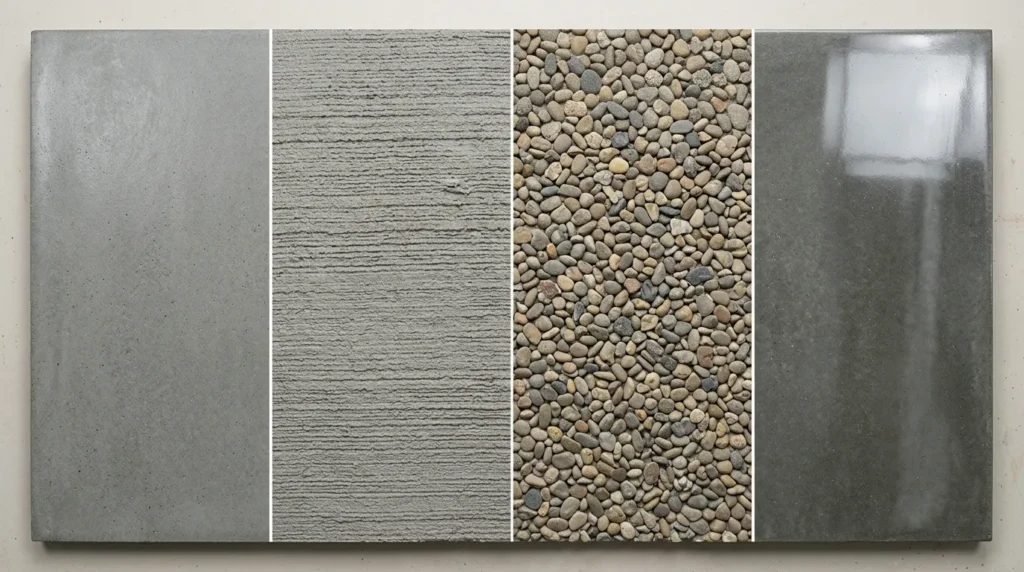

The finish on a concrete surface determines everything the eye sees and the foot feels — texture, color, sheen, slip resistance, and how well the surface holds up over years of weather, traffic, and cleaning. Pour the same concrete mix into two identical slabs and finish them differently, and you get surfaces that look and perform completely differently.
Understanding the types of concrete finishes available lets you match the surface treatment to your project’s actual requirements — functional grip for a driveway, aesthetic appeal for a patio, high reflectivity for a showroom floor, or low-maintenance durability for a warehouse. Every finish type has a cost, a skill requirement, a best application, and trade-offs.
This guide covers every major concrete finish — basic, decorative, and premium — with selection tables, worked examples, maintenance requirements, and a complete FAQ. Before calculating how much concrete your project needs, use the free concrete calculator at ConcreteCal to get accurate volume and cost estimates.
Table of Contents
- What Are Concrete Finishes and Why Do They Matter?
- Complete List of Types of Concrete Finishes
- Basic Concrete Finishes
- Decorative Types of Concrete Finishes
- Premium and Polished Concrete Finishes
- Best Concrete Finish by Application
- Indoor vs. Outdoor Concrete Finishes
- Concrete Finish Maintenance and Sealing
- How to Choose the Right Concrete Finish
- Frequently Asked Questions
What Are Concrete Finishes and Why Do They Matter?
A concrete finish is any surface treatment applied to fresh or hardened concrete — from the simplest broom drag across a wet surface to diamond-polished floors that rival polished stone. The finish is not cosmetic afterthought; it determines the surface’s functional performance and aesthetic character for the slab’s entire service life.
Functional impact:
- Slip resistance — smooth troweled surfaces can be dangerously slippery when wet; broom or textured finishes provide traction
- Abrasion resistance — burnished and hardened surfaces resist wear better than standard floated finishes
- Permeability — sealed and densified surfaces resist water and chemical penetration
- Maintenance — some finishes require annual sealing; others need minimal upkeep
Aesthetic impact:
- Color, pattern, texture, and sheen level all determined by finish choice
- The same grey concrete slab becomes a slate-look patio, a wood-grain deck, or a mirror-finish showroom floor depending entirely on finishing treatment
Functional vs. Decorative Finishes
| Category | Examples | Primary Goal |
|---|---|---|
| Functional | Broom, float, trowel | Traction, durability, economy |
| Decorative | Stamped, stenciled, exposed aggregate | Appearance, design |
| Premium | Polished, burnished, ground | High-end aesthetics + durability |
| Specialty | Salt finish, swirl, colored | Unique texture or color effect |
When the Finish Decision Must Be Made
For finishes applied to fresh concrete — broom, trowel, stamped, salt, swirl — the decision must be made before the pour. These finishes require specific timing during the concrete’s plastic (workable) stage.
For finishes applied to hardened concrete — grinding, polishing, staining, overlays — the decision can be made weeks or months after the pour. This flexibility makes post-applied decorative treatments a viable retrofit option for existing slabs.
Complete List of Types of Concrete Finishes
| Finish Type | Applied When | Skill Level | Cost Range | Best For |
|---|---|---|---|---|
| Trowel | Fresh | Low-Medium | $ | Smooth interior floors |
| Float | Fresh | Low | $ | Base finish, exterior |
| Broom | Fresh | Low | $ | Driveways, walkways |
| Swirl | Fresh | Medium | $$ | Pool decks, patios |
| Stamped | Fresh | High | $$$ | Patios, driveways |
| Stenciled | Fresh/hardened | Medium | $$ | Decorative flatwork |
| Exposed aggregate | Fresh | Medium | $$ | Driveways, paths |
| Salt finish | Fresh | Low-Medium | $ | Pool decks |
| Colored/stained | Fresh or hardened | Medium | $$ | Any application |
| Polished | Hardened | High | $$$$ | Showrooms, retail |
| Burnished | Fresh (power trowel) | High | $$$ | Warehouses, garages |
| Ground/honed | Hardened | High | $$$ | Interior floors |
Basic Concrete Finishes
Basic finishes are applied during or immediately after the concrete pour — they require minimal equipment, moderate skill, and produce functional, durable surfaces at low cost. They form the foundation of most residential and commercial flatwork.
Trowel Finish
A trowel finish uses a steel trowel — hand or power — to close and compact the concrete surface, producing a smooth, dense, slightly shiny surface. It is the standard finish for interior concrete floors and any surface requiring a smooth, cleanable base.
How it’s done: After screeding and floating, the surface is troweled with a steel trowel in overlapping circular or arc passes. Multiple trowel passes — the surface is typically troweled two to four times as the concrete stiffens — progressively close and densify the surface paste.
Power troweling uses a ride-on or walk-behind trowel machine with rotating blades — standard for large commercial and industrial floors where hand troweling is impractical.
Slip hazard note: A smooth trowel finish is slippery when wet — it should not be used as a final finish for exterior surfaces, pool surrounds, or any area that will be wet in service without an anti-slip coating or sealer with grip aggregate.
Best for: Interior garage floors, warehouse floors, basement slabs, commercial retail floors as a base for coatings or overlays.
Worked Example: A 10,000 sq ft retail store floor. Power troweled to a smooth finish as the base coat, then a hardener applied to densify the surface, followed by a semi-gloss sealer. Total finishing cost approximately $1.50–$2.00/sq ft — significantly less than polishing to the same apparent sheen.
Float Finish
A float finish uses a magnesium or wood float to level and consolidate the surface without fully closing it — leaving a slightly textured, matte surface with fine aggregate texture visible.
Result: Flat, uniformly textured surface — not as smooth as trowel, not as coarse as broom. Provides moderate slip resistance.
Best for: Base finish before decorative treatments (stamping, staining), exterior flatwork where moderate texture is acceptable, residential garage floors not requiring high polish.
Float finishing is often the intermediate step before stamping — the surface is floated, color hardener is applied and floated in, then stamps are pressed into the surface before final set.
Broom Finish
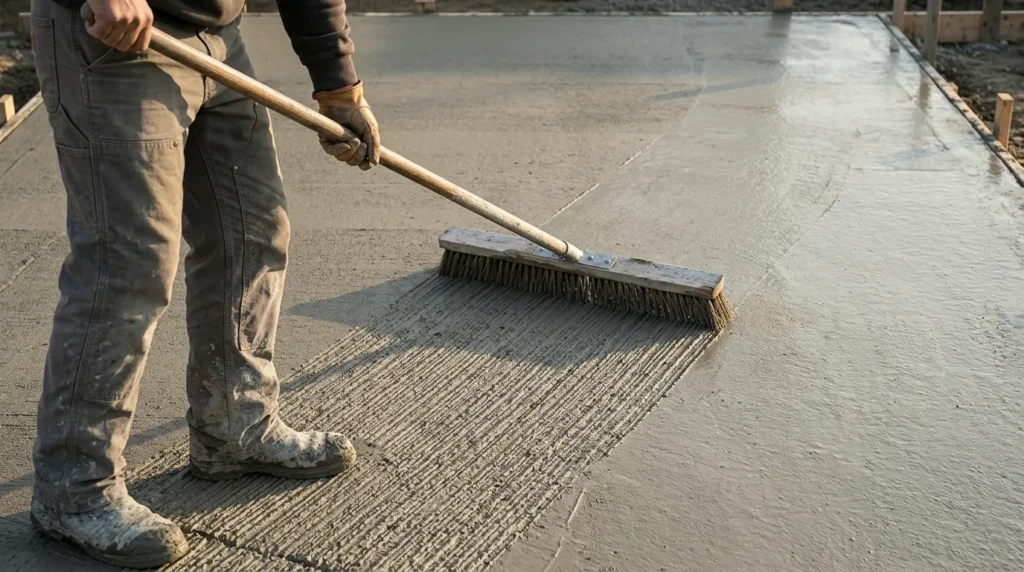
The broom finish is the most common concrete finish in residential construction — a stiff-bristled broom is dragged across the freshly floated surface, creating parallel grooves that provide traction.
Broom types and texture:
- Fine-bristle broom: Light texture — suitable for interior applications and light traffic
- Medium-bristle broom: Standard residential driveway and sidewalk texture
- Coarse-bristle broom: Deep texture — maximum traction, often used on steep driveways
Direction matters: Broom marks should run perpendicular to the direction of travel for maximum slip resistance. On a driveway, broom marks should run across the width, not along the length.
Best for: Driveways, sidewalks, public walkways, pool surrounds, any exterior surface requiring reliable wet traction.
Cost: The broom finish adds virtually no cost to a standard pour — it requires only a broom and 5 minutes of technique. It is the default residential exterior finish for this reason.
Worked Example: A 16 ft × 40 ft driveway. Concrete poured, screeded, and floated. Medium-bristle broom dragged across the 16-foot width in a single pass per strip, producing consistent parallel grooves running across the driveway. Texture depth approximately 1/16 inch — adequate for passenger vehicle traction in rain and snow without being uncomfortable underfoot.
Swirl Finish
A swirl finish creates overlapping arc patterns on the concrete surface using a float or trowel moved in circular motions. Each arc overlaps the previous, producing a consistent field of curved texture marks.
Slip resistance: Good — the overlapping arcs create multidirectional texture that resists slipping from any approach angle.
Aesthetic quality: More decorative than a straight broom finish — the pattern is intentional and visually interesting at close range.
Best for: Pool decks, patios, decorative exterior flatwork where texture and mild aesthetic interest are both desired.
Decorative Types of Concrete Finishes
Decorative finishes transform concrete from a utilitarian grey surface into a design element. They require more skill, more time, and higher cost — but produce surfaces that significantly enhance property aesthetics and value.
Stamped Concrete Finish
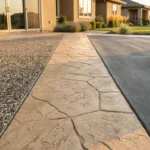
Stamped concrete is pressed with rubber or polyurethane stamps while still plastic, creating texture patterns that mimic natural stone, brick, slate, cobblestone, or wood.
For a complete breakdown of every stamped pattern type, color option, and cost range, see our dedicated guide on types of stamped concrete.
Summary specifications:
- Applied to fresh concrete during plastic stage
- Color added via integral pigment or surface color hardener
- Release agent applied to prevent stamp sticking and add secondary color
- Requires sealing after curing
- Cost: $8–$18/sq ft installed
Best for: Patios, driveways, pool decks, decorative walkways where natural stone aesthetics are desired at concrete cost.
Stenciled Concrete Finish
Stenciled concrete uses paper or plastic stencils laid on fresh concrete before the release agent is applied — creating sharp-edged pattern boundaries when the stencil is removed after stamping.
Difference from stamped: Stamping creates three-dimensional texture; stenciling creates two-dimensional pattern boundaries with color contrast. Stenciling is flatter but allows more intricate geometric patterns that stamps cannot replicate.
Best for: Decorative borders, geometric patterns, medallions, and custom designs in residential and commercial flatwork.
Cost: $4–$10/sq ft — less than stamping because the process is simpler and the materials are cheaper.
Exposed Aggregate Finish
Exposed aggregate removes the surface cement paste to reveal the decorative aggregate beneath — river rock, quartz, basalt, limestone, or custom stone blends.
Two methods:
- Surface retarder — applied immediately after pour; slows surface cement set while interior hardens. Surface is washed the next day to expose aggregate.
- Seeding — decorative aggregate broadcast on the surface after screeding and pressed in, then retarder applied and surface washed.
Aggregate options: Standard concrete aggregate (economical, variable appearance), colored quartz (consistent, bright colors), river rock (rounded, natural), basalt or granite (dark, contemporary look).
Slip resistance: Excellent — the exposed aggregate surface is inherently textured and provides outstanding wet traction.
Best for: Driveways, pool decks, garden paths, any exterior surface where traction and natural appearance are priorities.
Cost: $4–$8/sq ft for standard aggregate exposure; $6–$12/sq ft for decorative aggregate seeding.
Worked Example: A 200 sq ft pool deck. Standard river rock aggregate in the concrete mix, surface retarder spray-applied immediately after finishing. Next morning, surface washed with pressure washer at 1,500 PSI — grey cement paste washes away revealing rounded river rock aggregate. Sealed with non-slip sealer. Total cost approximately $7/sq ft — natural appearance, excellent slip resistance, no annual resealing required.
Salt Finish
The salt finish creates a pitted, lightly textured surface by pressing rock salt into fresh concrete and washing it out after curing — each salt crystal leaves a small depression.
Visual result: Random, lightly pitted surface — similar in appearance to natural stone weathered by water. Subtle at a distance; interesting texture at close range.
Slip resistance: Good — the pitting creates texture without the aggressive relief of a broom finish.
Best for: Pool decks, residential patios, any surface where a natural, subtle texture is preferred over the mechanical look of broom marks.
Cost addition: Minimal — salt is inexpensive; the main cost is the labor to press and wash.
Limitation: Not suitable for freeze-thaw climates — water trapped in the salt pits expands when frozen, causing progressive surface damage. Salt finish is a warm-climate finish.
Colored and Stained Concrete Finish
Color transforms grey concrete into virtually any tone — warm earth tones, cool greys, terracotta, slate blue, or custom blends.
Three coloring methods:
Integral color: Pigment mixed into the concrete before pouring. Color runs throughout full slab depth — most durable, cannot wear off.
Color hardener: Dry-shake pigment broadcast on fresh concrete surface and floated in. Creates stronger, more intensely colored surface than integral — standard for stamped concrete coloring.
Acid stain / concrete dye: Applied to hardened concrete. Acid stains react chemically with concrete minerals producing mottled, organic color variation. Dyes penetrate and color without chemical reaction — more uniform color, wider color range.
For projects combining color with stamped patterns, see our guide on types of stamped concrete for detailed color method comparison and cost breakdown.
Premium and Polished Concrete Finishes
Premium finishes are applied to hardened concrete using grinding and polishing equipment — they produce high-end floors used in retail, hospitality, commercial, and upscale residential applications.
Polished Concrete Finish
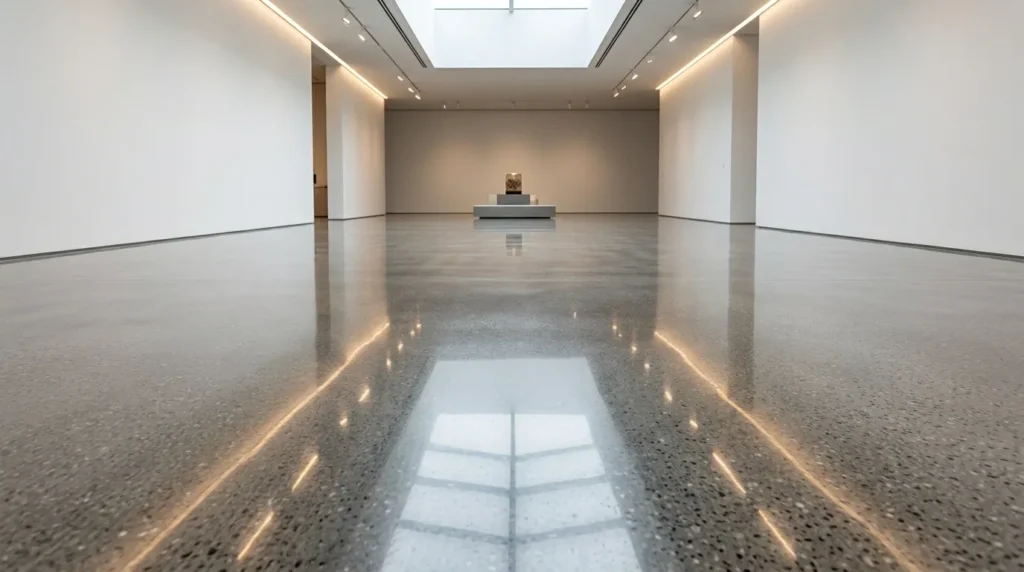
Polished concrete is ground and progressively polished using diamond-impregnated pads — starting at coarse grits (16–50) and finishing at fine grits (800–3,000+). A chemical densifier is applied mid-process to harden the surface and fill pores.
Gloss levels:
| Level | Grit Range | Appearance | Best For |
|---|---|---|---|
| Cream polish | 400 | Matte, subtle sheen | Industrial, utilitarian |
| Salt and pepper | 400–800 | Low gloss, aggregate visible | Commercial, modern aesthetic |
| Medium polish | 800–1,500 | Medium gloss, reflective | Retail, office |
| High polish | 1,500–3,000+ | Mirror-like reflectivity | Showrooms, luxury retail |
Advantages over other finishes:
- No coatings or sealers required (densified surface is the finish)
- Extremely durable — does not peel, chip, or require recoating
- Reflective surface reduces lighting requirements
- Low maintenance — damp mop cleaning only
Cost: $3–$8/sq ft for basic polish; $8–$15/sq ft for high-gloss mirror finish. Higher than coatings initially but lower lifetime cost due to no recoating requirement.
For a complete guide to polished floor types, gloss levels, and aggregate exposure levels, see our dedicated section on types of reinforced concrete floors which covers structural specifications for floors that will be polished.
According to the Concrete Polishing Association of America (CPAA), polished concrete is now the fastest-growing commercial flooring category in the US — driven by its combination of durability, aesthetics, and sustainability compared to carpet, vinyl, and tile.
Burnished Concrete Finish
Burnishing is achieved through aggressive power troweling — multiple passes with a high-speed power trowel at progressively tighter blade angles compresses and densifies the surface paste to a smooth, slightly shiny finish without grinding.
Difference from polished: Burnishing is a fresh-concrete process (power trowel on plastic concrete); polishing is a post-cure grinding process. Burnishing produces a lower sheen than full diamond polishing but at significantly lower cost.
Best for: Large commercial and industrial floors — warehouses, distribution centers, manufacturing facilities — where a hard, smooth, dust-free surface is required at lower cost than full polishing.
Cost: $0.50–$1.50/sq ft additional over standard trowel finish — extremely cost-effective for large areas.
Ground and Honed Finish
Grinding removes the surface layer of concrete to expose a specific level of aggregate — cream (no aggregate), fine aggregate (sand visible), medium aggregate (small stone visible), or coarse aggregate (full stone exposure).
Honing stops short of full polishing — typically at 400–800 grit — producing a flat, matte surface with aggregate exposure but without the reflective sheen of full polish.
Best for: Renovating existing slabs (grinding removes surface defects, stains, and old coatings), achieving specific aggregate exposure levels for design intent, preparing surfaces for overlays or coatings.
Best Concrete Finish by Application
Driveways
| Finish | Traction | Durability | Cost | Verdict |
|---|---|---|---|---|
| Broom | ✅ Excellent | ✅ High | $ | Best overall choice |
| Exposed aggregate | ✅ Excellent | ✅ High | $$ | Premium option |
| Stamped | ⚠️ Variable | ✅ High | $$$ | Aesthetic upgrade |
| Trowel | ❌ Slippery | ✅ High | $ | Not recommended |
Recommendation: Broom finish for function and economy; exposed aggregate for premium appearance with superior traction; stamped for maximum curb appeal with annual sealing commitment.
Patios
Patios prioritize aesthetics over pure function — the full range of decorative finishes is viable.
Best choices: Stamped (widest design range), exposed aggregate (natural look, no sealing required), salt finish (warm climates only), stained or colored over broom base (economical color addition).
Avoid: Plain trowel finish — slippery when wet and unattractive for a social outdoor space.
Pool Decks
Pool decks have a non-negotiable requirement: wet slip resistance. Every finish choice must be evaluated against this requirement first.
| Finish | Wet Traction | Heat Reflection | Maintenance |
|---|---|---|---|
| Broom | ✅ Excellent | ⚠️ Medium | Low |
| Exposed aggregate | ✅ Excellent | ✅ Good (light agg) | Low |
| Swirl | ✅ Good | ⚠️ Medium | Low |
| Salt finish | ✅ Good | ✅ Good | Low-Medium |
| Stamped (textured) | ✅ Good | ✅ Good (light color) | Medium (resealing) |
| Trowel/polished | ❌ Poor | ❌ Hot (dark) | Low |
Recommendation: Exposed aggregate or broom for maximum safety; stamped with light color and texture for aesthetics combined with safety; never smooth trowel or high-gloss finishes near water.
Garage Floors and Warehouses
Interior floors prioritize durability, dust control, and cleanability — not slip resistance (dry environment) or complex aesthetics.
Best choices:
- Burnished trowel: Economical, hard, dust-free — standard for warehouses
- Polished: Premium option — reflective surface reduces lighting cost, eliminates dust
- Epoxy coating over trowel: Chemical resistance, color options, moderate cost
Avoid: Decorative outdoor finishes (broom, exposed aggregate) — excessive texture collects dirt and is difficult to clean with floor equipment.
Interior Showrooms and Retail Floors
Showroom floors are design statements — they need to look exceptional while performing under daily foot traffic and retail cart loads.
Best choices:
- High-polish polished concrete: Mirror finish, reflective, requires no coatings
- Ground and stained: Aggregate exposure + color for designed aesthetic
- Burnished + sealer: Budget alternative to full polish with similar visual effect
Worked Example: A 5,000 sq ft furniture showroom. Existing concrete slab, 4 inches thick, 3,500 PSI. Ground to salt-and-pepper aggregate exposure (400 grit), densifier applied, polished to 1,500 grit, sealed with semi-gloss guard coat. Final surface: medium gloss, aggregate visible, highly reflective. Total cost: $6.50/sq ft — versus $12/sq ft for large-format porcelain tile with equivalent visual quality.
Indoor vs. Outdoor Concrete Finishes — Key Differences
| Factor | Indoor | Outdoor |
|---|---|---|
| Slip resistance priority | Lower (dry environment) | High (rain, wet) |
| Weather exposure | None | Full sun, rain, freeze-thaw |
| Finish options | All — including smooth | Textured finishes preferred |
| Sealer type | Interior grade | UV-stable exterior grade |
| Maintenance frequency | Lower | Higher (UV degradation) |
| Color stability | High (no UV) | UV fading risk without UV sealer |
The most critical difference is UV exposure. Interior finishes — sealers, dyes, and stains — are not formulated for UV stability. Using an interior sealer on an exterior surface produces rapid color fade, sealer yellowing, and surface degradation within one to two years. Always specify UV-stable exterior-grade sealers for any outdoor application.
Concrete Finish Maintenance and Sealing
| Finish Type | Sealing Required | Frequency | Maintenance Level |
|---|---|---|---|
| Broom | Optional (recommended) | Every 3–5 years | Low |
| Trowel (interior) | Recommended | Every 2–3 years | Low |
| Stamped | Required | Every 1–3 years | Medium |
| Exposed aggregate | Recommended | Every 3–5 years | Low |
| Salt finish | Recommended | Every 2–3 years | Low-Medium |
| Polished | Not required | N/A | Very Low (damp mop) |
| Burnished | Optional | Every 3–5 years | Low |
| Stained | Required | Every 1–3 years | Medium |
Sealer types:
Penetrating sealers (silane, siloxane): Soak into the concrete, line pore walls, repel water without changing surface appearance. Best for exterior flatwork — driveways, walkways, pool decks.
Film-forming sealers (acrylic, epoxy, polyurethane): Create a coating on the surface — provide gloss, enhance color, protect against stains. Require reapplication when worn. Best for stamped and colored interior floors.
Densifiers (sodium, potassium, or lithium silicate): React with calcium hydroxide in concrete to form calcium silicate hydrate — filling pores and hardening the surface permanently. Used as part of the polishing process and as standalone surface hardeners for warehouse floors.
How to Choose the Right Concrete Finish
Three questions narrow the decision:
1. Interior or exterior? Exterior → traction is priority → broom, exposed aggregate, textured stamped Interior → aesthetics and cleanability → trowel, polished, burnished
2. Budget? Low → broom or trowel finish Medium → exposed aggregate, stained, salt finish High → stamped, polished, ground and honed
3. Maintenance commitment? Low maintenance → polished (no recoating), exposed aggregate, broom Medium maintenance → stamped (reseal every 1–3 years), stained High maintenance tolerance → acid stained with annual wax, high-gloss coatings
Final Selection Framework
| Priority | Recommended Finish |
|---|---|
| Maximum traction | Coarse broom or exposed aggregate |
| Maximum aesthetics | Stamped or high-polish polished |
| Maximum durability | Polished with densifier |
| Minimum cost | Broom finish |
| Minimum maintenance | Polished concrete |
| Natural appearance | Exposed aggregate or salt finish |
| Custom color | Integral colored + stained |
| Interior commercial | Burnished or polished |
Frequently Asked Questions About Concrete Finishes
What are the types of concrete finishes?
The main types are trowel finish (smooth), float finish (slightly textured base), broom finish (parallel grooves for traction), swirl finish (arc texture), stamped (pattern impression), stenciled (two-dimensional pattern), exposed aggregate (stone surface), salt finish (pitted texture), colored/stained (color treatment), polished (diamond-ground mirror finish), burnished (power-troweled dense finish), and ground/honed (aggregate exposure without full polish).
What is the best concrete finish for a patio?
For appearance: stamped concrete offers the widest design range. For low maintenance with natural look: exposed aggregate. For budget with functionality: broom finish with integral color. The best choice depends on your aesthetic goal, climate, and maintenance commitment. In freeze-thaw climates, avoid salt finish and specify air-entrained concrete for any decorative finish.
What are the types of polished concrete floors?
Polished concrete floors range from cream polish (matte, no aggregate visible), salt-and-pepper (low gloss, fine aggregate visible), medium polish (reflective, mixed aggregate), to high-gloss mirror finish (maximum reflectivity, full aggregate exposure). The level is determined by the starting grit and finishing grit used in the diamond polishing process.
What is the difference between a broom finish and exposed aggregate?
A broom finish drags a brush across fresh concrete to create parallel grooves — the aggregate remains embedded in the surface. Exposed aggregate removes the surface paste to reveal the stone below — producing a textured surface with visible aggregate. Both provide excellent slip resistance; exposed aggregate provides a more natural, decorative appearance at higher cost.
How long does a concrete finish last?
The concrete itself lasts 25–50+ years. The finish treatment varies: polished concrete (permanent, no recoating), exposed aggregate (permanent surface, optional sealer), broom (permanent texture, optional sealer), stamped (permanent pattern, sealer renewal every 1–3 years), stained (permanent color if sealed, sealer renewal required), coatings (epoxy, polyurethane — 3–10 years before recoating).
What is the most durable concrete finish?
Polished concrete with densifier is the most durable finish — the chemical densification permanently hardens the surface, and the finish requires no coatings that can peel, chip, or wear off. Burnished trowel finish is a close second for large-area commercial applications where full polishing is cost-prohibitive.
Can concrete finish be changed after pouring?
Yes — hardened concrete can be ground, polished, stained, coated, or overlaid after curing. Grinding removes the existing surface to a new profile; overlays apply a thin bonded concrete topping for new texture or color. Fresh-concrete finishes (broom, stamp, trowel) cannot be changed after hardening without grinding.
What concrete finish is best for a pool deck?
Exposed aggregate and broom finish provide the best wet slip resistance for pool decks. Stamped concrete with moderate texture and light color is a premium aesthetic option that also provides adequate traction. Avoid smooth trowel or high-gloss polished finishes near water — they are dangerously slippery when wet.
Conclusion
Every concrete surface needs a finish decision — and the decision made at the pour determines how the surface looks, performs, and ages for decades. Broom and trowel finishes cost almost nothing extra and deliver reliable function. Decorative finishes — stamped, exposed aggregate, stained — add significant aesthetic value at moderate to high cost. Premium polished and burnished finishes deliver the highest long-term performance at higher upfront cost but lower lifetime maintenance expense. Match the finish to the application, the climate, the budget, and the maintenance commitment — and calculate your concrete volumes accurately before ordering with the ConcreteCal free concrete calculator