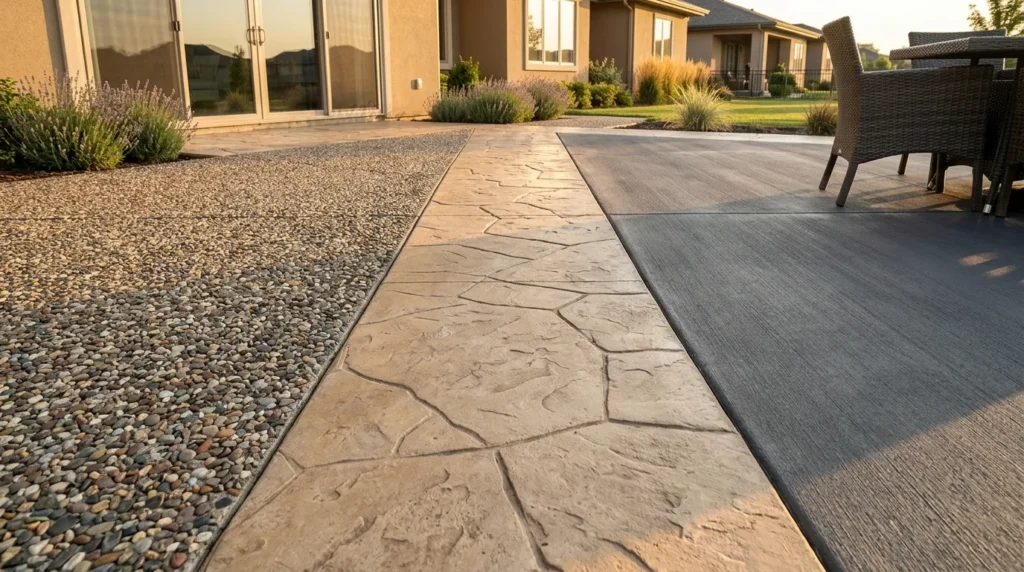

A concrete patio is one of the highest-return outdoor investments a homeowner can make — durable, low-maintenance, and completely customizable in appearance. But the finish is what determines whether your patio looks like a plain grey slab or a natural stone terrace. Choose the wrong finish for your climate, your usage, or your maintenance tolerance, and you’ll be resealing, repairing, or regretting within a few years.
The types of concrete finishes for patios range from a simple broom drag that costs almost nothing extra, to stamped and stained surfaces that rival the appearance of natural stone at half the price. Each option has different weather performance, aesthetic potential, maintenance requirements, and installed cost.
This guide covers every viable patio finish option with a complete cost breakdown, climate guidance, and a selection framework that matches finish to homeowner — not just to aesthetics.
Before calculating how much concrete your patio requires, use the free concrete calculator at ConcreteCalc to get accurate volume, bag count, and cost estimates for your specific dimensions.
Table of Contents
- Why Patio Concrete Finishes Are Different
- Types of Concrete Finishes for Patios — Overview
- Broom Finish Patio
- Stamped Concrete Patio Finish
- Exposed Aggregate Patio Finish
- Stained and Colored Concrete Patio Finish
- Salt Finish Patio — and When to Avoid It
- Swirl and Travertine Finish for Patios
- Patio Finish Comparison Table
- Patio Concrete Finish Cost Breakdown
- How to Choose the Best Finish for Your Patio
- Sealing and Maintaining Your Patio Finish
- Frequently Asked Questions
Why Patio Concrete Finishes Are Different from Other Applications
A patio finish faces challenges that interior floors and driveways don’t — or not in the same combination.
Full weather exposure: Rain, UV radiation, freeze-thaw cycling, and temperature extremes all act on the patio surface year-round. A finish that performs perfectly indoors can fail outdoors within two winters.
Barefoot and furniture use: Unlike a driveway (shoes only, no sitting), patios are used barefoot, with outdoor furniture dragging across the surface, and often adjacent to water features or pools. Texture comfort underfoot matters in a way it doesn’t for a utility surface.
Visibility and aesthetics: A patio is an outdoor living space — it’s seen from inside the home, from the garden, and by guests. Appearance matters more here than for a driveway or sidewalk.
Outdoor Exposure Challenges
| Challenge | Impact on Finish | Mitigation |
|---|---|---|
| UV radiation | Color fade, sealer yellowing | UV-stable sealer, integral color |
| Freeze-thaw | Surface scaling, spalling | Air-entrained concrete, penetrating sealer |
| Rain/moisture | Algae, staining, efflorescence | Penetrating sealer, slope for drainage |
| Thermal movement | Cracking | Control joints at correct spacing |
| Furniture abrasion | Surface wear, scuffing | Hard finish, protective pads |
Aesthetic Priority vs. Function Priority
Most patio owners want both — a surface that looks great and performs reliably. The finishes that score highest on both criteria are exposed aggregate (natural look + excellent traction) and stamped concrete (decorative appearance + adequate traction with correct texture). Plain broom finish scores highest on function alone; high-polish finishes score highest on aesthetics but lowest on outdoor safety.
Types of Concrete Finishes for Patios — Complete Overview
| Finish | Appearance | Traction | Weather | Maintenance | Cost/sq ft |
|---|---|---|---|---|---|
| Broom | Functional grey | ✅ Excellent | ✅ Excellent | Low | $4–$7 |
| Stamped | Decorative stone/brick | ✅ Good | ✅ Good | Medium | $8–$18 |
| Exposed aggregate | Natural stone | ✅ Excellent | ✅ Excellent | Low | $5–$10 |
| Acid stained | Organic color variation | ⚠️ Moderate | ⚠️ Needs sealer | Medium | $6–$12 |
| Integral colored | Consistent color | ✅ Good | ✅ Good | Low-Medium | $5–$9 |
| Salt finish | Subtle pitted texture | ✅ Good | ❌ Poor (cold) | Low-Medium | $4–$7 |
| Swirl/travertine | Decorative texture | ✅ Good | ✅ Good | Low | $5–$8 |
| Polished | High gloss | ❌ Poor (wet) | ❌ Poor | Low | $8–$15 |
Polished finish included for completeness — not recommended for exterior patios due to wet slip risk.
Broom Finish Patio — Simple, Durable, Affordable
The broom finish is the default choice for residential patios when budget is the primary constraint. A stiff-bristled broom dragged across fresh concrete creates parallel grooves — reliable traction in rain, zero maintenance beyond optional sealing, and a service life matching the slab itself.
Plain broom finish is not exciting — but it is honest, functional, and completely appropriate for utility patios, covered outdoor spaces, and any project where the budget belongs in the structure rather than the surface.
Broom Finish Variations for Patios
Light broom: Fine-bristle broom producing subtle texture — visually cleaner than heavy broom, adequate traction for covered patios with limited rain exposure.
Medium broom: Standard residential texture — the correct choice for most open patios exposed to rain.
Heavy broom: Deep grooves — maximum traction for steep or sloped patio areas, or any area adjacent to a pool or water feature.
Diagonal broom: Broom applied at 45° to the slab edge — creates a herringbone-like visual effect that is more interesting than straight parallel marks without any additional cost.
Adding Color to a Broom Finish Patio
A broom finish doesn’t have to be grey. Integral pigment mixed into the concrete batch adds consistent color throughout the slab at approximately $0.50–$1.50/sq ft additional cost — transforming a plain broom finish into a warm buff, terracotta, or charcoal surface that coordinates with the home’s exterior.
Worked Example: A 12 ft × 16 ft covered patio (192 sq ft). Standard 4-inch slab with integral terracotta pigment and medium broom finish. Total installed cost approximately $5.50/sq ft = $1,056. For a covered space primarily used for seating, this is a completely appropriate finish — the color adds visual warmth without the maintenance commitment of stamped or stained finishes.
Stamped Concrete Patio Finish
Stamped concrete is the most popular decorative patio finish — rubber or polyurethane stamps pressed into fresh concrete create texture patterns mimicking natural stone, brick, slate, cobblestone, or wood, while color hardener and antiquing release add realistic color depth.
For a complete guide to every stamp pattern, color method, and cost range, see our detailed post on types of stamped concrete.
According to the American Society of Concrete Contractors (ASCC), stamped concrete remains the most requested decorative finish in residential outdoor construction — driven by its combination of design flexibility and lower cost versus natural stone.
Best Stamp Patterns for Patios
Ashlar slate: Clean rectangular stone pattern — suits modern and transitional home styles. Most popular overall.
Random flagstone: Irregular organic stone shapes — natural, relaxed aesthetic that suits garden settings and traditional homes.
Cobblestone: Rounded stone pattern — warm, European aesthetic suitable for traditional and cottage-style homes.
Wood plank: Timber-grain texture — particularly effective for covered patios adjacent to wood-framed structures, creating visual continuity.
Travertine: Irregular pitted surface mimicking travertine stone — popular for Mediterranean and Florida-style homes.
Stamped Patio Cost and Maintenance
| Complexity Level | Description | Cost Per Sq Ft |
|---|---|---|
| Basic | Single pattern, one color | $8–$10 |
| Intermediate | Border + field, two colors | $10–$14 |
| Complex | Multiple patterns, custom color | $14–$18 |
| Premium | Hand detailing, artistic | $18–$25+ |
Maintenance reality: Stamped concrete requires resealing every 1–3 years depending on sun exposure and traffic. Skipping resealing causes color fade and surface vulnerability. Budget $0.50–$1.50/sq ft for resealing every 2 years — on a 300 sq ft patio, that’s $150–$450 per resealing cycle.
Worked Example: A 20 ft × 15 ft (300 sq ft) patio. Intermediate stamped finish — ashlar slate pattern, color hardener in warm grey, charcoal antiquing release. Installed cost: $11/sq ft = $3,300. Resealing every 2 years at $300/treatment. Over 10 years: $3,300 + $1,500 sealing = $4,800 total — versus natural flagstone at $18–$30/sq ft installed ($5,400–$9,000) with similar maintenance.
Exposed Aggregate Patio Finish
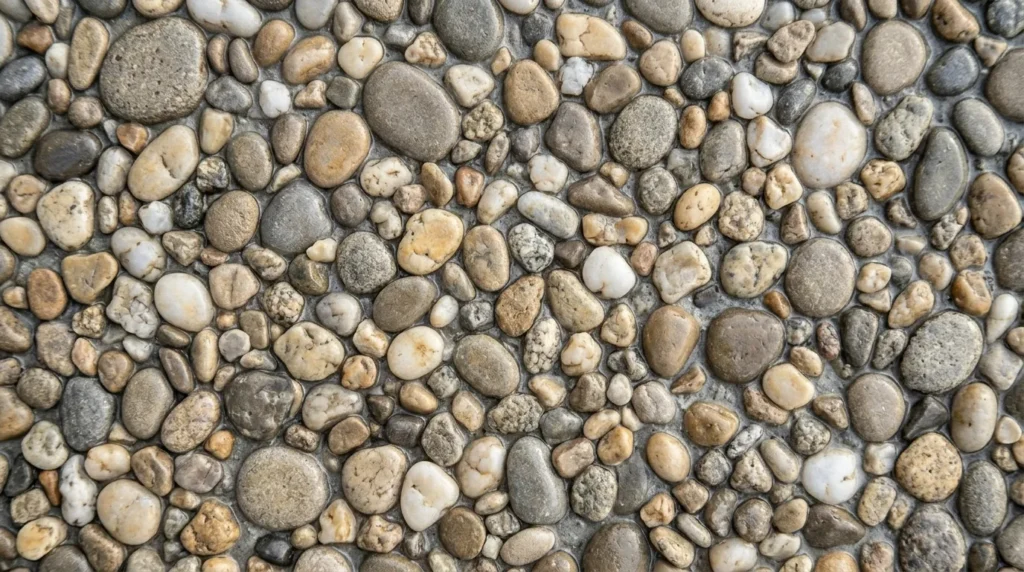
Exposed aggregate is the finish that consistently delivers the best combination of natural aesthetics, durability, and low maintenance for residential patios. The surface paste is removed to reveal the decorative aggregate beneath — creating a texture that is permanently slip-resistant, visually natural, and requires minimal upkeep.
Aggregate Options for Patios
Standard concrete aggregate (washed and exposed): River gravel or crushed stone from the mix — economical, appearance varies with local aggregate supply.
Colored quartz: Uniform, bright color — consistent appearance across the slab. Available in white, gold, black, red, and blended mixes.
River rock: Rounded, smooth river pebbles — natural organic appearance, comfortable underfoot despite textured surface.
Basalt or granite chips: Dark, contemporary aggregate — suits modern home styles with charcoal or dark grey color palette.
Tumbled glass: Smooth, colored glass aggregate — unique decorative effect for feature areas and pool surrounds.
Why Exposed Aggregate Suits Patio Use
Exposed aggregate is particularly well-suited to patios because:
- Permanent texture: The aggregate surface is not a coating — it cannot peel, fade, or wear off. The surface looks the same in year 1 and year 20.
- No resealing required: Optional sealer improves appearance but is not structurally necessary — unlike stamped or stained finishes.
- Comfortable barefoot: River rock and rounded aggregate creates a textured surface that is firm but not harsh underfoot.
- Natural integration: The organic appearance of exposed stone integrates naturally with garden plantings, wood furniture, and natural surroundings.
Cost: $5–$10/sq ft for standard aggregate exposure; $7–$14/sq ft for decorative seeded aggregate (premium stone types).
Stained and Colored Concrete Patio Finish
Color transforms a grey patio into a surface that coordinates with the home’s exterior, landscaping, and outdoor furniture. Three coloring methods suit patio applications differently.
Acid Stain vs. Water-Based Stain
Acid stain reacts chemically with minerals in the concrete — producing organic, mottled color variation that looks genuinely natural. No two acid-stained surfaces look identical. Colors are limited to earth tones (brown, tan, terracotta, blue-green, black) but the variation within those tones is rich and complex.
Water-based stain/dye penetrates without chemical reaction — wider color range including bright colors, more uniform application, easier for DIY. Less depth and variation than acid stain.
For patios: Acid stain suits natural, organic aesthetics; water-based dye suits contemporary or bold color schemes.
Maintenance: Both require sealing — UV-stable exterior sealer applied every 2–3 years. Without sealing, stained surfaces fade and become porous.
Integral Color for Patios
Integral color — iron oxide pigment mixed into the concrete before pouring — is the most durable coloring method. Color runs through the full slab depth; surface wear never exposes uncolored concrete.
Best for: Patios where color is desired with minimal long-term maintenance. Combine with broom or exposed aggregate finish for a colored functional surface without the resealing commitment of stamped or stained finishes.
Color range: Earth tones, warm greys, charcoal, buff, terracotta — similar range to acid stain but with consistent tone rather than organic variation.
Salt Finish Patio — and When to Avoid It
The salt finish creates small pitted depressions by pressing rock salt into fresh concrete then washing it out after curing. The result is a subtly textured surface that resembles natural weathered stone — organic and interesting at close range.
When it works well: Warm climates (Southwest US, Florida, coastal regions) with minimal freeze-thaw exposure. Salt finish patios in warm climates are attractive, low-cost, and require minimal maintenance beyond occasional sealing.
When to avoid it: Any climate with regular freezing temperatures. Water trapped in the salt pits freezes, expands, and progressively damages the surface — accelerating spalling and surface deterioration. In freeze-thaw climates, salt finish patios begin showing damage within 2–5 winters.
Climate rule: Salt finish → only in USDA hardiness zones 8 and above (average winter minimum above 10°F).
Swirl and Travertine Finish for Patios
Swirl Finish
A swirl finish applies overlapping arc patterns using a float or trowel in circular motions — creating multidirectional texture that provides traction from any approach angle.
Patio advantage: The swirl pattern is more visually interesting than straight broom marks while providing equivalent or better slip resistance. It suits circular or informal patio layouts where the organic pattern complements the design.
Cost addition: Minimal — swirl finishing requires the same time as broom finishing with slightly more skill.
Travertine Finish
A travertine finish mimics the pitted, irregular surface of natural travertine limestone — achieved using a sea sponge or specialized roller on fresh concrete, or through a specific stamping pattern. The result is a warm, Mediterranean aesthetic particularly popular in Florida and southwestern US residential design.
Best for: Pool-adjacent patios, Mediterranean and Spanish-style homes, any outdoor space where a warm, resort-like aesthetic is the design intent.
Patio Finish Comparison Table
| Finish | Aesthetics | Traction | Durability | Maintenance | Installed Cost | Best Climate |
|---|---|---|---|---|---|---|
| Broom | ⭐⭐ | ⭐⭐⭐⭐⭐ | ⭐⭐⭐⭐⭐ | ⭐⭐⭐⭐⭐ | $4–$7 | All |
| Stamped | ⭐⭐⭐⭐⭐ | ⭐⭐⭐⭐ | ⭐⭐⭐⭐ | ⭐⭐⭐ | $8–$18 | All |
| Exposed aggregate | ⭐⭐⭐⭐ | ⭐⭐⭐⭐⭐ | ⭐⭐⭐⭐⭐ | ⭐⭐⭐⭐⭐ | $5–$10 | All |
| Acid stained | ⭐⭐⭐⭐ | ⭐⭐⭐ | ⭐⭐⭐ | ⭐⭐⭐ | $6–$12 | All (sealed) |
| Integral colored | ⭐⭐⭐ | ⭐⭐⭐⭐ | ⭐⭐⭐⭐⭐ | ⭐⭐⭐⭐⭐ | $5–$9 | All |
| Salt finish | ⭐⭐⭐ | ⭐⭐⭐⭐ | ⭐⭐ | ⭐⭐⭐⭐ | $4–$7 | Warm only |
| Swirl | ⭐⭐⭐ | ⭐⭐⭐⭐⭐ | ⭐⭐⭐⭐⭐ | ⭐⭐⭐⭐⭐ | $4–$8 | All |
Patio Concrete Finish Cost Breakdown
Project basis: 300 sq ft patio (15 ft × 20 ft), 4-inch slab
| Finish Type | Concrete Cost | Finish Premium | Labor | Total Installed |
|---|---|---|---|---|
| Plain broom | $600–$900 | $0 | $600–$900 | $1,200–$1,800 |
| Colored broom | $600–$900 | $150–$300 | $600–$900 | $1,350–$2,100 |
| Exposed aggregate | $600–$900 | $300–$600 | $700–$1,000 | $1,600–$2,500 |
| Stamped (basic) | $600–$900 | $600–$900 | $900–$1,500 | $2,100–$3,300 |
| Stamped (premium) | $600–$900 | $900–$1,500 | $1,200–$2,000 | $2,700–$4,400 |
| Acid stained | $600–$900 | $400–$700 | $700–$1,000 | $1,700–$2,600 |
Concrete cost based on $160/yd³ ready-mix. Labor rates vary by region — use these as planning estimates.
How to Choose the Best Finish for Your Patio
Climate Considerations
Freeze-thaw climate (northern US, Canada):
- Use air-entrained concrete (4–7% air) — non-negotiable for outdoor concrete in freeze-thaw zones
- Avoid salt finish entirely
- Specify UV-stable exterior sealer for any decorative finish
- Best choices: exposed aggregate, stamped (with quality sealer), broom with integral color
Hot/dry climate (Southwest US):
- UV sealer is critical — intense sun degrades sealers faster
- Salt finish is viable
- All finish types perform well — wider selection available
- Best choices: stamped, exposed aggregate, salt, acid stained
Coastal/humid climate:
- Moisture and algae management — penetrating sealer important
- Salt air increases corrosion risk (less relevant for non-reinforced patio slab)
- All textured finishes perform well — smooth finishes become slippery with algae growth
- Best choices: exposed aggregate, broom, stamped
Maintenance Commitment
Low maintenance: Exposed aggregate, broom, integral colored, swirl — these finishes require sealing only occasionally (every 3–5 years) or not at all.
Medium maintenance: Stamped, acid stained — resealing every 1–3 years is required to maintain appearance and surface protection.
High maintenance: Coatings, waxed floors — not typically used on outdoor patios.
Budget Range
Under $2,000 (300 sq ft): Broom finish with or without integral color. Functional, durable, appropriate for utility patios.
$2,000–$3,000: Exposed aggregate or acid stained broom base. Natural appearance, low maintenance upgrade.
$3,000–$5,000: Basic to intermediate stamped concrete. Decorative stone or brick aesthetic.
$5,000+: Premium stamped, custom patterns, multiple colors. Showpiece outdoor living space.
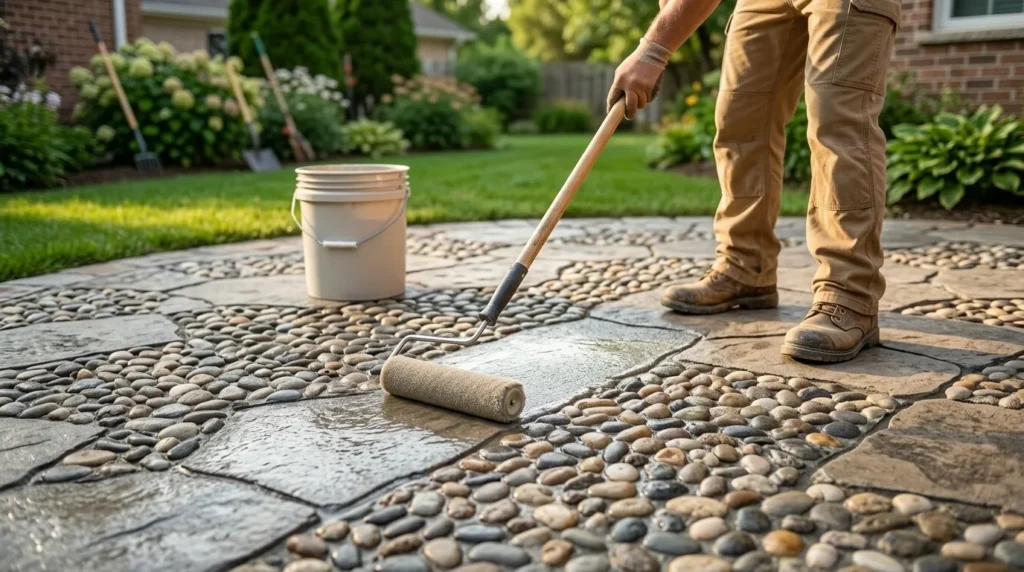
Sealing and Maintaining Your Patio Finish
| Finish | Sealer Type | First Seal | Reseal Frequency |
|---|---|---|---|
| Broom | Penetrating silane/siloxane | After 28-day cure | Every 3–5 years |
| Stamped | Acrylic or polyurethane film | After 28-day cure | Every 1–3 years |
| Exposed aggregate | Penetrating or acrylic | After 28-day cure | Every 3–5 years |
| Acid stained | Acrylic or epoxy | After stain application | Every 2–3 years |
| Integral colored | Penetrating | After 28-day cure | Every 3–5 years |
| Salt finish | Penetrating | After 28-day cure | Every 2–3 years |
Sealer application tips:
- Never seal new concrete before 28-day cure — trapped moisture reduces sealer adhesion
- Clean surface thoroughly before resealing — pressure wash and allow to dry completely
- Apply sealer in thin coats — thick application traps moisture and causes whitening
- Use UV-stable exterior grade sealer for all patio applications — interior sealers yellow rapidly outdoors
Frequently Asked Questions
What are the best types of concrete finishes for patios?
The best overall choices are exposed aggregate (natural appearance, excellent traction, minimal maintenance), stamped concrete (decorative stone or brick look, wide design range), and broom finish with integral color (economical, durable, functional). The right choice depends on budget, climate, and maintenance commitment.
What concrete finish is most durable for a patio?
Exposed aggregate and broom finish are the most durable — both are permanent surface treatments that cannot peel or wear off. Integral colored concrete with broom finish is equally durable. Stamped concrete is equally durable structurally but the sealer coating requires renewal. Stained finishes depend on sealer maintenance for long-term durability.
Can I change my concrete patio finish after it’s already poured?
Yes — hardened concrete can be ground, stained, overlaid, or coated after curing. Grinding removes the surface layer and can expose aggregate or prepare for staining. Micro-topping overlays apply a thin decorative layer over existing concrete. Fresh-concrete finishes (broom, stamp) cannot be applied after hardening without grinding the surface first.
How much does it cost to finish a concrete patio?
A plain broom finish patio costs $4–$7/sq ft installed. Exposed aggregate runs $5–$10/sq ft. Stamped concrete is $8–$18/sq ft depending on pattern complexity and color. Acid stained is $6–$12/sq ft. On a typical 300 sq ft patio, total installed cost ranges from $1,200 for plain broom to $5,400 for premium stamped.
Is stamped concrete a good choice for patios?
Yes — stamped concrete is one of the most popular patio finishes precisely because it delivers natural stone or brick aesthetics at half the cost of real stone. The trade-off is resealing every 1–3 years to maintain color and surface protection. In freeze-thaw climates, high-quality sealer and air-entrained concrete are essential for stamped patio longevity.
What patio finish is best for cold climates?
For freeze-thaw climates, specify air-entrained concrete (4–7%) for any patio finish. Best performing finishes in cold climates: exposed aggregate (no sealer required, naturally textured), broom with penetrating sealer (excellent freeze-thaw resistance), and stamped with high-quality penetrating base sealer. Avoid salt finish in freeze-thaw climates.
How long does a concrete patio finish last?
The concrete slab lasts 25–50+ years. The finish durability varies: exposed aggregate and broom — permanent (matching slab life); stamped — permanent texture, sealer renewal every 1–3 years; acid stain — permanent color if sealed, sealer renewal every 2–3 years; overlays and coatings — 5–15 years before recoating needed.
Does a concrete patio need to be sealed?
Sealing is recommended but not always required. Unsealed exposed aggregate and broom finish patios will perform structurally without sealing but will absorb stains more readily and show weather effects sooner. Stamped and stained patios require sealing — without it, color fades and the surface becomes porous. Penetrating sealers are the lowest-maintenance option for most patio applications.
Conclusion
A patio finish is a 25-year decision — make it based on your climate, your maintenance tolerance, and your aesthetic priorities, not just what looks good in photos. Exposed aggregate delivers the best combination of natural aesthetics, permanent durability, and minimal upkeep for most homeowners. Stamped concrete delivers the highest design impact at the cost of regular resealing. Broom with integral color gives you a reliable, good-looking patio at the lowest budget. Calculate your concrete volume before the pour with the ConcreteCal free concrete calculator — and match your finish choice to your actual priorities.