
Polished concrete is the fastest-growing commercial flooring category in the world — and it’s increasingly common in upscale residential interiors. The appeal is straightforward: a floor that gets harder and more reflective with grinding rather than softer and more damaged, requires no coatings that peel or need reapplication, and can last the lifetime of the building with simple damp-mop maintenance.
But “polished concrete” is not one finish — it’s a family of finishes defined by two variables: how deep the grinding goes (aggregate exposure level) and how fine the final polish is (gloss level). The types of polished concrete floors range from a flat, matte cream polish with no aggregate visible to a mirror-like full-aggregate exposure that rivals polished stone in reflectivity and visual depth.
Understanding these variables lets you specify exactly the floor you want — not just “polished concrete,” but the precise combination of aggregate exposure, gloss level, and color treatment that suits your space, budget, and maintenance commitment.
Before calculating the concrete volume for any slab that will be polished, use the free concrete calculator at ConcreteCalc — slab thickness and flatness specifications for polished floors differ from standard slabs and affect material quantities.
Table of Contents
- What Is Polished Concrete and How Is It Made?
- Types of Polished Concrete Floors by Aggregate Exposure
- Types of Polished Concrete Floors by Gloss Level
- Honed Concrete vs. Polished Concrete
- Polished Concrete for Different Applications
- Polished Concrete Cost by Type
- How to Choose the Right Type
- Polished Concrete Maintenance Guide
- Frequently Asked Questions
What Is Polished Concrete and How Is It Made?
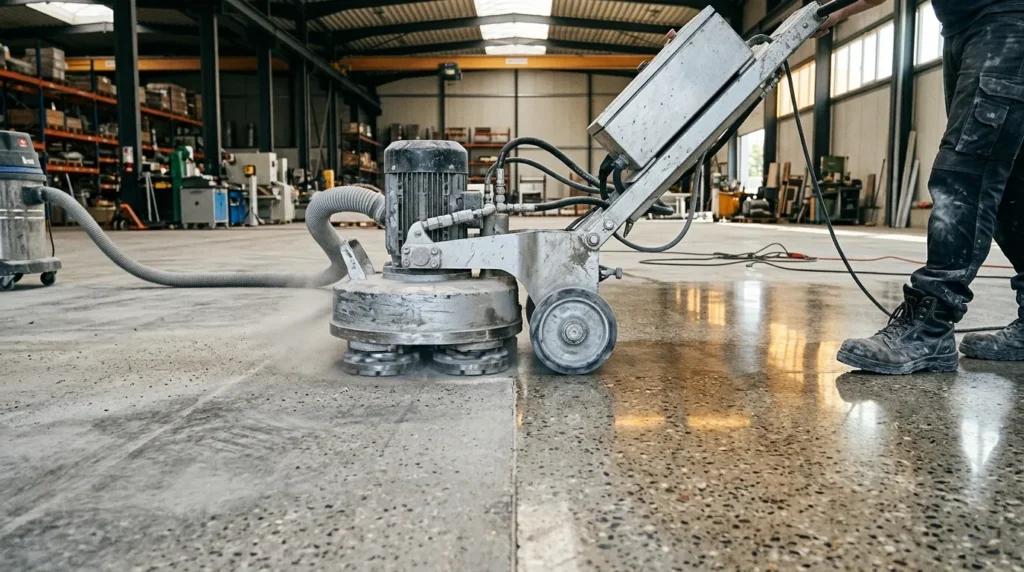
Polished concrete is created by mechanically grinding a concrete slab with progressively finer diamond-impregnated abrasive pads — starting at coarse grits that cut the surface aggressively and finishing at fine grits that refine the surface to the specified gloss level.
The process transforms the concrete surface at a physical level — compressing and densifying the paste rather than coating it. The result is a surface that is harder, less permeable, and more reflective than the original concrete — without any coating that can peel, chip, or require reapplication.
The Diamond Polishing Process
The polishing sequence follows a standard progression:
| Stage | Grit Range | Purpose |
|---|---|---|
| Coarse grinding | 16–30 grit | Remove surface layer, expose aggregate |
| Medium grinding | 50–100 grit | Flatten surface, refine profile |
| Fine grinding | 200–400 grit | Remove scratch marks from coarser grits |
| Densifier application | — | Harden and fill pores (between 400–800 grit) |
| Polishing | 800–1,500 grit | Develop sheen and reflectivity |
| Fine polishing | 1,500–3,000 grit | Maximum gloss — mirror finish |
| Guard coat (optional) | — | Stain protection without changing appearance |
The starting grit depends on the condition of the existing slab and the desired aggregate exposure level. A floor requiring deep aggregate exposure starts at 16–30 grit. A floor requiring cream polish (no aggregate) starts at 400 grit — the surface cement paste is refined without removing it.
Densifier — The Step Most People Skip
The densifier is the most important step in the polishing process — and the one most often omitted by contractors cutting corners.
A lithium, sodium, or potassium silicate solution is applied to the concrete surface mid-process (typically between 400 and 800 grit). The densifier reacts with calcium hydroxide in the concrete paste, forming calcium silicate hydrate — permanently filling the pores and hardening the surface.
Effects of densifier:
- Surface hardness increases by 20–40%
- Porosity decreases significantly — stain resistance improves
- Final polish achieves higher reflectivity on a densified surface
- Dust generation from floor traffic is dramatically reduced
Without densifier, polished concrete scratches more easily, dusts under traffic, and never achieves the mirror-like reflectivity that defines high-end polished floors. It is not optional on any quality polished floor installation.
Types of Polished Concrete Floors by Aggregate Exposure
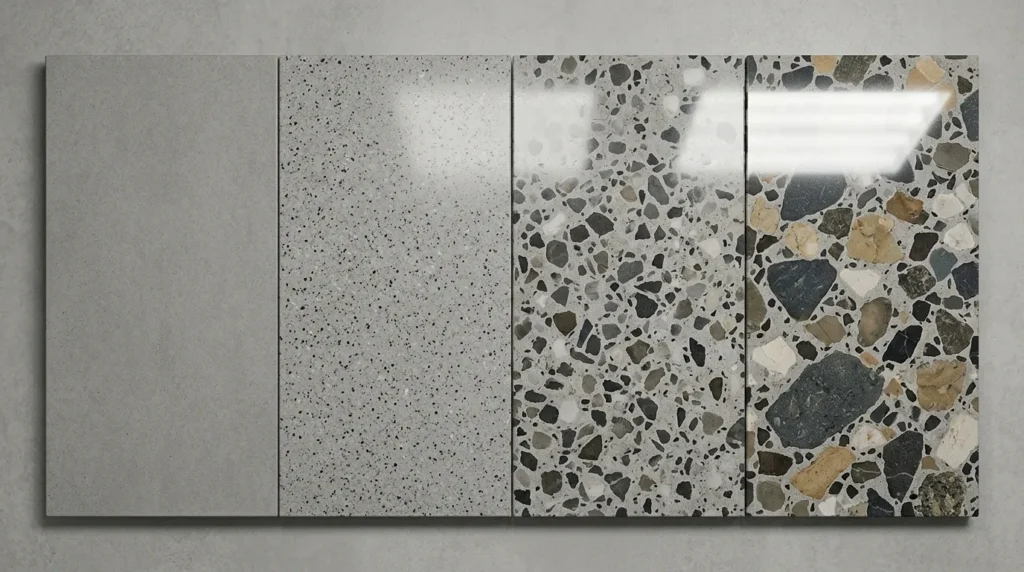
Aggregate exposure is the most visually defining characteristic of a polished concrete floor. It is controlled by how deeply the initial grinding cuts into the slab — deeper grinding removes more surface paste and exposes more of the coarse aggregate beneath.
Cream Polish
Grinding depth: Minimal — surface paste only, no aggregate removed Starting grit: 400 or finer Appearance: Smooth, uniform grey or colored surface — no stone visible, subtle to moderate sheen depending on final grit
Cream polish suits spaces where a clean, minimal, monolithic floor is the design intent — modern architecture, minimalist interiors, industrial aesthetic. The uniform surface reads as a design choice rather than a limitation.
Best for: Modern residential interiors, minimalist commercial spaces, floors where aggregate type or color is inconsistent and would look poor if exposed.
Limitation: Surface appearance is entirely dependent on the concrete mix and finish quality of the original slab — poor original finishing, trowel marks, or color variation in the original concrete will show through cream polish.
Salt and Pepper Polish
Grinding depth: Light — surface paste partially removed, fine aggregate (sand) exposed, some small stones beginning to appear Starting grit: 50–100 grit Appearance: Mixed surface — grey paste with fine aggregate visible, creating a speckled “salt and pepper” texture
Salt and pepper is the most popular polished concrete finish in commercial construction — it provides visual interest beyond a plain cream polish while remaining neutral enough to suit most interior design contexts.
Best for: Office floors, retail, commercial common areas, residential open-plan living spaces.
Cost advantage: Less grinding than full aggregate exposure — faster process, lower cost than deeper exposure levels.
Medium Aggregate Exposure
Grinding depth: Moderate — paste substantially removed, coarse aggregate (small stone, 3/8–1/2 inch) fully exposed Starting grit: 30–50 grit Appearance: Clearly visible stone aggregate in the paste matrix — the floor has visual depth and texture variation from the aggregate distribution
Medium aggregate exposure reveals the concrete’s aggregate character — the color, size, and distribution of the stone used in the mix become design elements. Concrete with interesting aggregate (coloured quartz, basalt, granite) looks exceptional at this exposure level.
Best for: Design-conscious commercial spaces, hospitality, upscale retail, residential interiors where the aggregate mix was selected for decorative effect.
Full Aggregate Exposure
Grinding depth: Maximum — surface ground deeply enough to cut through the aggregate itself, producing a terrazzo-like cross-section of stone Starting grit: 16–30 grit Appearance: Full stone cross-sections visible — resembles terrazzo or polished natural stone depending on aggregate type
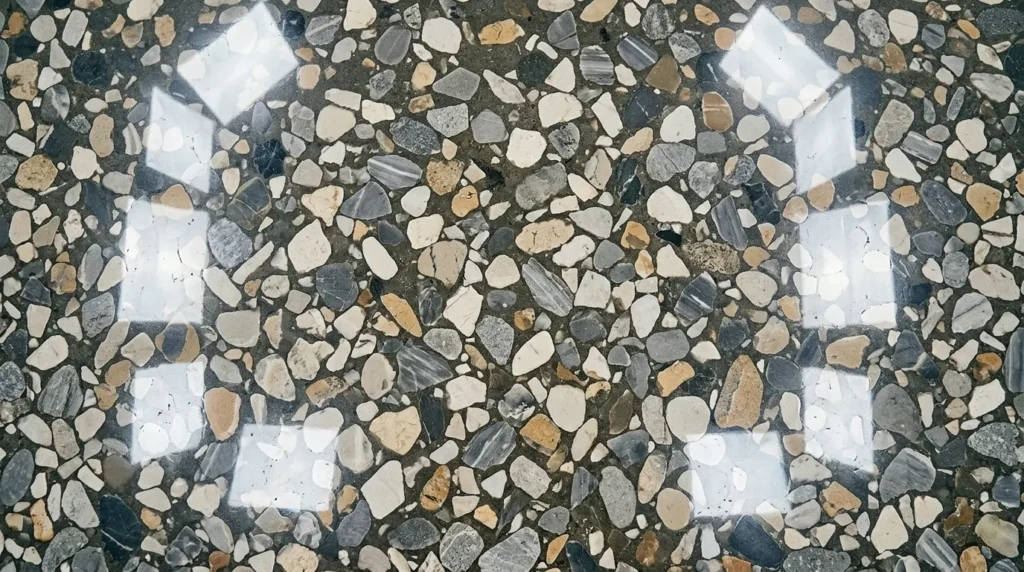
Full aggregate exposure is the premium option — it requires the most grinding passes, the most time, and produces the most visually striking result. The floor reads more like natural stone or terrazzo than concrete.
Best for: Luxury retail, hospitality lobbies, upscale residential, any space where the floor is a design centerpiece.
Cost: Highest of all exposure levels — significantly more grinding passes required.
Types of Polished Concrete Floors by Gloss Level
Gloss level is the second defining variable — independent of aggregate exposure. A salt-and-pepper surface can be finished at matte or mirror gloss; a full aggregate floor can be honed at 400 grit or polished to 3,000 grit. The combination of exposure level and gloss level defines the final floor.
Matte / Flat Finish
Final grit: 200–400 Sheen: None — flat, non-reflective surface Appearance: Clean, sophisticated, non-glossy — looks intentionally matte rather than unfinished
Matte polished concrete suits contemporary and industrial interior design where a glossy floor would feel inappropriate — photography studios, art galleries, industrial-aesthetic restaurants, and modern residential spaces where the floor should recede rather than dominate.
Satin Finish
Final grit: 400–800 Sheen: Low — subtle reflectivity, surface catches light at certain angles
Satin finish is the most versatile gloss level — enough sheen to read as “finished” and premium, without the high-maintenance appearance of a mirror floor. It suits offices, schools, healthcare facilities, and residential spaces where a refined but practical floor is the goal.
Semi-Gloss Finish
Final grit: 800–1,500 Sheen: Medium — clearly reflective, overhead lighting visible as a soft reflection in the floor
Semi-gloss is the standard commercial finish for retail, office, and hospitality applications. The reflectivity reduces artificial lighting requirements — the floor bounces light back into the space, improving illumination efficiency.
Worked Example: A 20,000 sq ft retail store switching from vinyl composition tile (VCT) to semi-gloss polished concrete. VCT required monthly waxing and annual strip-and-wax at $0.50/sq ft/year = $10,000/year maintenance. Polished concrete at semi-gloss: damp mop cleaning, annual guard coat reapplication at $0.05/sq ft = $1,000/year. Maintenance saving: $9,000/year — the floor pays for its installation premium within 3–5 years.
High-Gloss Mirror Finish
Final grit: 1,500–3,000+ Sheen: Maximum — mirror-like reflectivity, clear overhead light and surrounding objects reflected in floor
High-gloss mirror finish is the premium specification — used in luxury retail flagships, hospitality lobbies, car showrooms, and upscale residential great rooms. The reflectivity creates a sense of space and light that no other flooring material replicates at this cost level.
Limitation: Shows footprints, dust, and cleaning streaks more readily than lower gloss levels. In high-traffic commercial applications, cleaning frequency increases with gloss level.
Honed Concrete vs. Polished Concrete
Honed concrete and polished concrete are often confused — they use the same diamond grinding equipment but stop at different points in the process.
| Factor | Honed | Polished |
|---|---|---|
| Final grit | 400–800 | 800–3,000+ |
| Sheen | Matte to low satin | Satin to mirror |
| Densifier | Optional | Required |
| Appearance | Flat, refined, stone-like | Reflective, glossy |
| Maintenance | Lower (less visible marks) | Higher (footprints show) |
| Cost | Lower | Higher |
| Best for | Residential, healthcare, schools | Retail, showrooms, luxury |
When to choose honed: Spaces where a refined, matte concrete look is desired without high-gloss maintenance — residential bedrooms, healthcare facilities, educational buildings, anywhere that a mirror finish would feel inappropriate or impractical.
When to choose polished: Commercial spaces where the floor’s reflectivity reduces lighting costs, retail and hospitality where a premium appearance justifies the maintenance, and luxury residential where the floor is a design statement.
Polished Concrete for Different Applications
Retail and Showroom Floors
Retail floors take more abuse than almost any other interior floor type — shopping carts, high heels, dropped merchandise, and constant foot traffic. Polished concrete handles all of these better than carpet, vinyl, or tile.
Recommended specification: Salt-and-pepper to medium aggregate, semi-gloss to high-gloss, densified, guard coat applied.
Specific advantage: The reflective surface reduces lighting energy requirements by 15–30% — a significant operational saving for large retail spaces with extensive artificial lighting.
According to the Concrete Polishing Association of America (CPAA), polished concrete in retail applications achieves the lowest 10-year lifecycle cost of any hard flooring option when installation, maintenance, and replacement costs are compared.
Warehouse and Industrial Floors
Warehouse floors need hardness, dust control, and resistance to forklift wheel traffic — not aesthetics. Polished and densified concrete delivers all three at lower cost than coatings.
Recommended specification: Cream to salt-and-pepper, matte to satin finish, heavily densified, no guard coat required.
Key advantage over coatings: Epoxy and polyurethane coatings on warehouse floors delaminate under heavy forklift traffic within 3–7 years. Polished and densified concrete has no coating to delaminate — the floor surface is the concrete itself, and it gets harder under traffic rather than softer.
Residential Interior Floors
Polished concrete in homes is growing in popularity in open-plan living areas, kitchens, and master bedrooms — driven by its combination of modern aesthetics, hypoallergenic properties (no carpet fibers or grout lines to trap allergens), and durability.
Recommended specification: Cream to salt-and-pepper, satin to semi-gloss, radiant heat compatible (polished concrete conducts and radiates heat efficiently).
Comfort consideration: Polished concrete is hard underfoot — area rugs in seating and bedroom areas address the comfort issue without compromising the floor aesthetic. Radiant heating beneath a polished concrete slab eliminates the cold underfoot feeling common in colder climates.
Worked Example: A 1,200 sq ft open-plan living and kitchen area. Existing 4-inch slab, 3,500 PSI. Cream polish to satin finish — no aggregate exposure, warm grey appearance coordinating with white cabinetry and natural wood accents. Cost: $4/sq ft = $4,800. Versus large-format porcelain tile at $8–$12/sq ft installed ($9,600–$14,400) — polished concrete delivers a comparable aesthetic at 35–50% lower cost.
Commercial Office Floors
Office floors need durability, cleanability, and a professional appearance that doesn’t dominate the space. Satin or semi-gloss polished concrete suits most office environments — refined enough to read as premium, matte enough to not distract.
Recommendation: Salt-and-pepper, satin finish, guard coat for stain resistance in kitchen and break room areas.
Polished Concrete Cost by Type
| Type | Specification | Cost Per Sq Ft |
|---|---|---|
| Cream polish, matte | 400 grit final | $2–$4 |
| Cream polish, satin | 800 grit final | $3–$5 |
| Salt and pepper, semi-gloss | 100 grit start, 1,500 final | $4–$7 |
| Medium aggregate, semi-gloss | 50 grit start, 1,500 final | $5–$8 |
| Full aggregate, high-gloss | 16 grit start, 3,000 final | $8–$15 |
| Honed (any exposure) | 400–800 grit final | $3–$6 |
| Existing floor renovation | Variable | Add $1–$3/sq ft |
Costs include grinding, densifier, and polishing. Guard coat, staining, and crack repair are additional.
Cost factors that move the price:
- Existing floor condition — cracks, joint repairs, coating removal add cost
- Slab flatness — uneven slabs require more grinding passes
- Aggregate type — hard aggregate (granite, basalt) dulls diamond tooling faster
- Area size — large areas achieve lower per-sq-ft cost through equipment efficiency
How to Choose the Right Type of Polished Concrete Floor
Step 1 — Determine aggregate exposure preference. Do you want a uniform, monolithic look (cream)? A textured, slightly varied surface (salt and pepper)? Or a stone-like surface with visible aggregate (medium to full)? If your concrete has interesting aggregate, expose it. If it has poor or inconsistent aggregate, stay with cream or salt-and-pepper.
Step 2 — Determine gloss level. High traffic + high aesthetics → semi-gloss to high-gloss. Residential or matte design intent → satin to matte. Healthcare or education → satin (lower maintenance, less slippery appearance). Warehouse → matte densified.
Step 3 — Assess existing slab condition. New slab: specify flatness (FF/FL values) appropriate for the polish level — mirror-finish floors require higher flatness tolerance than standard pours. Existing slab: assess crack extent, joint condition, and any coating removal needed before budgeting.
Step 4 — Match specification to budget.
| Budget | Recommended Specification |
|---|---|
| Economy | Cream polish, satin, no guard coat |
| Mid-range | Salt and pepper, semi-gloss, guard coat |
| Premium | Medium aggregate, high-gloss, color, guard coat |
| Luxury | Full aggregate, mirror finish, custom color |
Polished Concrete Maintenance Guide
Polished concrete is the lowest-maintenance hard floor available — but “low maintenance” is not “no maintenance.”
Daily: Dust mop or auto-scrubber with clean water — remove grit that can scratch the surface under foot traffic.
Weekly: Damp mop with pH-neutral cleaner — avoid acidic cleaners (vinegar, citrus) that etch the surface and alkaline cleaners (bleach, ammonia) that dull the finish.
Annually: Reapply guard coat (stain-resistant penetrating treatment) — restores stain resistance and maintains surface appearance. Cost approximately $0.05–$0.15/sq ft — negligible for the protection provided.
Never use:
- Wax or polish (designed for other floors — creates buildup on concrete)
- Acidic cleaners (etch the densified surface)
- Steam mops (excessive heat can damage densifier bond)
- Abrasive scrubbing pads (scratch the polished surface)
| Maintenance Task | Frequency | DIY or Professional |
|---|---|---|
| Dust mop | Daily/weekly | DIY |
| Damp mop | Weekly | DIY |
| Guard coat reapplication | Annually | Professional recommended |
| Re-polish (scratch repair) | Every 5–10 years | Professional |
| Full re-polish | Every 15–25 years | Professional |
Frequently Asked Questions
What are the types of polished concrete floors?
Polished concrete floors are classified by aggregate exposure level (cream, salt and pepper, medium aggregate, full aggregate) and gloss level (matte, satin, semi-gloss, high-gloss mirror). These two variables combine to define the final floor — a salt-and-pepper satin finish is a completely different result from a full-aggregate mirror finish, despite using the same process.
Is polished concrete slippery?
Standard polished concrete has a coefficient of friction (COF) comparable to polished marble — it is not inherently more slippery than other hard floors. The floor becomes slippery when wet, like all smooth hard floors. For wet areas, specify a guard coat with anti-slip aggregate, or choose a lower gloss level. Matte and satin polished floors are significantly less slippery than high-gloss when wet.
How much does polished concrete cost per square foot?
Cream polish at satin finish runs $3–$5/sq ft. Salt-and-pepper at semi-gloss is $4–$7/sq ft. Full aggregate mirror finish is $8–$15/sq ft. Costs vary with slab condition, area size, and regional labor rates. Large areas achieve lower per-sq-ft cost through polishing equipment efficiency.
How long does polished concrete last?
Polished concrete lasts the lifetime of the slab — 25–50+ years with basic maintenance. There is no coating to peel or wear through. The surface may require re-polishing every 15–25 years in high-traffic commercial applications to restore maximum gloss level, but the floor itself does not fail.
Can old concrete be polished?
Yes — existing slabs can be polished regardless of age, as long as the concrete is structurally sound. Old coatings must be removed first (grinding removes most coatings). Cracks and joints must be filled and repaired before polishing. The concrete must have adequate strength — very low-strength concrete (under 2,500 PSI) may not achieve a quality polish.
What is the difference between honed and polished concrete?
Honed concrete stops at 400–800 grit — producing a flat, matte to low-satin surface without maximum reflectivity. Polished concrete continues to 1,500–3,000 grit — producing medium to mirror-gloss sheen. Honed is lower cost, lower maintenance, and suits spaces where matte aesthetics are preferred. Polished is higher cost, more reflective, and suits commercial and luxury applications.
What grit is used for polished concrete?
The process starts at 16–400 grit depending on required aggregate exposure, progresses through intermediate grits (50, 100, 200, 400), applies densifier between 400–800 grit, then finishes at 800, 1,500, or 3,000 grit depending on the specified gloss level. Each step removes the scratches from the previous, finer step.
Is polished concrete good for homes?
Yes — polished concrete suits modern, contemporary, and industrial-aesthetic homes particularly well. It is hypoallergenic, durable, compatible with radiant heating, and significantly less expensive than large-format natural stone tile. The main considerations are hardness underfoot (addressed with area rugs) and the cold feel in winter without radiant heating.
Conclusion
Polished concrete is not one floor — it’s a matrix of exposure levels and gloss levels that produces radically different results depending on specification. Cream polish at matte grit suits a minimalist interior; full aggregate at mirror gloss suits a luxury showroom. Both are polished concrete. Know the exposure level you want, specify the gloss level that suits your maintenance tolerance and design intent, and ensure the slab specification (strength, flatness, aggregate selection) supports the finish you’re targeting. Calculate your slab requirements accurately before the pour with the ConcreteCal free concrete calculator — a polished concrete floor starts with a correctly specified slab.