
Concrete is strong — but exactly how strong depends on variables most people never consider: slab thickness, compressive strength (PSI), reinforcement, and the condition of the soil beneath. A 4-inch residential driveway and a 6-inch warehouse floor are both “concrete” — but their load capacities differ by a factor of three or more.
How much weight concrete can hold is not one number. It’s a range determined by how the slab was designed, mixed, reinforced, cured, and supported. Understanding these variables lets you make informed decisions — whether you’re planning a new pour, evaluating whether an existing slab can handle a heavy load, or trying to understand why a slab cracked.
This guide covers load capacity by thickness, PSI, and reinforcement type — with worked examples, reference tables, and a complete FAQ answering the most searched questions about concrete strength and weight limits.
Before planning any concrete pour, calculate your exact material requirements with the free concrete bag calculator at ConcreteCal — and check our concrete bag yield guide to understand exactly how much each bag produces.
Table of Contents
- What Determines How Much Weight Concrete Can Hold?
- How Much Weight Will 4 Inches of Concrete Hold?
- How Much Weight Can a 6-Inch Concrete Slab Hold?
- Concrete Load Capacity by Thickness — Reference Table
- Point Load vs. Distributed Load
- How PSI Affects Concrete Load Capacity
- Reinforcement and Its Effect on Load Capacity
- Common Applications and Their Load Requirements
- How to Increase Concrete Load Capacity
- Frequently Asked Questions
What Determines How Much Weight Concrete Can Hold?
Concrete load capacity is not a single property — it’s the combined result of four variables working together. Change any one of them and the capacity changes significantly.
Compressive Strength (PSI)
Compressive strength — measured in PSI (pounds per square inch) — is the most commonly cited concrete property. It describes how much compressive force the concrete can resist before crushing.
Standard residential concrete is 3,000–4,000 PSI. Commercial and structural concrete runs 4,000–6,000 PSI. High-performance concrete exceeds 10,000 PSI.
But here’s what most people misunderstand: PSI measures resistance to crushing under direct compression — not the slab’s ability to carry a load on its surface. A slab on grade carries loads through bending, not pure compression. The relevant property for slab load capacity is flexural strength — typically 10–15% of compressive strength.
| Compressive Strength | Flexural Strength (Approx.) | Modulus of Rupture |
|---|---|---|
| 2,500 PSI | 250–375 PSI | 400–450 PSI |
| 3,000 PSI | 300–450 PSI | 475–525 PSI |
| 3,500 PSI | 350–525 PSI | 525–575 PSI |
| 4,000 PSI | 400–600 PSI | 575–625 PSI |
| 5,000 PSI | 500–750 PSI | 650–700 PSI |
Slab Thickness
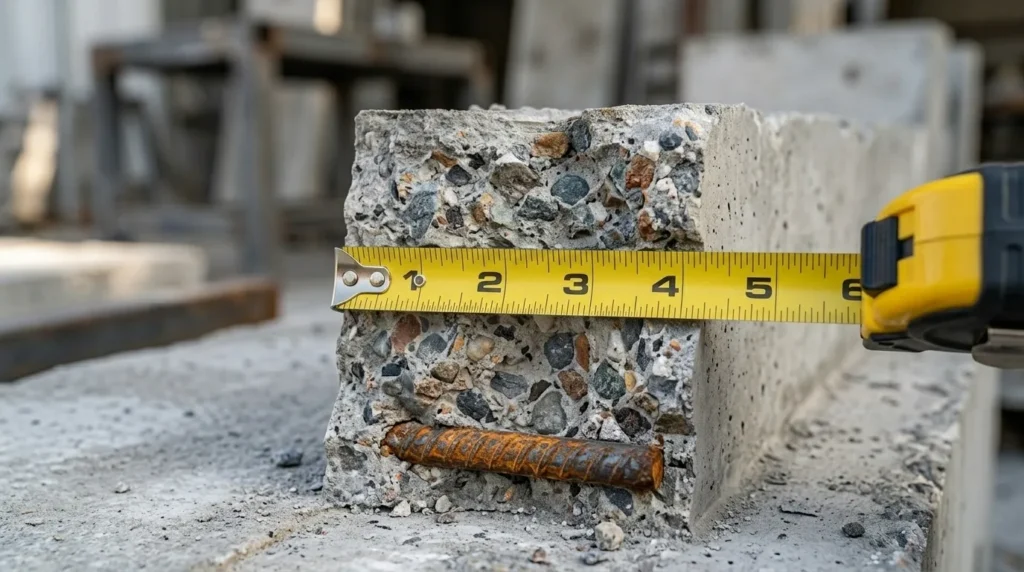
Thickness is the most powerful variable in slab load capacity — capacity increases with the cube of thickness. Double the thickness and you increase load capacity by a factor of eight, not two.
This is why the difference between a 4-inch and 6-inch slab is not 50% more capacity — it’s approximately 3.4× more capacity for equivalent loading conditions.
Reinforcement
Unreinforced concrete carries loads until it cracks — then it fails suddenly. Reinforced concrete (rebar or wire mesh) continues to carry load after cracking, distributing the crack and preventing catastrophic failure.
For slabs on grade, reinforcement controls crack width and prevents differential settlement from causing structural failure — it doesn’t dramatically increase the load before first cracking, but it determines what happens after.
Subgrade and Soil Bearing Capacity
A concrete slab is only as strong as what’s beneath it. A well-designed 4,000 PSI slab on poorly compacted fill will punch through the subgrade under load — the concrete doesn’t fail, the soil does.
Standard residential subgrade compaction targets 95% Proctor density. Soft or expansive soils require a granular base course (compacted gravel) to distribute loads before they reach the native soil.
How Much Weight Will 4 Inches of Concrete Hold?
A 4-inch concrete slab is the standard residential specification — driveways, patios, garage floors, and sidewalks all typically use 4-inch slabs. Understanding its load limits is critical for homeowners and contractors alike.
Unreinforced 4-Inch Slab
An unreinforced 4-inch slab at 3,000 PSI on a well-prepared subgrade has an approximate distributed load capacity of:
800–1,200 PSI of surface area under static, evenly distributed load.
For practical reference: a 4-inch unreinforced slab can support approximately 40,000–50,000 lbs distributed evenly across a 400 sq ft area (100–125 lbs/sq ft).
Point load capacity is significantly lower — a concentrated load on a small area (like a vehicle tire or equipment foot) creates stress concentrations far exceeding the distributed load capacity.
Reinforced 4-Inch Slab
Adding #4 rebar on 18-inch centers or 6×6 W2.9×W2.9 wire mesh to a 4-inch slab does not dramatically increase the load before first cracking — it controls what happens after cracking.
A reinforced 4-inch slab at 4,000 PSI:
- Passenger vehicle load (4,000 lbs per axle): ✅ Handles comfortably
- Light truck (8,000 lbs per axle): ✅ Within capacity with adequate thickness
- Heavy pickup + trailer (14,000 lbs per axle): ⚠️ Approaching limit — depends on subgrade
- Commercial truck (20,000 lbs per axle): ❌ Exceeds design capacity for 4-inch residential slab
Real-World Applications at 4 Inches
Worked Example — Residential Garage Floor: A 24×24 ft garage floor, 4 inches thick, 4,000 PSI, #4 rebar on 18-inch centers, compacted gravel subbase.
- Two passenger vehicles (average 4,000 lbs each): 8,000 lbs total on 576 sq ft = 13.9 lbs/sq ft — far below capacity
- Loaded pickup truck (7,000 lbs): 12.2 lbs/sq ft — well within capacity
- RV or motorhome (20,000–30,000 lbs): ⚠️ 34–52 lbs/sq ft — approaching or exceeding recommended limits for a 4-inch slab
How Much Weight Can a 6-Inch Concrete Slab Hold?
A 6-inch slab is the standard specification for driveways and floors subject to vehicle loads heavier than passenger cars — RVs, delivery trucks, light commercial vehicles, and forklifts.
Unreinforced 6-Inch Slab
An unreinforced 6-inch slab at 3,500 PSI on compacted subgrade has approximately 3.4× the flexural capacity of a 4-inch slab of equivalent mix — this is the cube relationship: (6/4)³ = 3.375.
Distributed load capacity: approximately 300–400 lbs/sq ft under static conditions.
Reinforced 6-Inch Slab
A reinforced 6-inch slab at 4,000 PSI:
- Passenger vehicle (4,000 lbs per axle): ✅ Well within capacity
- Light commercial vehicle (12,000 lbs per axle): ✅ Handles comfortably
- Medium truck (18,000 lbs per axle): ✅ Within capacity on good subgrade
- Heavy truck (34,000 lbs per axle — legal US highway limit): ⚠️ Requires engineering review
- Forklift with load (20,000–40,000 lbs total): ✅–⚠️ Depends on tire contact area and load distribution
Real-World Applications at 6 Inches
Worked Example — RV Pad: Homeowner wants to park a 32-foot Class A motorhome (28,000 lbs gross) on a concrete pad.
- 6-inch slab, 4,000 PSI, #4 rebar on 12-inch centers, 6-inch compacted gravel base
- Motorhome weight distribution: approximately 10,000 lbs per axle, four tires per axle
- Contact area per tire: approximately 35 sq ft (wide RV tires)
- Load per sq ft at tire contact: 10,000 ÷ (4 × 35) = 71 lbs/sq ft
A 6-inch reinforced slab at 4,000 PSI handles this load comfortably. A 4-inch slab would be at or exceeding its safe capacity — 6 inches is the correct specification for RV storage pads.
Concrete Load Capacity by Thickness — Reference Table
| Thickness | PSI | Reinforcement | Approx. Distributed Capacity | Typical Application |
|---|---|---|---|---|
| 3.5 inches | 2,500 | None | 60–80 lbs/sq ft | Sidewalks, light patio |
| 4 inches | 3,000 | Wire mesh | 75–100 lbs/sq ft | Residential patio, walkway |
| 4 inches | 4,000 | #4 rebar | 100–125 lbs/sq ft | Garage floor, driveway |
| 5 inches | 4,000 | #4 rebar | 150–180 lbs/sq ft | Heavy driveway, RV pad |
| 6 inches | 4,000 | #4 rebar | 200–250 lbs/sq ft | Commercial driveway, RV storage |
| 6 inches | 4,500 | #5 rebar | 250–300 lbs/sq ft | Light industrial, warehouse |
| 8 inches | 4,500 | #5 rebar | 400–500 lbs/sq ft | Heavy industrial, truck traffic |
| 10 inches | 5,000 | #6 rebar | 600–750 lbs/sq ft | Heavy forklift, industrial |
| 12 inches | 5,000 | #6 rebar | 800–1,000 lbs/sq ft | Structural, heavy equipment |
All values assume properly prepared, uniformly compacted subgrade. Point loads require separate engineering analysis.
Point Load vs. Distributed Load — Why It Matters
The load tables above assume distributed loads — weight spread evenly across a large area. Real-world loads are rarely perfectly distributed.
Distributed load: A vehicle parked on a slab distributes its weight through four tire contact patches. A storage rack distributes weight through its full footprint. These are manageable by standard slab designs.
Point load: A jack stand, equipment leg, storage rack upright, or hydraulic lift concentrates enormous weight on a tiny area — sometimes as small as a few square inches. The stress concentration at a point load can exceed the slab’s capacity even when the total weight seems manageable.
Worked Example — Storage Rack Point Load: A warehouse storage rack holds 8,000 lbs of inventory. The rack has four legs, each with a 2-inch × 2-inch foot pad.
- Total area: 4 × (2 × 2) = 16 sq inches = 0.11 sq ft
- Load per sq ft: 8,000 ÷ 0.11 = 72,727 lbs/sq ft
This is an enormous point load — far exceeding any standard slab’s capacity at the contact point. The solution is a base plate beneath each rack leg — a 6-inch × 6-inch plate increases contact area to 36 sq inches per leg, reducing the load to 8,000 lbs/sq ft — still high but manageable for a 6-inch industrial slab.
Rule: For any point load from equipment legs, rack uprights, or jack stands — calculate the contact area and use base plates or spreader plates to reduce the load per square inch to a level the slab can handle.
How PSI Affects Concrete Load Capacity
Higher PSI concrete is often ordered for heavy-load applications — but the relationship between PSI and slab load capacity is less direct than most people assume.
Increasing PSI from 3,000 to 4,000 improves flexural strength by approximately 15–20%. Increasing from 4,000 to 5,000 adds another 10–15%. These are meaningful improvements — but far less dramatic than increasing slab thickness.
“According to the American Concrete Institute (ACI 318), flexural strength of concrete — the property that governs slab load capacity — is typically 10–15% of compressive strength, which is why increasing slab thickness has far greater impact on load capacity than increasing PSI alone.”
The practical implication: If you need significantly more load capacity, increase thickness before increasing PSI. Going from 4-inch to 6-inch thickness at the same PSI increases capacity by 3.4×. Going from 3,000 PSI to 5,000 PSI at the same thickness increases capacity by approximately 25–30%.
| Change Made | Capacity Increase |
|---|---|
| 3,000 → 4,000 PSI (same thickness) | ~15–20% |
| 4,000 → 5,000 PSI (same thickness) | ~10–15% |
| 4″ → 6″ thickness (same PSI) | ~240% (3.4×) |
| 4″ → 8″ thickness (same PSI) | ~700% (8×) |
| Add rebar to unreinforced slab | Controls post-crack behavior, not initial capacity |
When higher PSI is worth specifying:
- Freeze-thaw exposure — 4,000+ PSI with air entrainment dramatically improves durability
- Deicer chemical exposure — 4,500 PSI minimum reduces permeability and chemical attack
- Abrasion resistance — higher PSI concrete resists surface wear under heavy traffic
- Structural elements — columns, beams, foundations where compressive strength directly governs
Reinforcement and Its Effect on Load Capacity
This is the most misunderstood aspect of concrete load capacity. Reinforcement in a slab on grade has a specific and limited role — it does not dramatically increase the load the slab can carry before first cracking.
What reinforcement does:
Before cracking: Adds minimal load capacity (rebar contributes little to pre-crack stiffness in a slab on grade).
After cracking: Keeps cracks tight, prevents differential movement between cracked sections, maintains load transfer across cracks, and prevents the slab from failing catastrophically.
For settlement: Rebar bridges soft spots in the subgrade — if one area settles, the reinforcement transfers the load to adjacent supported areas rather than allowing a section to punch through.
This means:
- A well-compacted subgrade matters more than rebar for preventing overload failure
- Rebar matters most for controlling the consequences of failure — keeping a cracked slab functional
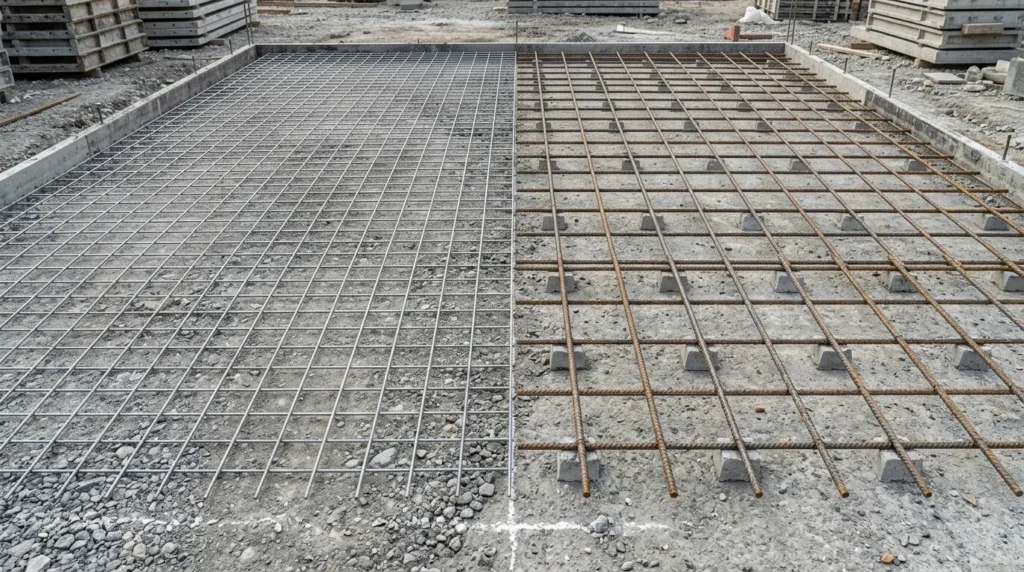
Wire mesh vs. rebar for load capacity:
| Reinforcement | Pre-crack Capacity | Post-crack Control | Settlement Bridging |
|---|---|---|---|
| No reinforcement | Baseline | None | None |
| 6×6 W1.4 wire mesh | +2–5% | Fair | Limited |
| 6×6 W2.9 wire mesh | +3–7% | Good | Moderate |
| #4 rebar @ 18″ | +5–10% | Good | Good |
| #4 rebar @ 12″ | +8–15% | Excellent | Excellent |
| #5 rebar @ 12″ | +12–20% | Excellent | Excellent |
Common Applications and Their Load Requirements
Residential Driveways
Standard residential driveways serve passenger vehicles (2,000–5,000 lbs) and occasional light trucks. The critical load case is axle load — not total vehicle weight.
Recommended specification: 4 inches, 4,000 PSI, air-entrained in freeze-thaw climates, #4 rebar on 18-inch centers or 6×6 W2.9 wire mesh.
Load limits:
- Passenger car (2,500 lbs per axle): ✅ Comfortably within capacity
- Full-size pickup (5,000 lbs per axle): ✅ Within capacity
- Moving truck (14,000 lbs per axle): ⚠️ Exceeds recommended limit for 4-inch driveway
- Concrete delivery truck (20,000+ lbs per axle): ❌ Significantly exceeds 4-inch capacity
For driveways that will regularly receive delivery trucks or service vehicles, specify 5–6 inches with #4 rebar on 16-inch centers.
Garage Floors
A garage floor typically supports two passenger vehicles plus tool storage, shelving, and occasional use of a floor jack.
Standard specification: 4 inches, 4,000 PSI, #4 rebar on 18-inch centers.
Floor jack and jack stand loads: A floor jack lifts one corner of a vehicle — concentrating the vehicle’s weight on the jack pad. A 4,000 lb vehicle with weight on one jack: approximately 2,000–2,500 lbs on a 3-inch diameter jack pad = 280–353 lbs/sq inch.
A 4-inch, 4,000 PSI slab handles this — but the load is significant. Always use a jack stand with a wide base plate for extended periods under load. Never use a floor jack on a 3.5-inch or thinner slab for heavy vehicles.
Patios and Walkways
Patios and walkways carry foot traffic, outdoor furniture, and occasional equipment (wheelbarrows, lawn tractors).
Standard specification: 3.5–4 inches, 3,000–3,500 PSI, wire mesh or no reinforcement.
These applications are rarely load-governed — a properly designed patio slab is overspecified for foot traffic loads. Shrinkage cracking and freeze-thaw durability are the primary design concerns, not load capacity.
Warehouse and Industrial Floors
Industrial floors carry the most demanding loads in concrete construction — forklifts, heavy racking, roll-off containers, and vehicle repair lifts.
Forklift loads: A 6,000 lb capacity forklift carrying a full load weighs 12,000–18,000 lbs total, concentrated on drive axle tires. Tire contact pressure of 150–300 PSI is common.
Standard industrial specification: 6–8 inches, 4,500 PSI, #5 rebar on 12-inch centers or steel fiber reinforcement at 40–60 lbs/yd³.
Worked Example — Vehicle Lift in Auto Shop: A 2-post vehicle lift rated at 12,000 lbs has two base plates, each 12 inches × 14 inches.
- Total base area: 2 × (12 × 14) = 336 sq inches = 2.33 sq ft
- Load per sq ft: 12,000 ÷ 2.33 = 5,150 lbs/sq ft
This is a severe point load. The American Concrete Institute recommends a minimum 6-inch slab at 3,500 PSI for vehicle lifts — many lift manufacturers specify a minimum 4,000 PSI, 6-inch slab with rebar. Always verify the lift manufacturer’s concrete specification before installation.
How to Increase Concrete Load Capacity
If an existing slab is insufficient for new loads, or if you’re designing a new slab for heavy use, here are the options ranked by effectiveness:
1. Increase slab thickness (most effective). Thickness has the greatest impact on load capacity of any single variable. If designing new, always increase thickness before increasing PSI or reinforcement when more capacity is needed.
2. Improve subgrade preparation. For existing slabs on poor subgrade, mudjacking or slab lifting can restore subgrade support — eliminating the differential settlement that causes load failures. For new pours, a 4–6 inch compacted granular base distributes loads to the native soil more effectively.
3. Add a concrete overlay. A bonded concrete overlay — 2–4 inches of new concrete bonded to the existing slab — effectively increases thickness. The existing slab must be structurally sound and properly prepared for bonding. A 4-inch slab with a 2-inch bonded overlay performs similarly to a 6-inch slab.
4. Increase PSI specification. Upgrading from 3,000 to 4,500 PSI provides meaningful improvement — approximately 20–25% more flexural capacity. Less impactful than thickness but achievable without changing the pour dimensions.
5. Improve reinforcement. Upgrading from wire mesh to #4 rebar on 12-inch centers, or adding steel fibers to the mix, improves post-crack behavior and settlement bridging — particularly valuable for slabs on variable or uncertain subgrade conditions.
6. Use post-tensioning. For new slabs in residential or commercial settings where maximum load capacity is required at minimum thickness, post-tensioned slabs achieve significantly higher load capacity at 4–5 inch thickness than conventionally reinforced slabs of the same dimension. Post-tensioning requires engineering design and specialist installation.
Frequently Asked Questions
How much weight will 4 inches of concrete hold?
A 4-inch reinforced concrete slab at 4,000 PSI on a properly compacted subgrade can support approximately 100–125 lbs per square foot under distributed loading. For point loads (vehicle tires, equipment legs), the capacity depends on the contact area. A typical passenger vehicle (2,500 lbs per axle) is well within the capacity of a 4-inch residential slab. A commercial truck axle (20,000 lbs) exceeds it.
How much weight can a 6-inch concrete slab hold?
A 6-inch reinforced slab at 4,000 PSI supports approximately 200–250 lbs per square foot under distributed load — approximately 3.4 times the capacity of an equivalent 4-inch slab. It comfortably handles RVs, light commercial vehicles, and most residential heavy equipment. For forklifts and commercial trucks, 8 inches is the safer specification.
How much weight will concrete hold per square foot?
It depends on thickness and PSI. A 4-inch slab: 75–125 lbs/sq ft. A 6-inch slab: 200–250 lbs/sq ft. An 8-inch slab: 400–500 lbs/sq ft. These are distributed load values — point loads from equipment legs or lift bases require separate calculation based on contact area.
Can a concrete slab hold the weight of a car?
Yes — a standard 4-inch, 3,000+ PSI reinforced slab handles the weight of any passenger vehicle with no problems. An average car weighs 3,000–4,000 lbs and distributes its weight across four tire contact patches, producing less than 25 lbs/sq ft of load on the slab — far below the capacity of any properly constructed residential slab.
How much weight can concrete hold before it cracks? Concrete’s tensile strength (crack resistance) is approximately 10% of its compressive strength. A 3,000 PSI slab has a flexural strength of approximately 450–525 PSI. First cracking occurs when bending stress from the applied load exceeds this value at any point in the slab. After cracking, reinforcement maintains load transfer — the slab continues to function even after cracking, but the first crack indicates the slab has reached its design limit.
What PSI concrete do I need for heavy vehicles?
For driveways with occasional light trucks: 4,000 PSI minimum. For driveways regularly receiving delivery trucks or commercial vehicles: 4,500 PSI with 5–6 inch thickness. For industrial floors with forklifts: 4,500–5,000 PSI with 6–8 inch thickness and #5 rebar. Always increase thickness before increasing PSI for maximum impact on load capacity.
Does reinforcement increase how much weight concrete can hold?
Reinforcement has minimal effect on load capacity before first cracking — it does not significantly increase the load that causes the slab to crack initially. What reinforcement dramatically improves is behavior after cracking: keeping cracks tight, maintaining load transfer, bridging soft subgrade spots, and preventing catastrophic failure. A reinforced slab that cracks under heavy load continues to function; an unreinforced slab that cracks can fail suddenly.
How thick should concrete be for a forklift?
Minimum 6 inches for light forklifts (under 5,000 lb capacity). For forklifts with 8,000–12,000 lb capacity: 8 inches minimum. For heavy forklifts exceeding 15,000 lb capacity: 10 inches with engineering design. All forklift floor specifications should account for the dynamic load factor — a moving forklift generates higher impact loads than the static weight suggests, typically 1.3–1.5× the static load.
Conclusion
Concrete load capacity is determined by thickness first, PSI second, reinforcement third, and subgrade always. A 4-inch slab handles everything residential — cars, furniture, foot traffic, and most garage loads. A 6-inch slab handles RVs, light commercial vehicles, and most small warehouse equipment. For heavy industrial applications, 8 inches with engineering design is the starting point, not the ceiling. Calculate your concrete requirements accurately before any pour with the ConcreteCal bag calculator — and reference our concrete bag yield guide to understand exactly what each bag produces before ordering.