
Four inches is the standard concrete slab thickness for most residential projects — driveways, garage floors, patios, sidewalks, and shed bases. It’s what contractors pour by default, what building codes typically specify as minimum for flatwork, and what most homeowners end up with.
But how much weight will 4 inches of concrete hold — really? The answer isn’t a single number. It depends on the concrete’s compressive strength, whether the slab is reinforced, the quality of the subgrade beneath it, and critically, whether the load is spread across a large area or concentrated on a small one.
This guide gives you the exact numbers — load tables, vehicle weight comparisons, point load calculations, and clear guidance on where a 4-inch slab is the right specification and where you need more thickness.
Before pouring your slab, calculate your exact bag count and material cost with the free concrete bag calculator at ConcreteCal.
For a complete comparison across all slab thicknesses from 3.5 to 12 inches, see our full guide on how much weight can concrete hold.
Table of Contents
- What Makes a 4-Inch Concrete Slab Strong or Weak?
- How Much Weight Will 4 Inches of Concrete Hold?
- Can a 4-Inch Concrete Slab Hold a Car?
- Point Load vs. Distributed Load on a 4-Inch Slab
- 4-Inch Concrete Slab Load Limits by Application
- How to Maximize Load Capacity of Your 4-Inch Slab
- When to Upgrade from 4 Inches to 6 Inches
- Frequently Asked Questions
What Makes a 4-Inch Concrete Slab Strong or Weak?
Two identical 4-inch slabs can have very different load capacities depending on how they were designed, mixed, and built. These are the variables that matter most.
Compressive Strength and Flexural Strength
Concrete strength is measured in PSI — pounds per square inch of compressive force the material can resist before crushing. Standard residential concrete is 3,000–4,000 PSI. This number is widely quoted but frequently misapplied to slab load capacity.
Here is the critical distinction: a concrete slab on grade does not carry loads in pure compression. It carries them in bending — the slab flexes slightly under load, developing tensile stress on its bottom face. The relevant property for slab load capacity is flexural strength — also called modulus of rupture — which is approximately 10–15% of compressive strength.
| Compressive Strength | Flexural Strength (Approx.) | Common Application |
|---|---|---|
| 2,500 PSI | 300–375 PSI | Sidewalks, light patio |
| 3,000 PSI | 375–450 PSI | Standard residential |
| 3,500 PSI | 440–525 PSI | Better residential |
| 4,000 PSI | 500–600 PSI | Driveway, garage floor |
| 4,500 PSI | 560–675 PSI | Heavy residential, commercial |
| 5,000 PSI | 625–750 PSI | Industrial, structural |
The practical implication: upgrading from 3,000 PSI to 4,000 PSI on your 4-inch driveway improves flexural capacity by approximately 20–25%. Meaningful — but far less impactful than what reinforcement placement and subgrade quality contribute.
Subgrade Quality — The Hidden Variable
The subgrade is the soil or base material beneath the concrete slab. It is the most overlooked variable in residential concrete construction — and one of the most important.
A concrete slab does not carry loads independently. It transfers loads to the subgrade beneath it. If the subgrade is soft, loose, or unevenly compacted, the slab loses support in some areas while remaining supported in others. This differential support creates bending — exactly the stress condition concrete handles worst.
What a good subgrade looks like:
- Native soil compacted to 95% Proctor density
- OR 4–6 inches of compacted granular base (crushed stone or gravel) over native soil
- Uniform — no soft spots, organic material, or poorly compacted fill
- Properly drained — water accumulation beneath a slab softens subgrade and dramatically reduces effective load capacity
Worked Example — Subgrade Failure: A 4-inch garage floor poured over poorly compacted fill. Over 18 months, the fill settles unevenly — one corner drops 0.5 inches while the rest remains supported. The slab is now spanning across an unsupported zone. A vehicle parked in that corner concentrates 2,000 lbs on an unsupported section — the slab cracks, not because it was too weak, but because it lost its foundation.
The same slab on properly compacted subgrade would have handled that load without any issue. This is why subgrade preparation is as important as concrete specification.
Reinforcement — What It Actually Does
This is the most misunderstood aspect of concrete slab load capacity. Most people assume rebar or wire mesh makes a slab dramatically stronger — able to hold significantly more weight. The reality is more nuanced.
What reinforcement does NOT do: Reinforcement does not significantly increase the load at which a slab first cracks. The crack-initiation load is governed by concrete strength and slab thickness — not the presence of rebar.
What reinforcement DOES do: After cracking occurs, reinforcement keeps the crack tight, maintains load transfer across the crack, bridges soft spots in the subgrade, and prevents catastrophic failure. A reinforced slab that cracks under excessive load continues to function; an unreinforced slab that cracks can fail suddenly and completely.
For residential 4-inch slabs, reinforcement is most valuable for controlling shrinkage cracking and bridging minor subgrade imperfections — not for dramatically increasing the maximum load the slab can carry before damage.
How Much Weight Will 4 Inches of Concrete Hold — The Exact Numbers
With the context established, here are the actual load capacity figures for 4-inch concrete slabs.
Unreinforced 4-Inch Slab Capacity
An unreinforced 4-inch slab at 3,000 PSI on a properly compacted subgrade:
Distributed load capacity: Approximately 75–100 lbs per square foot under static, evenly distributed loading.
What this means practically:
- A 400 sq ft patio (20×20 ft): can support 30,000–40,000 lbs distributed evenly
- A 576 sq ft garage floor (24×24 ft): can support 43,200–57,600 lbs distributed evenly
These numbers sound enormous — and they are for distributed loads. The problem arises with concentrated loads, which are far more common in real use.
Reinforced 4-Inch Slab Capacity
A reinforced 4-inch slab at 4,000 PSI on compacted subgrade with #4 rebar on 18-inch centers:
Distributed load capacity: Approximately 100–125 lbs per square foot
The reinforcement provides approximately 20–25% improvement in practical load capacity — not because it dramatically increases crack resistance, but because it allows the slab to redistribute loads more effectively and bridges minor subgrade variations.
Load Capacity by PSI — Reference Table
| Slab Spec | Distributed Capacity | Max Axle Load (Approx.) | Safe For |
|---|---|---|---|
| 4″ / 2,500 PSI / no rebar | 60–75 lbs/sq ft | 4,000 lbs | Foot traffic, light furniture |
| 4″ / 3,000 PSI / wire mesh | 75–95 lbs/sq ft | 6,000 lbs | Residential patio, sidewalk |
| 4″ / 3,500 PSI / wire mesh | 90–110 lbs/sq ft | 8,000 lbs | Residential driveway (light use) |
| 4″ / 4,000 PSI / #4 rebar | 100–125 lbs/sq ft | 10,000 lbs | Standard residential driveway |
| 4″ / 4,500 PSI / #4 rebar | 115–140 lbs/sq ft | 12,000 lbs | Heavy residential, light trucks |
| 4″ / 4,000 PSI / #5 rebar | 110–135 lbs/sq ft | 11,000 lbs | Garage floor, heavy residential |
All values assume properly prepared, uniformly compacted subgrade. Soft or uneven subgrade reduces these values significantly.
Can a 4-Inch Concrete Slab Hold a Car?
This is the most commonly searched question about 4-inch concrete — and the answer is yes, with important qualifications depending on vehicle type and weight.
Passenger Cars and Sedans
Standard passenger cars weigh 2,500–4,500 lbs. The critical number for slab design is not total weight but axle load — the weight on a single axle.
A 3,500 lb sedan with 55/45 front-to-rear weight distribution:
- Front axle load: 1,925 lbs — distributed across two tires
- Rear axle load: 1,575 lbs — distributed across two tires
- Load per tire contact patch: approximately 480–960 lbs per patch
A standard tire contact patch on a passenger car is approximately 25–35 sq inches. Load per square inch: approximately 14–38 lbs/sq inch — well within the capacity of any 3,000+ PSI, 4-inch slab.
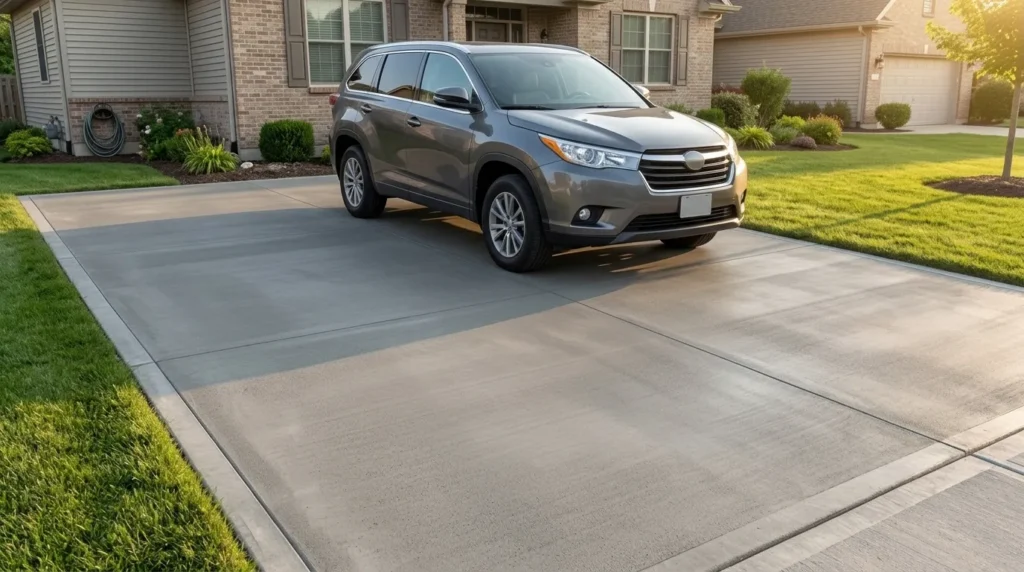
Answer: Any properly constructed 4-inch slab handles passenger cars without any concern. This is exactly what the specification was designed for.
Pickup Trucks and SUVs
Full-size pickup trucks and large SUVs are significantly heavier than passenger cars — and increasingly common in residential driveways.
| Vehicle | Approx. Weight | Front Axle Load | Within 4″ Capacity? |
|---|---|---|---|
| Mid-size SUV | 4,000–5,000 lbs | 2,200–2,750 lbs | ✅ Yes |
| Full-size SUV | 5,500–6,500 lbs | 3,025–3,575 lbs | ✅ Yes |
| Half-ton pickup (empty) | 4,500–5,500 lbs | 2,475–3,025 lbs | ✅ Yes |
| Half-ton pickup (loaded) | 6,500–8,000 lbs | 3,575–4,400 lbs | ✅ Yes |
| Three-quarter ton pickup | 7,000–9,000 lbs | 3,850–4,950 lbs | ✅ Yes |
| One-ton dually (loaded) | 12,000–14,000 lbs | 6,600–7,700 lbs | ⚠️ Approaching limit |
Full-size pickups and SUVs are within the load capacity of a properly constructed 4-inch, 4,000 PSI reinforced driveway. Heavily loaded one-ton dually trucks begin approaching the upper limits — particularly if the subgrade is not excellent.
Worked Example — Loaded Half-Ton Pickup: A F-150 loaded to its 2,000 lb payload capacity weighs approximately 7,200 lbs. Front axle load: approximately 3,600 lbs across two tires. Each tire contact patch approximately 28 sq inches. Load per sq inch at each tire: 3,600 ÷ (2 × 28) = 64 lbs/sq inch.
A 4-inch, 4,000 PSI reinforced slab handles this comfortably. No concern.
Heavy Trucks and Delivery Vehicles
This is where 4-inch slabs begin to show their limitations.
| Vehicle | Gross Weight | Rear Axle Load | Within 4″ Capacity? |
|---|---|---|---|
| Box truck (16 ft) | 14,000–18,000 lbs | 8,000–12,000 lbs | ⚠️ Borderline |
| Moving truck (26 ft) | 26,000 lbs | 16,000–18,000 lbs | ❌ Exceeds limit |
| Delivery truck (Amazon/UPS) | 10,000–15,000 lbs | 7,000–10,000 lbs | ⚠️ Approaching limit |
| Concrete delivery truck | 60,000–70,000 lbs | 30,000–35,000 lbs | ❌ Far exceeds limit |
| Garbage truck | 33,000–40,000 lbs | 22,000–28,000 lbs | ❌ Exceeds limit |
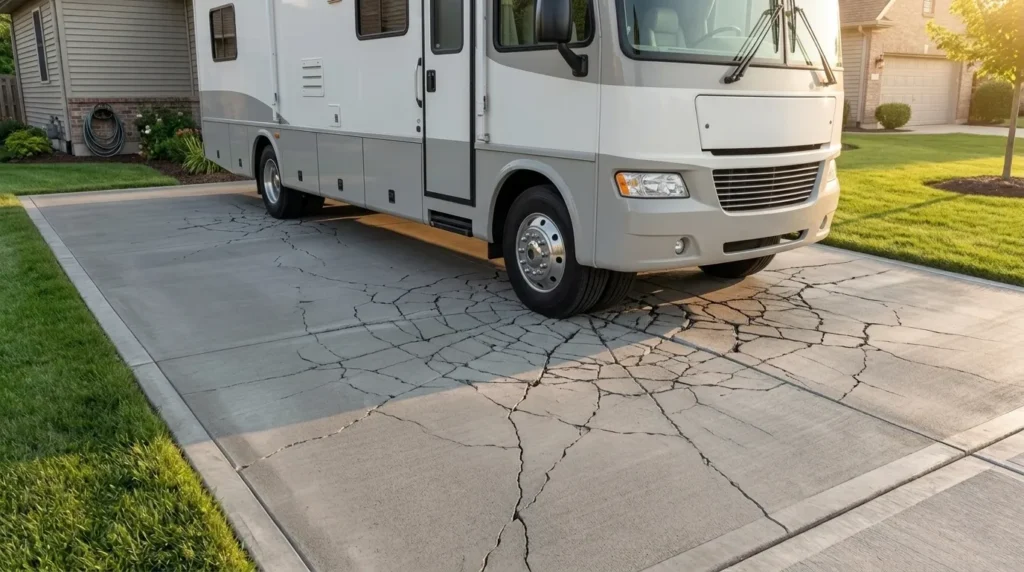
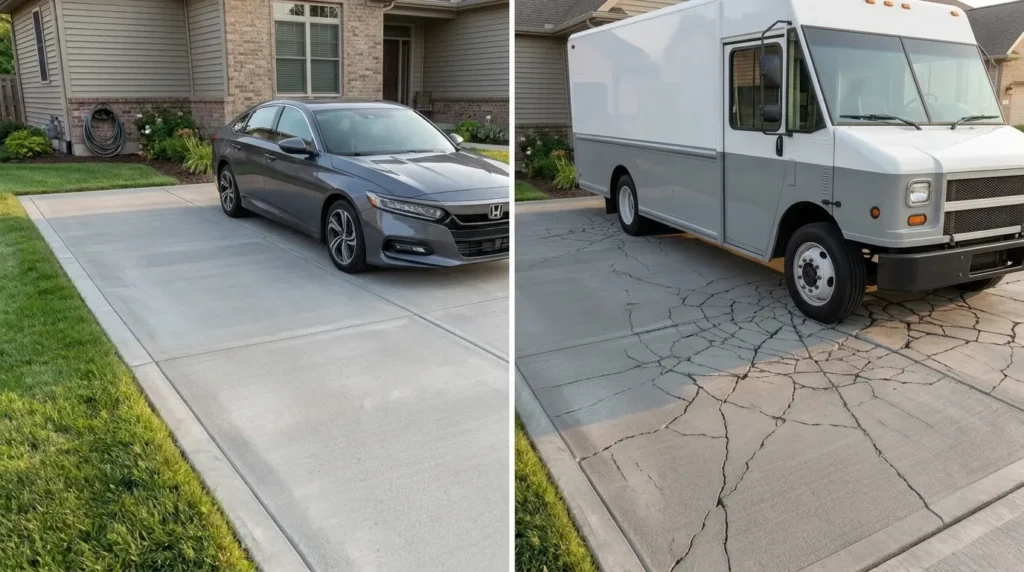
Heavy delivery trucks, moving trucks, and service vehicles exceed the safe load capacity of a standard 4-inch residential driveway. Occasional crossings — a moving truck once every few years — are unlikely to cause immediate failure, but repeated heavy truck traffic will shorten the slab’s service life significantly.
For driveways that regularly receive heavy delivery vehicles, 5–6 inches with #4 rebar on 12-inch centers is the correct specification.
RVs and Motorhomes
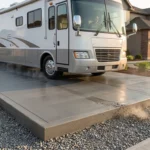
RVs are the most common load concern for residential 4-inch slabs. They’re heavy, they concentrate weight on relatively small tire patches, and homeowners often want to park them on existing driveways or new pads.
| RV Type | Gross Weight | Axle Load | Within 4″ Capacity? |
|---|---|---|---|
| Travel trailer (20 ft) | 5,000–8,000 lbs | 2,500–4,000 lbs (tandem) | ✅ Yes |
| Fifth wheel (30 ft) | 12,000–18,000 lbs | 6,000–9,000 lbs | ⚠️ Borderline |
| Class C motorhome | 12,000–16,000 lbs | 6,000–10,000 lbs | ⚠️ Borderline |
| Class A motorhome (30 ft) | 20,000–30,000 lbs | 10,000–15,000 lbs | ❌ Exceeds limit |
| Class A diesel pusher | 30,000–45,000 lbs | 15,000–25,000 lbs | ❌ Far exceeds limit |
Clear answer for RVs: Small travel trailers on a 4-inch driveway — acceptable. Any Class A motorhome or large fifth wheel — specify 6 inches minimum. This is one of the most common reasons homeowners need to upgrade from a 4-inch to a 6-inch specification.
Point Load vs. Distributed Load on a 4-Inch Slab
The load capacity tables above assume distributed loads — weight spread evenly across a large area. Real-world loads are rarely perfectly distributed, and point loads are far more dangerous to a concrete slab than equivalent distributed weights.
Why Point Loads Are Dangerous
A distributed load of 100 lbs/sq ft on a 576 sq ft garage floor = 57,600 lbs total — easily within capacity.
The same 57,600 lbs concentrated on a 4 sq ft area = 14,400 lbs/sq ft — far exceeding the slab’s capacity at that location.
The concrete doesn’t care about total weight. It responds to stress — force per unit area — at any given point. Concentrated loads create stress concentrations that can exceed local capacity even when the total load seems manageable.
Real-World Point Load Examples on 4-Inch Slabs
Floor jack under a vehicle: A floor jack lifting one corner of a 5,000 lb vehicle. Weight on jack: approximately 2,500 lbs. Jack pad diameter: 3 inches (area = 7.07 sq inches = 0.049 sq ft). Load per sq ft: 2,500 ÷ 0.049 = 51,020 lbs/sq ft.
This is an enormous point load — but it acts over such a small area that the surrounding concrete distributes it through the slab thickness. A 4-inch reinforced slab handles floor jack loads from passenger vehicles — the jack pad is small but the load distributes through the slab before reaching the subgrade.
Jack stands: A jack stand supporting 1,500 lbs on a 3-inch base: 30,560 lbs/sq ft point load. Same distribution principle applies — the 4-inch slab distributes this through its depth. Acceptable for standard passenger vehicles.
Storage shelving legs: A garage shelf holding 800 lbs on four legs, each with a 1-inch × 1-inch foot pad. Load per sq inch: 800 ÷ 4 = 200 lbs per leg ÷ 1 sq inch = 200 lbs/sq inch = 28,800 lbs/sq ft.
This sounds alarming — but the slab distributes it effectively. However, if the subgrade beneath one leg is soft, the leg can punch through the concrete at that point. Solution: add base plates (3-inch × 3-inch minimum) beneath each shelf leg.
Vehicle lift posts: A 2-post vehicle lift rated at 10,000 lbs. Each post base plate approximately 10 × 12 inches = 120 sq inches = 0.83 sq ft. Load per sq ft: 10,000 ÷ (2 × 0.83) = 6,024 lbs/sq ft.
According to the American Concrete Institute (ACI), vehicle lift installations require a minimum 4-inch slab at 3,000 PSI — but most lift manufacturers specify 4,000 PSI as minimum. For lifts over 10,000 lb capacity, 6 inches is recommended.
Worked Example — Garage Shelving System: A full wall of garage shelving, 20 feet long, holding 4,000 lbs of tools and equipment. Weight distributed across 10 upright posts, each with a 4 × 4 inch base plate.
- Load per post: 4,000 ÷ 10 = 400 lbs
- Contact area per post: 4 × 4 = 16 sq inches = 0.11 sq ft
- Load per sq ft per post: 400 ÷ 0.11 = 3,636 lbs/sq ft
A 4-inch, 4,000 PSI reinforced garage floor handles this without issue — the load distributes through the slab depth before reaching the subgrade, reducing the effective stress to manageable levels. This is typical residential garage shelving within normal parameters.
4-Inch Concrete Slab Load Limits by Application
Residential Driveway Load Limits
A standard residential driveway is designed for:
- Passenger cars and light trucks: ✅ Comfortably within capacity
- Loaded full-size pickups: ✅ Within capacity
- Occasional delivery trucks: ⚠️ Acceptable for infrequent crossings
- Regular heavy truck traffic: ❌ Exceeds design intent
Correct specification for standard residential driveway: 4 inches, 4,000 PSI, air-entrained in freeze-thaw climates, #4 rebar on 18-inch centers or 6×6 W2.9 wire mesh, control joints every 8–10 feet.
Signs a 4-inch driveway is being overloaded:
- Cracking that appears near tire tracks rather than at control joints
- Slab rocking or deflecting noticeably when driven on
- Cracks that widen progressively over multiple seasons
Garage Floor Load Limits
A standard garage floor accommodates:
- Two passenger vehicles: ✅ Well within capacity (13–14 lbs/sq ft)
- Full-size pickups: ✅ Within capacity
- Floor jacks and jack stands: ✅ Within capacity for standard vehicles
- Vehicle lifts (2-post, up to 10,000 lbs): ✅ Acceptable at 4,000 PSI minimum
- Vehicle lifts (over 10,000 lbs): ⚠️ Verify with lift manufacturer
- Loaded cargo shelving: ✅ Within capacity with base plates
Correct specification for residential garage floor: 4 inches, 4,000 PSI, #4 rebar on 18-inch centers, control joints at 12-foot maximum spacing, vapor barrier beneath slab.
Patio and Walkway Load Limits
Patios and walkways are almost never load-governed. Foot traffic, outdoor furniture, and typical garden equipment produce loads far below what any concrete slab can handle.
The governing design considerations for patio slabs are:
- Shrinkage cracking control (control joints, correct water-cement ratio)
- Freeze-thaw durability (air entrainment in cold climates)
- Surface finish and aesthetics
Correct specification for residential patio: 3.5–4 inches, 3,000–3,500 PSI, 6×6 W1.4×W1.4 wire mesh or no reinforcement, control joints every 8 feet, penetrating sealer for freeze-thaw protection.
What a 4-Inch Slab Cannot Handle
Being clear about limitations is as important as knowing what a 4-inch slab can do:
| Application | Why 4 Inches Is Insufficient |
|---|---|
| RV storage (Class A/B) | Axle loads 10,000–25,000 lbs exceed capacity |
| Regular delivery truck traffic | Repeated 14,000+ lb axle loads cause progressive damage |
| Heavy equipment storage | Point loads from equipment outriggers exceed safe limits |
| Commercial vehicle parking | Legal highway truck loads far exceed residential specs |
| Boat trailer storage (large) | Combined boat + trailer weight can exceed 15,000 lbs |
| Industrial forklift traffic | Dynamic forklift loads require 6–8 inches minimum |
How to Maximize Load Capacity of Your 4-Inch Slab
If you’re designing a new 4-inch slab and want to maximize its load capacity within the 4-inch thickness constraint, these steps have the greatest impact.
Subgrade Preparation
The single most impactful improvement available. A well-prepared subgrade dramatically increases effective slab capacity by providing uniform support.
Steps:
- Remove all organic material, soft soil, and debris from the slab area
- Proof-roll the subgrade — drive a loaded vehicle across it and watch for deflection. Areas that deflect more than 1 inch need additional compaction or replacement
- Install 4–6 inches of compacted crushed stone base if native soil is soft, expansive clay, or poorly draining
- Compact to 95% Proctor density — verify with a nuclear density gauge if the application is critical
- Ensure positive drainage — slope subgrade away from structures to prevent water accumulation beneath the slab
A 4-inch slab on excellent subgrade outperforms a 6-inch slab on poor subgrade in real-world load capacity. This investment costs almost nothing extra compared to the concrete itself.
PSI Specification
Upgrading from 3,000 PSI to 4,000 PSI costs approximately $5–$15 per cubic yard extra — a minimal premium for a meaningful capacity improvement.
For residential driveways and garage floors: always specify 4,000 PSI minimum. The additional cost on a standard 2-car driveway is $50–$150 — a negligible investment for 20–25% more flexural capacity and significantly better durability.
In freeze-thaw climates, specify 4,000–4,500 PSI with 5–7% air entrainment. The air entrainment costs approximately $5–$10 per yard extra but dramatically improves freeze-thaw durability — preventing the surface scaling that undermines 4-inch slabs in northern US climates within 5–10 years.
Correct Reinforcement Placement
Reinforcement in the wrong position provides almost no benefit. Wire mesh or rebar lying flat on the subgrade — the most common installation error — sits at the bottom of the slab where tensile stress is highest, but only if it was placed in the tension zone. Mesh on the ground is effectively in the compression zone and contributes almost nothing.
Correct placement:
- Wire mesh: Elevated to the center of the slab using concrete chairs or wire supports — at 2 inches from the bottom of a 4-inch slab
- Rebar: Positioned at 1.5–2 inches from the bottom face — in the tension zone where bending stress concentrates
This single correction — elevating reinforcement to the correct position — provides more practical benefit than upgrading from wire mesh to rebar while leaving it on the ground.
Proper Curing
Concrete gains strength through hydration — the chemical reaction between cement and water. This reaction requires moisture and time. A slab that dries out too quickly never reaches its specified strength.
Standard curing for residential slabs:
- Keep surface moist for minimum 7 days after pour
- Use wet burlap, plastic sheeting, or a curing compound
- In hot weather: begin curing immediately after finishing — within 20–30 minutes
- In cold weather: protect from freezing for minimum 3 days — concrete that freezes before reaching 500 PSI is permanently damaged
A properly cured 4,000 PSI concrete mix achieves approximately:
- 50% of specified strength at 3 days
- 70% at 7 days
- 90% at 14 days
- 100% at 28 days
Loading a slab before 7-day cure is complete risks permanent damage — particularly for driveways where vehicle loads are applied within days of pouring.
When to Upgrade from 4 Inches to 6 Inches
The 4-inch vs. 6-inch decision is one of the most consequential choices in residential concrete construction — and one of the least expensive to get right at the design stage.
The cost difference between a 4-inch and 6-inch slab on a standard 24×24 ft garage floor:
- 4-inch: approximately 7.1 cubic yards
- 6-inch: approximately 10.7 cubic yards
- Difference: 3.6 cubic yards at $160/yard = $576 additional material cost
For $576 more concrete, you get a slab with 3.4× more load capacity. This is almost always worth it when any of the following conditions apply:
| Condition | Upgrade to 6 Inches? |
|---|---|
| RV or motorhome storage | ✅ Yes — always |
| Regular delivery truck access | ✅ Yes |
| Vehicle lift installation | ✅ Yes for lifts over 10,000 lbs |
| Heavy equipment storage | ✅ Yes |
| Soft or uncertain subgrade | ✅ Yes |
| Slope greater than 5% | ✅ Yes |
| Commercial vehicle access | ✅ Yes |
| Uncertain future use | ✅ Yes — build in capacity |
The rule: If you’re unsure whether 4 inches is enough, the cost of upgrading to 6 inches is almost always less than the cost of repairing or replacing a failed 4-inch slab.
Frequently Asked Questions
How much weight will 4 inches of concrete hold?
A reinforced 4-inch slab at 4,000 PSI on properly compacted subgrade supports approximately 100–125 lbs per square foot under distributed loading. For vehicle loads, a 4-inch residential slab handles passenger cars and full-size pickups comfortably. It begins approaching its limits with one-ton dually trucks fully loaded and is insufficient for RVs over 12,000 lbs or regular commercial truck traffic.
Can a 4-inch concrete slab hold a car?
Yes — without any concern. A standard passenger car weighing 3,500 lbs produces less than 25 lbs per square foot on a garage floor or driveway — far below the 100+ lbs per square foot capacity of a standard 4-inch reinforced slab. Even a loaded full-size pickup truck is well within capacity.
How much weight can a 4-inch concrete driveway hold per square foot?
Approximately 100–125 lbs per square foot for a reinforced 4-inch slab at 4,000 PSI on good subgrade. For an unreinforced slab at 3,000 PSI on average subgrade, expect 60–80 lbs per square foot. Both figures assume static, distributed loading — point loads from vehicle tires require separate analysis based on tire contact area.
Is 4-inch concrete strong enough for a truck?
It depends on the truck. A half-ton or three-quarter ton pickup: yes, comfortably. A one-ton dually fully loaded: borderline — acceptable for regular use on good subgrade. A box truck or moving truck: no — axle loads of 14,000–20,000 lbs exceed the safe capacity of a standard 4-inch residential slab. For driveways that regularly receive large delivery or moving trucks, specify 5–6 inches.
Can 4-inch concrete hold an RV?
It depends on RV size and weight. Small travel trailers under 8,000 lbs: yes. Large fifth wheels and Class C motorhomes: borderline — acceptable on excellent subgrade but risky long-term. Class A motorhomes over 20,000 lbs: no — these require a 6-inch minimum slab specification. For dedicated RV pads, always specify 6 inches regardless of RV size — the cost difference is minimal and the capacity improvement is substantial.
What PSI should a 4-inch concrete slab be?
For residential driveways and garage floors: 4,000 PSI minimum. For patios and sidewalks: 3,000–3,500 PSI is adequate. In freeze-thaw climates with deicer exposure, 4,000–4,500 PSI with air entrainment is the correct specification regardless of application. Never specify below 3,000 PSI for any exterior concrete in the US.
Does wire mesh make a 4-inch slab stronger?
Wire mesh improves post-crack behavior — it keeps cracks tight, maintains load transfer across cracks, and bridges minor subgrade variations. It does not significantly increase the load at which the slab first cracks. The most important factor in wire mesh performance is placement — mesh must be elevated to the center of the slab, not left lying on the subgrade where it provides minimal benefit.
How long should I wait before driving on a 4-inch concrete slab?
Wait minimum 7 days before allowing passenger vehicle traffic. 28 days for full design strength. In cold weather (below 50°F), extend the waiting period — concrete gains strength more slowly in cold conditions. Never drive on concrete that has not completed its initial cure — loading too early permanently reduces the slab’s strength and durability.
Conclusion
A 4-inch concrete slab is the correct specification for the vast majority of residential applications — driveways, garage floors, patios, and sidewalks. It handles passenger cars, SUVs, and full-size pickups comfortably when built to the correct specification: 4,000 PSI, properly placed reinforcement, and well-compacted subgrade. Its limits begin with heavy trucks and large RVs — applications that belong on a 6-inch slab. Build your 4-inch slab correctly from the start — right subgrade, right PSI, right reinforcement placement, right curing — and it will perform exactly as designed for decades. Calculate your exact material requirements before ordering with the ConcreteCal bag calculator.