
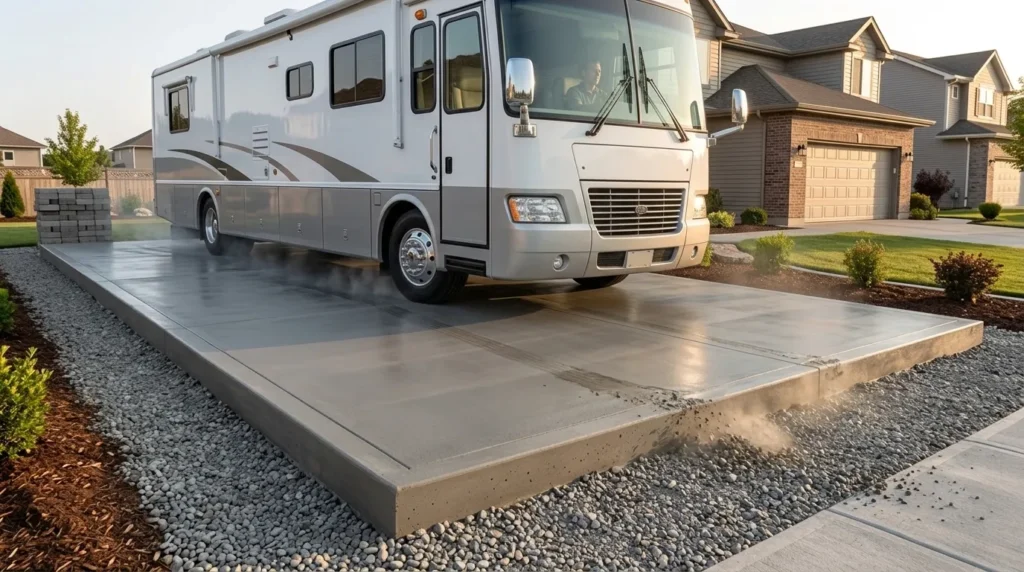

Six inches is where residential concrete becomes heavy-duty. A 6-inch slab is not just 50% thicker than a 4-inch slab — it is approximately 3.4 times stronger in flexural capacity due to the cubic relationship between thickness and bending strength. This single specification change opens up a completely different range of applications: RV storage, commercial driveways, warehouse floors, vehicle lifts rated above 10,000 lbs, and light industrial equipment pads.
How much weight can a 6-inch concrete slab hold depends on PSI, reinforcement, subgrade quality, and whether the load is distributed across a large area or concentrated at a single point — the same variables that govern 4-inch slabs, but operating at a significantly higher baseline capacity.
This guide gives you the complete picture: load tables, RV weight comparisons, forklift specifications, point load calculations, and clear guidance on when 6 inches is the right specification and when you need to go further.
Before pouring your slab, calculate your exact material requirements with the free concrete bag calculator at ConcreteCal.
For a complete comparison across all thicknesses — 3.5 inches through 12 inches — see our full reference guide on how much weight can concrete hold.
Table of Contents
- Why 6 Inches? Understanding the Step Up from 4-Inch Slabs
- How Much Weight Can a 6-Inch Concrete Slab Hold?
- 6-Inch vs. 4-Inch Slab — Capacity Comparison
- Can a 6-Inch Concrete Slab Hold an RV?
- Can a 6-Inch Concrete Slab Hold a Forklift?
- Heavy Truck Load Capacity on a 6-Inch Slab
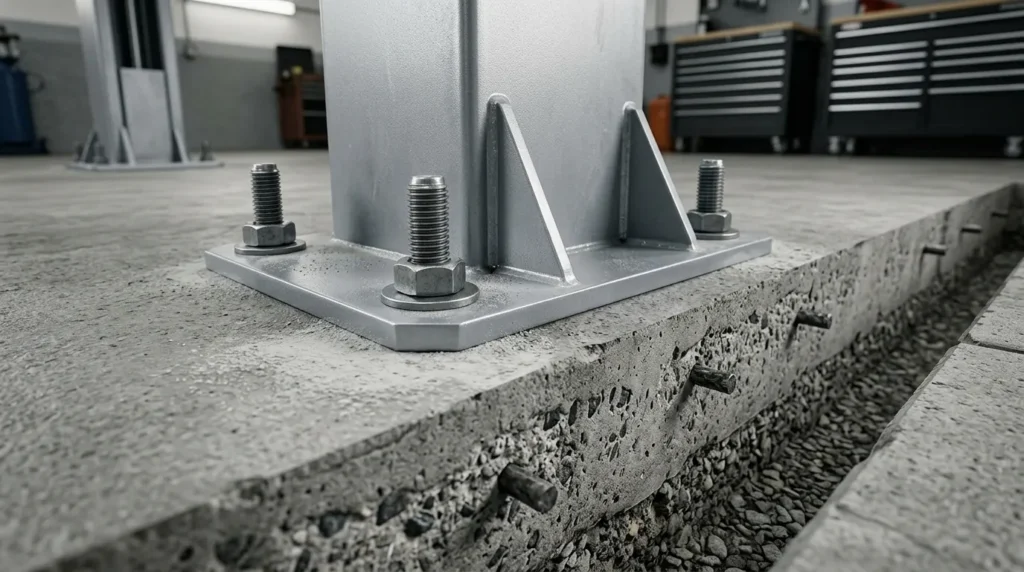
- Point Load Analysis for 6-Inch Slabs
- 6-Inch Concrete Slab Applications and Specifications
- How to Maximize Load Capacity of a 6-Inch Slab
- When to Upgrade Beyond 6 Inches
- Frequently Asked Questions
Why 6 Inches? Understanding the Step Up from 4-Inch Slabs
Most homeowners and contractors know that 6 inches is “stronger” than 4 inches — but few understand by exactly how much, or why the relationship is not simply proportional.
The Cube Rule — Why Thickness Matters So Much
Concrete slab flexural capacity scales with the square of thickness in simplified beam theory, and approaches a cubic relationship in slab-on-grade analysis. The result is that small increases in thickness produce large increases in load capacity.
The comparison between 4-inch and 6-inch slabs:
(6 ÷ 4)³ = 1.5³ = 3.375
A 6-inch slab has approximately 3.4 times the flexural load capacity of a 4-inch slab at the same PSI and reinforcement — not 50% more, but 240% more.
This is why the 4-inch to 6-inch upgrade is almost always worth the additional material cost. The cost increase is approximately 50% more concrete. The capacity increase is 340%. No other single specification change delivers this return.
Cost vs. capacity comparison — 24×24 ft slab:
| Specification | Concrete Volume | Material Cost (at $160/yd³) | Relative Capacity |
|---|---|---|---|
| 4 inch, 4,000 PSI | 7.1 yd³ | $1,136 | 1.0× (baseline) |
| 5 inch, 4,000 PSI | 8.9 yd³ | $1,424 | 1.95× |
| 6 inch, 4,000 PSI | 10.7 yd³ | $1,712 | 3.4× |
| 8 inch, 4,000 PSI | 14.2 yd³ | $2,272 | 8.0× |
For $576 more concrete (4-inch to 6-inch), you get 3.4× the load capacity. This is one of the best value-for-money upgrades in construction.
When 4 Inches Is Not Enough
Before specifying 6 inches, it is worth understanding exactly when 4 inches fails:
- RVs and motorhomes over 12,000 lbs: Axle loads exceed safe 4-inch capacity
- Regular delivery truck traffic: Repeated 14,000+ lb axle loads cause progressive damage
- Forklifts of any size: Dynamic wheel loads exceed 4-inch residential specification
- Vehicle lifts over 10,000 lbs: Point loads from lift posts require 6-inch minimum
- Heavy equipment storage: Outrigger point loads exceed 4-inch safe limits
- Uncertain or soft subgrade: 6 inches provides better load bridging over weak spots
- Future-proofing: If unsure about future use, 6 inches is almost always the right call
How Much Weight Can a 6-Inch Concrete Slab Hold — The Exact Numbers
Unreinforced 6-Inch Slab Capacity
An unreinforced 6-inch slab at 3,500 PSI on properly compacted subgrade:
Distributed load capacity: Approximately 175–225 lbs per square foot under static, evenly distributed loading.
For a 576 sq ft area (24×24 ft): supports approximately 100,000–130,000 lbs distributed evenly — over 60 tons. The unreinforced 6-inch slab is structurally substantial for distributed loads.
The limitation, as always, is concentrated loads and subgrade failure — an unreinforced slab that loses subgrade support cracks suddenly and without warning.
Reinforced 6-Inch Slab Capacity
A reinforced 6-inch slab at 4,000 PSI with #4 rebar on 18-inch centers on compacted subgrade:
Distributed load capacity: Approximately 200–250 lbs per square foot
With heavier reinforcement (#5 rebar on 12-inch centers):
Distributed load capacity: Approximately 250–300 lbs per square foot
These are the numbers that make a 6-inch slab appropriate for RVs, light commercial vehicles, forklifts, and vehicle lifts — applications that simply exceed what 4 inches can reliably deliver.
Load Capacity by PSI — Reference Table
| Slab Spec | Distributed Capacity | Max Axle Load (Approx.) | Safe For |
|---|---|---|---|
| 6″ / 3,000 PSI / wire mesh | 160–190 lbs/sq ft | 16,000 lbs | RV storage, light trucks |
| 6″ / 3,500 PSI / wire mesh | 175–215 lbs/sq ft | 18,000 lbs | Commercial driveway |
| 6″ / 4,000 PSI / #4 rebar | 200–250 lbs/sq ft | 22,000 lbs | Standard commercial |
| 6″ / 4,000 PSI / #5 rebar | 225–275 lbs/sq ft | 25,000 lbs | Heavy commercial |
| 6″ / 4,500 PSI / #5 rebar | 250–300 lbs/sq ft | 28,000 lbs | Light industrial |
| 6″ / 5,000 PSI / #5 rebar | 275–325 lbs/sq ft | 32,000 lbs | Industrial floor |
All values assume properly prepared, uniformly compacted subgrade with granular base course. Soft subgrade reduces these values by 30–50%.
6-Inch Concrete Slab vs. 4-Inch Slab — Capacity Comparison
| Factor | 4-Inch Slab (4,000 PSI) | 6-Inch Slab (4,000 PSI) | Difference |
|---|---|---|---|
| Distributed capacity | 100–125 lbs/sq ft | 200–250 lbs/sq ft | +100–125% |
| Max safe axle load | ~10,000 lbs | ~22,000 lbs | +120% |
| Flexural capacity | Baseline | 3.4× baseline | +240% |
| Material cost (24×24) | $1,136 | $1,712 | +51% |
| Safe for passenger cars | ✅ Yes | ✅ Yes | Same |
| Safe for full-size pickups | ✅ Yes | ✅ Yes | Same |
| Safe for Class A RV | ❌ No | ✅ Yes | Different |
| Safe for forklifts | ❌ No | ✅ Light forklifts | Different |
| Safe for delivery trucks | ⚠️ Borderline | ✅ Yes | Different |
| Safe for semi-trucks | ❌ No | ⚠️ Borderline | Marginal |
The table makes the upgrade argument clear — for $576 more concrete on a standard garage-size slab, you move from “borderline” to “comfortable” on a wide range of heavy applications.
Can a 6-Inch Concrete Slab Hold an RV?
RV storage is one of the most common reasons homeowners specify 6-inch concrete — and one of the clearest applications where 4 inches falls short.
Travel Trailers and Fifth Wheels
| RV Type | Gross Weight | Axle Load | 6-Inch Capacity? |
|---|---|---|---|
| Small travel trailer (18 ft) | 3,500–6,000 lbs | 1,750–3,000 lbs | ✅ Comfortably |
| Medium travel trailer (24 ft) | 6,000–9,000 lbs | 3,000–4,500 lbs | ✅ Yes |
| Large travel trailer (30 ft) | 9,000–14,000 lbs | 4,500–7,000 lbs | ✅ Yes |
| Small fifth wheel (28 ft) | 12,000–16,000 lbs | 6,000–8,000 lbs | ✅ Yes |
| Large fifth wheel (36 ft) | 18,000–24,000 lbs | 9,000–12,000 lbs | ✅ Yes |
All travel trailers and fifth wheels are well within the capacity of a properly constructed 6-inch reinforced slab. A 4-inch slab handles most travel trailers but struggles with large fifth wheels — another reason the 6-inch specification is the correct choice for any dedicated RV pad.
Class A and Class C Motorhomes
| RV Type | Gross Weight | Drive Axle Load | 6-Inch Capacity? |
|---|---|---|---|
| Class B camper van | 8,000–12,000 lbs | 4,000–6,000 lbs | ✅ Yes |
| Class C (24 ft) | 12,000–16,000 lbs | 8,000–10,000 lbs | ✅ Yes |
| Class C (30 ft) | 16,000–22,000 lbs | 10,000–14,000 lbs | ✅ Yes |
| Class A gas (34 ft) | 20,000–26,000 lbs | 12,000–16,000 lbs | ✅ Yes |
| Class A diesel (38 ft) | 28,000–36,000 lbs | 18,000–24,000 lbs | ⚠️ Borderline |
| Class A diesel (40+ ft) | 36,000–45,000 lbs | 24,000–30,000 lbs | ❌ Exceeds limit |
Worked Example — Class A Gas Motorhome: A 34-foot Class A gas motorhome with GVWR of 24,000 lbs. Drive axle load approximately 14,000 lbs across two rear tires. Wide-base RV tires with contact area of approximately 45 sq inches each.
Load per sq inch at each drive tire:
14,000 ÷ (2 × 45) = 155 lbs/sq inch
A 6-inch, 4,000 PSI reinforced slab handles this comfortably — the load distributes through the slab depth before reaching the subgrade. A 4-inch slab at the same spec would be at or above its safe limit.
For large diesel pushers over 36,000 lbs: An 8-inch slab with engineering design is the correct specification. These are the largest production motorhomes and their drive axle loads approach commercial truck territory.
Correct RV Pad Specification
For any dedicated RV storage pad — regardless of current RV size — specify 6 inches as the minimum:
- Thickness: 6 inches minimum; 8 inches for diesel pushers over 30,000 lbs
- PSI: 4,000 minimum; 4,500 in freeze-thaw climates
- Reinforcement: #4 rebar on 12–18 inch centers
- Subgrade: 6-inch compacted granular base minimum
- Control joints: Every 10–12 feet — RV tires apply concentrated loads at predictable locations
- Air entrainment: 5–7% in freeze-thaw climates
The reason to always specify 6 inches even for a small current RV: you will likely own a larger RV in the future, and upgrading a concrete pad is expensive. Build the capacity in from the start.
Can a 6-Inch Concrete Slab Hold a Forklift?
Forklifts are among the most demanding loads a concrete floor can face — not because of their total weight, but because of how that weight is distributed and the dynamic forces generated by movement.
Forklift Weight and Axle Loads
A critical and counterintuitive fact about forklifts: the drive axle (rear) carries the majority of the load, not the front. This is because the counterweight at the rear of the forklift balances the load being carried at the front — shifting the center of gravity and concentrating weight on the rear axle.
| Forklift Capacity | Total Weight (loaded) | Drive Axle Load | 6-Inch Capacity? |
|---|---|---|---|
| 3,000 lb capacity | 8,000–10,000 lbs | 6,000–7,500 lbs | ✅ Yes |
| 5,000 lb capacity | 10,000–13,000 lbs | 7,500–10,000 lbs | ✅ Yes |
| 8,000 lb capacity | 14,000–18,000 lbs | 10,500–13,500 lbs | ✅ Yes |
| 10,000 lb capacity | 18,000–22,000 lbs | 13,500–16,500 lbs | ⚠️ Borderline |
| 15,000 lb capacity | 26,000–32,000 lbs | 19,500–24,000 lbs | ❌ Exceeds |
| 20,000 lb capacity | 35,000–42,000 lbs | 26,000–31,500 lbs | ❌ Exceeds |
A 6-inch, 4,500 PSI reinforced slab handles forklifts up to approximately 8,000–10,000 lb capacity comfortably. Above 10,000 lb capacity, engineering analysis is required — 8-inch slabs are typically specified for medium to large forklifts.
Dynamic Load Factor
A moving forklift generates significantly higher loads than its static weight suggests. Every time a forklift:
- Accelerates or decelerates
- Turns with a load
- Travels over a joint or crack
- Drops or picks up a load
…the dynamic impact multiplies the effective load on the floor. Standard engineering practice applies a dynamic load factor of 1.3–1.5× to forklift static loads for floor design.
Practical implication: A 5,000 lb capacity forklift with a 10,000 lb static drive axle load produces:
10,000 × 1.3 = 13,000 lbs effective design load
This is still within the capacity of a 6-inch, 4,500 PSI reinforced slab — but the dynamic factor is why static load tables alone are insufficient for industrial floor design.
When 6 Inches Is Enough and When It Is Not
| Application | 6-Inch Sufficient? | Notes |
|---|---|---|
| Light forklift (3,000 lb cap.) | ✅ Yes | Standard warehouse spec |
| Medium forklift (5,000 lb cap.) | ✅ Yes | 4,500 PSI recommended |
| Heavy forklift (8,000 lb cap.) | ✅ Yes | 4,500 PSI + #5 rebar |
| Large forklift (10,000 lb cap.) | ⚠️ Borderline | Engineering review required |
| Extra-large forklift (15,000+) | ❌ No | 8–10 inch required |
| Reach truck or narrow-aisle | ✅ Usually | Smaller tire contact area |
Heavy Truck Load Capacity on a 6-Inch Slab
Delivery Trucks and Box Trucks
| Vehicle | Gross Weight | Rear Axle Load | 6-Inch Capacity? |
|---|---|---|---|
| Sprinter van (loaded) | 8,500 lbs | 4,500–5,500 lbs | ✅ Yes |
| Box truck (16 ft) | 14,000–18,000 lbs | 8,000–12,000 lbs | ✅ Yes |
| Box truck (26 ft) | 26,000 lbs | 14,000–18,000 lbs | ✅ Yes |
| Straight truck (33,000 lbs) | 33,000 lbs | 18,000–22,000 lbs | ✅ Yes |
| Delivery truck (Amazon/UPS) | 10,000–15,000 lbs | 7,000–10,000 lbs | ✅ Yes |
A 6-inch, 4,000 PSI reinforced slab on well-prepared subgrade handles all standard delivery and box truck configurations — this is one of the primary reasons commercial loading docks and delivery areas specify 6-inch concrete as a minimum.
Semi-Trucks and Commercial Vehicles
This is where 6-inch slabs begin to reach their limits.
| Vehicle | Gross Weight | Drive Axle Load | 6-Inch Capacity? |
|---|---|---|---|
| Single-axle semi (light load) | 40,000 lbs | 18,000–22,000 lbs | ✅ Borderline |
| Tandem-axle semi (full load) | 80,000 lbs | 34,000 lbs per axle | ❌ Exceeds |
| Dump truck (loaded) | 55,000–70,000 lbs | 28,000–35,000 lbs | ❌ Exceeds |
| Concrete truck | 60,000–70,000 lbs | 30,000–35,000 lbs | ❌ Exceeds |
Important practical note: Concrete delivery trucks — used to pour the very slab being discussed — exceed the safe capacity of a 6-inch slab. This is why ready-mix trucks never drive onto finished residential or light commercial slabs. The truck drives alongside the formwork during the pour, not on the finished concrete.
For driveways or aprons that must accommodate fully loaded semi-trucks, 8–10 inches with engineering design is required — 6 inches is insufficient.
Point Load Analysis for 6-Inch Slabs
Vehicle Lift Load Requirements
Vehicle lifts are one of the most common point load applications in residential and light commercial settings.
2-post lift (10,000 lb capacity):
- Two base plates, each approximately 10 × 12 inches
- Total base area: 240 sq inches = 1.67 sq ft
- Load per sq ft: 10,000 ÷ 1.67 = 5,988 lbs/sq ft
A 6-inch, 4,000 PSI reinforced slab handles this load — and this is exactly why 6 inches is the minimum specification for most 2-post lift manufacturers.
4-post lift (14,000 lb capacity):
- Four posts, each with approximately 12 × 12 inch base plate
- Total base area: 4 × 144 = 576 sq inches = 4.0 sq ft
- Load per sq ft: 14,000 ÷ 4.0 = 3,500 lbs/sq ft
A 4-post lift distributes load across four points rather than two — the load per unit area is lower than a 2-post lift. A 6-inch, 4,000 PSI slab handles 4-post lifts up to 14,000 lb capacity comfortably.
Worked Example — Auto Repair Shop: A professional auto repair shop installing two 2-post lifts at 12,000 lb capacity each. Slab specification requirement from lift manufacturer: 6 inches minimum, 4,000 PSI, #4 rebar on 12-inch centers, minimum 28-day cure before lift installation.
Each lift post base: 10 × 12 inches = 120 sq inches = 0.83 sq ft Load per sq ft per lift (two posts): 12,000 ÷ (2 × 0.83) = 7,229 lbs/sq ft
A 6-inch, 4,000 PSI reinforced slab handles this. A 4-inch slab at the same spec would be overstressed at the post locations — exactly why lift manufacturers specify 6 inches.
According to the American Concrete Institute (ACI), vehicle lift installations require engineering verification of slab thickness and PSI before installation — minimum 6-inch, 4,000 PSI is the baseline for any lift rated above 10,000 lbs.
Storage Rack and Equipment Loads
Heavy-duty pallet racking (6,000 lb per bay):
- 4 upright posts per bay section
- Base plates: 4 × 4 inches = 16 sq inches per post
- Load per post: 6,000 ÷ 4 = 1,500 lbs
- Load per sq inch: 1,500 ÷ 16 = 93.75 lbs/sq inch = 13,500 lbs/sq ft
This is a significant point load. A 6-inch, 4,000 PSI slab distributes this through its depth — the load reaching the subgrade is far lower than 13,500 lbs/sq ft. However, for very heavily loaded racking (over 20,000 lbs per bay), engineering analysis and base plate sizing are required.
Rule for storage racks on 6-inch slabs: Add minimum 4 × 4 inch base plates under every rack upright. For racks loaded above 8,000 lbs per bay, use 6 × 6 inch minimum base plates and verify with a structural engineer.
6-Inch Concrete Slab Applications and Specifications
Commercial Driveway
A commercial driveway serving delivery trucks, box trucks, and frequent heavy vehicle traffic:
Recommended specification:
- Thickness: 6 inches
- PSI: 4,000–4,500
- Reinforcement: #4 rebar on 12–18 inch centers
- Subgrade: 6-inch compacted granular base
- Air entrainment: 5–7% in freeze-thaw climates
- Control joints: Every 12 feet maximum
- Joint edges: Armored with steel angle at high-traffic joints
What it handles: All delivery trucks, box trucks, straight trucks, and light semi-trucks. Not suitable for fully loaded 80,000 lb semi-trucks on a regular basis.
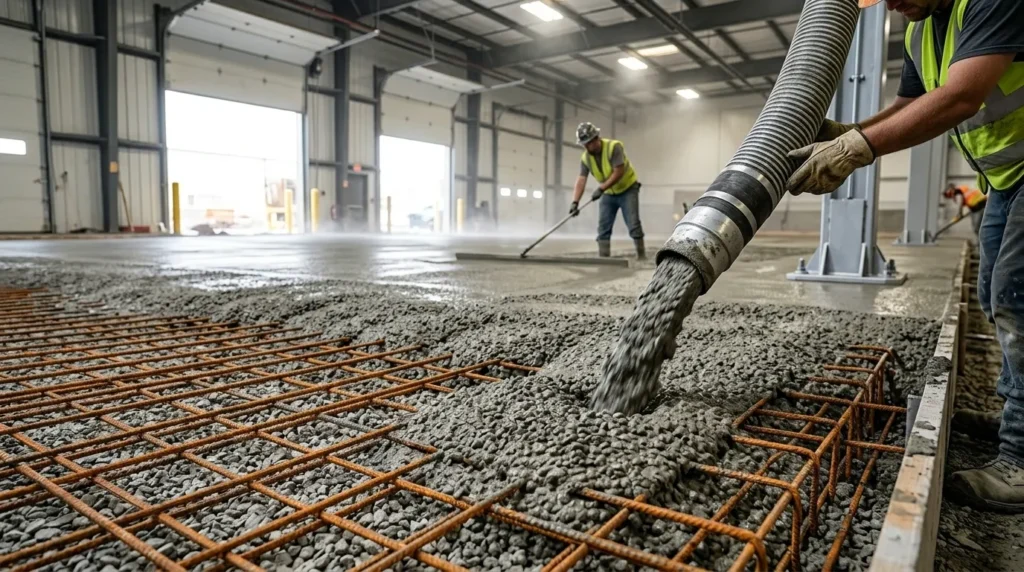
Warehouse and Industrial Floor
A warehouse floor serving forklifts up to 8,000 lb capacity, pallet racking, and standard industrial traffic:
Recommended specification:
- Thickness: 6 inches minimum; 8 inches preferred for heavy forklift use
- PSI: 4,500
- Reinforcement: #5 rebar on 12-inch centers OR steel fiber at 40–60 lbs/yd³
- Subgrade: 6-inch compacted crushed stone base, vapor barrier
- Surface: Power troweled to burnished finish
- Control joints: Every 15–20 feet with armored edges
Worked Example — Small Warehouse: A 10,000 sq ft warehouse floor. 6-inch, 4,500 PSI slab, steel fiber at 50 lbs/yd³ (eliminates conventional rebar for this application), burnished trowel finish, control joints at 18-foot spacing with armored edges.
Total concrete: 10,000 × (6/12) ÷ 27 = 185 yd³ Fiber addition: 185 × 50 lbs = 9,250 lbs of steel fiber Result: Floor handles 5,000 lb capacity forklifts, standard pallet racking up to 8,000 lbs per bay, and foot and light vehicle traffic — all within 6-inch capacity.
RV Storage Pad
A dedicated RV storage pad for motorhomes up to 30,000 lbs:
Recommended specification:
- Thickness: 6 inches
- PSI: 4,000
- Reinforcement: #4 rebar on 12-inch centers
- Subgrade: 6-inch compacted gravel base
- Dimensions: Minimum 14 ft wide × length of RV + 6 ft
- Control joints: Along length at 10-foot intervals
- Slope: 1–2% for drainage
Heavy Equipment Pad
An equipment pad for construction equipment, generators, compressors, or HVAC units:
Specification depends on equipment weight and outrigger loads. For equipment up to 40,000 lbs on outriggers:
- Thickness: 6–8 inches depending on outrigger contact area
- PSI: 4,500
- Reinforcement: #5 rebar on 12-inch centers
- Subgrade: Engineered fill, compacted
For equipment with outrigger point loads exceeding 50,000 lbs per pad: engineering design required — 6 inches alone may be insufficient regardless of PSI.
How to Maximize Load Capacity of a 6-Inch Slab
The same principles that maximize 4-inch slab capacity apply to 6-inch slabs — but the baseline is already high, so these improvements push capacity into territory that handles virtually all residential and light commercial applications.
1. Granular base course — the most impactful improvement. A 6-inch compacted crushed stone base beneath the concrete provides uniform support, improves drainage, and prevents the differential settlement that causes slab failure regardless of concrete strength. On soft or variable soil, this single addition can double the effective slab capacity.
2. Specify 4,500 PSI instead of 4,000 PSI. The cost premium is approximately $10–$20 per cubic yard. On a 185 yd³ warehouse floor, that’s $1,850–$3,700 extra for 15–20% more flexural capacity and significantly better abrasion resistance. Worth it for any floor with forklift or heavy equipment traffic.
3. Use #5 rebar on 12-inch centers instead of #4 on 18-inch centers. #5 rebar is 56% heavier than #4 per linear foot — more material cost, but significantly better post-crack load transfer and subgrade bridging. For warehouse floors and commercial applications, #5 on 12-inch centers is the preferred specification.
4. Consider steel fiber reinforcement. Steel fibers at 40–60 lbs/yd³ replace conventional rebar in many industrial floor applications — eliminating the labor of placing and tying rebar while providing superior crack control and post-crack toughness. Many warehouse floor specifications now use fiber exclusively for 6-inch slabs.
5. Armored joint edges. In forklifted floors, joint edge spalling — the progressive chipping of concrete at control joint edges under forklift wheel impact — is the most common floor failure mode. Steel angle armor embedded at joint edges prevents this entirely. This is a 6-inch floor improvement that has no equivalent for residential 4-inch slabs.
6. Cure for full 28 days before heavy loading. A 6-inch slab gains strength more slowly than a 4-inch slab due to its greater mass — the interior hydrates more slowly. Full 28-day cure is important before subjecting the slab to its maximum design loads. At 7 days, a 4,500 PSI mix has achieved approximately 65–70% of specified strength — adequate for light loads but not for forklifts or heavy equipment.
When to Upgrade Beyond 6 Inches
Six inches handles the vast majority of residential and light commercial applications. The situations that require more:
| Application | Minimum Thickness | Reason |
|---|---|---|
| Fully loaded semi-trucks | 8–10 inches | 34,000 lb axle load exceeds 6-inch capacity |
| Large forklifts (10,000+ lb cap.) | 8 inches | Dynamic loads exceed 6-inch safe limits |
| Heavy crane pads | 10–12 inches | Outrigger point loads require engineering |
| Diesel pusher RV (40,000+ lbs) | 8 inches | Drive axle load at upper 6-inch limit |
| High-cube warehouse (heavy racking) | 8 inches | Combined racking + forklift loads |
| Foundation slabs | Engineer specified | Structural requirements govern |
The 8-inch decision rule: If any vehicle or equipment with an axle or outrigger load exceeding 25,000 lbs will use the slab regularly, specify 8 inches with engineering design. One-time crossings of heavy vehicles on a 6-inch slab are generally acceptable — regular traffic is not.
Frequently Asked Questions
How much weight can a 6-inch concrete slab hold?
A reinforced 6-inch slab at 4,000 PSI on properly compacted subgrade supports approximately 200–250 lbs per square foot under distributed loading — approximately 3.4 times the capacity of an equivalent 4-inch slab. It handles RVs up to 30,000 lbs, delivery trucks, box trucks, forklifts up to 8,000 lb capacity, and vehicle lifts up to 14,000 lbs.
How much stronger is a 6-inch concrete slab than a 4-inch slab?
Approximately 3.4 times stronger in flexural capacity — the property that governs slab load capacity. This is due to the cubic relationship between thickness and bending strength: (6÷4)³ = 3.375. For $576 more concrete on a standard 24×24 ft slab, you get 240% more load capacity.
Can a 6-inch concrete slab hold an RV?
Yes — a 6-inch, 4,000 PSI reinforced slab handles all travel trailers, fifth wheels, Class B and C motorhomes, and Class A gas motorhomes up to approximately 30,000 lbs. Large diesel pushers over 36,000 lbs approach the upper limits of 6-inch capacity — an 8-inch specification is recommended for these vehicles.
Can a 6-inch concrete slab hold a forklift?
Yes for light to medium forklifts. A 6-inch, 4,500 PSI reinforced slab handles forklifts up to approximately 8,000–10,000 lb capacity when dynamic load factors are applied. Larger forklifts require engineering analysis and typically 8-inch minimum slab thickness.
What is the difference between a 6-inch and 8-inch concrete slab?
An 8-inch slab has approximately 2.37 times the flexural capacity of a 6-inch slab at the same PSI — (8÷6)³ = 2.37. The 8-inch specification is required for large forklifts over 10,000 lb capacity, fully loaded semi-trucks, heavy crane pads, and any application where 6-inch capacity is insufficient. Cost is approximately 33% more concrete than 6 inches.
Is 6-inch concrete enough for a warehouse floor?
For light to medium warehouse use with forklifts up to 8,000 lb capacity and standard pallet racking: yes. For heavy forklift operations with machines over 10,000 lb capacity, or high-density racking systems loaded above 20,000 lbs per bay: specify 8 inches with engineering design.
What PSI should a 6-inch concrete slab be?
For residential applications (RV pad, heavy driveway): 4,000 PSI minimum. For commercial driveways and loading areas: 4,000–4,500 PSI. For warehouse and industrial floors: 4,500 PSI minimum. In freeze-thaw climates with deicer exposure: 4,500 PSI with 5–7% air entrainment regardless of application.
How much does a 6-inch concrete slab cost compared to 4 inches?
Approximately 50% more concrete volume — a 24×24 ft slab uses 10.7 yd³ at 6 inches versus 7.1 yd³ at 4 inches. At $160/yd³, the material cost difference is approximately $576. For the 3.4× capacity improvement this delivers, the 6-inch upgrade is almost always the correct economic decision when heavy loads are anticipated.
Can a 6-inch concrete slab hold a semi-truck?
Partially. A lightly loaded single-axle semi (under 22,000 lb axle load) is borderline acceptable on a 6-inch, 4,500 PSI reinforced slab with good subgrade. A fully loaded tandem-axle semi at 34,000 lbs per axle exceeds 6-inch capacity — 8–10 inches with engineering design is required for regular semi-truck traffic.
Conclusion
A 6-inch concrete slab is the right specification for every application where 4 inches is not enough — RVs, delivery trucks, light commercial vehicles, forklifts up to 8,000 lb capacity, and vehicle lifts. The 3.4× capacity improvement over 4 inches costs only 50% more concrete — making it one of the best value decisions in residential and commercial construction. Specify 4,000–4,500 PSI, use #4 or #5 rebar correctly placed in the tension zone, prepare your subgrade properly, and cure for the full 28 days before heavy loading. Calculate your exact concrete requirements before ordering with the ConcreteCal bag calculator — and see our complete thickness comparison in the full guide on how much weight can concrete hold.