
The first question every homeowner asks before a concrete project is the same: how much is this going to cost? And the first number a concrete supplier gives you is always a per-yard price. Understanding what that number means, what it includes, what it doesn’t include, and how it varies — by region, by mix, by season, and by volume — is the difference between a realistic budget and a surprise invoice.
How much does a yard of concrete cost in 2026 ranges from $115 to $200+ per cubic yard for standard ready mix, depending on where you are in the country, what mix specification you need, and how much you’re ordering. Add delivery fees, short load charges, and fuel surcharges, and the real cost per yard is often $30–$80 higher than the quoted material price.
This guide breaks down every component of concrete pricing — regional rates, mix premiums, delivery fees, and the strategies contractors use to get the best price on every pour.
Before calculating how much your project will cost, find out exactly how many yards you need with our free concrete cost calculator at ConcreteCal — it calculates volume, material cost, and delivery fees together.
For a complete project cost breakdown including labor and finishing, see our full guide on the concrete cost calculator.
Table of Contents
- What Is a Cubic Yard of Concrete?
- How Much Does a Yard of Concrete Cost?
- What Affects the Price of Concrete Per Yard?
- Concrete Delivery Cost — What to Expect
- Bagged Concrete vs. Ready Mix — Cost Per Yard
- How to Get the Best Price on Concrete Per Yard
- Cost Per Yard by Project Type
- Frequently Asked Questions
What Is a Cubic Yard of Concrete?
Before comparing prices, it helps to understand exactly what you’re buying when you order “a yard” of concrete.
A cubic yard is a volume measurement — one yard × one yard × one yard = 27 cubic feet of concrete. This is the standard unit used by all ready mix suppliers in the United States. Every price quote you receive will be in dollars per cubic yard.
How Big Is a Cubic Yard?
Visualizing a cubic yard helps you understand why concrete is priced this way and how quickly volume adds up.
One cubic yard of concrete:
- Fills a box 3 feet × 3 feet × 3 feet
- Covers 81 square feet at 4 inches thick
- Covers 54 square feet at 6 inches thick
- Weighs approximately 4,050 lbs (2 tons)
A standard ready mix truck holds 8–10 cubic yards — approximately 16–20 tons of concrete. This is why concrete trucks are heavy and why they can’t always access tight residential sites.
How Many Cubic Yards Do I Need?
The formula:
Volume (yd³) = Length (ft) × Width (ft) × Thickness (ft) ÷ 27
Worked Example: A 16 ft × 40 ft driveway at 5 inches thick:
16 × 40 × (5÷12) ÷ 27 = 16 × 40 × 0.417 ÷ 27 = 9.9 cubic yards
Add 10% waste factor: 9.9 × 1.10 = 10.9 yards — order 11 yards.
For instant volume calculation without manual math, use our concrete cost calculator — enter your dimensions and get cubic yards, bag count, and estimated cost in seconds.
How Much Does a Yard of Concrete Cost — Current Prices
Ready mix concrete pricing in 2025 varies significantly by region, mix specification, and market conditions. Here are current price ranges based on aggregated supplier data across the US.
Ready Mix Concrete Price by Region
| Region | Low | High | Typical Average |
|---|---|---|---|
| Northeast US | $145 | $225 | $180 |
| Southeast US | $120 | $190 | $152 |
| Midwest US | $115 | $180 | $148 |
| Southwest US | $130 | $195 | $162 |
| West Coast US | $155 | $235 | $195 |
| Mountain West | $140 | $210 | $172 |
| Rural / Remote | $165 | $260+ | $210+ |
Prices per cubic yard, standard 3,000–4,000 PSI ready mix delivered, 2025. Source: aggregated from regional supplier surveys and RS Means Construction Data.
These are material-only prices — delivery fees are additional and covered below.
What Is Included in the Per-Yard Price?
When a supplier quotes you $160 per cubic yard, that price typically includes:
✅ Concrete material — cement, aggregate, sand, water ✅ Batching and mixing at the plant ✅ Standard mix design (3,000–4,000 PSI) ✅ Delivery within standard distance (usually 10–15 miles)
It does NOT include: ❌ Short load fee (if ordering under minimum) ❌ Fuel surcharge (often separate line item) ❌ Waiting time / standby charges (if pour takes too long) ❌ Pump hire (if truck cannot reach pour location directly) ❌ Saturday or after-hours premium ❌ Specialty mix upgrades (fiber, accelerator, retarder)
Always ask your supplier for a fully itemized quote — the base per-yard price is just the starting point.
Price by PSI and Mix Specification
Standard 3,000 PSI concrete is the baseline price. Every upgrade adds cost:
| Mix Specification | Premium Over Base 3,000 PSI |
|---|---|
| 3,000 PSI standard | Baseline |
| 3,500 PSI | +$5–$10/yd |
| 4,000 PSI | +$10–$20/yd |
| 4,500 PSI | +$15–$25/yd |
| 5,000 PSI | +$20–$35/yd |
| Air entrainment (4–7%) | +$5–$15/yd |
| Fiber reinforcement | +$15–$30/yd |
| Accelerating admixture | +$8–$15/yd |
| Retarding admixture | +$5–$12/yd |
| Water reducer / plasticizer | +$8–$20/yd |
| Fly ash replacement (20%) | -$5–$10/yd (saves cost) |
Worked Example — Driveway Mix Upgrade: Standard 3,000 PSI driveway quote: $150/yd Upgrade to 4,000 PSI with air entrainment for freeze-thaw climate: +$25/yd = $175/yd
On a 11-yard driveway order: $275 total premium for a mix that dramatically improves durability and surface life in northern climates. Almost always worth it.
What Affects the Price of Concrete Per Yard?
Regional Supply and Demand
Concrete is a local commodity — it cannot be shipped long distances because it begins hydrating immediately after mixing. This means pricing is entirely governed by local market conditions.
High-cost markets: Dense urban areas with high real estate costs, limited plant locations, and strong construction demand — New York, San Francisco, Boston, Seattle.
Low-cost markets: Areas with abundant aggregate supply, multiple competing batch plants, and moderate construction activity — Midwest states, rural Southeast.
The practical implication: Getting quotes from multiple suppliers in your area is the single most effective cost-reduction strategy. Price differences of $20–$40 per yard between competing suppliers in the same city are common.
Fuel and Delivery Distance
Ready mix trucks are heavy, fuel-intensive vehicles. Fuel costs directly affect concrete pricing — supplier surcharges rise and fall with diesel prices.
Delivery distance matters: most suppliers include delivery within 10–15 miles of the plant in the base price. Beyond that, per-mile charges of $5–$15/mile are common.
Worked Example: Your project is 22 miles from the nearest batch plant. Supplier charges $8/mile beyond 15 miles.
Extra mileage: 22 – 15 = 7 miles × $8 = $56 delivery surcharge per truck load.
On an 11-yard order delivered in two trucks: $112 additional delivery cost — not insignificant on a small residential pour.
Mix Specification and Admixtures
As shown in the price table above, higher PSI and specialty admixtures add meaningful cost. The largest single mix premium is typically high-strength concrete (5,000+ PSI) and fiber reinforcement — both commonly specified for commercial and industrial applications.
For residential use, the most common and cost-effective upgrade is air entrainment in freeze-thaw climates — typically $5–$15/yd extra for dramatic durability improvement.
Order Volume and Seasonal Timing
Volume: Suppliers prefer large orders that fill trucks efficiently. Small orders (under 3–4 yards) attract short load fees and sometimes less competitive pricing. Orders of 10+ yards often qualify for volume pricing.
Seasonal timing: Spring and summer are peak concrete season — highest demand, tightest supply, least price flexibility. Fall orders see moderate pricing. Winter orders (where weather permits) often see the best pricing — plants are less busy and more willing to negotiate.
Off-peak discount potential: 5–15% savings on material price for winter or off-peak orders — on a $2,000 material order, that’s $100–$300 in savings for flexible scheduling.
Concrete Delivery Cost — What to Expect
Delivery cost is where many concrete budgets go wrong — it’s separate from the per-yard material price and has several components.
Standard Delivery Fee
Most ready mix suppliers charge a flat delivery fee that covers:
- Truck dispatch from the plant
- Driver time to site and back
- Standard pour time (typically 5–7 minutes per yard to discharge)
| Distance from Plant | Typical Delivery Fee |
|---|---|
| Under 5 miles | $50–$100 |
| 5–10 miles | $75–$150 |
| 10–15 miles | $100–$200 |
| 15–20 miles | $150–$250 |
| Over 20 miles | $200+ plus per-mile charge |
Short Load Fee — The Hidden Cost
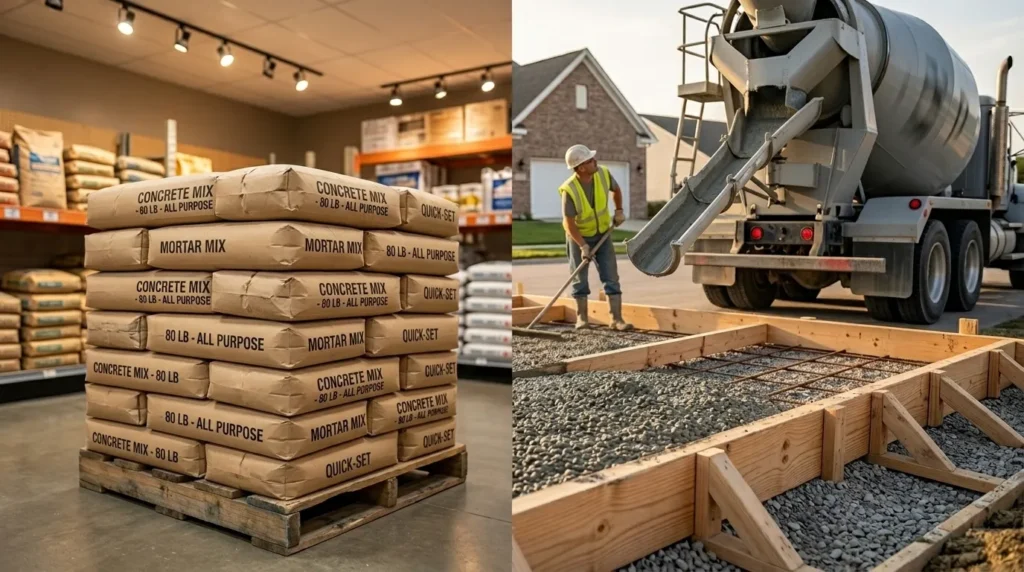
A short load fee is charged when your order falls below the plant’s minimum — typically 8–10 yards per truck. If you order 4 yards, you’re using less than half a truck’s capacity — the supplier charges a premium to compensate.
| Order Volume | Typical Short Load Fee |
|---|---|
| Under 1 yard | $150–$250 |
| 1–2 yards | $100–$175 |
| 2–3 yards | $75–$125 |
| 3–4 yards | $50–$100 |
| 5+ yards | Usually waived |
Strategy: If your project falls just below a fee threshold, consider slightly expanding the slab — adding 2 feet of width or length to push your order over the minimum can save more than the concrete costs.
Worked Example: A 10 ft × 12 ft shed base at 4 inches thick = 1.48 yards. At this volume, short load fee of $125 applies. Total: (1.48 × $160) + $125 = $362.
Alternative: Expand the base to 12 ft × 12 ft = 1.78 yards. Still triggers the short load fee but better value per yard. OR: use 80 lb bags — 1.78 yards = approximately 80 bags at $7.50 = $600 in bags — ready mix wins even with the short load fee.
Fuel Surcharges
Many suppliers add a fuel surcharge — typically $5–$20 per yard — as a separate line item that fluctuates with diesel prices. This surcharge is sometimes buried in the quote and sometimes listed separately.
Always ask: “Does your quoted price include fuel surcharge?” — if not, add $5–$15 per yard to your estimate.
Bagged Concrete vs. Ready Mix — Cost Per Yard Comparison
Understanding the cost crossover between bagged and ready mix helps you make the right choice for small projects.
| Bag Size | Price Per Bag | Yield | Bags Per Yard | Cost Per Yard |
|---|---|---|---|---|
| 40 lb | $5.50 | 0.30 ft³ | 90 | $495 |
| 60 lb | $6.50 | 0.45 ft³ | 60 | $390 |
| 80 lb | $7.50 | 0.60 ft³ | 45 | $338 |
| Ready mix | — | — | — | $130–$200 |
The crossover point: At 45 bags of 80 lb mix (1 cubic yard), bagged concrete costs $338 versus $130–$200 for ready mix. Ready mix is almost always cheaper per yard for any project over 1 cubic yard.
When bags win:
- Project under 0.5 yards (under 22 bags) — no delivery fee, no minimum
- No truck access to the pour site
- Flexible timeline — mix as needed without time pressure
- Remote location far from any batch plant
When ready mix wins:
- Any project over 1 cubic yard
- Time-sensitive pours requiring continuous placement
- Consistent mix quality and PSI specification
- Any project with complex forming that benefits from faster pour
How to Get the Best Price on Concrete Per Yard
Get Multiple Quotes
The single most effective strategy. Concrete pricing varies $20–$50 per yard between competing suppliers in the same market — on a 10-yard order, that’s $200–$500 in savings for 30 minutes of phone calls.
Call at least three suppliers. Give each the same specification: volume in yards, PSI required, air entrainment (yes/no), pour date, and site address. Compare fully itemized quotes — not just the per-yard headline price.
Order in Off-Peak Season
November through February is the slowest period for ready mix plants in most US markets. Suppliers are more willing to negotiate price, waive short load fees, and accommodate flexible scheduling.
Realistic savings: 5–15% on material price. On a $1,760 material order (11 yards at $160), that’s $88–$264 in savings.
Combine Projects
If you need a driveway and a patio, pour them on the same day. One delivery fee, one truck, one order. Combining orders that would individually attract short load fees into a single larger order often eliminates the fee entirely.
Negotiate Short Load Fees
Short load fees are often negotiable — particularly for repeat customers or if you’re willing to accept delivery at a time convenient for the plant. Ask directly: “Can you waive the short load fee if I’m flexible on delivery time?”
Cost Per Yard by Project Type
Driveway Cost Per Yard
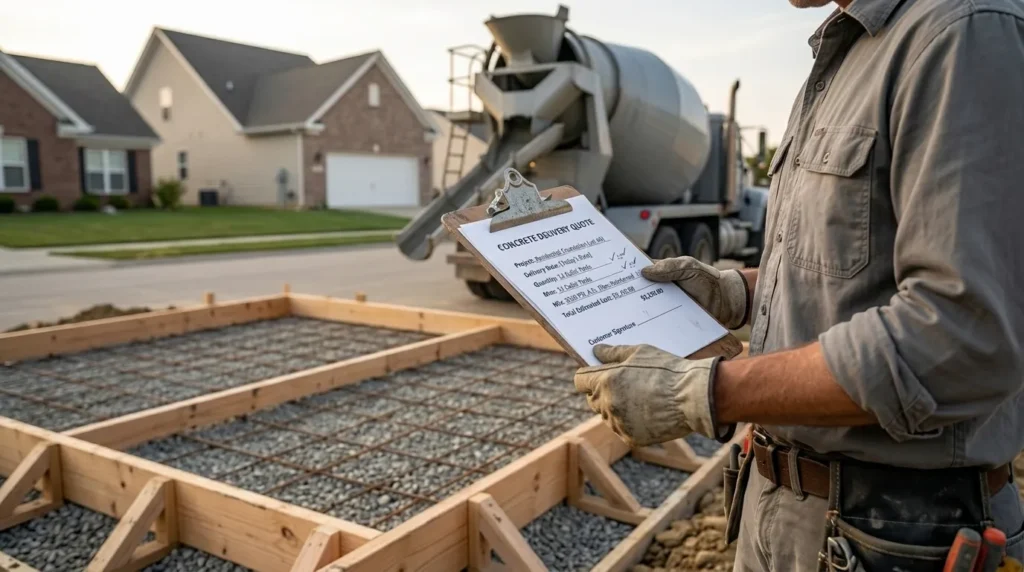
A standard two-car driveway (16 ft × 40 ft, 5 inches thick) requires approximately 9.9 yards before waste — order 11 yards.
| Item | Cost |
|---|---|
| Material: 11 yd³ at $160/yd | $1,760 |
| Delivery fee | $100 |
| 4,000 PSI upgrade + air entrainment | $275 (11 × $25) |
| Total material + delivery | $2,135 |
Labor for forming, pouring, and finishing: $2,500–$4,500 depending on region. Total installed driveway: $4,635–$6,635
Patio Cost Per Yard
A 16 ft × 20 ft patio at 4 inches thick requires approximately 3.95 yards — order 4.5 yards.
| Item | Cost |
|---|---|
| Material: 4.5 yd³ at $160/yd | $720 |
| Delivery fee | $100 |
| Short load fee (under 5 yards) | $75 |
| Total material + delivery | $895 |
Labor: $800–$1,600. Total installed patio: $1,695–$2,495
Garage Floor Cost Per Yard
A 24 ft × 24 ft garage floor at 5 inches thick requires approximately 8.9 yards — order 10 yards.
| Item | Cost |
|---|---|
| Material: 10 yd³ at $160/yd | $1,600 |
| Delivery fee | $100 |
| 4,000 PSI upgrade | $200 (10 × $20) |
| Total material + delivery | $1,900 |
Labor: $1,500–$3,000. Total installed garage floor: $3,400–$4,900
Foundation Cost Per Yard
A 30 ft × 40 ft foundation slab at 8 inches thick requires approximately 29.6 yards — order 33 yards.
| Item | Cost |
|---|---|
| Material: 33 yd³ at $160/yd | $5,280 |
| Delivery (multiple trucks) | $300 |
| 4,000 PSI + rebar spec | $660 (33 × $20) |
| Pump hire (trench/footing work) | $600 |
| Total material + delivery | $6,840 |
Frequently Asked Questions
How much does a yard of concrete cost in 2026?
The national average for ready mix concrete in 2026 is $130–$200 per cubic yard delivered, depending on region, PSI specification, and supplier. The Midwest averages $115–$180/yd; the West Coast averages $155–$235/yd. Add delivery fees of $75–$200 and any applicable short load charges to get your true cost per yard.
How much is 5 yards of concrete?
At $160/yd average: $800 in material. Add delivery ($100) and the short load fee may be waived at 5 yards with most suppliers. Total: approximately $900–$1,000 for 5 yards delivered.
How much is 8 yards of concrete?
At $160/yd: $1,280 in material plus delivery. At 8 yards, most suppliers waive short load fees. Total: approximately $1,380–$1,480 depending on delivery distance and mix specification.
How much does 10 yards of concrete cost?
At $160/yd average: $1,600 in material. Delivery typically included or minimal at this volume. Total: approximately $1,700–$1,900 depending on mix upgrades and region.
How much does 12 yards of concrete cost?
At $160/yd: $1,920. At this volume, suppliers may offer slight volume pricing. Budget $2,000–$2,300 including delivery and any mix upgrades.
How much is ready mix concrete per yard?
Ready mix concrete ranges from $115 to $235 per cubic yard in the US in 2025, depending on region. Standard 3,000 PSI in the Midwest starts around $115–$140/yd. The same spec on the West Coast runs $155–$190/yd. High-strength or specialty mixes add $15–$35/yd on top of the base price.
What is a short load fee for concrete?
A short load fee is charged when your order falls below the batch plant’s minimum — typically 8–10 yards per truck. Fees range from $50 for orders just under minimum to $250 for very small orders of 1 yard or less. At 5+ yards, most suppliers waive the fee. The fee compensates the supplier for dispatching a truck that is only partially filled.
Is concrete cheaper in winter?
Yes — in most US markets, concrete is 5–15% cheaper in winter (November–February) due to lower demand. Suppliers are more willing to negotiate price, waive short load fees, and offer flexible scheduling. In climates where ground freezes, outdoor concrete work is limited in winter — but if your project is in a heated space or in a mild-winter climate, winter ordering can deliver meaningful savings.
How do I get the best price on concrete?
Get at least three quotes from competing suppliers, specify the same mix for each comparison, ask for fully itemized quotes including all fees, order in off-peak season if flexible, combine multiple small projects into one order to avoid short load fees, and ask directly about fee waivers for flexible scheduling.
How much is a truck of concrete?
A full ready mix truck holds 8–10 cubic yards. At $160/yd, a full truck runs $1,280–$1,600 in material plus delivery. Most residential projects don’t need a full truck — and ordering significantly more than you need wastes money since most plants don’t accept concrete returns.
Conclusion
A yard of concrete costs $115–$235 depending on where you are, what mix you need, and when you order. But the per-yard material price is just the starting point — delivery fees, short load charges, fuel surcharges, and mix upgrades routinely add $30–$80 per effective yard to your real cost. Get multiple quotes, ask for fully itemized pricing, order in off-peak season when possible, and calculate your volume accurately before you call. Use the ConcreteCal concrete cost calculator to build your complete project budget before picking up the phone.