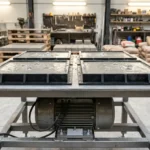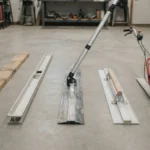
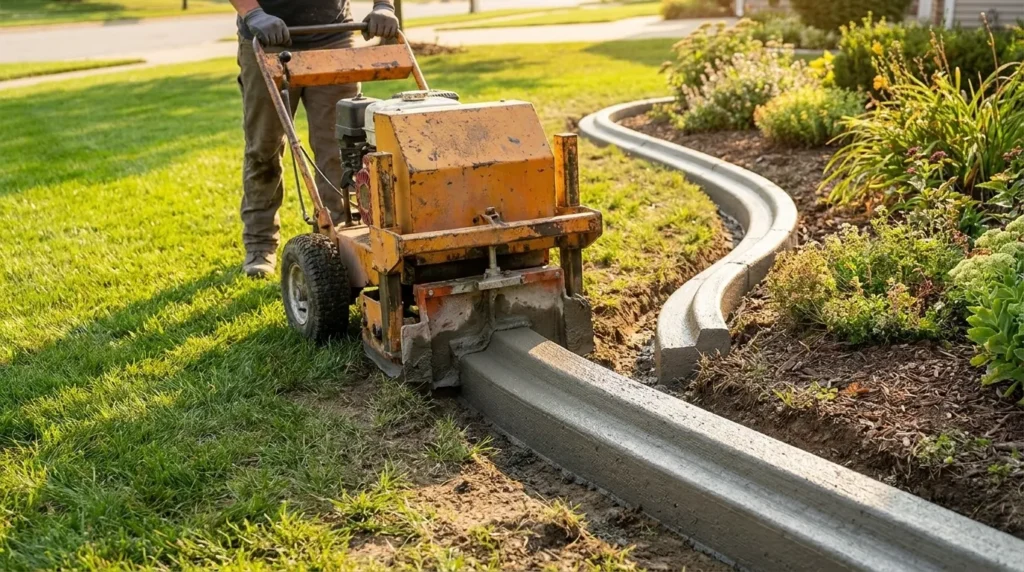

A concrete curbing machine does in one continuous pass what a team of skilled form workers would take hours to achieve manually — it places, shapes, and finishes a concrete curb in a single operation, moving forward at a controlled speed while the operator monitors the profile quality behind it. Whether it is a walk-behind landscape curbing extruder creating garden border definition in a residential backyard, or a full-size slipform paver laying highway barrier profile at 20 linear feet per minute, the principle is the same: concrete goes in the hopper, the machine shapes it through a die, and a finished curb is left on the ground.
Understanding concrete curbing machines — what types exist, what they cost, how they are operated, and what applications they suit — is the foundation of any successful curbing project or curbing business decision. This guide covers every category of curbing machine from small landscape extruders to professional road paving equipment, with specification comparisons, operating guidance, and a complete cost and ROI analysis.
For concrete volume calculations before any curbing project, use the free concrete calculator at ConcreteCal. For a complete guide to curb types and design specifications, see our types of concrete curbs guide.
Table of Contents
- What Is a Concrete Curbing Machine?
- Types of Concrete Curbing Machines
- Harbor Freight Concrete Curbing Machine
- Concrete Curbing Machine — Key Specifications
- Concrete Curbing Machine Comparison Table
- What Concrete Mix Do You Use in a Curbing Machine?
- How to Operate a Concrete Curbing Machine
- Landscape Curbing Machine — Residential Applications
- Concrete Curbing Machine Cost and ROI
- Frequently Asked Questions
What Is a Concrete Curbing Machine?
A concrete curbing machine is a self-propelled or walk-behind piece of equipment that continuously forms concrete into a specific curb profile as it moves forward. Fresh concrete is loaded into the machine’s hopper, conveyed to a shaped extrusion die, and extruded onto the prepared ground surface in a continuous strip. The concrete stiffens rapidly behind the machine, holding the extruded profile without any formwork.
How a Curbing Machine Works
The operating principle of any concrete curbing machine involves five sequential steps:
1. Concrete loading: Fresh concrete is loaded into the machine’s hopper — either manually (for small landscape machines) or by direct chute from a ready mix truck or mixer drum (for larger commercial equipment).
2. Conveyance: An auger or conveyor moves concrete from the hopper to the extrusion die at a controlled rate matched to the machine’s forward travel speed.
3. Extrusion: The concrete is forced through a shaped die that forms the curb profile. The die cross-section determines the curb shape — different dies produce different profiles (barrier curb, mountable curb, mower’s edge, serpentine, Victorian, etc.).
4. Compaction: Many machines include a vibration system — either a vibrating die or an internal vibrator — that consolidates the concrete as it passes through the die, ensuring adequate density without manual rodding.
5. Surface finishing: Immediately behind the die, a float or trowel attachment provides initial surface finishing. The operator may apply additional hand finishing in the moments after the machine passes before the concrete stiffens.
The critical variable is speed — the machine must move forward at a rate that matches the concrete feed rate and stiffness. Too fast and the die does not fill completely (profile gaps); too slow and the concrete over-fills and slumps (profile distortion).
Curbing Machine vs Manual Curb Forming
| Factor | Curbing Machine | Manual Forming |
|---|---|---|
| Production rate | 50–200+ linear ft/hour | 8–20 linear ft/hour |
| Profile consistency | Excellent | Variable |
| Labour requirement | 1–2 operators | 3–6 workers |
| Formwork | None required | Required |
| Minimum quantity | 50–100 linear ft (economical) | Any quantity |
| Curved sections | Limited radius | Any curve |
| Setup time | 15–30 minutes | 2–4 hours |
| Finish quality | Good to excellent | Good (skilled crew) |
| Cost per linear foot | Lower at scale | Lower at small scale |
The break-even point: Manual forming is more cost-effective for very short runs (under 50 linear feet) where machine setup time dominates total project time. For any project over 100 linear feet — particularly for landscape curbing where the same profile repeats along the full length — machine production is faster, cheaper, and more consistent.
Types of Concrete Curbing Machines
Walk-Behind Slipform Curbing Machine
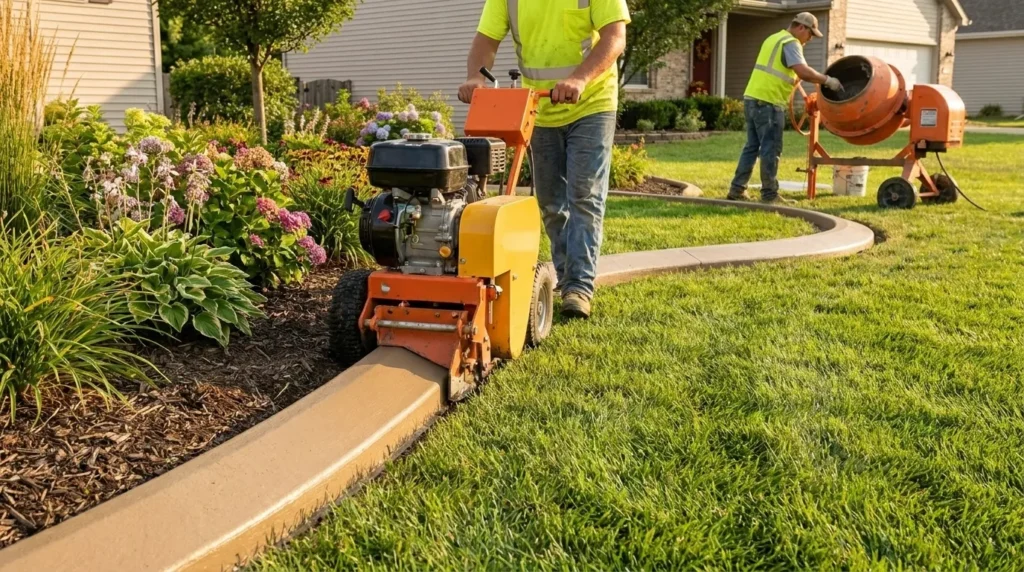
The walk-behind slipform curbing machine is the workhorse of the landscape curbing industry. An operator walks behind a self-propelled machine that extrudes continuous curb at rates of 50–150 linear feet per hour, depending on machine size and concrete consistency.
Key characteristics:
- Self-propelled (engine-driven track or wheel drive)
- Hopper capacity: 1–4 cubic feet
- Output rate: 50–150 linear ft/hour
- Profile flexibility: Multiple die options (mower’s edge, slant, serpentine, barrier, rolled)
- Concrete supply: Manual loading from wheelbarrow or small mixer
- Weight: 200–600 lbs depending on size
- Engine: Gasoline, typically 5–13 HP
Best for: Landscape curbing contractors, residential property curbing, garden border installation, commercial landscape maintenance companies.
Worked Example — Residential Landscape Project:
A landscaping contractor installing continuous garden border curbing around a 1-acre residential property. Total curbing run: 400 linear feet. Machine: walk-behind landscape curber, 8 HP gasoline, mower’s edge profile. Production rate: 80 linear ft/hour. Total machine time: 5 hours. Concrete required: 400 linear feet × 0.028 cubic yards per linear foot = 11.2 cubic yards.
Manual forming equivalent: 400 linear feet ÷ 12 linear ft/hour/person = 33 person-hours. Machine option: 5 hours × 2 operators = 10 person-hours. Machine saves 23 person-hours on this project alone.
Ride-On Curbing Machine
Ride-on curbing machines are larger commercial equipment — the operator rides on the machine rather than walking behind it. These are used for road curbing, parking lot perimeter curbing, and large commercial landscape projects.
Key characteristics:
- Operator seated on machine
- Output rate: 150–500+ linear ft/hour
- Hopper capacity: 3–8+ cubic feet
- Concrete supply: Ready mix truck direct delivery to hopper
- Profile capability: Full range including barrier, mountable, curb-and-gutter
- Weight: 1,000–4,000+ lbs
- Engine: Diesel or gasoline, 25–50+ HP
Best for: Road construction contractors, large commercial site contractors, parking lot construction, any project requiring hundreds to thousands of linear feet of consistent curb profile.
Landscape Curbing Machine (Extruder)
The landscape curbing machine — often called a curbing extruder or curbing machine — is a purpose-designed tool for residential and commercial landscape curbing specifically. It differs from a general slipform paver in being optimised for the curved borders, decorative profiles, and relatively short runs of landscape applications.
Distinguishing features of landscape curbing machines:
- Tight turning radius — can navigate curves as small as 12–18 inches
- Multiple decorative die profiles — mower’s edge, slant, serpentine, Victorian, cobblestone
- Color integrated concrete capability — accepts pigmented mixes
- Stamp and texture tools compatible — can imprint pattern into fresh curb
- Smaller hopper (1–3 cubic feet) matched to wheelbarrow concrete supply
- Lightweight (200–400 lbs) for transport and setup
The landscape curbing business: Landscape curbing machines have enabled a significant cottage industry — contractor-owners who operate a landscape curbing machine as a standalone business, marketing continuous concrete edging to residential and commercial clients. Startup cost is relatively low (machine plus a small concrete mixer), and the product has high perceived value at moderate material cost.
Road Curb Slipform Paver
A road curb slipform paver is heavy construction equipment — the machine used for large-scale highway, arterial road, and airport perimeter curbing. These are not available for casual purchase and are operated by civil construction specialists.
Scale comparison:
| Machine Type | Output Rate | Weight | Cost |
|---|---|---|---|
| Landscape extruder | 50–120 ft/hr | 200–400 lbs | $8,000–$25,000 |
| Walk-behind commercial | 80–150 ft/hr | 400–700 lbs | $15,000–$40,000 |
| Ride-on commercial | 150–400 ft/hr | 1,000–3,000 lbs | $40,000–$120,000 |
| Road slipform paver | 500–2,000 ft/hr | 5,000–50,000 lbs | $150,000–$500,000+ |
Harbor Freight Concrete Curbing Machine — What to Know
Harbor Freight is one of the most searched terms combined with “concrete curbing machine” — typically by homeowners and small contractors researching the lowest-cost entry into curbing equipment.
What Harbor Freight Offers
As of the knowledge available for this guide, Harbor Freight does not sell a dedicated concrete curbing machine in its standard product catalog. Harbor Freight’s construction tool range focuses on hand tools, power tools, and general construction equipment — concrete mixers, trowels, screeds — but not concrete extrusion or slipform curbing equipment.
What people searching “Harbor Freight concrete curbing machine” are typically looking for:
- A low-cost entry into landscape curbing equipment
- An affordable alternative to commercial curbing machine brands
- General concrete tools for DIY curbing projects
Is Harbor Freight Curbing Equipment Worth It?
For concrete curbing specifically: The most affordable concrete curbing machines start at approximately $8,000–$10,000 from specialist manufacturers. This price point does not overlap with Harbor Freight’s typical product range ($50–$2,000 for most power tools).
What Harbor Freight offers that IS relevant to concrete curbing projects:
- Concrete mixers ($200–$600) for preparing curbing concrete
- Concrete floats and finishing tools ($15–$50)
- Wheelbarrows for concrete transport ($80–$150)
- Rebar benders and cutters for any reinforcement requirements
For DIY curbing without a machine: Small concrete edge projects can be formed manually using 4-inch PVC pipe split lengthwise as a mould, or using pre-made plastic edging forms available from landscape suppliers. The result is not as clean as machine-extruded curbing, but it is achievable at very low cost.
For the concrete curbing tool set available here — this represents the hand tools and accessories that complement curbing machine operation or enable manual small-scale curbing without a dedicated machine.
Concrete Curbing Machine — Key Specifications
Output Rate (Linear Feet Per Hour)
Output rate is the primary productivity specification of any curbing machine. It depends on:
- Machine size and auger capacity
- Concrete consistency (stiffer concrete = slower throughput)
- Profile complexity (complex profiles require slower speed for detail)
- Curve radius (tight curves require slower speed for alignment control)
- Operator experience
Realistic output rates by machine category:
| Machine Type | Ideal Conditions | Average Real-World | Curved Sections |
|---|---|---|---|
| Small landscape extruder | 100–120 ft/hr | 60–80 ft/hr | 30–50 ft/hr |
| Commercial walk-behind | 140–180 ft/hr | 100–140 ft/hr | 60–80 ft/hr |
| Ride-on commercial | 300–500 ft/hr | 200–350 ft/hr | 100–150 ft/hr |
Output rate affects project profitability directly. A landscape curbing contractor charging $4–$8 per linear foot needs high output to maintain reasonable hourly revenue. At 80 linear feet per hour and $6 per linear foot: $480/hour gross revenue. Material cost of approximately $0.80–$1.20/linear foot leaves $384–$416/hour gross margin — against which machine cost, fuel, and labour are covered.
Motor and Power Options
Gasoline engines: Most walk-behind and landscape curbing machines use gasoline engines — 5HP to 13HP depending on machine size. Gasoline provides complete independence from electrical supply and adequate power for auger drive, track drive, and vibration systems simultaneously.
Electric motors: Some smaller landscape curbing extruders offer electric motor options — useful for enclosed or noise-sensitive environments. Requires power supply within cable distance of the work area.
Hydraulic systems: Larger commercial curbing machines use hydraulic systems driven by the main engine — providing smooth, variable speed control of both the track drive and the concrete conveyance auger, allowing precise matching of forward speed to concrete feed rate.
Curb Profile Capability
The die attached to the extrusion head determines the curb profile. Most landscape curbing machines accept interchangeable dies — the operator selects the die that matches the client’s specification and bolts it in place.
Standard profile dies available for most landscape curbing machines:
- Mower’s edge: Flat-topped profile, allows lawnmower wheel to ride on top
- Slant/slant face: Most common residential border — angled face, flat top
- Serpentine: S-curved profile face — decorative, garden aesthetic
- Victorian: Scalloped profile — ornamental, period property aesthetic
- Barrier/straight face: Vertical face — more formal, commercial applications
- Rolled/mountable: Gradual curved transition — allows vehicle crossing
Die change time: Typically 10–20 minutes including bolt removal, die exchange, and retightening. Experienced operators change dies in less than 10 minutes.
Feed Hopper Capacity
Hopper capacity determines how often the machine must stop for concrete reloading — directly affecting production efficiency.
Small landscape machines (1–1.5 cubic feet): Must reload every 35–50 linear feet from a wheelbarrow. Requires a two-person operation — one operating the machine, one mixing and wheeling concrete. The stop-start rhythm limits practical output rate to 60–80 linear feet/hour even if the machine’s rated output is higher.
Medium commercial machines (2–3 cubic feet): Reload every 70–100 linear feet. Can accept concrete from a larger portable mixer, reducing reload frequency.
Large commercial machines (4–8+ cubic feet): Can accept direct chute delivery from a ready mix truck or a large tow-behind mixer — enabling nearly continuous operation on large projects.
Concrete Curbing Machine Comparison Table
| Machine | Type | Output (ft/hr) | Engine | Hopper | Profiles | Price Range |
|---|---|---|---|---|---|---|
| Small landscape extruder | Walk-behind | 50–100 | 5–6 HP gas | 1–1.5 ft³ | 4–8 standard | $8,000–$14,000 |
| Mid landscape curber | Walk-behind | 80–140 | 8–9 HP gas | 1.5–2 ft³ | 6–12 standard | $14,000–$22,000 |
| Commercial walk-behind | Walk-behind | 120–180 | 11–13 HP gas | 2–3 ft³ | Full range | $22,000–$40,000 |
| Ride-on commercial | Ride-on | 200–400 | 25–35 HP diesel | 4–6 ft³ | Full range | $50,000–$120,000 |
| Road slipform paver | Ride-on | 500–2,000 | 50+ HP diesel | Self-feeding | Road profiles | $150,000+ |
What Concrete Mix Do You Use in a Curbing Machine?
The concrete mix for curbing machines is fundamentally different from the mix used for poured slabs or columns. The machine extrudes concrete — it must hold its shape immediately after leaving the die, without any formwork support. This requires a stiff, low-slump mix that the machine can shape but that does not slump or deform after extrusion.
Slump Requirements
Target slump for landscape curbing machines: 0–2 inches (very stiff)
A 0-inch slump concrete is essentially dry — it crumbles if you try to squeeze it in your hand. Curbing concrete sits between a true zero-slump and a 2-inch slump: stiff enough to hold the extruded profile without formwork, but wet enough to extrude through the die without binding.
Testing slump in the field: The finger test — push your finger 1 inch into the mix. The indentation should hold its shape cleanly. If the mix flows back, it is too wet. If the indentation crumbles at the edges, it may be too dry.
What happens with wrong slump:
- Too wet (over 2 inches): Profile slumps after extrusion — curb looks rounded and shapeless
- Too dry (under 0 inches): Machine auger jams; concrete cracks and crumbles at die exit
Mix Design for Different Profiles
Standard landscape curbing mix:
- Cement: 1 bag (94 lbs / 43 kg)
- Sand: 120–150 lbs (coarse, clean, washed)
- Pea gravel or 3/8-inch stone: 100–130 lbs
- Water: 2.5–3.5 gallons (adjust on site)
- Colour pigment: 1–3 lbs iron oxide per bag of cement (optional)
Key aggregate specification: Maximum aggregate size 3/8 inch (10mm) — larger stone causes bridging in the auger and inconsistent die filling, resulting in voids and rough surfaces in the finished curb.
Water adjustment on site: Curbing concrete water content must be adjusted for ambient temperature, aggregate moisture content, and mix temperature. In hot dry conditions, add water at the lower end and work quickly. In cool humid conditions, the mix stays workable longer and slump is more stable.
Worked Example — Calculating Mix for 100 Linear Feet:
Standard slant profile curbing, cross-section approximately 0.025 cubic yards per linear foot.
Volume: 100 × 0.025 = 2.5 cubic yards.
Material quantities for 2.5 cubic yards of curbing concrete:
- Cement: approximately 8 bags (94 lbs each)
- Coarse sand: approximately 1,100 lbs
- 3/8-inch pea gravel: approximately 900 lbs
- Water: approximately 22–28 gallons (adjust on site)
- Pigment (if coloured): 8–24 lbs iron oxide depending on intensity
For quick cross-check on concrete volumes, use our concrete calculator — enter the cross-section area and total length to get precise cubic yards.
How to Operate a Concrete Curbing Machine
Operating a concrete curbing machine correctly requires attention to four variables simultaneously: forward speed, concrete feed rate, mix consistency, and alignment. An experienced operator manages all four almost intuitively — a new operator needs to focus consciously on each.
Setup and Alignment
Step 1 — Mark the curb line.
String lines, chalk lines, or laser alignment marks define where the curb edge will run. For straight sections, a string line between two stakes is sufficient. For curves, mark the line with chalk or spray paint before setting up the machine.
Step 2 — Prepare the base.
The ground surface must be compacted, graded to the correct slope, and free of loose material. The machine rides on the prepared surface — an uneven base produces an uneven curb top. For residential landscape curbing, a firm, raked natural soil or compacted subbase is adequate. For commercial curbing on pavement, the existing surface provides the base.
Step 3 — Position and align the machine.
Position the machine at the starting point with the die aligned to the string line. Check that the machine sits level across its width — a tilted machine produces a leaning curb. Most machines have leveling adjustments on the track or wheel assemblies.
Step 4 — Pre-wet the die.
Before the first batch of concrete is run through, spray water on the die and auger — dry metal surfaces cause the first batch to stick and bind rather than extrude smoothly. Pre-wetting allows the first portion of concrete to extrude cleanly.
Concrete Feed and Consistency
The rhythm of machine operation: One operator feeds concrete into the hopper while the machine operator controls forward speed and alignment. The feeder must keep the hopper at approximately 2/3 full at all times — too full and the machine slows; too empty and the die does not fill completely.
Batch preparation: Mix concrete in small batches (1–2 cubic feet per mix) to maintain consistent consistency. Concrete that sits in a mixer for more than 20–30 minutes in warm conditions begins to stiffen — the slump changes and the machine behavior changes with it.
Consistency check between batches: Before adding a new batch to the hopper, perform the finger test on the new mix and compare to what is currently running through the machine. If the new batch is noticeably stiffer or wetter, adjust water addition before loading.
Speed Control and Profile Quality
Forward speed is the most critical operator control. The machine’s forward speed must exactly match the rate at which concrete is being extruded from the die. The correct speed produces a consistently filled profile — the concrete fills the die completely and exits in a clean, uninterrupted strip.
Reading the output behind the die: An experienced operator watches the extruded curb 6–12 inches behind the die. A correctly running machine produces a smooth, consistently shaped profile. Corrective action for common issues:
- Rough or cracked surface behind die: Slow down slightly, or check if mix is too dry
- Profile slumping: Speed up, or check if mix is too wet
- Voids in profile face: Check hopper level — likely running low
- Wavy alignment: Correct steering input, or recheck string line alignment
Finishing and Cutting
Immediate finishing: A steel trowel or float in the operator’s off hand can address minor surface imperfections in the freshly extruded concrete before it stiffens. This window is typically 2–5 minutes before the concrete becomes too firm for surface work.
Control joint cutting: Concrete curbs require control joints — cuts across the full width of the curb at regular intervals (typically 5–10 feet) to control where cracking occurs as the concrete shrinks during curing. Joints are typically cut with a grooving tool or a circular saw with a concrete blade 4–24 hours after placement.
Curing: Cover freshly extruded curbing with plastic sheeting or apply curing compound within 30 minutes of extrusion to prevent rapid moisture loss in hot or windy conditions. Plastic sheeting is more effective but must be handled carefully to avoid disturbing the fresh profile.
Landscape Curbing Machine — Residential Applications
The landscape curbing machine market was largely created by a specific business model: independent contractors who purchase a landscape curbing machine and sell continuous concrete edge curbing as a residential landscaping service.
Garden Border Curbing
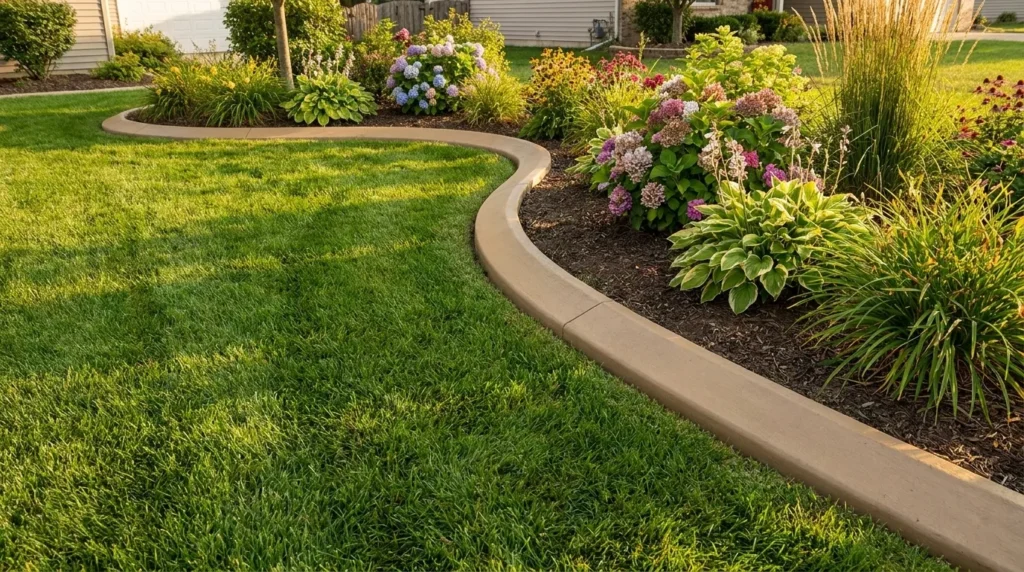
Garden border concrete curbing is the most common landscape curbing application — a continuous concrete edge between lawn areas and planting beds. The curb serves both functional (preventing grass encroachment into beds, containing mulch) and aesthetic (clean professional edge definition) purposes.
Standard specifications for garden border curbing:
- Profile: Mower’s edge or slant face (most popular)
- Width: 4–6 inches at base
- Height above grade: 2–4 inches
- Depth below grade: 2–3 inches
Color options: Landscape curbing is almost always coloured — grey concrete reads as utilitarian in a garden setting. Common colours include earth tones (tan, brown, terracotta, sandstone) using iron oxide pigments, and more contemporary options (charcoal, slate grey, sage green).
Stamp patterns: Many landscape curbing operators offer stamped surface textures — cobblestone, slate, wood grain, brick — imprinted into the fresh concrete immediately after the machine passes. A stamp roller or individual stamps applied by hand create the texture before the concrete stiffens.
Driveway Edge Curbing
Driveway edge curbing — concrete borders along the sides of asphalt or concrete driveways — adds definition, prevents edge cracking, and improves drainage management at the driveway perimeter.
Key difference from garden border curbing: Driveway edge curbing is installed against an existing paved surface rather than in soil. The machine must navigate precisely along the driveway edge, and the concrete must bond adequately to the existing pavement edge. A bonding agent applied to the existing pavement edge before curbing significantly improves adhesion.
Decorative Curbing Profiles
Beyond standard profiles, some landscape curbing machines and operators offer:
Rolled-top profile: A smooth curved top that reads as a natural stone or organic edge — popular in naturalistic garden designs.
Victorian/scalloped: A repeating scallop pattern along the face of the curb — period-appropriate for heritage properties and formal garden designs.
River rock appearance: Aggregate is seeded into the fresh concrete surface immediately after extrusion and lightly pressed in — produces a decorative exposed aggregate surface mimicking natural stone.
Concrete Curbing Machine Cost and ROI
Purchase Price Ranges
Concrete curbing machines span a wide price range depending on size and capability:
| Category | Price Range | Who Buys |
|---|---|---|
| Entry landscape extruder | $8,000–$12,000 | First-time curbing contractor |
| Standard landscape machine | $12,000–$20,000 | Established landscape curber |
| Commercial walk-behind | $20,000–$40,000 | Commercial contractor |
| Ride-on commercial | $50,000–$120,000 | Large commercial curbing business |
| Used landscape machine | $3,000–$8,000 | Budget start-up, second machine |
Additional startup costs:
- Small concrete mixer (350–450 litre): $600–$1,500
- Wheelbarrows (2): $200–$400
- Die profile set (4–6 profiles): $500–$1,500
- Stamping tools: $300–$800
- Trailer for machine transport: $1,000–$3,000
- Total startup (entry level): approximately $12,000–$18,000
Rental vs Buy Decision
Several specialist equipment rental companies stock landscape curbing machines — rental rates of $200–$500 per day for a standard walk-behind curber. For contractors doing 1–3 curbing projects per month, rental makes financial sense. For contractors doing 10+ projects per month, machine ownership has lower total cost within 6–12 months.
Break-even calculation:
- Machine purchase: $15,000
- Monthly rental cost at 12 projects/month: 12 × $350 = $4,200/month
- Break-even: $15,000 ÷ $4,200 = 3.6 months
At 12 projects per month, owning is financially superior after less than 4 months of operation.
Return on Investment for Landscapers
Landscape curbing revenue model:
| Item | Rate | Monthly (15 projects × 200 ft avg) |
|---|---|---|
| Revenue | $6.00/linear ft | $18,000 |
| Concrete material | $1.00/linear ft | $3,000 |
| Pigment and supplies | $0.30/linear ft | $900 |
| Fuel | $0.15/linear ft | $450 |
| Machine maintenance | $0.10/linear ft | $300 |
| Gross margin | $4.45/linear ft | $13,350 |
Against a machine purchase of $15,000 (amortised over 5 years = $250/month), a single operator running 15 residential curbing projects per month generates approximately $13,100/month gross margin — making landscape curbing one of the highest-return equipment investments available in the landscaping industry.
Frequently Asked Questions
What is a concrete curbing machine?
A concrete curbing machine is a self-propelled piece of equipment that continuously extrudes fresh concrete through a shaped die to form a concrete curb or border. The concrete is loaded into the machine’s hopper, conveyed by an auger to the die, and extruded in a continuous strip that holds its shape without formwork. Used for landscape garden borders, driveway edges, road curbing, and parking lot perimeters.
Does Harbor Freight sell a concrete curbing machine?
Harbor Freight does not typically sell dedicated concrete curbing machines in their standard product catalog. Concrete curbing machines are specialist equipment starting at approximately $8,000 for entry landscape models — outside Harbor Freight’s typical price range. Harbor Freight does sell concrete tools relevant to curbing projects including mixers, finishing tools, and wheelbarrows.
How much does a concrete curbing machine cost?
Entry-level landscape curbing machines: $8,000–$12,000. Standard commercial landscape curbers: $12,000–$25,000. Commercial walk-behind machines: $25,000–$40,000. Ride-on commercial equipment: $50,000–$120,000+. Used landscape curbing machines are available for $3,000–$8,000 as a lower-cost entry point.
What concrete mix is used in a curbing machine?
Curbing concrete uses a very stiff mix — typically 0–2 inch slump. Standard mix: 1 part cement, 1.5–2 parts coarse sand, 1–1.5 parts 3/8-inch pea gravel, and minimal water (the mix should hold its shape when squeezed but not crumble). Maximum aggregate size 3/8 inch. Iron oxide pigment is added when coloured curbing is specified.
How fast does a concrete curbing machine work?
Small landscape extruders: 50–100 linear feet per hour in real-world conditions. Standard commercial walk-behind machines: 80–150 linear feet per hour. Ride-on commercial equipment: 200–400 linear feet per hour. Output rate depends on machine size, concrete consistency, profile complexity, and curve radius.
Can I rent a concrete curbing machine?
Yes — some specialist equipment rental companies stock landscape curbing machines at $200–$500 per day. General tool rental chains like United Rentals or Sunbelt Rentals occasionally stock commercial walk-behind curbers. Availability varies significantly by region — call ahead to confirm stock. For contractors doing more than 3–4 curbing projects per month, purchasing is typically more economical than ongoing rental.
How deep does concrete curbing go?
Standard residential landscape curbing extends 2–3 inches below grade and 2–4 inches above grade. Deeper installation (3–4 inches below grade) improves stability in soft or sandy soil. Road and commercial curbing sits on a prepared aggregate base and may extend 4–6 inches below finished grade depending on the curb design specification.
What profiles can a landscape curbing machine make?
Most landscape curbing machines accept interchangeable dies. Standard available profiles include: mower’s edge (flat top), slant face (most common), serpentine (curved face), Victorian (scalloped), rolled/mountable, and barrier/straight face. Specialty profiles including double slant, cobblestone face, and custom designs are available from some die manufacturers. Die changes typically take 10–20 minutes.
Conclusion
A concrete curbing machine is one of the most productive single-operator pieces of equipment available in the landscaping and light construction industry — it converts one or two people into a curbing production operation that no manual crew can match on cost per linear foot. Choose the machine size that matches your project scale and growth ambitions. Learn the mix consistency before the first job, not during it. Keep the die clean, the alignments true, and the concrete flowing — and a landscape curbing machine turns garden edges into a business that pays for itself within months. Calculate your concrete volumes accurately for any curbing project with the ConcreteCal free concrete calculator, and see our types of concrete curbs guide for the full range of curb profiles your machine can create.