
Buying too few bags mid-pour is every DIYer’s nightmare. Buying too many means wasted money and stacks of hardened cement sitting in your garage. A concrete bags calculator eliminates both problems by converting your project dimensions directly into a bag count — down to the specific bag weight you’re buying.
This guide covers the full calculation method: how bag yield works, how many bags fit in a cubic yard, how to handle different mix grades, and how to estimate sand and aggregate alongside your cement. Whether you’re pouring a small shed base, a 10×10 patio slab, or a set of footings, the math here applies directly.
If you’ve already calculated your slab volume and just need cubic yards converted to bags, our Concrete Slab Calculator handles that step and links naturally into this workflow.
Table of Contents
- What Does a Concrete Bags Calculator Actually Do?
- How to Calculate Bags of Concrete — The Core Formula
- How Many Bags of Concrete Per Cubic Yard?
- How Many Bags of Concrete for a 10×10 Slab?
- Cement Quantity by Concrete Mix Ratio
- Sand and Aggregate Estimation
- Material Waste Allowance
- Bags vs. Ready-Mix Concrete
- Tips for Accurate On-Site Bag Estimation
- Frequently Asked Questions
What Does a Concrete Bags Calculator Actually Do?
Most people confuse a concrete bags calculator with a slab volume calculator. They’re related but different tools solving different problems.
A slab calculator answers: how much volume do I need? A bags calculator answers: how many physical bags do I buy to fill that volume?
The bags calculator takes your volume (in cubic feet or cubic yards), divides it by the yield of your chosen bag size, and returns a bag count. It also accounts for the fact that dry bagged mix yields slightly less than its listed volume once water is added and the mix settles.
For cement-specific projects — where you’re batching your own concrete from Portland cement, sand, and aggregate rather than buying premixed bags — the calculator works differently. It factors in the concrete mix ratio, the dry-to-wet volume conversion, and the bulk density of cement to tell you exactly how many 50 kg or 40 kg cement bags to order alongside your aggregates.
Both workflows are covered below.
How to Calculate Bags of Concrete — The Core Formula
The formula is simple. What trips people up is unit consistency and the difference between cubic feet and cubic yards.
Step 1 — Find Your Volume in Cubic Feet
Volume (ft³) = Length (ft) × Width (ft) × Thickness (ft)
Convert thickness from inches to feet by dividing by 12.
Example: A 10 ft × 12 ft slab at 4 inches thick:
10 × 12 × (4÷12) = 10 × 12 × 0.333 = 40 cubic feet
Step 2 — Choose Your Bag Size and Yield
Premixed bagged concrete (like Quikrete or Sakrete) lists yield on the bag. Standard yields:
| Bag Size | Approximate Yield |
|---|---|
| 40 lb bag | 0.30 cubic feet |
| 60 lb bag | 0.45 cubic feet |
| 80 lb bag | 0.60 cubic feet |
These yields are industry-standard values confirmed by manufacturers including Quikrete’s product data sheets.
Step 3 — Divide and Add Waste Allowance
needed = Volume (ft³) ÷ Yield per bag
Then add 10% for waste and breakage.
Continuing the example above (40 ft³, using 80 lb bags):
40 ÷ 0.60 = 66.7 → round up to 67 bags Add 10%: 67 × 1.10 = 74 bags to purchase
Always round up to the nearest whole bag. Never round down.
How Many Bags of Concrete Per Cubic Yard?
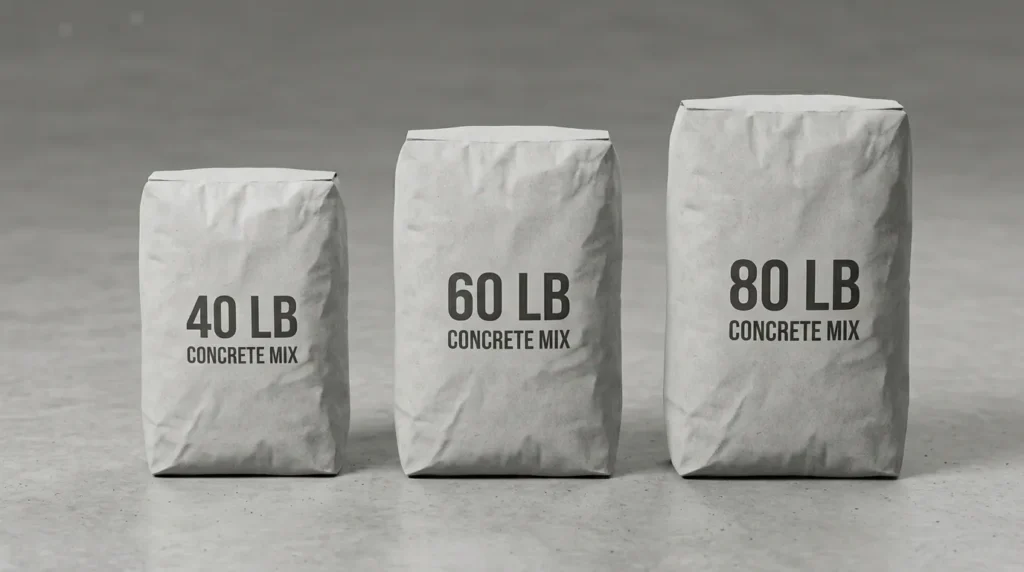
One cubic yard = 27 cubic feet. This is the standard unit used by ready-mix suppliers in the US, and it’s the most common point of confusion when switching between bagged and bulk concrete.
40 lb Bags Per Yard
27 ÷ 0.30 = 90 bags per cubic yard
60 lb Bags Per Yard
27 ÷ 0.45 = 60 bags per cubic yard
80 lb Bags Per Yard
27 ÷ 0.60 = 45 bags per cubic yard
Quick Reference Table — Bags Per Cubic Yard:
| Bag Size | Yield (ft³) | Bags Per Cubic Yard |
|---|---|---|
| 40 lb | 0.30 | 90 bags |
| 60 lb | 0.45 | 60 bags |
| 80 lb | 0.60 | 45 bags |
This table makes one thing clear: 80 lb bags are the most efficient choice for any pour over 5 cubic feet. The fewer bags you handle, the faster the job goes and the lower your cost per cubic foot of concrete.
For projects exceeding 1 cubic yard (45+ bags of 80 lb mix), the economics almost always favor switching to ready-mix delivery. More on that in the comparison section below.
How Many Bags of Concrete for a 10×10 Slab?
A 10×10 slab is one of the most searched project sizes — small enough to DIY, large enough that underestimating hurts. The answer changes significantly with thickness.
At 4 Inches Thick
10 × 10 × (4÷12) = 33.3 ft³ Using 80 lb bags: 33.3 ÷ 0.60 = 55.6 → 56 bags With 10% waste: 62 bags
At 6 Inches Thick
10 × 10 × (6÷12) = 50 ft³ Using 80 lb bags: 50 ÷ 0.60 = 83.3 → 84 bags With 10% waste: 93 bags
10×10 Slab Bag Count Summary:
| Thickness | Volume (ft³) | 40 lb Bags | 60 lb Bags | 80 lb Bags |
|---|---|---|---|---|
| 3.5 inches | 29.2 | 98 | 65 | 49 |
| 4 inches | 33.3 | 112 | 74 | 56 |
| 5 inches | 41.7 | 139 | 93 | 70 |
| 6 inches | 50.0 | 167 | 112 | 84 |
All figures before waste factor. Add 10% to final purchase quantity.
For a 4-inch 10×10 slab, you’re looking at 62 bags of 80 lb mix including waste. At roughly $7 per bag, that’s around $434 in materials. At this scale, a half-yard ready-mix order (if your supplier allows it) can sometimes be cheaper and faster. Use our Concrete Slab Calculator to run the cost comparison side-by-side before you decide.
Cement Quantity by Concrete Mix Ratio (M10, M15, M20, M25)
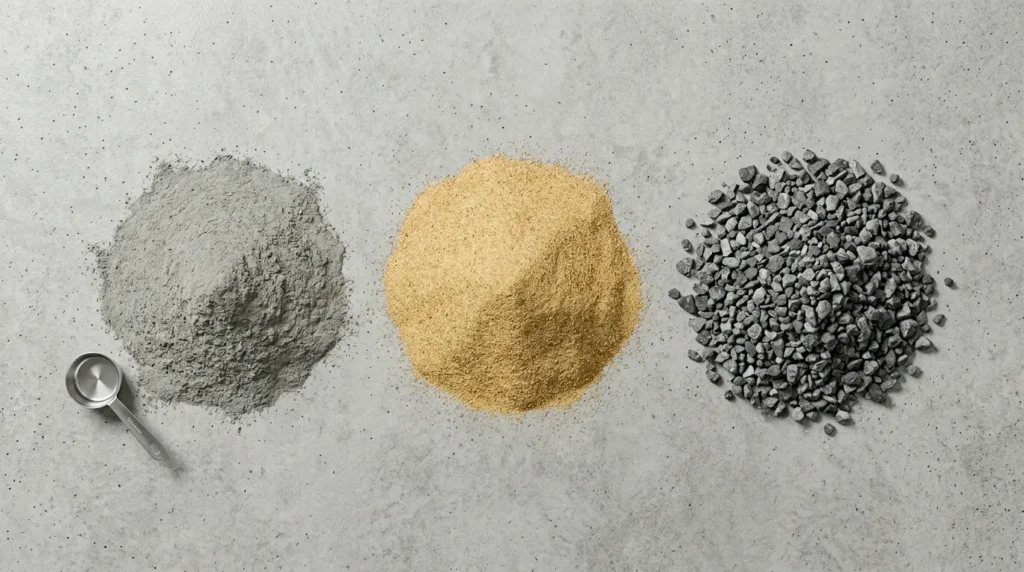
When you’re batching your own concrete from raw materials — Portland cement, sand (fine aggregate), and stone (coarse aggregate) — the bag calculation works differently. You’re not buying premixed bags; you’re buying separate cement bags and aggregates.
The amount of cement per cubic meter of concrete depends on the mix ratio (the proportion of cement : sand : aggregate by volume).
Dry Volume vs. Wet Volume — Why It Matters
This is the calculation step most DIYers skip — and the reason their estimates come up short.
When you mix dry ingredients with water, the paste fills the air voids between particles. The resulting wet concrete volume is less than the sum of the dry ingredient volumes.
To account for this, engineers apply a dry volume factor of 1.54:
Dry Volume = Wet Volume × 1.54
So if you need 1 m³ of finished (wet) concrete, you must start with 1.54 m³ of dry ingredients.
This factor is a civil engineering standard used across construction estimation globally, consistent with guidelines published by the Bureau of Indian Standards (IS 456) for concrete mix design.
Cement Bags Required Per Cubic Meter by Grade
Formula:
Cement volume = (Cement ratio ÷ Sum of ratios) × Dry volume Cement weight = Cement volume × Bulk density of cement (1440 kg/m³) Bags = Cement weight ÷ Bag weight (50 kg)
Common Mix Grades:
| Grade | Mix Ratio (C:S:A) | Cement per m³ (kg) | 50 kg Bags | Use Case |
|---|---|---|---|---|
| M10 | 1:3:6 | 138 kg | 2.8 → 3 bags | Lean concrete, blinding |
| M15 | 1:2:4 | 200 kg | 4.0 → 4 bags | Pathways, non-structural |
| M20 | 1:1.5:3 | 320 kg | 6.4 → 7 bags | Residential slabs, beams |
| M25 | 1:1:2 | 480 kg | 9.6 → 10 bags | Structural columns, foundations |
Worked Example — M20 Concrete, 1 cubic meter:
- Wet volume needed: 1 m³
- Dry volume: 1 × 1.54 = 1.54 m³
- Cement ratio in M20 (1:1.5:3): cement portion = 1 ÷ (1+1.5+3) = 1 ÷ 5.5 = 0.182
- Cement volume: 0.182 × 1.54 = 0.280 m³
- Cement weight: 0.280 × 1440 = 403 kg
- Number of 50 kg bags: 403 ÷ 50 = 8.06 → 9 bags (rounded up with waste)
Sand and Aggregate Estimation Alongside Cement
Once you know how to calculate cement bags, extending the calculation to sand and coarse aggregate is straightforward. Use the same proportional approach from your mix ratio.
For M20 (1:1.5:3) — continuing the example above:
| Material | Ratio Part | Volume (m³) | Approx. Weight |
|---|---|---|---|
| Cement | 1 | 0.280 m³ | 403 kg |
| Sand (fine aggregate) | 1.5 | 0.420 m³ | ~630 kg |
| Stone (coarse aggregate) | 3 | 0.840 m³ | ~1,260 kg |
| Total | 5.5 | 1.54 m³ dry | → 1 m³ wet |
Sand and aggregate are typically sold by weight (kg or tonnes) or by volume (m³). Check with your local supplier — in most regions, a tonne of coarse aggregate covers approximately 0.67 m³.
For quantity takeoff on larger projects, civil engineers and contractors typically reference standards like ACI 211.1 for mix proportioning, which provides approved methods for calculating all concrete ingredients simultaneously.
Material Waste Allowance — How Much Extra to Order
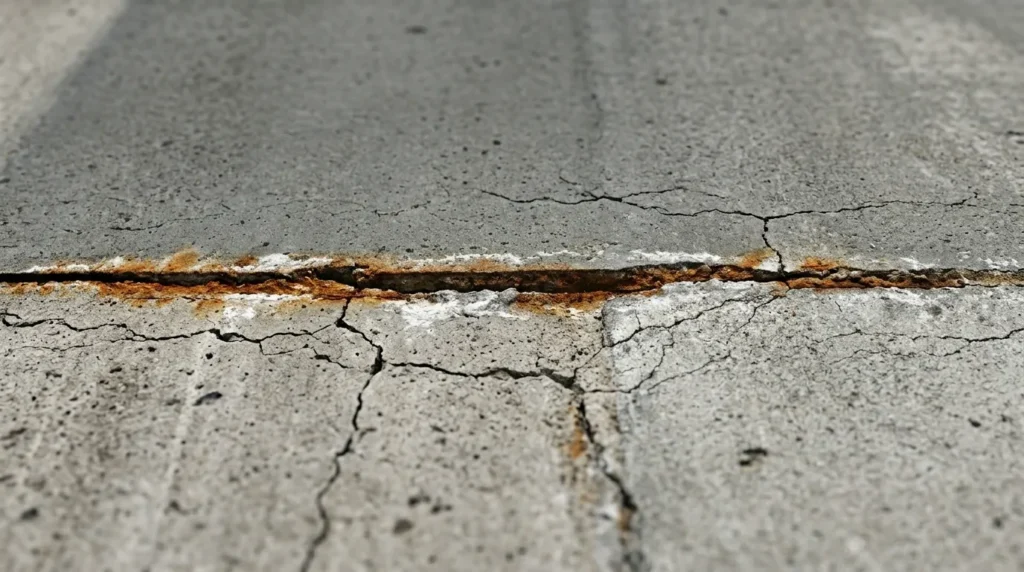
No estimate is perfect at the point of delivery. Material wastage in concrete work comes from multiple sources: spillage during mixing, over-fill at form edges, uneven subgrades, and absorption by dry soil.
Standard waste allowances:
| Project Type | Recommended Waste Factor |
|---|---|
| Small pads, fence posts | 5% |
| Residential slabs (patios, driveways) | 10% |
| Footings and foundations | 10–15% |
| Complex or irregular shapes | 15% |
Apply waste to your final calculated quantity, not to intermediate steps. If your calculation says 7 bags, add 10% at the end: 8 bags to purchase.
Never order the exact calculated amount. A short pour — stopping mid-slab because you’ve run out — creates a cold joint, a structural weak point that’s difficult to repair and impossible to make invisible.
Bags vs. Ready-Mix Concrete — Which Should You Choose?
The decision isn’t just about cost. It’s about volume, site access, and how much time you have to work with the material.
| Factor | Bagged Concrete | Ready-Mix Delivery |
|---|---|---|
| Best volume range | Under 1 cubic yard | 1 cubic yard and above |
| Cost per cubic yard | $225–$360 | $130–$200 |
| Mixing control | Full control | Fixed at plant |
| Minimum order | None | Usually 1 yard |
| Site access needed | Minimal | Truck access required |
| Speed of pour | Slower (batch by batch) | Fast (continuous pour) |
| PSI consistency | Variable (hand mixing) | Consistent (plant batched) |
Rule of thumb: If your project needs more than 45 bags of 80 lb mix (= 1 cubic yard), get a ready-mix quote. The labor saving and consistency improvement usually outweigh the per-yard premium.
For planning both scenarios together, our Concrete Slab Calculator at ConcreteCal lets you compare bag cost versus ready-mix cost side by side before you commit.
Tips for Accurate On-Site Bag Estimation
1. Weigh your bag before mixing. Bags absorb moisture during storage. A damp 80 lb bag may yield slightly less than 0.60 ft³. If bags have been stored outdoors, add an extra 5% to your count.
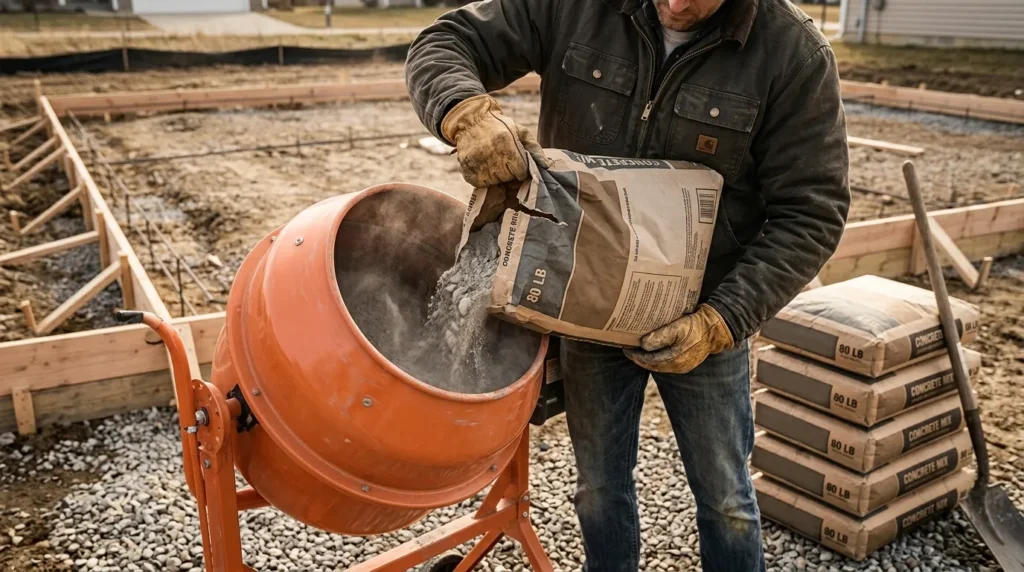
2. Use a consistent mixing method. Hand mixing in a wheelbarrow introduces more air voids than a drum mixer, slightly reducing effective yield. For large bag counts, rent a mixer.
3. Never add extra water. Adding water beyond the manufacturer’s recommendation weakens the concrete and increases shrinkage cracking. Mix to the stiffest workable consistency you can manage.
4. Pre-count bags before the pour starts. Lay out all bags in groups of 10 near the pour site. If you’re using 62 bags, you want to see six groups of ten and one group of two before you tear the first bag open.
5. Keep two spare bags. Always have two 80 lb bags in reserve for topping up low spots, filling around anchor bolts, or addressing any small shortfall at form edges.
6. Record your actual usage. Track how many bags you actually used versus your estimate. Over time, this gives you a personal waste factor that’s more accurate than any formula — because it reflects your specific site conditions and mixing method.
Frequently Asked Questions About Concrete Bags
How many bags of concrete are in a cubic yard?
It depends on bag size: 90 bags of 40 lb, 60 bags of 60 lb, or 45 bags of 80 lb equal approximately one cubic yard. Always add 10% for waste, bringing real-world purchase quantities to 99, 66, and 50 bags respectively.
How do I calculate how many bags of concrete I need?
Multiply length × width × thickness (all in feet) to get cubic feet. Divide by your bag’s yield (0.30, 0.45, or 0.60 ft³ for 40, 60, or 80 lb bags). Add 10% to the result and round up to the nearest whole number.
How many bags of concrete for a 10×10 slab?
At 4 inches thick: approximately 62 bags of 80 lb mix (including 10% waste). At 6 inches thick: approximately 93 bags of 80 lb mix. Thinner slabs use fewer bags; always confirm your thickness against the load requirements.
How many bags of concrete per cubic yard?
45 bags of 80 lb mix, 60 bags of 60 lb mix, or 90 bags of 40 lb mix. The 80 lb bag is the most efficient for any pour requiring multiple bags.
What is the dry volume factor and why does it matter?
The dry volume factor (1.54) accounts for the fact that dry cement, sand, and aggregate compress into a smaller volume when mixed with water. Without applying this factor, you’ll calculate too little material and run short.
Which concrete mix ratio should I use?
For residential slabs and patios: M20 (1:1.5:3). For driveways and garage floors: M20 to M25. For non-structural paths and blinding layers: M15 (1:2:4). For structural columns and foundations: M25 (1:1:2) or higher — consult an engineer.
Does concrete grade affect how many cement bags I need?
Yes, significantly. M25 requires approximately 10 bags of 50 kg cement per cubic meter versus 4 bags for M15. Higher-grade concrete uses more cement relative to aggregates, so the mix ratio is the single biggest variable in your cement bag count.
Why add extra material for wastage?
Spillage, uneven subgrades, absorption into dry soil, and form edge over-fill all consume more material than the theoretical calculation. Standard practice is 5–15% depending on project complexity. Skipping the waste factor is the most common cause of mid-pour material shortages.
Can a concrete bags calculator estimate project cost?
Yes — once you have your bag count, multiply by the current price per bag. Add delivery costs if applicable. For a full cost picture including labor, see our Concrete Slab Calculator which builds the complete material and labor cost estimate together.
How accurate are cement calculators?
Within 5–10% for standard rectangular pours on prepared subgrades. Accuracy drops for irregular shapes, soft subgrades, or hand mixing. Always apply a waste factor and round up — the cost of one extra bag is far less than the cost of a cold joint or a second delivery.
Conclusion
The difference between a clean pour and a scramble for more bags comes down to one thing: running the numbers before you open the first bag. Use the yield tables and formulas here to calculate your exact bag count, apply your waste factor, and buy slightly more than you think you need. The ConcreteCal Concrete Bags Calculator automates every step — plug in your dimensions and walk away with a bag count you can trust.