
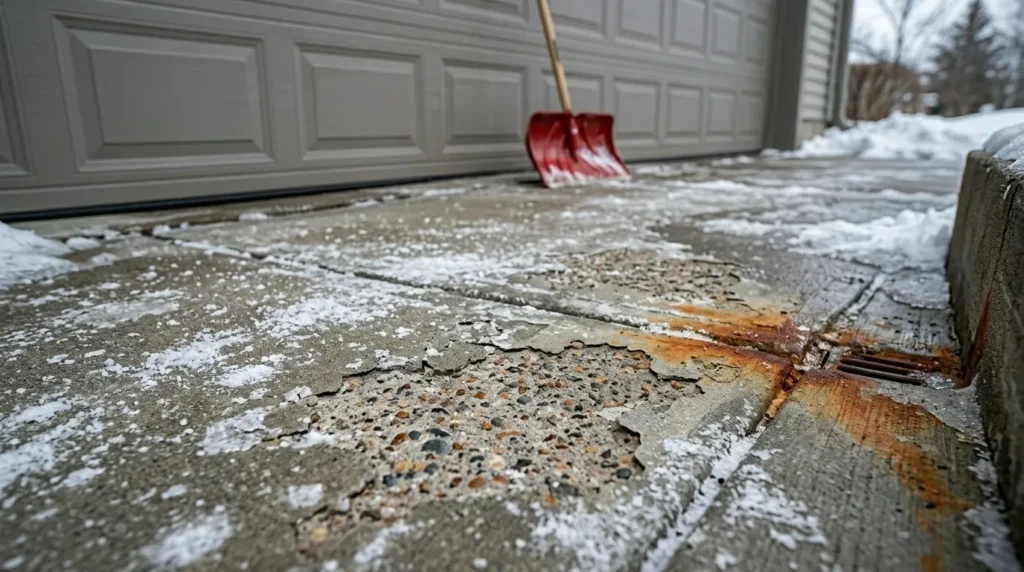

Every winter, millions of homeowners reach for a bag of ice melt and scatter it across their driveways, walkways, and steps without a second thought. The ice clears. The concrete looks fine. And then spring arrives, and the surface tells a different story — fine scaling where the top layer of paste has flaked away, small pits where aggregate has been exposed, and in older slabs, rust staining from rebar beginning to corrode within.
The damage from using the wrong deicer on concrete is real, cumulative, and expensive. A single winter of heavy rock salt use can accelerate surface deterioration by years. Understanding what type of ice melt is safe for concrete — and which products should never touch your driveway — is one of the most practical pieces of winter maintenance knowledge a homeowner can have.
This guide covers every common deicer product with an honest assessment of its concrete safety, a complete comparison table, and a set of protection strategies that dramatically reduce winter deicer damage regardless of which product you use.
For the concrete itself — including specifications that improve deicer resistance — use our free concrete calculator at ConcreteCal for project planning and material estimation.
Table of Contents
- How Ice Melt Damages Concrete — The Real Mechanism
- Common Ice Melt Products — What’s Actually in Them
- Rock Salt (Sodium Chloride)
- Calcium Chloride
- Magnesium Chloride
- Potassium Chloride
- Calcium Magnesium Acetate (CMA)
- Urea
- Sand, Grit, and Non-Chemical Traction Agents
- Ice Melt Comparison Table
- What Type of Ice Melt Is Safe for Concrete — The Verdict
- How to Protect Concrete from Ice Melt Damage
- Pet-Safe and Plant-Safe Deicer Options
- Frequently Asked Questions
How Ice Melt Damages Concrete — The Real Mechanism
Before comparing products, it helps to understand exactly how deicers damage concrete — because the mechanism determines which product properties matter.
Freeze-Thaw Cycle Damage
This is the primary damage mechanism — and it is important to understand that deicers make it worse, not cause it independently.
When water freezes in concrete pores, it expands approximately 9% in volume. This expansion fractures the surrounding paste matrix. With repeated freeze-thaw cycles — common in northern climates with fluctuating temperatures — this progressive fracturing causes surface scaling: the top layer of cement paste breaks away in thin flakes, exposing aggregate beneath.
Where deicers make this dramatically worse:
Deicers work by lowering the freezing point of water — which sounds helpful but creates a specific problem. Instead of water freezing once when the temperature drops below 32°F (0°C), salt-treated water may freeze and thaw multiple times in a single day as temperatures fluctuate around 20–28°F (-7 to -2°C). Each freeze-thaw cycle causes another round of expansion damage.
Rock salt on a concrete driveway can increase the number of damaging freeze-thaw cycles the surface experiences by 3–5 times compared to an untreated surface in the same conditions. This acceleration effect is why salt-treated driveways in moderate freeze-thaw climates deteriorate faster than comparable surfaces in colder climates where temperatures stay consistently below freezing.
Chemical Attack on Cement Paste
Beyond the physical freeze-thaw mechanism, some deicers chemically attack the cement paste itself.
Magnesium chloride and calcium chloride react with calcium hydroxide (a byproduct of cement hydration) in the concrete to form calcium oxychloride — an expansive compound that forms within the concrete pore structure and exerts internal pressure. This chemical attack is separate from freeze-thaw damage and occurs even when temperatures do not drop below freezing.
Research published by the Portland Cement Association found that magnesium chloride produces more chemical damage to concrete at moderate concentrations than sodium chloride, despite being marketed as “concrete-safe” in many commercial products.
Rebar Corrosion from Chlorides
Chloride ions from any chloride-based deicer (sodium, calcium, or magnesium chloride) penetrate concrete through the capillary pore network. When chloride concentration at the rebar depth exceeds the threshold level — typically 0.2% by weight of cement — the passive oxide layer protecting the steel breaks down and corrosion initiates.
Corrosion produces rust, which occupies 3–4 times the volume of the original steel — generating expansive pressure that cracks and spalls the concrete from within. This is the long-term structural damage that cosmetic surface scaling does not reveal until significant internal damage has already occurred.
For a complete explanation of how corrosion-induced damage presents and progresses, see our guide on types of concrete damage.
New Concrete Is Most Vulnerable
The first two winters of a concrete surface’s life are the period of maximum deicer vulnerability.
New concrete (under 12 months old) has not yet achieved its full density and pore refinement through continued hydration. The surface paste is more porous than it will become with age — allowing faster chloride penetration and more rapid freeze-thaw damage.
The rule for new concrete: No deicer of any type in the first full winter after placement. Use sand only for traction. Even “concrete-safe” deicers should be avoided on concrete under 12 months old — the surface has not developed sufficient resistance.
Common Ice Melt Products — What’s Actually in Them
Walk into any hardware store in winter and you will find shelves of ice melt products with names like “Safe-T-Salt,” “Pet Safe,” “Concrete Guard,” and dozens of others. The marketing language is designed to make purchasing decisions feel simple — but the active ingredient listed in small print on the back of the bag is what actually determines concrete safety.
The five main deicer active ingredients:
| Active Ingredient | Chemical Symbol | Common Names |
|---|---|---|
| Sodium chloride | NaCl | Rock salt, road salt |
| Calcium chloride | CaCl₂ | Calcium chloride pellets |
| Magnesium chloride | MgCl₂ | Mag chloride, “pet-safe” products |
| Potassium chloride | KCl | Potash, fertiliser-grade salt |
| Calcium magnesium acetate | CMA | CMA deicer, acetate deicer |
Most commercial ice melt products are blends of two or more of these — always read the ingredients, not just the product name.
Rock Salt (Sodium Chloride) — The Most Damaging Option
Rock salt is the most widely used and most widely available deicer — it is also the most damaging to concrete of any commonly used product.
Why it is so damaging:
- Creates multiple freeze-thaw cycles at temperatures just below 32°F — the most damaging temperature range for concrete
- Chloride ions penetrate concrete readily — relatively small chloride molecules move through the pore network efficiently
- Does not chemically attack the paste at low concentrations — but the freeze-thaw multiplication effect causes more surface damage than any other product at equivalent application rates
- Leaves white residue that is tracked indoors and causes staining
Effective temperature range: Down to approximately 15°F (-9°C). Below this temperature, rock salt becomes ineffective — it cannot generate enough heat from dissolution to melt ice.
Verdict for concrete: Avoid on concrete surfaces whenever possible. If cost forces the choice, use sparingly (far less than package directions suggest), rinse thoroughly when temperatures allow, and never use on new concrete.
Worked Example — Rock Salt Damage Pattern: A 10-year-old concrete driveway in Minnesota. Owner uses rock salt generously every winter, as directed on the packaging. By year 12, surface scaling is visible across the entire driveway — the top 1/4 inch of cement paste has flaked away in the areas heaviest salt use occurs near the garage apron. Aggregate is exposed and loose surface particles appear each spring. Repair: resurfacing at $3–$5/sq ft, or replacement.
Calcium Chloride — Fast but Risky
Calcium chloride is the most effective deicer for extreme cold — it works down to -25°F (-32°C) and generates heat exothermically as it dissolves, providing faster initial melting than rock salt.
The concrete safety problem:
Calcium chloride reacts with calcium hydroxide in the concrete to form calcium oxychloride — an expansive crystalline compound that forms within the concrete pore structure. Research has documented that calcium chloride at typical application concentrations causes measurable chemical deterioration of the concrete paste — in addition to the freeze-thaw multiplication effect of all chloride deicers.
At concentrations above 3% (solution in melt water): Calcium chloride causes measurable chemical damage to concrete paste. At the application rates typical of consumer products, this concentration is easily reached in the melt water at the concrete surface.
Where calcium chloride is appropriate: On asphalt driveways, on steps and paths made of materials other than concrete, and in situations where extreme cold (-25°F to -15°F) makes other products ineffective.
Verdict for concrete: Not recommended for regular use on concrete. Better options exist for moderate cold conditions. If used at all on concrete, apply at minimum effective rates and rinse when temperatures allow.
Magnesium Chloride — The Most Concrete-Friendly Chloride
Magnesium chloride is widely marketed as a “concrete-safe” or “pet-safe” alternative to rock salt — and in comparison to sodium chloride and calcium chloride, it is somewhat less damaging. But “less damaging” is not the same as “safe.”
Relative advantages over rock salt:
- Lower chloride ion concentration at equivalent application rates — slightly less chloride penetration
- Generates less heat of dissolution than calcium chloride — less thermal shock to the surface
- Effective to approximately -13°F (-25°C) — wider temperature range than rock salt
Why it still damages concrete:
Magnesium chloride reacts more aggressively with calcium hydroxide in cement paste than calcium chloride does at equivalent concentrations — forming magnesium hydroxide and calcium oxychloride compounds that deteriorate the paste matrix. The chemical attack mechanism is significant enough that some researchers consider magnesium chloride more chemically damaging to concrete than sodium chloride, despite the marketing claims.
The realistic assessment: Magnesium chloride is genuinely better than rock salt for concrete — it causes less freeze-thaw cycle multiplication at moderate temperatures. But it is not harmless. Used sparingly and with proper surface sealing, it is an acceptable compromise where ice melt is genuinely necessary on concrete.
Verdict for concrete: Acceptable for occasional use on sealed, mature concrete at minimum effective application rates. Not recommended for frequent heavy use or on new concrete.
Potassium Chloride — Gentle but Limited
Potassium chloride (KCl) is the mildest of the chloride-based deicers — it causes the least freeze-thaw cycle multiplication and the lowest chemical attack on cement paste of any chloride product.
Why it is gentle:
- Larger potassium ion moves through concrete pores more slowly than sodium or calcium ions
- Lower solubility — produces lower chloride concentrations in melt water at equivalent application rates
- Less exothermic than calcium or magnesium chloride — less thermal shock
The significant limitation:
Potassium chloride only melts ice effectively down to approximately 25°F (-4°C). Below this temperature, it becomes largely ineffective — making it suitable only for the mildest freeze conditions.
Verdict for concrete: The most concrete-friendly chloride deicer, but only useful in a narrow temperature window (25°F to 32°F). Best used as a “first response” deicer for light icing before temperatures drop further.
Calcium Magnesium Acetate (CMA) — The Safest Chemical Deicer
Calcium magnesium acetate is the only chemical deicer that is genuinely safe for concrete — it contains no chloride ions and does not chemically attack cement paste.
How it works: CMA depresses the freezing point of water through a different chemical mechanism than chloride salts — it interferes with the bonding of ice crystals to the pavement surface rather than dissolving aggressively in melt water. This makes it slightly less aggressive as an ice melter but dramatically less damaging to the concrete below.
Key properties:
- No chloride ions — zero rebar corrosion risk
- No chemical attack on cement paste
- Biodegradable — breaks down into calcium, magnesium, and acetate (a natural organic acid)
- Safe for vegetation — does not kill grass or plants adjacent to the driveway
- Pet-safer than chloride products
The limitations that explain why CMA is not widely used:
Cost: CMA costs 5–10 times more per pound than rock salt. A bag of CMA deicer costs $20–$40 versus $5–$10 for equivalent weight rock salt. For a long driveway, the cost difference is significant.
Performance: CMA works more slowly than chloride deicers and is less effective below approximately 20°F (-7°C). It is best used preventively — applied before ice forms — rather than reactively after ice has bonded to the surface.
Availability: CMA is less widely available than chloride products. It is carried by some hardware stores and online retailers but is not universally stocked.
Verdict for concrete: The best chemical deicer choice for concrete if budget allows. Particularly recommended for new concrete, decorative concrete, or any surface where long-term preservation matters more than immediate cost savings.
Worked Example — CMA Cost-Benefit: A 640 sq ft driveway. Annual deicer use: 10 applications per winter season.
- Rock salt: 40 lbs per application × 10 = 400 lbs/year at $0.15/lb = $60/year. Replace driveway at 15 years due to damage: $8,000.
- CMA: 40 lbs per application × 10 = 400 lbs/year at $0.80/lb = $320/year. Driveway lifespan 30+ years.
- 30-year cost: Rock salt $1,800 + replacement $8,000 = $9,800. CMA $9,600. Break-even at 30 years. The math is tight — but CMA wins clearly when factoring in the disruption and inconvenience of driveway replacement.
Urea — Plant-Safe but Not Concrete-Safe
Urea (carbamide) is a nitrogen-based compound widely used as a fertiliser. It is sometimes sold as a deicer and marketed as “pet-safe” or “environment-friendly.”
The problem: While urea contains no chlorides and does not chemically attack concrete directly, it breaks down in the environment to ammonia — which at high concentrations can damage vegetation despite the “plant-safe” marketing. More importantly, urea is a relatively weak deicer and has limited effectiveness in cold conditions.
Verdict for concrete: Urea does not damage concrete chemistry directly, but its performance as a deicer is limited. It is not a recommended choice for concrete driveways.
Sand, Grit, and Non-Chemical Traction Agents
The safest thing you can put on concrete in winter is nothing that melts ice — but something that provides traction on top of it.
Coarse sand: Applied over ice, sand provides traction without any chemical interaction with the concrete. It does not melt ice — it simply makes the surface safer to walk and drive on. In the spring, it must be swept up and disposed of properly.
Gravel or grit: Similar to sand — larger particle size provides better traction for vehicles. No chemical damage whatsoever.
Kitty litter (clay-based): Provides traction but can become slippery when wet if over-applied. Avoid on surfaces where it will be tracked indoors. Clay-based only — avoid crystal or silica gel cat litter.
The traction-only approach works best when:
- Temperatures are consistently below the effective range of any deicer
- You are willing to shovel and clear snow mechanically before applying traction
- The concrete is new (under 12 months) and no deicer should be used
- Budget is the primary constraint
The limitation: Traction agents do not melt ice — they only make it safer to navigate. If melting is genuinely required (ice is bonded to steps that must be clear for safety), a deicer is necessary.
Ice Melt Comparison Table
| Deicer | Concrete Safety | Effective To | Rebar Risk | Pet Safety | Cost | Best Use |
|---|---|---|---|---|---|---|
| Rock salt (NaCl) | ❌ Poor | 15°F (-9°C) | High | ❌ Poor | $ | Avoid on concrete |
| Calcium chloride | ❌ Poor | -25°F (-32°C) | High | ⚠️ Moderate | $$ | Asphalt, extreme cold |
| Magnesium chloride | ⚠️ Moderate | -13°F (-25°C) | Moderate | ⚠️ Moderate | $$ | Occasional use, sealed concrete |
| Potassium chloride | ✅ Good | 25°F (-4°C) | Low | ✅ Good | $$ | Light icing only |
| CMA | ✅ Excellent | 20°F (-7°C) | None | ✅ Good | $$$$ | Best for concrete |
| Urea | ⚠️ Neutral | 25°F (-4°C) | None | ✅ Good | $$$ | Limited performance |
| Sand/grit | ✅ Excellent | Any | None | ✅ Excellent | $ | Traction only |
What Type of Ice Melt Is Safe for Concrete — The Verdict
No deicer is completely harmless to concrete. The honest ranking from least to most damaging:
- Sand/grit — no chemical effect, zero concrete damage
- Calcium magnesium acetate (CMA) — no chlorides, safest chemical option
- Potassium chloride — mildest chloride, limited effectiveness
- Magnesium chloride — moderate damage, widely marketed as “concrete-safe”
- Calcium chloride — effective in extreme cold, significant chemical damage
- Rock salt (sodium chloride) — most damaging, most widely used
The practical recommendation for most homeowners:
- New concrete (under 12 months): Sand only. No exceptions.
- Mature concrete, sealed: Use CMA if budget allows. If not, magnesium chloride at minimum effective application rates.
- Mature concrete, unsealed: Seal it before winter. Then use CMA or magnesium chloride at minimum rates.
- Extreme cold below -13°F: Calcium chloride is the only effective option. Use sparingly and rinse when temperatures allow.
- Budget is the primary constraint: Rock salt used sparingly (far less than packaging suggests) on a sealed, mature concrete surface — with aggressive spring rinsing. Not ideal, but the least damaging way to use the least expensive product.
How to Protect Concrete from Ice Melt Damage
The best protection strategy reduces deicer damage regardless of which product you use.
Seal Before Winter
A penetrating silane-siloxane sealer — applied to clean, dry concrete in early autumn — dramatically reduces the rate of chloride penetration into the concrete. Water repellency at the surface also reduces the volume of water entering the pore network and freezing.
A well-sealed concrete surface can reduce chloride ion uptake by 60–80% compared to unsealed concrete at equivalent deicer application rates. This single action has more impact on deicer damage than switching from rock salt to magnesium chloride on an unsealed surface.
For the complete guide to concrete sealer selection and application, see our post on types of concrete sealers.
Sealing schedule: Apply penetrating sealer every 3–5 years on driveways and walkways. The best time is September/October in northern US — before the first freeze, after summer heat has passed.
Apply Correctly — Less Is More
Every deicer product is over-applied by most homeowners. The packaging directions suggest application rates that maximize product use — not rates that minimize concrete damage.
The effective application rate for most deicers on concrete is approximately half the package directions. Enough to wet the surface and initiate melting — not enough to leave a visible white residue.
Application technique:
- Apply after shoveling or snow blowing — never as a shortcut to skip clearing
- Spread thinly and evenly — not in piles
- Use a hand-cranked spreader for even distribution rather than broadcasting by hand
Rinse in Spring
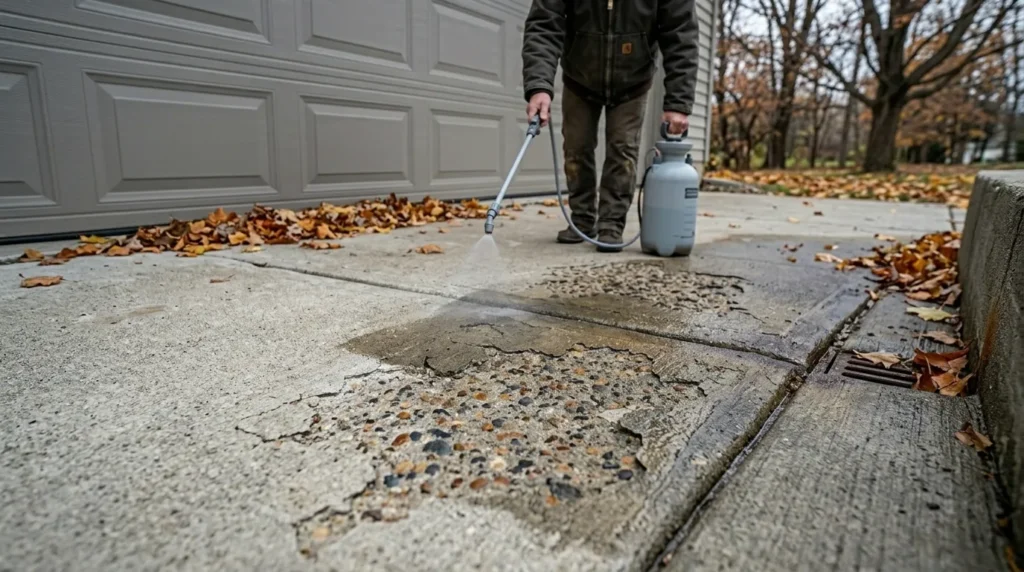
Every spring, as soon as temperatures consistently stay above 40°F, pressure wash or hose down all concrete surfaces that received deicer during winter. This removes chloride residue from the surface before it can continue to migrate deeper into the concrete during the warmer, wetter spring months.
This single spring action costs almost nothing and measurably extends the life of concrete surfaces exposed to deicer.
Never Use Deicer on New Concrete
Repeat this clearly: no deicer of any type on concrete less than 12 months old. New concrete is more porous, more vulnerable to freeze-thaw damage, and less chemically mature than concrete that has cured through a full year.
The first winter after a concrete driveway is poured, use sand only for traction. Shovel diligently. Accept that some ice will form and manage it mechanically.
Pet-Safe and Plant-Safe Deicer Options
Two secondary concerns influence product selection for many homeowners: pet safety and plant safety.
For pets: All chloride deicers can irritate pet paws — particularly cracked or dry paw skin in winter. The irritation comes from the salt drawing moisture from the skin, not toxicity.
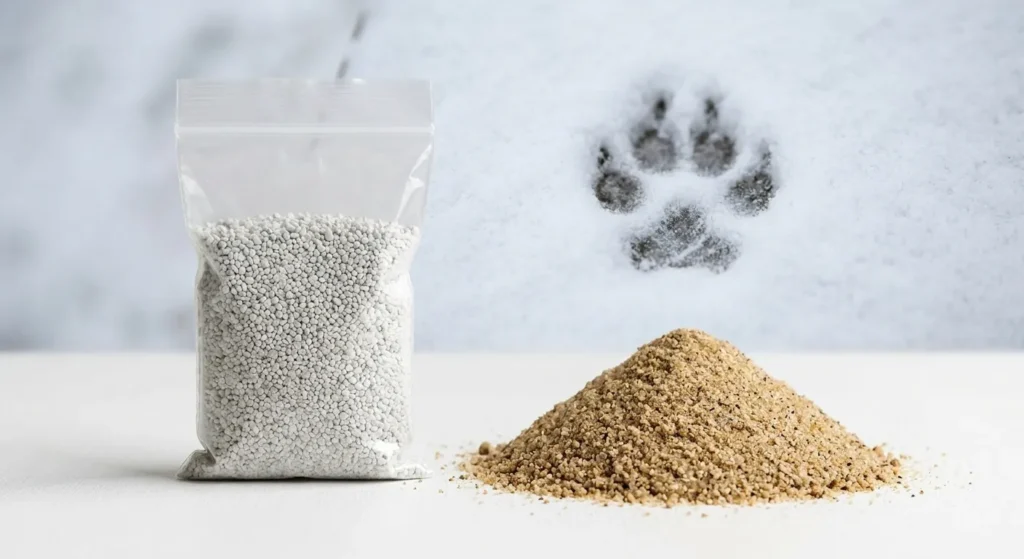
Genuinely pet-safer options: CMA, potassium chloride, sand. If using chloride products, wipe pet paws after walks on treated surfaces.
For plants: Chloride deicers runoff into soil and lawn areas adjacent to driveways — accumulating chloride concentrations that inhibit plant growth and cause browning of grass and shrubs.
Plant-safer options: CMA (biodegrades to harmless components), sand. Potassium chloride is a plant fertiliser at low concentrations — safe for plants in moderate quantities.
Products marketed as “pet-safe”: Many products use this label when the active ingredient is magnesium chloride — which is less irritating to paw pads than rock salt but is not harmless to concrete. Always read the ingredients.
Frequently Asked Questions
What type of ice melt is safe for concrete?
No ice melt is completely harmless to concrete. The safest chemical option is calcium magnesium acetate (CMA) — no chlorides, no rebar corrosion risk, biodegradable. The next safest is potassium chloride, though it only works down to 25°F. Sand and grit provide traction with zero chemical damage. Rock salt (sodium chloride) is the most damaging and should be avoided on concrete whenever possible.
Is calcium chloride safe for concrete?
No — calcium chloride reacts with calcium hydroxide in concrete to form calcium oxychloride, an expansive compound that deteriorates the cement paste. It also multiplies freeze-thaw cycles. While effective for extreme cold (down to -25°F), it is not a concrete-safe product and should not be used regularly on concrete driveways or walkways.
Is rock salt bad for concrete?
Yes — rock salt (sodium chloride) is the most widely used and most damaging deicer for concrete. It multiplies freeze-thaw cycles at temperatures just below 32°F, accelerating surface scaling. Chloride ions also penetrate the concrete and cause rebar corrosion over time. If cost makes rock salt the only practical option, use it sparingly, seal your concrete first, and rinse thoroughly every spring.
Is magnesium chloride safe for concrete?
It is less damaging than rock salt but not safe in the sense of harmless. Magnesium chloride chemically attacks cement paste through a reaction with calcium hydroxide. It is marketed as “concrete-safe” because it causes less freeze-thaw cycle multiplication than sodium chloride — but at high application rates it causes measurable chemical damage. Use sparingly on sealed mature concrete only.
What can I use instead of salt on concrete?
The safest alternative is coarse sand or grit — provides traction without any chemical damage. For chemical melting, calcium magnesium acetate (CMA) is the best option — no chlorides, no chemical attack on concrete. Potassium chloride is the mildest chloride option for light icing above 25°F. Prevent ice formation where possible by clearing snow promptly before it bonds to the surface.
What ice melt is safe for new concrete?
None. New concrete (under 12 months old) should receive no deicer of any type during its first winter. The surface is too porous and too vulnerable to both freeze-thaw damage and chemical attack. Use sand only for traction. Shovel frequently and mechanically clear ice rather than using chemical deicers.
How do I protect concrete from ice melt damage?
Seal the concrete with a penetrating silane-siloxane sealer every 3–5 years — this is the single most effective protection measure. Apply deicer at minimum effective rates (far less than package directions suggest). Shovel before applying deicer — never use deicer as a substitute for mechanical snow removal. Rinse all deicer residue with water every spring.
Is CMA deicer worth the cost?
For concrete driveways where long-term preservation matters, yes — over a 30-year period, the cost difference between CMA and rock salt narrows significantly when the cost of driveway replacement from salt damage is included. CMA is particularly worth the premium on new concrete, decorative or stamped concrete, and any surface where damage would be particularly costly to repair.
Conclusion
The ice melt question has a clear answer even if homeowners do not always like it: no chloride-based deicer is truly safe for concrete, and rock salt is the worst of the widely available options. Sand provides traction without damage. CMA provides chemical melting without chloride damage. Potassium chloride is the mildest chloride option for light conditions. Magnesium chloride is an acceptable compromise on sealed mature concrete at minimum application rates. Seal your concrete before winter, apply any deicer sparingly, shovel first, and rinse in spring — these four habits reduce deicer damage more than switching products alone. Calculate your concrete project requirements accurately with the ConcreteCal free concrete calculator and protect that investment through the winter with the right deicer choice.