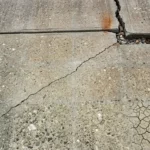
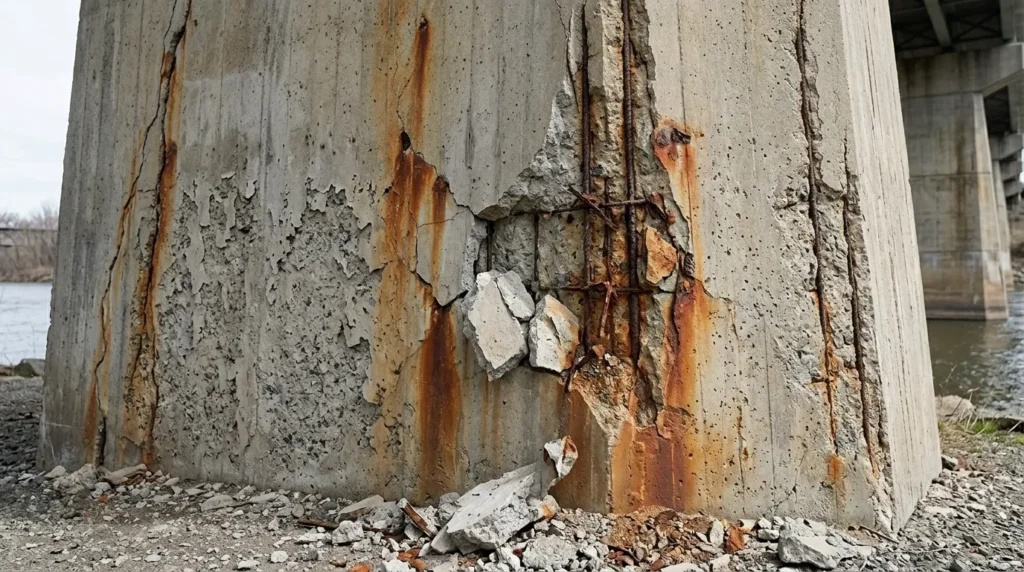

Concrete is one of the most durable construction materials available — but durability is not the same as invulnerability. Given enough time, moisture, temperature variation, chemical exposure, or physical loading, concrete deteriorates. The damage it develops goes well beyond cracking: chunks break away from the surface, the top layer flakes off in winter, embedded steel corrodes and fractures the surrounding matrix, and chemical reactions silently destroy the internal structure.
Identifying the types of concrete damage accurately is the critical first step. Surface spalling looks different from delamination. Freeze-thaw scaling looks different from deicer attack. Corrosion damage has a specific signature that no other deterioration type replicates. Each damage type has a different cause, a different progression rate, and a different repair requirement — misdiagnosing the problem leads to repairs that fail quickly because they addressed the symptom rather than the source.
This guide covers every major concrete damage type with identification features, causes, severity assessment, and proven repair methods.
If your concrete damage includes visible cracking alongside surface deterioration, see our companion guide on types of cracks in concrete — cracking and surface damage frequently occur together but require different assessment frameworks.
For replacement concrete quantities after removing damaged sections, use the concrete calculator at ConcreteCal.
Table of Contents
- What Is Concrete Damage and How Does It Differ from Cracking?
- Main Types of Concrete Damage
- Spalling — Chunks Breaking Away
- Scaling — Surface Layer Flaking Off
- Delamination — Surface Separating from Base
- Corrosion Damage — Rebar Rust Destroying from Inside
- Chemical Attack on Concrete
- Abrasion and Wear Damage
- Concrete Damage Severity Guide
- How to Prevent Concrete Damage
- Frequently Asked Questions
What Is Concrete Damage and How Does It Differ from Cracking?
Cracking is one specific form of concrete distress — tensile failure producing a fracture plane through the material. Concrete damage is a broader category that includes all forms of deterioration: surface disintegration, internal chemical reactions, physical wear, and corrosion-driven failure.
The distinction matters because the repair strategies are fundamentally different. A crack is repaired by filling or injecting the fracture. Spalling is repaired by removing loose material and applying a patch. Chemical attack may require complete removal and replacement with a chemically resistant mix. Corrosion damage requires addressing the steel — not just the concrete surface.
Surface Damage vs. Structural Damage
| Category | Affects | Examples | Structural Risk |
|---|---|---|---|
| Surface damage | Top layer only | Scaling, crazing, abrasion | Low initially |
| Delamination | Bond between layers | Hollow-sounding areas, peeling | Medium |
| Spalling | Full depth chunks | Corrosion spalls, impact damage | Medium-High |
| Internal damage | Full section | ASR, sulfate attack, corrosion | High |
| Structural damage | Load-bearing capacity | Corrosion loss of rebar section | Critical |
How Concrete Damage Progresses Over Time
Most concrete damage follows a progressive pattern. Surface damage that goes unrepaired allows moisture to penetrate deeper, accelerating internal deterioration. A small area of scaling that exposes aggregate becomes a pathway for water and chlorides — which then reach the rebar, initiate corrosion, and produce spalling on a much larger scale. Early intervention is almost always cheaper and more effective than waiting.
Main Types of Concrete Damage
Concrete deterioration falls into six primary categories:
| Damage Type | Visual Signature | Primary Cause | Severity Range |
|---|---|---|---|
| Spalling | Chunks or fragments breaking off | Corrosion, impact, freeze-thaw | Medium–Critical |
| Scaling | Thin surface layer flaking | Freeze-thaw, deicers | Low–Medium |
| Delamination | Hollow areas, surface peeling | Finishing errors, bleed water | Medium |
| Corrosion | Rust staining, spalling along rebar | Chloride/carbonation penetration | Medium–Critical |
| Chemical attack | Softening, disintegration, expansion | Sulfates, acids, ASR | Medium–Critical |
| Abrasion/wear | Surface grinding down, aggregate exposure | Traffic, mechanical wear | Low–Medium |
Spalling — Chunks Breaking Away
Spalling is the detachment of fragments from the concrete surface or body — ranging from thin surface chips to large chunks several inches deep. It is one of the most visible and alarming forms of concrete damage, and one of the most structurally significant when it occurs in load-bearing elements.
Causes of Concrete Spalling
Corrosion-induced spalling is the most common cause in reinforced concrete. When embedded rebar corrodes, the rust product occupies 3–4 times the volume of the original steel. This expansive pressure fractures the surrounding concrete, eventually pushing off the cover layer in large fragments. Corrosion spalling is identifiable by its location directly above rebar lines and by the rust staining that accompanies the detached fragments.
Freeze-thaw spalling occurs when water trapped in surface pores freezes, expands, and fractures the concrete matrix. Unlike scaling (which removes thin surface layers), freeze-thaw spalling removes deeper chunks — particularly at edges and corners where moisture concentrates.
Impact and overload spalling — physical damage from dropped objects, vehicle impact, or blast loading — produces irregular fragments with fresh, unweathered fracture faces. The concrete itself is typically undamaged away from the impact zone.
Fire damage spalling — extreme heat causes rapid moisture vaporization within the concrete, generating internal pressure that explosively fractures the surface. Fire-damaged concrete spalls extensively and loses compressive strength — fire-affected structural elements require engineering assessment before return to service.
How to Repair Spalled Concrete
Step 1 — Remove all loose and delaminated material. Use a cold chisel and hammer or a grinding disc to remove all unsound concrete back to a solid base. Any material that sounds hollow when tapped must come out — leaving it produces a repair that debonds rapidly.
Step 2 — Address corrosion if present. If rebar is exposed, remove all rust with a wire brush or abrasive blasting, apply a corrosion-inhibiting primer, and ensure the repair mortar will provide adequate cover depth (minimum 1.5 inches for exterior exposure).
Step 3 — Apply bonding agent. Brush a concrete bonding adhesive onto the prepared surface. This chemical bridge between old and new concrete is critical — without it, repair mortars often debond within a few freeze-thaw cycles.
Step 4 — Apply repair mortar. Use a polymer-modified repair mortar matched to the existing concrete strength. For deep repairs (over 1.5 inches), build up in layers. For thin repairs, use a specifically formulated thin-section repair product.
Step 5 — Cure and seal. Keep the repair moist for minimum 3 days. Apply a penetrating sealer to the repaired area and surrounding concrete to reduce future moisture infiltration.
Worked Example: A bridge abutment shows a 300 mm × 400 mm spalled area above a rebar line, with rust staining on the exposed bar. Repair sequence: saw-cut perimeter to 10 mm depth (prevents feathered edges), remove all loose concrete to 25 mm behind the bar, abrasive blast the bar to bare metal, apply zinc-rich primer, install additional cover concrete to achieve 40 mm cover, apply SBR-modified repair mortar in two lifts, cure for 7 days, apply silane penetrating sealer to the full abutment face.
Scaling — Surface Layer Flaking Off
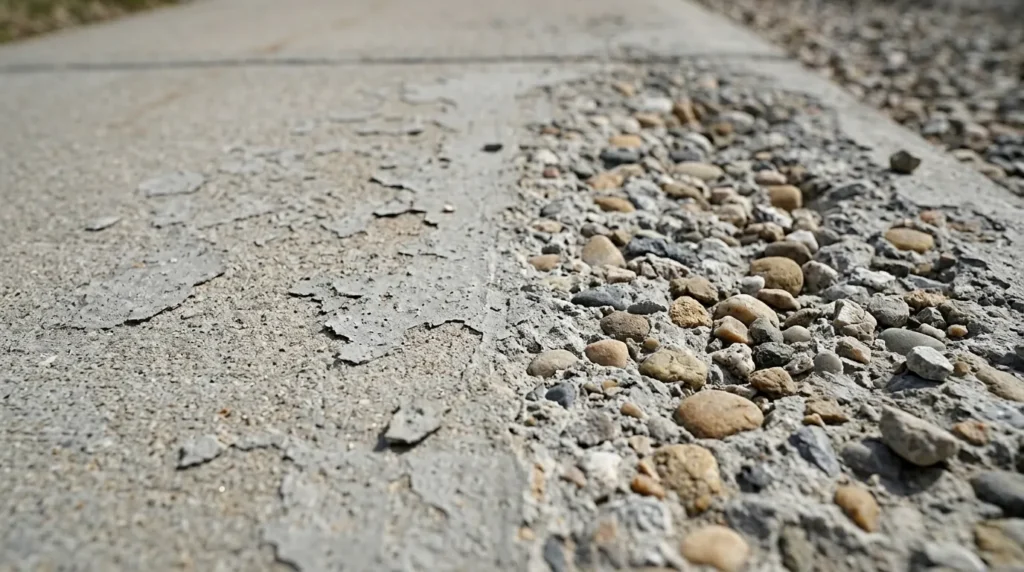
Scaling is the progressive detachment of thin concrete surface layers — typically 1–5 mm thick — leaving a rough, aggregate-exposed surface beneath. It affects appearance immediately and structural integrity gradually as the protective cover layer disappears.
Freeze-Thaw Scaling
Freeze-thaw scaling is the dominant damage mechanism for exterior concrete in cold climates. Water penetrates the surface pores, freezes, expands, and fractures the thin paste layer at the surface. With each freeze-thaw cycle, another thin layer detaches.
Severity progression:
- Level 1: Slight mortar loss, aggregate still fully embedded
- Level 2: Moderate mortar loss, coarse aggregate beginning to show
- Level 3: Severe mortar loss, coarse aggregate exposed and loose
- Level 4: Coarse aggregate lost, rough irregular surface
- Level 5: Surface destroyed, full replacement required
Air-entrained concrete resists freeze-thaw scaling dramatically — the entrained air bubbles provide microscopic relief space for freezing water. Non-air-entrained concrete in freeze-thaw climates will scale; it is a matter of when, not whether.
Deicer Salt Scaling
Deicer salts — sodium chloride, calcium chloride, magnesium chloride — accelerate scaling beyond what freeze-thaw alone produces. The mechanism is twofold: the salt solution has a lower freezing point, increasing the number of freeze-thaw cycles per winter; and certain salts (particularly magnesium chloride) react chemically with calcium hydroxide in the cement paste, weakening the surface layer.
Critical specification: Concrete exposed to deicers must be:
- Minimum 4,000 PSI compressive strength
- Air-entrained at 6–7% for the exposure zone
- Water-cement ratio below 0.45
- Cured for minimum 28 days before first deicer exposure
New concrete is particularly vulnerable — deicers applied in the first winter after placement cause disproportionate damage. The surface paste has not yet fully hardened and densified.
Delamination — Surface Separating from Base
Delamination is the separation of the concrete surface layer from the underlying base concrete — producing a hollow, drum-like sound when tapped, visible as a plane of weakness just below the surface.
How Delamination Happens
Delamination is almost always a finishing error — specifically, finishing (troweling) the surface before bleed water has fully evaporated.
When concrete bleeds (water rises to the surface as heavier particles settle), finishing over that bleed water traps it beneath the surface layer. As the concrete hardens, the trapped water evaporates, leaving a plane of weakness — a thin void between the surface paste and the underlying concrete.
This plane of weakness becomes a delamination failure when:
- Traffic or load stress causes the surface layer to flex and detach
- Freeze-thaw cycling forces the layers apart
- Moisture infiltrates and freezes within the void
Identifying delamination: Walk the slab and tap with a steel rod or chain. Sound areas produce a solid thud. Delaminated areas produce a hollow, resonant sound — the difference is unmistakable.
Detecting and Repairing Delamination
Detection: Chain drag or hammer sounding is the standard method. Mark all hollow-sounding areas with chalk — this defines the repair boundary.
Repair: Remove all delaminated material by saw-cutting the perimeter and grinding or milling the hollow areas. Apply bonding agent and resurface with polymer-modified overlay or grinding the full surface to a sound base and applying a self-leveling topping.
Prevention is far more effective than repair. Never finish concrete while bleed water is visible on the surface. In conditions that slow bleeding (cool temperatures, low water-cement ratio, use of SCMs), wait until all surface sheen has disappeared before any finishing operations.
Corrosion Damage — Rebar Rust Destroying from Inside
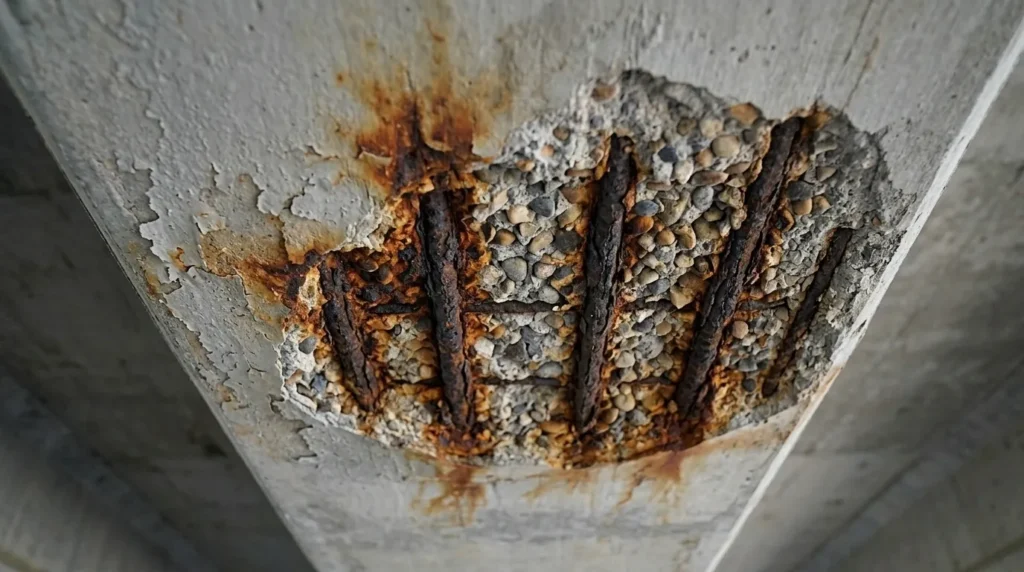
Reinforcement corrosion is the most widespread cause of serious concrete damage globally — responsible for billions of dollars in infrastructure repair annually. It is insidious because it begins invisibly, deep within the concrete, and by the time surface symptoms appear, significant structural degradation has already occurred.
How Corrosion Spreads in Concrete
Steel embedded in concrete is normally protected by the highly alkaline environment (pH 12–13) of the cement paste — this alkalinity passivates the steel surface, preventing corrosion. Two mechanisms destroy this protection:
Chloride attack: Chloride ions from deicing salts or marine environments penetrate the concrete cover and break down the passive film when they reach a threshold concentration at the rebar surface. This is the primary corrosion mechanism in parking structures, bridge decks, and coastal concrete.
Carbonation: Carbon dioxide from the atmosphere reacts with calcium hydroxide in the cement paste, reducing the pH progressively inward from the surface. When the carbonation front reaches the rebar depth, the protective alkalinity is gone and corrosion begins. Carbonation is slower than chloride attack but affects all exposed concrete over sufficient time.
Corrosion progression:
- Chlorides or carbonation reach rebar depth — corrosion initiates
- Rust forms — volume expands 3–4×
- Expansive pressure builds — tensile stress in concrete
- Longitudinal cracks appear above rebar lines
- Cover concrete spalls off in fragments
- Rebar cross-section reduces — structural capacity lost
Corrosion Repair Methods
Surface patch repair — for localized corrosion damage, remove all delaminated and carbonated concrete, treat the rebar, restore cover depth with repair mortar. Effective for isolated damage; does not address the underlying corrosion initiation mechanism.
Electrochemical chloride extraction — an impressed current system extracts chloride ions from the concrete over several weeks, restoring the passive environment around the rebar. Used on bridge decks and parking structures where full removal is impractical.
Cathodic protection — impressed current or sacrificial anode systems maintain the steel at a potential that prevents corrosion. The standard long-term solution for structures in aggressive chloride environments where coating and patching alone are insufficient.
According to the American Concrete Institute, reinforcement corrosion affects an estimated 15% of the approximately 600,000 bridges in the United States — making it the single largest driver of concrete infrastructure repair expenditure.
Chemical Attack on Concrete
Sulfate Attack
Sulfates — found in soils, groundwater, and industrial effluents — react with the calcium aluminate phases in Portland cement, producing expansive reaction products that fracture the concrete from within.
Symptoms: White efflorescence on surface, progressive cracking following the paste rather than aggregate, surface softening and disintegration
Prevention: Use sulfate-resistant cement (Type V Portland or high-slag blends), low water-cement ratio (under 0.45), and adequate cover depth in sulfate-bearing soils.
Common locations: Foundation concrete in clay soils, sewage infrastructure, industrial floors
Acid Attack
Concrete is not acid-resistant. Any acid — including weak acids like carbonic acid in rainwater, organic acids in agricultural settings, and industrial acids — dissolves the calcium compounds in the cement paste.
Symptoms: Surface etching, softening, progressive loss of paste, aggregate exposure
Low pH threshold: Concrete begins to deteriorate at pH below approximately 6.5. Industrial environments with pH below 4.5 cause rapid and severe damage.
Solution: Acid-resistant coatings (epoxy, vinyl ester) or polymer concrete in aggressive acid environments. Standard Portland cement concrete cannot be specified in pH environments below 5 without protective coatings.
Alkali-Silica Reaction (ASR)
ASR is a chemical reaction between the alkalis in cement paste and reactive silica in certain aggregates. The reaction product absorbs water and expands, generating internal pressure that cracks the concrete in a characteristic pattern.
Visual signature: Map cracking (similar in appearance to crazing but deeper and progressive), white gel exuding from crack faces, overall expansion of the affected element
Key difference from crazing: ASR map cracking is progressive — it worsens over time. Crazing is stable. If a map-cracked surface is expanding or if white gel is visible in crack faces, suspect ASR.
Management: No chemical cure exists for active ASR. Management focuses on reducing moisture availability (which drives the expansion reaction) through drainage, waterproofing, and sealing. Severely affected structural elements require engineering assessment for load-carrying capacity.
Abrasion and Wear Damage
Abrasion damage is the progressive loss of concrete surface material through mechanical wear — from vehicular traffic, foot traffic, industrial equipment, or erosive fluid flow.
Symptoms: Surface paste worn away, fine aggregate exposed, coarse aggregate exposed (advanced), rough or pitted surface
Most vulnerable locations: Industrial warehouse floors (forklift traffic), parking decks, hydraulic structures (dam spillways, culverts)
Prevention and repair: Hard aggregate selection (granite, trap rock) significantly improves abrasion resistance. Surface hardeners — dry-shake metallic or mineral aggregates broadcast on fresh concrete — create an extremely hard surface layer. Epoxy or polyurethane coatings provide abrasion resistance in areas where the base concrete is too weak or porous for the wear demand.
Concrete Damage Severity Guide
| Damage Type | Early Stage | Advanced Stage | Critical — Act Immediately |
|---|---|---|---|
| Scaling | Surface paste loss, no aggregate exposed | Coarse aggregate exposed | Full surface destroyed |
| Spalling | Small chips, no rebar exposure | Large fragments, rebar approaching | Rebar exposed, section loss |
| Delamination | Hollow sound, no visible damage | Surface lifting at edges | Large areas detaching |
| Corrosion | Rust staining on surface | Longitudinal cracking above rebar | Spalling + rebar section loss |
| Sulfate attack | Surface softening, white staining | Progressive cracking | Disintegration of section |
| ASR | Fine map cracking | Progressive expansion, gel visible | Structural movement/expansion |
| Abrasion | Surface roughening | Aggregate exposed | Structural depth lost |
How to Prevent Concrete Damage
Specify the correct mix for the exposure. Freeze-thaw exposure requires air entrainment. Sulfate soils require sulfate-resistant cement. High-traffic floors require hard aggregate and surface hardener. The mix design is the first and most effective line of defense.
Achieve adequate cover depth. Every millimeter of cover between the rebar and the surface is a barrier against chloride and carbonation penetration. Minimum 1.5 inches for interior; 2 inches for exterior; 3 inches for concrete cast against earth.
Cure completely. Poorly cured concrete is more permeable — moisture, chlorides, and carbon dioxide penetrate faster. A minimum 7-day moist cure significantly densifies the surface paste and reduces permeability.
Apply penetrating sealers. Silane or siloxane sealers penetrate the concrete surface and line the pore walls — dramatically reducing water and chloride absorption without changing surface appearance. Applied every 5–10 years on exterior concrete, they extend service life significantly.
Act on early damage immediately. A small spall repaired correctly costs very little. The same spall left unrepaired allows moisture to reach rebar, initiates corrosion, and produces repair costs 10–50 times higher within a few years. Early intervention is the highest-return maintenance action in concrete asset management.
Frequently Asked Questions About Concrete Damage
What are the types of concrete damage?
The main types are spalling (chunks detaching), scaling (surface layer flaking), delamination (surface separating from base), corrosion damage (rebar rust fracturing concrete from inside), chemical attack (sulfate, acid, or ASR deterioration), and abrasion wear (surface grinding down under traffic). Each has a distinct visual signature, cause, and repair method.
What is the difference between spalling and scaling?
Scaling removes thin surface layers — typically 1–5 mm — leaving aggregate exposed but the slab otherwise intact. Spalling removes larger fragments of varying depth, often exposing rebar in reinforced concrete. Scaling is primarily a surface durability issue; spalling can be a structural concern depending on depth and location.
What causes concrete to spall?
The most common cause is corrosion of embedded reinforcement — rust expands and fractures the cover concrete. Other causes include freeze-thaw cycling, impact damage, and fire exposure. In all cases, spalling indicates that concrete material has physically detached from the element.
How do I know if concrete damage is structural?
Structural damage involves load-bearing elements (beams, columns, foundation walls, load-bearing slabs) or damage that has reduced the cross-section of a structural member. Exposed or corroded rebar, large spalled areas in structural elements, and progressive cracking in load-bearing members all indicate potential structural compromise. Professional engineering assessment is required for any damage in a structural element.
What is alkali-silica reaction in concrete?
ASR is a chemical reaction between alkalis in cement and reactive silica in certain aggregates. The reaction product absorbs water and expands, creating internal pressure and map cracking that progresses over time. Unlike surface crazing, ASR cracking worsens progressively and may be accompanied by white gel exuding from crack faces.
Can concrete damaged by chemical attack be repaired?
It depends on severity. Mild sulfate attack and surface acid etching can be repaired by removing damaged material and applying chemical-resistant coatings or replacement concrete with appropriate cement type. Severe ASR or advanced sulfate attack affecting the full structural section typically requires element replacement — chemical repair of the internal reaction is not currently feasible.
How long does concrete last before damage appears?
Well-designed and properly constructed concrete in benign environments can last 50–100+ years with minimal damage. Exterior concrete in freeze-thaw climates without air entrainment may show scaling within 5–10 years. Concrete in marine or deicer chloride environments without adequate cover may develop corrosion damage within 15–30 years. The single biggest factor is mix design quality relative to the actual exposure condition.
Conclusion
Concrete damage is not random — every deterioration type has a specific cause, a specific progression pattern, and a specific repair requirement. Scaling tells you about freeze-thaw and deicer exposure. Corrosion spalling tells you about chloride penetration or inadequate cover. ASR map cracking tells you about reactive aggregate and moisture. Identify the damage type correctly, address the cause — not just the symptom — and intervene early. A correctly diagnosed and properly repaired concrete element can serve its full design life. One misdiagnosed and incorrectly repaired costs far more to fix the second time. For any replacement concrete after removing damaged sections, calculate your material quantities accurately with the ConcreteCal concrete calculator.