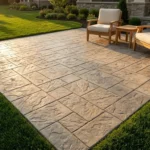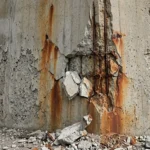
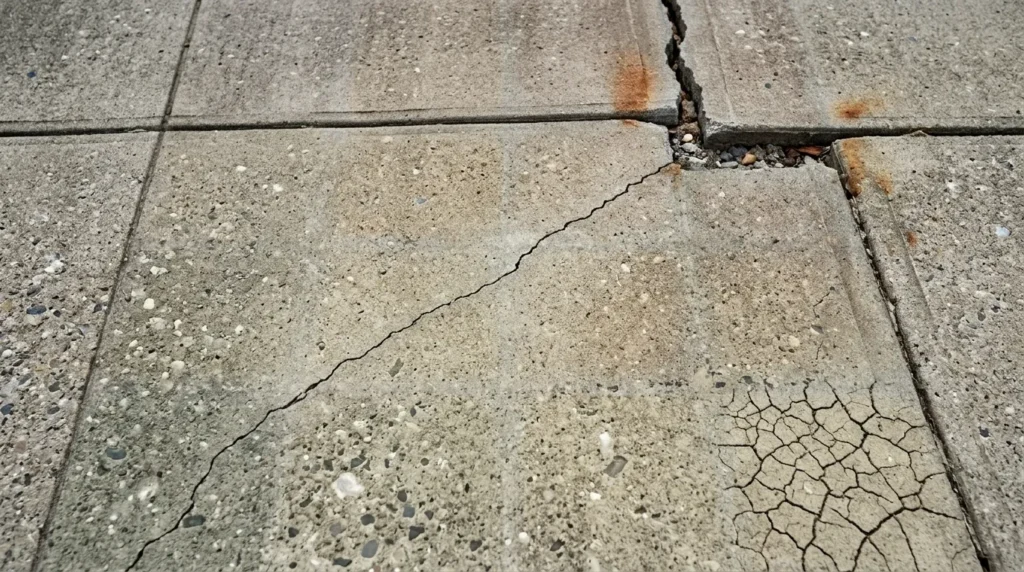

Every concrete surface cracks eventually. Some cracks are cosmetic — surface-level hairlines that mean nothing structurally. Others are warning signs of serious problems: soil movement, overloading, reinforcement corrosion, or foundation failure. The difference between a crack you can ignore and one that demands immediate professional attention is not always obvious from the surface.
Understanding the types of cracks in concrete — what pattern they form, where they appear, what caused them, and how wide they are — is the first step toward making the right call: monitor, seal, inject, or call a structural engineer.
This guide covers every major crack type found in slabs, walls, driveways, foundations, and structural elements, with a severity rating system, repair method guide, and prevention checklist. Whether you’re a homeowner looking at a crack in your driveway or a contractor assessing a foundation wall, the diagnostic framework here applies directly.
Before pouring new concrete to replace a damaged section, use the concrete calculator at ConcreteCal to estimate your material requirements accurately.
Table of Contents
- Why Does ConcreteCrack?
- Structural vs. Non-Structural Cracks
- Types of Cracks in Concrete by Pattern
- Types of Cracks by Location
- Crack Severity Guide — When to Worry
- Concrete Crack Repair Methods
- How to Prevent Concrete Cracks
- Frequently Asked Questions
Why Does Concrete Crack? The Core Reasons
Concrete cracks because it is strong in compression but weak in tension. Any force, movement, or condition that introduces tensile stress into a concrete element — stress that exceeds the concrete’s tensile capacity of roughly 300–500 PSI — produces a crack.
The causes are numerous, but they fall into four primary categories.
Shrinkage — The Most Common Cause
Concrete shrinks as it cures. Water evaporates from the mix, the cement paste contracts, and the slab tries to get smaller. If the slab is restrained — by subgrade friction, formwork, or adjacent structures — it cannot shrink freely, and tensile stress builds until the concrete cracks.
Plastic shrinkage occurs in the first few hours after pouring, while the concrete is still workable. Rapid moisture loss from the surface — driven by heat, wind, or low humidity — causes the surface to shrink faster than the interior, producing cracks that can appear within hours of the pour.
Drying shrinkage develops over weeks and months as the concrete continues to lose moisture during long-term curing. These cracks typically appear at re-entrant corners (inside corners of L-shaped slabs), at construction joints, and at random intervals across the slab.
Thermal Movement and Freeze-Thaw
Concrete expands when heated and contracts when cooled. In climates with significant temperature swings, this movement — if not accommodated by expansion joints — generates tensile stress that cracks the slab.
Freeze-thaw damage is a related but more destructive mechanism. Water trapped in concrete pores expands approximately 9% when it freezes — enough to fracture the surrounding paste. Over repeated freeze-thaw cycles, this produces surface scaling, crazing, and eventually deep structural cracking. Air-entrained concrete resists this by providing microscopic relief spaces for the expanding ice.
Overloading and Structural Stress
Concrete slabs and structural elements have defined load capacities. Exceeding those limits — with heavy vehicles on a residential driveway, point loads from equipment, or structural loads beyond design — produces flexural cracking in bending zones and diagonal cracking near supports.
Worked Example: A residential driveway designed for passenger vehicles (typically 4,000 lbs axle load) regularly supporting a delivery truck with 20,000 lb axle loads will develop flexural cracks at midspan — where bending stress is highest — within a relatively short service period.
Settlement and Soil Movement
When the subgrade beneath a concrete slab moves — due to soil compression, washout, expansive clay swelling, or tree root intrusion — the slab loses support in some areas while remaining supported in others. This differential support creates bending that concrete cannot resist without cracking.
Settlement cracks are particularly common in:
- Slabs poured over poorly compacted fill
- Driveways where water has eroded subgrade beneath the edges
- Foundations in areas with expansive clay soils that swell when wet and shrink when dry
Structural vs. Non-Structural Cracks — Know the Difference
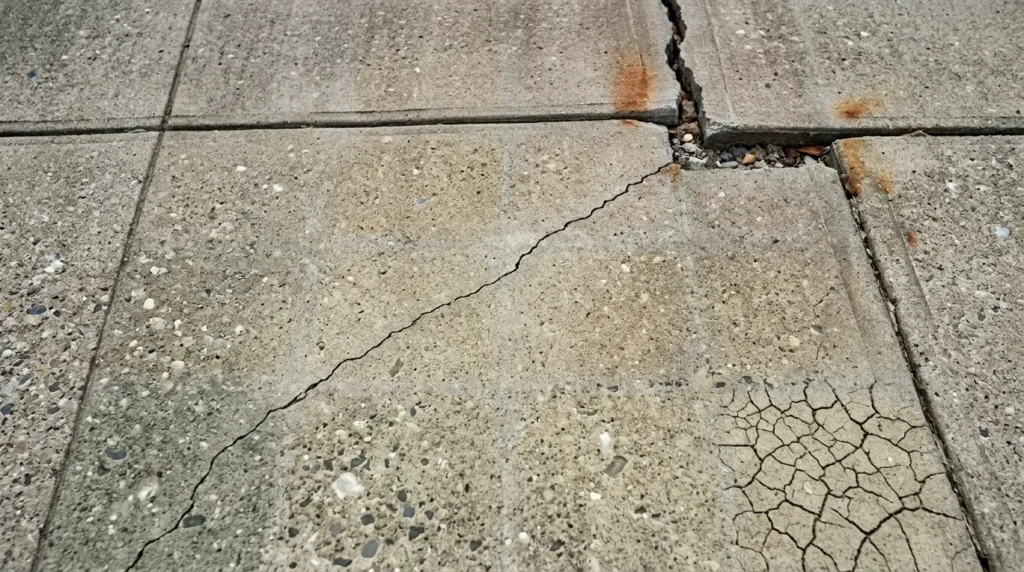
The most important classification in concrete crack assessment is structural versus non-structural. This distinction determines whether a crack requires monitoring, cosmetic repair, structural repair, or immediate professional evaluation.
| Factor | Non-Structural | Structural |
|---|---|---|
| Width | Under 0.3 mm (hairline) | Over 0.3 mm, often wider |
| Depth | Surface only | Through full thickness |
| Pattern | Random, map, parallel | Diagonal, stepped, horizontal |
| Movement | Stable — not growing | Active — widening or lengthening |
| Location | Field of slab | Corners, supports, walls |
| Load path | Not on load-bearing element | On structural element |
| Concern level | Low — monitor | High — professional assessment |
Key rule: Any crack that is actively growing, shows displacement between the two faces (one side higher than the other), or appears in a load-bearing element (column, beam, foundation wall) requires professional structural assessment — not DIY repair.
Types of Cracks in Concrete by Pattern
Pattern is the most useful diagnostic tool. The shape, direction, and distribution of cracks tells you what caused them.
Hairline Cracks
Width: Under 0.2 mm Pattern: Fine, random, often barely visible Cause: Normal drying shrinkage, minor thermal movement Severity: Low — cosmetic only in most cases
Hairline cracks are the most common type in residential concrete — they appear in virtually every slab, sidewalk, and driveway within the first few years. They rarely penetrate more than a few millimeters and do not affect structural performance.
When to act: Only if water infiltration is a concern (basement walls, below-grade elements) or if the crack is in an exposed architectural surface where appearance matters.
Crazing and Map Cracking
Width: Very fine — surface only Pattern: Network of interconnected cracks resembling a road map or dried mud Cause: Rapid surface drying during curing, overworking the surface (excessive troweling), crusting
Crazing affects only the surface paste layer — it does not penetrate into the aggregate zone below. It is caused by the surface drying and shrinking faster than the interior during the critical early curing hours.
Prevention: Curing compounds, wet burlap covers, and avoiding troweling over bleed water eliminate crazing almost entirely.
Plastic Shrinkage Cracks
Width: 0.1–3 mm Pattern: Roughly parallel, diagonal to the slab direction, typically 300–600 mm apart Cause: Rapid moisture evaporation from fresh concrete surface before initial set Timing: Appear within 30 minutes to 6 hours of pouring
These are among the most preventable cracks — they form exclusively during the pour and early curing period. High temperature, low humidity, and wind all accelerate surface evaporation. When evaporation rate exceeds bleed water rate, the surface shrinks and cracks.
Worked Example: A 20 ft × 20 ft patio poured on a 90°F afternoon with 15 mph wind. Evaporation rate exceeds 0.2 lbs/ft²/hour — the threshold above which plastic shrinkage cracking risk becomes high. Without windbreaks or evaporation retarder, parallel diagonal cracks appear across the surface within 2–3 hours of screeding.
Drying Shrinkage Cracks
Width: 0.1–0.5 mm typically; can be wider Pattern: Random field cracks; concentrated at re-entrant corners and construction joints Cause: Long-term moisture loss from curing concrete Timing: Develop over weeks to months after pouring
Drying shrinkage cracks are the most common long-term crack type. They’re particularly predictable at re-entrant corners — the inside corners of L-shaped slabs, cutouts around columns, or any abrupt change in slab geometry. These corners concentrate stress and almost always crack first without control joints or corner reinforcement.
Settlement Cracks
Width: Variable — often 1–5 mm, can be much wider Pattern: Often straight or gently curved; may show vertical displacement between faces Cause: Differential subgrade settlement — one part of the slab loses support while an adjacent part remains supported
Settlement cracks are distinguished from shrinkage cracks by displacement — one side of the crack is higher than the other, indicating the slab has moved vertically. A crack with no vertical displacement is likely shrinkage; a crack where one face is elevated is almost certainly settlement.
Expansion and Thermal Cracks
Width: Variable Pattern: Often at construction joints, where the slab is restrained; can be transverse (across the slab width) Cause: Thermal expansion of concrete against a fixed restraint — adjacent structure, curb, or building foundation
Expansion cracks form when concrete is heated and tries to expand but is blocked by an adjacent structure. Without adequate expansion joints, the slab pushes against the restraint until something gives — typically the concrete itself.
Prevention: Expansion joints filled with compressible filler at all fixed boundaries — building walls, curbs, columns — eliminate this crack type entirely.
Heaving Cracks
Width: Variable — often wide with significant vertical displacement Pattern: Upward displacement of a slab section; cracks around the perimeter of the heaved area Cause: Subgrade expansion — expansive clay soils swelling when wet, frost heave, tree root growth beneath slab
Heaving is the opposite of settlement — the subgrade pushes up rather than dropping away. The result is a raised section of slab with cracks at its boundaries. In freeze-thaw climates, frost heave is a seasonal problem — the slab lifts in winter and drops in spring, cracking progressively with each cycle.
Flexural and Diagonal Cracks
Width: Variable — often 0.3–2 mm; can be wider in severe overload Pattern: Flexural cracks run perpendicular to the tensile stress (often transverse across a beam or slab); diagonal cracks run at 45° near supports Cause: Bending stress exceeding concrete’s tensile capacity; shear stress near supports Severity: HIGH — these are structural cracks
Flexural cracks in beams, columns, or load-bearing slabs indicate the element is experiencing stress beyond its design capacity. Diagonal cracks near beam supports (at 45°) are shear cracks — one of the most serious crack types in structural concrete. Both require immediate professional evaluation.
Corrosion-Induced Cracks
Width: Variable — often start narrow, widen progressively Pattern: Linear, following the path of embedded rebar beneath the surface; often accompanied by rust staining Cause: Steel reinforcement corroding — rust expands to 3–4 times the volume of the original steel, fracturing the surrounding concrete
Corrosion cracks are particularly insidious because they indicate the reinforcement is compromised — the structural steel is weakening while the cracking is occurring. Common causes include insufficient concrete cover, deicing salt infiltration, and carbonation of the concrete reducing the pH that normally protects the steel.
Identifying feature: Rust-colored staining along the crack line. If you see rust stains following a crack in a concrete wall, slab, or column, assume corrosion until proven otherwise.
Types of Cracks by Location
Concrete Slab Cracks
Slabs are the most common location for cracking — they’re large, flat, restrained by subgrade friction, and exposed to temperature and moisture variation across their full surface.
Most common types in slabs:
- Plastic shrinkage (early — parallel diagonal pattern)
- Drying shrinkage (later — random field cracks, re-entrant corners)
- Settlement (differential subgrade movement — displaced faces)
- Overload (vehicle loads — transverse midspan cracks)
Control joints — saw-cut or tooled grooves at regular intervals — are the primary prevention tool. They create planned weak points where shrinkage cracks will form in a controlled, straight line rather than randomly across the slab surface.
Foundation and Footing Cracks
Foundation cracks are the most anxiety-inducing crack type for homeowners — and the most important to correctly diagnose.
| Crack Type | Pattern | Likely Cause | Severity |
|---|---|---|---|
| Hairline vertical | Straight, narrow | Normal shrinkage | Low |
| Wide vertical (>3mm) | Straight, wider | Settlement or overload | Medium-High |
| Horizontal | Runs across wall | Lateral soil/hydrostatic pressure | HIGH |
| Diagonal (stair-step) | 45° or stair-step in block | Differential settlement | HIGH |
| Diagonal (poured wall) | 45° from corners | Settlement or overload | HIGH |
Horizontal cracks in foundation walls are the most serious — they indicate the wall is being pushed inward by lateral soil pressure or hydrostatic pressure. This is a structural failure mode that requires immediate professional assessment and often wall reinforcement or underpinning.
Wall Cracks
Wall cracks follow similar diagnostic patterns to foundation cracks but add the dimension of moisture infiltration risk. Any crack in a below-grade wall that allows water entry is a waterproofing problem in addition to a structural concern.
Vertical wall cracks — most common, usually shrinkage-related, low severity unless wide or active. Horizontal wall cracks — serious, lateral pressure indicator. Diagonal wall cracks — often indicate differential settlement in the structure above.
Driveway and Pavement Cracks
Driveway cracks are typically non-structural but affect appearance and can worsen over time if water infiltrates and erodes the subbase.
D-cracking — a pattern of cracks parallel to joints and edges — is a specific pavement deterioration pattern caused by freeze-thaw damage to certain aggregate types. It’s common in older concrete pavements in northern climates and is not repairable — affected sections must be replaced.
Crack Severity Guide — When to Worry
| Crack Width | Type | Action Required |
|---|---|---|
| Under 0.2 mm | Hairline | Monitor — no action usually needed |
| 0.2–0.3 mm | Fine | Seal if water infiltration risk |
| 0.3–1.0 mm | Moderate | Seal; investigate cause if structural element |
| 1–3 mm | Wide | Professional assessment if structural; repair if non-structural |
| Over 3 mm | Very wide | Professional structural assessment required |
| Any width + displacement | Any | Professional assessment — possible settlement |
| Any width + active growth | Any | Professional assessment immediately |
| Horizontal in foundation wall | Any | Professional assessment immediately |
According to the American Concrete Institute (ACI 224R), crack widths above 0.3 mm in reinforced concrete exposed to weather or deicers should be evaluated for potential reinforcement corrosion risk — even if the crack appears stable.
Concrete Crack Repair Methods
The right repair method depends on crack width, depth, activity (stable vs. growing), and whether water infiltration is occurring.
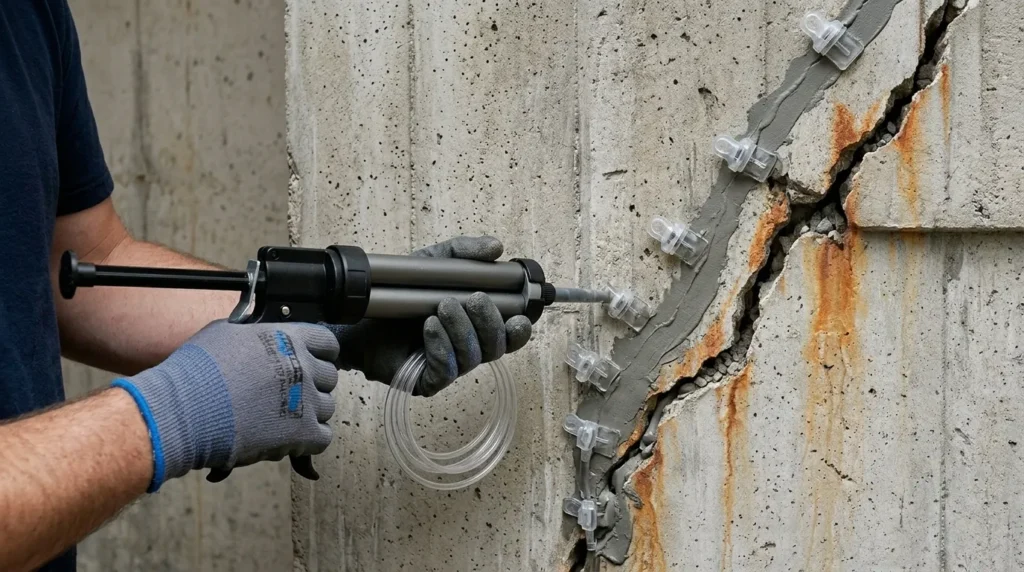
Epoxy Injection
Best for: Structural cracks — restores monolithic strength across the crack plane Crack width: 0.05–6 mm Process: Low-pressure injection of two-part epoxy resin through ports spaced along the crack Result: Bond strength often exceeds original concrete strength
Epoxy injection is the standard repair for structural cracks in beams, columns, foundations, and bridge elements where load transfer across the crack must be restored. It does not work on active (moving) cracks — the epoxy sets rigid and will re-crack if movement continues.
Polyurethane Injection
Best for: Active cracks with water infiltration; flexible seal for moving cracks Crack width: 0.5 mm and above Process: Injection of expanding polyurethane foam that reacts with moisture to fill the crack Result: Flexible, waterproof seal — accommodates ongoing movement
Polyurethane injection is the standard repair for leaking foundation cracks and any crack that continues to move seasonally. Unlike epoxy, it remains flexible — so thermal movement doesn’t re-crack the repair.
Crack Sealing and Routing
Best for: Non-structural surface cracks in pavements and slabs Process: Crack is routed (widened with a saw) to create a uniform reservoir, then filled with flexible sealant (polyurethane or silicone) Result: Waterproof seal that accommodates movement; prevents debris infiltration and edge deterioration
Routing and sealing is the most cost-effective repair for driveway and pavement cracks — it’s fast, durable, and prevents the water infiltration that erodes subbase and widens cracks over winter freeze-thaw cycles.
Acrylate Gel Injection
Best for: Very fine cracks (under 0.1 mm) and cracks in water-retaining structures Process: Low-viscosity acrylate gel is injected under pressure, penetrating micro-cracks and gelling on contact with moisture Result: Waterproof seal in extremely fine crack networks
Acrylate gel injection is a specialty method used primarily in water-retaining structures (tanks, tunnels, dams) and in fine crack networks where epoxy viscosity is too high to penetrate.
Repair Method Quick Reference
| Method | Crack Width | Moving Crack? | Water Present? | Best Application |
|---|---|---|---|---|
| Epoxy injection | 0.05–6 mm | No | No | Structural repair |
| Polyurethane injection | 0.5 mm+ | Yes | Yes | Foundation leaks |
| Routing + sealant | Any surface crack | Yes | Surface | Driveways, pavements |
| Acrylate gel | Under 0.1 mm | No | Yes | Fine cracks, tanks |
| Surface sealer | Hairline only | No | Surface | Cosmetic, waterproofing |
How to Prevent Concrete Cracks
1. Use the correct water-cement ratio. Every extra unit of water added beyond the specified ratio increases shrinkage and reduces strength. High water-cement ratios are the single biggest controllable contributor to shrinkage cracking. Never add water at the truck to increase workability.
2. Install control joints at correct spacing. For residential slabs, control joints should be spaced at 2–3 times the slab thickness in feet — a 4-inch slab needs joints every 8–12 feet. Joints must be cut to at least one-quarter of the slab depth to be effective.
3. Cure properly. Concrete that loses moisture too quickly shrinks and cracks. Keep the surface moist for a minimum of 7 days using wet burlap, curing blankets, or a curing compound. In hot or windy conditions, start curing immediately after finishing.
4. Prepare the subgrade correctly. Compact the subgrade uniformly to the specified density. Soft spots, organic material, and poorly compacted fill all produce differential settlement. A well-compacted, uniform subgrade is the most effective long-term crack prevention measure.
5. Use air-entrained concrete in freeze-thaw climates. Air entrainment at 4–7% provides microscopic relief space for freezing water — dramatically reducing scaling and freeze-thaw cracking. Specify this whenever exterior concrete will be exposed to freezing temperatures or deicers.
6. Place expansion joints at all fixed boundaries. Wherever a slab meets a building wall, column, curb, or other fixed structure, install a compressible expansion joint filler. This accommodates thermal movement without generating restraint cracks.
7. Reinforce correctly. Rebar or wire mesh in the correct position — elevated to the lower third of the slab, not lying on the subgrade — controls crack width even when cracking occurs. Reinforcement doesn’t prevent cracks but keeps them tight and structurally sound.
Frequently Asked Questions About Concrete Cracks
What are the types of cracks in concrete?
The main types are: hairline cracks (fine, cosmetic), crazing/map cracking (surface network), plastic shrinkage cracks (early diagonal pattern), drying shrinkage cracks (random field), settlement cracks (displaced faces), thermal/expansion cracks (at restraints), heaving cracks (upward displacement), flexural cracks (structural bending), diagonal shear cracks (near supports), and corrosion-induced cracks (following rebar path with rust staining).
What are the types of cracks in concrete slabs?
Concrete slabs most commonly develop plastic shrinkage cracks (within hours of pouring), drying shrinkage cracks (weeks to months later), settlement cracks (from subgrade movement), and overload cracks (from vehicles or point loads exceeding design capacity). Control joints manage shrinkage cracking by creating planned weak points.
What is the difference between structural and non-structural cracks?
Non-structural cracks are surface-level, stable, and do not affect load-carrying capacity — hairline cracks and crazing fall in this category. Structural cracks penetrate through the element, may show displacement between faces, often grow over time, and occur in load-bearing elements. Structural cracks require professional assessment; non-structural cracks typically need only monitoring or cosmetic repair.
When should I worry about a concrete crack?
Worry when: the crack is wider than 3 mm; one side is higher than the other (displacement); the crack is actively growing; the crack is horizontal in a foundation or retaining wall; rust staining follows the crack line; or the crack is in a structural element (beam, column, load-bearing wall). Any of these conditions warrants a professional structural assessment.
What causes cracks in concrete slabs?
The most common causes are shrinkage (plastic and drying), thermal movement, differential settlement, overloading, freeze-thaw cycling, and reinforcement corrosion. Most residential slab cracks are shrinkage-related and non-structural. Settlement and overload cracks are less common but more serious.
What are the types of concrete damage beyond cracking?
Concrete damage includes spalling (surface chunks breaking off), scaling (surface layer flaking), delamination (surface layer separating), corrosion (rebar rust causing cracking and spalling), chemical attack (sulfate, chloride, or acid deterioration), and abrasion wear. These are covered in detail in a separate guide on types of concrete damage.
How do I repair cracks in a concrete driveway?
For stable surface cracks, routing and sealing with flexible polyurethane sealant is the standard repair. Clean the crack, rout it to a uniform width and depth, apply backer rod for cracks deeper than 1/2 inch, and fill with sealant. For active cracks or cracks with subbase erosion, address the underlying cause before sealing the surface.
Can concrete cracks be prevented entirely?
No — shrinkage cracking in some form is virtually inevitable in concrete flatwork. The goal is to control where cracks occur (using control joints) and to minimize their width (using correct water-cement ratio, proper curing, and reinforcement). Well-designed and well-constructed concrete limits cracking to tight, stable cracks at planned locations.
Conclusion
Concrete cracks — but not all cracks are equal. A hairline shrinkage crack in a driveway is a normal part of concrete’s life cycle. A horizontal crack in a foundation wall or a diagonal crack widening month by month is a structural emergency. The crack pattern, width, displacement, and location tell you which category you’re dealing with. Use the severity guide and repair method table in this article to make an informed assessment — and when in doubt about a crack in a structural element, call a licensed structural engineer before attempting any repair. For replacement pours after removing damaged sections, calculate your concrete needs accurately with the ConcreteCal concrete calculator.