
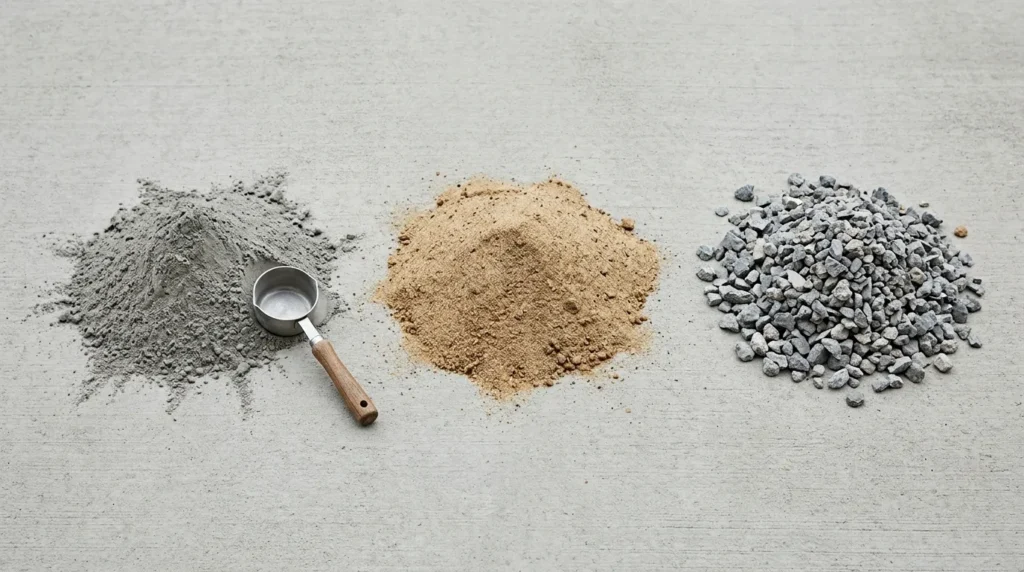

There are two completely different calculations hiding inside the question of how to calculate the amount of concrete needed — and most online guides only answer one of them.
The first is volume: how many cubic yards or cubic meters of mixed concrete does your project require? This is what ready mix suppliers need when you call to order. The second is ingredients: how much cement, sand, aggregate, and water do you need to batch your own concrete from raw materials? This is what anyone mixing on site needs to know before ordering bags of cement and loads of aggregate.
Most people need one or the other — rarely both. This guide covers both calculations completely, so you can answer whichever version of the question applies to your project.
For the volume calculation only, use our concrete bag calculator for an instant result. If you want to understand the full ingredient breakdown for site-mixed concrete, this guide walks you through every step.
Before any concrete pour, make sure your subbase is correctly prepared — see our guides on what type of gravel under concrete and how much gravel under a concrete slab to get the foundation right before calculating your concrete.
Table of Contents
- What the Calculation Actually Involves
- How to Calculate the Volume of Concrete Needed
- Concrete Mix Ratios — What They Mean
- How to Calculate Cement, Sand, and Aggregate Quantities
- Worked Examples — Full Mix Calculations
- Mix Material Quick Reference Tables
- Bagged Concrete vs. Site-Mix
- Waste Factor — Why You Always Need More
- Frequently Asked Questions
What the Calculation Actually Involves
Before running any numbers, it helps to be clear about what you are actually calculating — because the two types of concrete calculation require completely different inputs and produce completely different outputs.
Volume vs. Ingredients — Two Different Calculations
Volume calculation answers: how much space will the concrete occupy? The output is cubic yards (US) or cubic meters (metric). This is what you give a ready mix supplier. It is calculated from your project dimensions — length × width × thickness.
Ingredient calculation answers: how much cement, sand, aggregate, and water do I need to make that volume of concrete? The output is kilograms or bags of cement, tonnes of sand, tonnes of aggregate, and litres of water. This is what you need when batching concrete on site from raw materials.
If you are ordering ready mix — call with volume. If you are site-mixing — you need both.
Which Calculation Do You Need?
| Situation | Calculation Needed | Output |
|---|---|---|
| Ordering ready mix | Volume only | Cubic yards / cubic meters |
| Buying bagged premix | Volume → bags | Number of bags |
| Site mixing from raw materials | Volume + ingredients | Cement bags, sand tonnes, aggregate tonnes |
| Checking a contractor’s estimate | Volume | Cubic yards to verify order |
| Calculating project cost | Volume + ingredients | Material quantities × unit prices |
How to Calculate the Volume of Concrete Needed
Volume is always the starting point — whether you are ordering ready mix or calculating ingredients for site mixing.
The Core Volume Formula
Volume = Length × Width × Thickness
All three dimensions must be in the same unit before multiplying. Convert thickness from inches to feet (divide by 12) or from millimetres to metres (divide by 1,000).
In US units (output in cubic feet):
Volume (ft³) = Length (ft) × Width (ft) × Thickness (ft) Volume (yd³) = ft³ ÷ 27
In metric units (output in cubic meters):
Volume (m³) = Length (m) × Width (m) × Thickness (m)
Worked Example — Basic Volume: A 4m × 6m patio, 100mm thick:
Volume = 4 × 6 × 0.10 = 2.4 m³
A 12 ft × 20 ft patio, 4 inches thick:
Volume = 12 × 20 × (4÷12) = 12 × 20 × 0.333 = 79.9 ft³ ÷ 27 = 2.96 cubic yards
Converting to Cubic Yards
1 cubic yard = 27 cubic feet 1 cubic meter = 1.308 cubic yards
Use our concrete bag calculator to convert your volume directly to bag count or to cross-check a ready mix order.
Volume by Project Type
| Application | Standard Thickness | Formula Notes |
|---|---|---|
| Patio slab | 4 inches (100mm) | L × W × 0.333 ft |
| Driveway | 5 inches (125mm) | L × W × 0.417 ft |
| Garage floor | 5–6 inches | L × W × 0.417–0.500 ft |
| Sidewalk | 4 inches | L × W × 0.333 ft |
| Foundation footing | 8–12 inches | L × W × 0.667–1.000 ft |
| Column | π × r² × height | Round cross-section formula |
| Wall | Length × Height × Thickness | All in feet |
Concrete Mix Ratios — What They Mean and How to Use Them
Once you have your volume, the mix ratio tells you the proportions of cement, sand, and aggregate that make up that volume. This is where site mixing calculations begin.
“The mix designations M10 through M40 follow the concrete grade classifications defined by the Bureau of Indian Standards IS 456 and widely adopted internationally — the number represents the characteristic compressive strength in MPa at 28 days under standard curing conditions.”
Standard Mix Ratios (Nominal Mix)
A concrete mix ratio is written as Cement : Sand : Aggregate by volume or weight. The most common nominal mixes:
| Mix Designation | Ratio (C:S:A) | Equivalent Grade | Common Use |
|---|---|---|---|
| M10 | 1 : 3 : 6 | 10 MPa / 1,450 PSI | Lean concrete, blinding |
| M15 | 1 : 2 : 4 | 15 MPa / 2,175 PSI | Light non-structural |
| M20 | 1 : 1.5 : 3 | 20 MPa / 2,900 PSI | Residential slabs, beams |
| M25 | 1 : 1 : 2 | 25 MPa / 3,625 PSI | Driveways, structural elements |
| M30 | Design mix | 30 MPa / 4,350 PSI | Heavy structural, commercial |
| M40 | Design mix | 40 MPa / 5,800 PSI | High-performance structural |
M20 is the most commonly used mix for residential construction — strong enough for slabs, footings, and most structural elements while remaining workable enough for manual mixing.
What Each Ratio Component Does
Cement is the binder — it reacts with water (hydration) to form the paste that glues everything together. More cement means higher strength and higher cost.
Sand (fine aggregate) fills the voids between coarse aggregate particles. Too little sand produces a harsh, difficult-to-work mix. Too much produces a weak, porous concrete.
Coarse aggregate (gravel, crushed stone) provides the bulk of the concrete’s volume and compressive strength. Maximum aggregate size is typically 20mm (3/4 inch) for slabs and 10mm (3/8 inch) for thin sections.
Water triggers hydration but must be carefully controlled. Too much water increases workability (easier to place) but dramatically reduces strength. The water-cement ratio (w/c) governs concrete strength more than any other single variable — a w/c ratio of 0.40–0.50 is typical for structural concrete.
Choosing the Right Mix Ratio for Your Project
| Project | Recommended Mix | Reason |
|---|---|---|
| Blinding / leveling layer | M10 (1:3:6) | Strength not critical |
| Garden path, non-structural | M15 (1:2:4) | Light loads only |
| Residential patio, slab | M20 (1:1.5:3) | Standard structural minimum |
| Driveway, garage floor | M25 (1:1:2) | Vehicle loads require higher strength |
| Foundation, structural beam | M25–M30 | Engineer specification typically governs |
| Commercial, industrial | M30–M40 | Design mix by structural engineer |
How to Calculate Cement, Sand, and Aggregate Quantities
This is where the ingredient calculation diverges from the simple volume formula — and where most DIYers get confused.
The Dry Volume Factor (1.54)
Here is the key concept that most concrete calculation guides skip entirely: dry ingredients occupy more space than the wet concrete they produce.
When you mix cement, sand, and aggregate with water, the paste fills the voids between aggregate particles. The resulting wet concrete volume is less than the sum of the dry ingredient volumes — typically by about 35%.
To produce 1 m³ of wet concrete, you need to start with approximately 1.54 m³ of dry ingredients.
Dry volume = Wet volume × 1.54
This 1.54 factor is standard in civil engineering quantity estimation — it accounts for the volume reduction from void filling during mixing.
Worked Example — Why the Factor Matters: If you need 2.4 m³ of concrete (our patio example):
Dry volume needed: 2.4 × 1.54 = 3.696 m³ of dry ingredients total
Without this factor, you would calculate ingredient quantities for only 2.4 m³ — and end up with approximately 35% less concrete than needed. That is a significant shortfall on any meaningful pour.
Calculating Cement Quantity
For a mix ratio of 1 : 1.5 : 3 (M20), the sum of ratio parts = 1 + 1.5 + 3 = 5.5 parts total.
Cement fraction: 1 ÷ 5.5 = 0.1818
Cement volume = Dry volume × cement fraction Cement volume = 3.696 × 0.1818 = 0.672 m³
Convert to weight: cement bulk density = 1,440 kg/m³
Cement weight = 0.672 × 1,440 = 967.7 kg
Bags of cement (50 kg bags):
967.7 ÷ 50 = 19.35 → 20 bags of cement
Calculating Sand Quantity
Sand fraction for M20: 1.5 ÷ 5.5 = 0.2727
Sand volume = Dry volume × sand fraction Sand volume = 3.696 × 0.2727 = 1.008 m³
Convert to weight: sand bulk density ≈ 1,600 kg/m³
Sand weight = 1.008 × 1,600 = 1,612.8 kg ≈ 1.61 tonnes
Calculating Aggregate Quantity
Aggregate fraction for M20: 3 ÷ 5.5 = 0.5455
Aggregate volume = Dry volume × aggregate fraction Aggregate volume = 3.696 × 0.5455 = 2.016 m³
Convert to weight: aggregate bulk density ≈ 1,500 kg/m³
Aggregate weight = 2.016 × 1,500 = 3,024 kg ≈ 3.02 tonnes
Calculating Water Requirement
Water quantity is determined by the water-cement ratio (w/c). For M20 residential concrete, w/c = 0.45–0.55. Using 0.50:
Water = Cement weight × w/c ratio Water = 967.7 × 0.50 = 483.85 litres
This is the theoretical water — in practice, adjust for site temperature, aggregate moisture content, and desired workability (slump).
Worked Examples — Full Mix Calculations
Example 1 — Residential Patio Slab (M20 Mix)
Project: 4m × 6m patio, 100mm thick Mix: M20 (1:1.5:3)
Step 1 — Volume:
4 × 6 × 0.10 = 2.4 m³
Step 2 — Dry volume:
2.4 × 1.54 = 3.696 m³
Step 3 — Ingredients:
| Material | Fraction | Volume (m³) | Weight | Bags/Tonnes |
|---|---|---|---|---|
| Cement | 1/5.5 = 0.182 | 0.672 m³ | 968 kg | 20 bags (50kg) |
| Sand | 1.5/5.5 = 0.273 | 1.008 m³ | 1,613 kg | 1.61 tonnes |
| Aggregate | 3/5.5 = 0.545 | 2.016 m³ | 3,024 kg | 3.02 tonnes |
| Water | w/c = 0.50 | — | 484 kg | 484 litres |
Add 10% waste to each quantity before ordering.
Example 2 — Driveway (M25 Mix)
Project: 5m × 10m driveway, 125mm thick Mix: M25 (1:1:2) — sum of parts = 4
Step 1 — Volume:
5 × 10 × 0.125 = 6.25 m³
Step 2 — Dry volume:
6.25 × 1.54 = 9.625 m³
Step 3 — Ingredients:
| Material | Fraction | Volume (m³) | Weight | Bags/Tonnes |
|---|---|---|---|---|
| Cement | 1/4 = 0.25 | 2.406 m³ | 3,465 kg | 69 bags (50kg) |
| Sand | 1/4 = 0.25 | 2.406 m³ | 3,850 kg | 3.85 tonnes |
| Aggregate | 2/4 = 0.50 | 4.813 m³ | 7,219 kg | 7.22 tonnes |
| Water | w/c = 0.45 | — | 1,559 kg | 1,559 litres |
Note: At this project scale (6.25 m³ = approximately 8.2 cubic yards), ordering ready mix is almost certainly more economical than site mixing. The ingredient calculation is useful for verifying a contractor’s order or understanding what goes into the mix — but the practical choice for a 5×10m driveway is a ready mix truck.
Example 3 — Foundation Footing (M15 Mix)
Project: 8 linear metres of strip footing, 500mm wide, 250mm deep Mix: M15 (1:2:4) — sum of parts = 7
Step 1 — Volume:
8 × 0.5 × 0.25 = 1.0 m³
Step 2 — Dry volume:
1.0 × 1.54 = 1.54 m³
Step 3 — Ingredients:
| Material | Fraction | Volume (m³) | Weight | Bags/Tonnes |
|---|---|---|---|---|
| Cement | 1/7 = 0.143 | 0.220 m³ | 317 kg | 7 bags (50kg) |
| Sand | 2/7 = 0.286 | 0.440 m³ | 704 kg | 0.70 tonnes |
| Aggregate | 4/7 = 0.571 | 0.880 m³ | 1,320 kg | 1.32 tonnes |
| Water | w/c = 0.55 | — | 174 kg | 174 litres |
At 1 m³, bagged concrete may be more practical than site mixing from raw materials — approximately 45 bags of 80 lb premix, or 12–14 bags of 25kg premix.
Mix Material Quick Reference Tables
Ingredients Per Cubic Meter by Mix Grade
| Mix Grade | Cement (kg) | Sand (kg) | Aggregate (kg) | Water (litres) |
|---|---|---|---|---|
| M10 (1:3:6) | 152 | 456 | 912 | 76 |
| M15 (1:2:4) | 220 | 440 | 880 | 121 |
| M20 (1:1.5:3) | 403 | 605 | 1,210 | 181 |
| M25 (1:1:2) | 554 | 554 | 1,108 | 249 |
Per cubic meter of finished concrete. Add 10% for waste.
Ingredients Per Cubic Yard by Mix Grade
| Mix Grade | Cement (lbs) | Sand (lbs) | Aggregate (lbs) | Water (gallons) |
|---|---|---|---|---|
| M10 (1:3:6) | 255 | 765 | 1,530 | 20 |
| M15 (1:2:4) | 369 | 738 | 1,476 | 32 |
| M20 (1:1.5:3) | 676 | 1,014 | 2,028 | 48 |
| M25 (1:1:2) | 929 | 929 | 1,858 | 66 |
Per cubic yard of finished concrete. Add 10% for waste.
Bagged Concrete vs. Site-Mix — Which to Calculate For
The calculation method changes entirely depending on whether you are mixing from scratch or buying premixed bags.
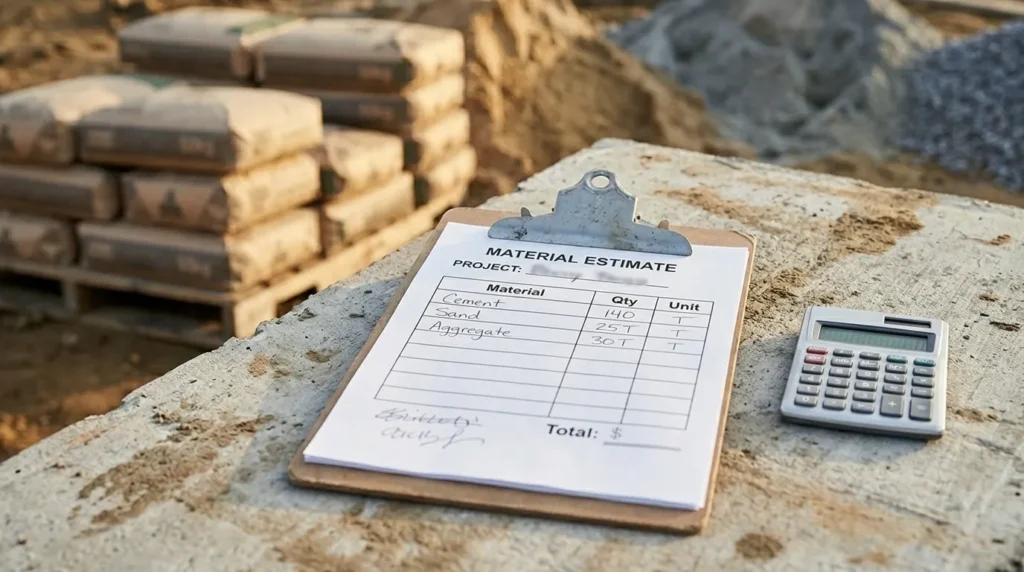
Premixed bagged concrete (Quikrete, Sakrete, etc.) already contains cement, sand, and aggregate in the correct proportions — you only add water. For these products, the only calculation is volume (how many bags), not ingredients. Use our concrete bag calculator for this.
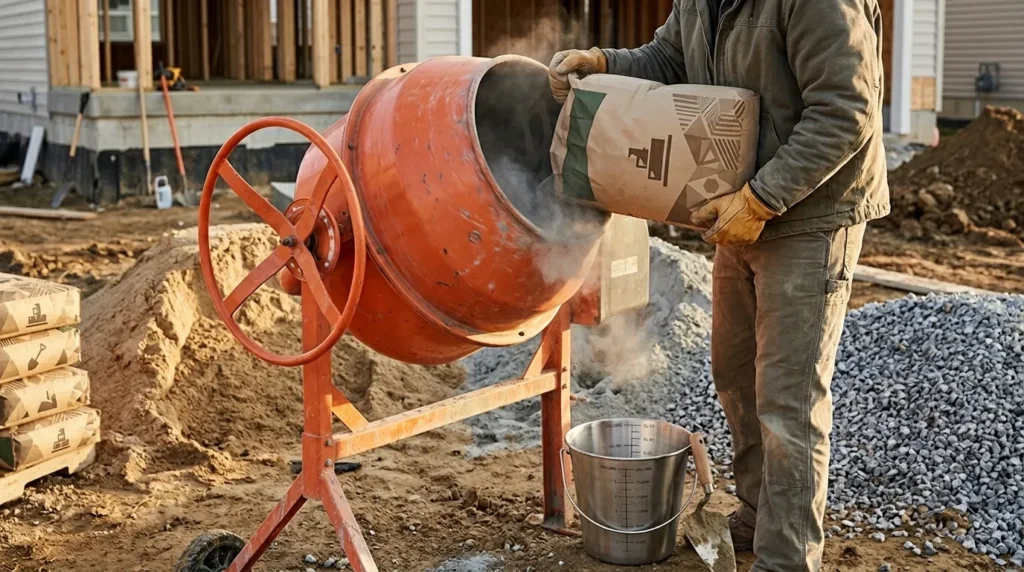
Site mixing from raw materials requires the full ingredient calculation in this guide — cement bags, sand, and aggregate ordered separately and batched on site. This is less common for residential work but standard for:
- Remote sites where ready mix cannot deliver
- Large commercial projects where on-site batching plant is more economical
- Developing countries where ready mix infrastructure is limited
- Specialty mixes not available from local ready mix suppliers
Ready mix — you give the supplier your volume, PSI requirement, and mix specification. They do the ingredient calculation internally. You never need to calculate individual ingredient quantities for a ready mix order.
The practical decision:
| Volume | Recommended Approach |
|---|---|
| Under 0.5 m³ (0.65 yd³) | Bagged premix — convenient, no waste |
| 0.5–2 m³ | Ready mix with possible short-load fee |
| Over 2 m³ | Ready mix — clearly most economical |
| Remote site, any volume | Site mix or bagged |
Waste Factor — Why You Always Need More Than the Formula Says
Every concrete and ingredient calculation produces a theoretical minimum. Real projects always use more.
Why waste occurs in concrete:
- Spillage during mixing and transport to formwork
- Residue left in the mixer drum and on tools
- Uneven subgrade absorbing more concrete than calculated
- Form edge overfill during screeding
- Slight measurement inaccuracies in project dimensions
Why waste occurs in ingredient calculations:
- Cement absorbed by bags and mixer walls
- Sand and aggregate loss during handling and mixing
- Moisture in aggregates changing effective water content
- Batching inaccuracies in manual mixing
Standard waste factors:
| Project Type | Recommended Waste | Apply To |
|---|---|---|
| Volume calculation | 10% | Cubic yards/meters ordered |
| Cement quantity | 10% | Bags purchased |
| Sand quantity | 10% | Tonnes ordered |
| Aggregate quantity | 10% | Tonnes ordered |
| Bagged premix count | 10% | Bags purchased |
Always apply the waste factor after calculating the base quantity — not before. Calculate correctly first, then add 10% to each material quantity.
A real consequence of skipping waste factor: A 2.4 m³ patio pour with M20 mix. Calculation says 20 bags of cement. Site mixer uses 22 bags due to spillage and residue. Without the 10% waste addition (which would have put the order at 22 bags), the pour stops with one section unfinished — a cold joint is the result. Two bags of cement, ordered in advance, prevent a structural problem.
Frequently Asked Questions
How do I calculate the amount of concrete needed?
Multiply length × width × thickness (all in feet or all in meters) to get volume. In feet: divide cubic feet by 27 to get cubic yards. In meters: result is directly in cubic meters. Add 10% for waste. This gives you the volume to order from a ready mix supplier or to convert to bag count.
How do I calculate how much cement I need?
First calculate your concrete volume with the formula above. Multiply by 1.54 to get dry ingredient volume. Multiply by the cement fraction from your mix ratio (for M20: 1÷5.5 = 0.182). Multiply by cement density (1,440 kg/m³). Divide by bag weight (typically 50 kg). Add 10% for waste. For 1 m³ of M20 concrete: approximately 8 bags of 50 kg cement (with waste).
What is the formula for calculating concrete volume?
Volume (m³) = Length (m) × Width (m) × Thickness (m). Or in US units: Volume (ft³) = Length (ft) × Width (ft) × Thickness (ft), then divide by 27 for cubic yards. Always convert thickness from inches to feet (divide by 12) before multiplying. Add 10% to the result for waste before ordering.
What does a concrete mix ratio of 1:1.5:3 mean?
The ratio means 1 part cement : 1.5 parts sand : 3 parts coarse aggregate by volume or weight. This is the M20 mix — the standard for residential slabs and most non-structural concrete work. The higher the cement proportion (lower total ratio), the stronger the concrete — M25 (1:1:2) has proportionally more cement than M20.
Why do I multiply by 1.54 in the ingredient calculation?
Dry concrete ingredients (cement, sand, aggregate) occupy more volume than the wet concrete they produce. When mixed with water, the cement paste fills the voids between aggregate particles, reducing total volume. To produce 1 cubic meter of finished concrete, you need approximately 1.54 cubic meters of dry ingredients. Without this factor, your ingredient calculation will produce 35% less concrete than required.
How much cement, sand, and aggregate do I need per cubic meter?
For M20 concrete (1:1.5:3): approximately 403 kg cement, 605 kg sand, and 1,210 kg aggregate per cubic meter of finished concrete. For M25 (1:1:2): approximately 554 kg cement, 554 kg sand, and 1,108 kg aggregate. Always add 10% to these quantities for purchasing.
What is the water-cement ratio and how does it affect concrete strength?
The water-cement ratio (w/c) is the weight of water divided by the weight of cement in a mix. Lower w/c ratios produce stronger, less permeable concrete — but also stiffer, harder-to-work mixes. Typical residential concrete uses w/c = 0.45–0.55. Structural concrete may specify w/c as low as 0.40. Adding extra water to improve workability dramatically reduces strength — every 0.05 increase in w/c reduces compressive strength by approximately 5–7%.
Should I use site mix or ready mix for my project?
For volumes under 0.5 m³: bagged premix is most practical. For 0.5–2 m³: ready mix with a possible short-load fee, or site mix if the site is remote. For over 2 m³: ready mix is almost always more economical than site mixing from raw materials. Site mixing from raw materials is rarely cost-competitive with ready mix in urban and suburban US markets due to labour, equipment, and material handling costs.
Conclusion
Calculating the amount of concrete needed is straightforward when you know which calculation you actually need. For ordering ready mix: volume formula, convert to cubic yards, add 10% waste. For site mixing from raw materials: volume formula × 1.54 dry volume factor, then apply mix ratio fractions to find cement, sand, and aggregate quantities. The reference tables in this guide give you ingredient quantities per cubic meter and per cubic yard for M10 through M25 mixes — use them to verify any estimate before ordering. For instant volume-to-bag-count calculations, use our concrete bag calculator — and make sure your subbase is right before the first yard goes down with our guides on gravel type under concrete and how much gravel under a concrete slab.