
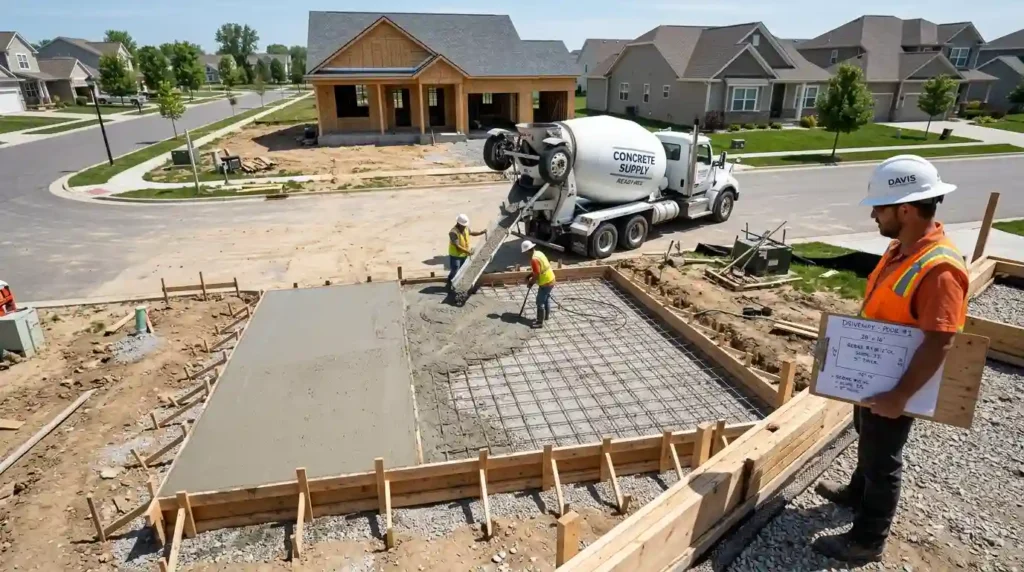

When planning any concrete project — whether laying walkways, pouring a garage floor, or setting footings — knowing how to calculate cubic yards of concrete is the most critical step before you call a ready-mix supplier or load up on pre-mix bags. Get this number wrong and you either waste money on unused material or face costly shortages mid-pour that can compromise the entire slab. This guide walks you through the exact math, practical estimating tips, real-world worked examples, and everything a contractor or DIYer needs to order the right yardage with confidence.
The good news: the formula is straightforward once you understand it. Concrete volume is always calculated in three dimensions — length, width, and thickness (or depth, for footings and columns). Those measurements convert into cubic feet, and cubic feet convert into cubic yards. Master this process once, and you will never rely on guesswork again.
Calculating cubic yards of concrete is essential for estimating the right amount of material for any construction project. By measuring the length, width, and depth accurately, you can avoid costly shortages or unnecessary waste. For detailed concrete standards and best practices, visit the American Concrete Institute (ACI).
How to Calculate Cubic Yards of Concrete
This is the core formula every builder, DIYer, and contractor needs to know.
Step 1 — Measure your dimensions in feet.
For slabs, patios, driveways, and garage floors, you need:
- Length (in feet)
- Width (in feet)
- Thickness (in feet — convert inches to feet by dividing by 12)
For example, a 4-inch-thick slab = 4 ÷ 12 = 0.333 feet of thickness.
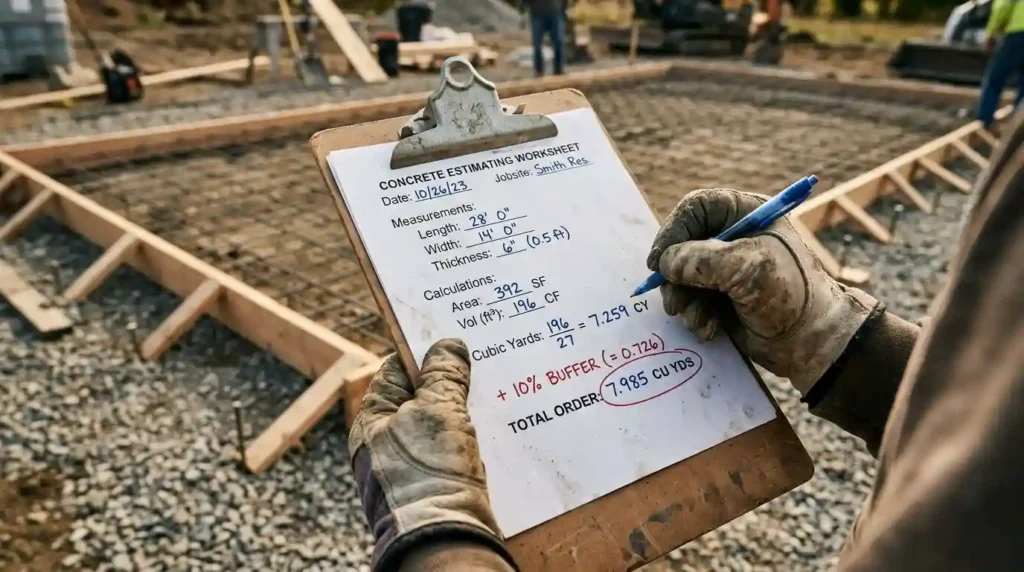
Step 2 — Calculate cubic feet.
Multiply length × width × thickness (depth):
Cubic Feet = Length × Width × Thickness
Step 3 — Convert cubic feet to cubic yards.
There are 27 cubic feet in one cubic yard. Divide your cubic feet result by 27:
Cubic Yards = Cubic Feet ÷ 27
Quick Example:
A 10×10 slab at 4 inches thick:
- 10 × 10 × 0.333 = 33.3 cubic feet
- 33.3 ÷ 27 = 1.23 cubic yards
Always add a 10% margin of safety to your final number to account for spillage, uneven compacted grade, and minor form irregularities. For the example above, order approximately 1.35 cubic yards.
Understanding the Concrete Calculator Formula
The formula works for any flat pour or rectangular volume. Let’s break down what each variable really means at the jobsite.
Length and Width define the footprint of your concrete placement. For rectangular slabs — like residential slabs, shed bases, or porch pads — this is simply the outer dimensions of your formed area.
Thickness (or Depth) is the vertical measurement of concrete being placed. Residential walkways and patios typically use 4 inches. Driveways handling standard vehicle traffic are typically 4 to 6 inches. Heavy-duty driveways for trucks or commercial applications often require 6 to 8 inches. Footings and structural elements go deeper still, sometimes 12 inches or more depending on local frost depth and load requirements.
Why divide by 27? One cubic yard is a 3×3×3-foot cube — 3 × 3 × 3 = 27 cubic feet. Since concrete is always sold by the cubic yard (yardage) when ordered from a ready-mix supplier, and bags are sold by weight that converts to cubic feet, this conversion is the bridge between field measurements and ordering units.
How Much Concrete Do I Need? Common Project Scenarios
Different project types require different approaches to volume calculation. Here are the most common scenarios with worked examples.
Concrete Slab Calculator (Patios, Shed Bases, Garage Floors)
These are flat pours with uniform thickness — the easiest calculations.
Example: 20×30 garage floor at 6-inch thickness
- 20 × 30 × 0.5 = 300 cubic feet
- 300 ÷ 27 = 11.11 cubic yards
- Add 10% buffer: ~12.2 cubic yards — order 12.5 yards
For residential slabs with standard 4-inch thickness, a simple rule of thumb is: every 81 square feet of surface area equals approximately 1 cubic yard of concrete.
Concrete Driveway Calculator
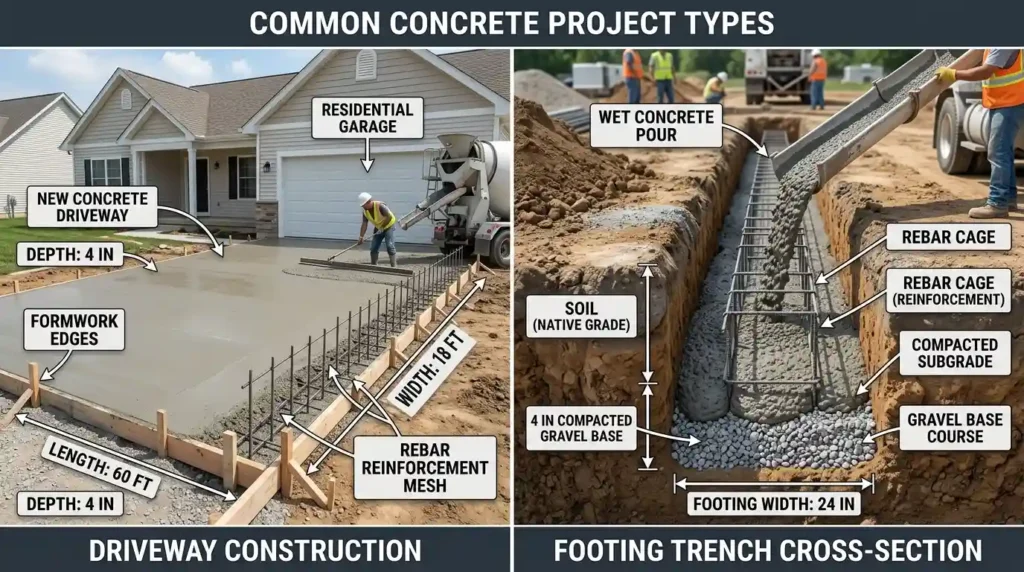
Driveways vary by width, length, and thickness. A standard two-car driveway is about 20 feet wide. Measure the length from the street to the garage. For heavy-duty driveways (pickup trucks, RVs), use 6-inch thickness minimum.
Example: 20×60 driveway at 5-inch thickness
- 20 × 60 × 0.417 = 500 cubic feet
- 500 ÷ 27 = 18.5 cubic yards
- With 10% buffer: ~20.4 cubic yards
Concrete Footing Volume Calculator
Footings are trenches or pads that support structural elements like walls, columns, and foundations. The same length × width × depth formula applies, but depth is often larger.
Example: A continuous footing 40 ft long, 16 inches wide, 12 inches deep
- Convert: Width = 16 ÷ 12 = 1.33 ft; Depth = 12 ÷ 12 = 1 ft
- 40 × 1.33 × 1.0 = 53.2 cubic feet
- 53.2 ÷ 27 = 1.97 cubic yards — order 2.25 yards
Column, Sonotube, and Pier Volume Calculator
Circular concrete elements — including Sonotubes (tube forms), post bases, and circular pads — require a different formula because they are cylinders, not rectangles.
Formula for circular columns:
Volume (cubic feet) = π × r² × height
Where r = radius (diameter ÷ 2), and height = the depth of the pour.
Example: 12-inch diameter Sonotube, 4 feet deep
- Radius = 0.5 ft
- π × (0.5)² × 4 = 3.14159 × 0.25 × 4 = 3.14 cubic feet
- 3.14 ÷ 27 = 0.116 cubic yards
For multiple post bases or piers, multiply by the number of columns and add a 10–15% buffer. Even small tube calculator volumes add up quickly across a large deck or pergola project.
Stair Calculator
Concrete steps are among the trickiest shapes to estimate because they are neither full rectangles nor simple odd shapes. The simplest approach is to treat each step as a separate rectangular solid and add the volumes together.
Example: 4 steps, each 4 feet wide, 12 inches deep, and varying heights
- Step 1 (bottom): 4 × 1.0 × 0.583 = 2.33 cubic feet
- Step 2: 4 × 1.0 × 0.583 = 2.33 cubic feet (same tread depth)
- Continue for each step, then total and divide by 27
Add a 15% material waste buffer for steps, as forming and pouring irregular shapes typically results in more overrun than flat pours.
How Many Bags of Concrete Do I Need?
Not every project requires a ready-mix truck delivery. For small jobs — small patios, post bases, walkways under 1 yard, or repairs — pre-mix bags are more practical. Here is how bag estimates work.
Common bag sizes and their yields:
| Bag Weight | Approximate Yield | Bags Per Cubic Yard |
| 40 lb | 0.30 cubic feet | ~90 bags |
| 60 lb | 0.45 cubic feet | ~60 bags |
| 80 lb | 0.60 cubic feet | ~45 bags |
Example: 0.5 cubic yards needed (13.5 cubic feet)
- Using 80 lb bags: 13.5 ÷ 0.60 = 22.5 → order 25 bags (built-in buffer)
- Using 60 lb bags: 13.5 ÷ 0.45 = 30 → order 33 bags
Quikrete vs Sakrete: Both popular brands offer standard and high-strength mixes. High-strength 80 lb bags are ideal for footings and structural elements. Standard bags suit walkways, shed bases, and light residential slabs. For fiber-reinforced or rapid-set needs, check specialty bag options — they yield slightly less volume per bag due to different mix design formulations.
Should I Order from a Ready-Mix Supplier or Use Bags?
The right choice depends on volume, access, and cost efficiency.
Use bags when:
- Your total volume is under 1 cubic yard
- The jobsite has no truck access
- You are doing a repair, circular pads, or small post bases
- You want color choice flexibility with pigment additives
Order ready-mix when:
- Your volume exceeds 1 cubic yard
- You need consistent mix design across a large slab
- The pour is for structural elements, foundations, or commercial applications
- Time-saving is critical (mixing bags manually for a 5-yard driveway is impractical)
Watch for minimum load fees. Most ready-mix suppliers charge a short-load fee for orders under 3 to 5 cubic yards. Factor delivery distance and minimum load fees into your budgeting before choosing between bags and truck delivery.
Concrete Estimating Tips: Avoid Shortages and Over-Ordering
Experienced contractors know that estimating concrete is as much about field judgment as formula. Here are the most important planning and ordering tips.
Always overestimate slightly. A 5–10% buffer is standard for flat pours like driveways, patios, and garage floors. Increase to 10–15% for footings, trenches, sloped areas, and odd shapes. Running short on a pour is far more expensive than having a small surplus — leftover concrete can be used for small repairs, stepping stones, or curbs.
Account for subgrade conditions. Your measurements assume a uniform compacted grade. In reality, low spots, soft soil areas, or uneven excavation depths increase actual volume poured. Always verify that your forms are level and your subgrade is consistently compacted before finalizing your order.
Odd shapes and non-rectangular areas. For L-shaped, circular, or irregular project footprints, break the shape into smaller rectangles or geometric sections, calculate each volume separately, and add them together. Online tools and block calculators help automate this for complex quantity takeoffs.
Consider material waste. Even with precise measurements, concrete left in the truck’s drum, spillage during chutes, and residue in wheelbarrows add up. Factor this into scheduling — your supplier needs at least 24–48 hours’ notice for most deliveries, and last-minute additions to an order are rarely possible.
Reinforce before you pour. The volume calculation covers concrete only. Rebar, mesh reinforcement, aggregates, and gravel base are separate materials. For residential slabs, #3 or #4 rebar at 12–18 inch spacing is common. Heavy-duty driveways and structural elements often require heavier rebar schedules or welded wire mesh. Plan reinforcement quantities in your initial scheduling alongside concrete ordering.
Concrete Calculator in Cubic Yards: Manual Conversion Reference
For those who prefer working without tools or apps, here is a complete manual conversion reference.
Converting inches to feet (thickness):
- 3 inches = 0.25 ft
- 3.5 inches = 0.292 ft
- 4 inches = 0.333 ft
- 5 inches = 0.417 ft
- 6 inches = 0.5 ft
- 8 inches = 0.667 ft
- 10 inches = 0.833 ft
- 12 inches = 1.0 ft
Common slab size quick reference (4-inch thickness):
| Slab Dimensions | Cubic Feet | Cubic Yards | With 10% Buffer |
| 10 × 10 ft | 33.3 | 1.23 | 1.35 yd |
| 12 × 12 ft | 48.0 | 1.78 | 1.96 yd |
| 10 × 20 ft | 66.7 | 2.47 | 2.72 yd |
| 20 × 20 ft | 133.3 | 4.94 | 5.43 yd |
| 20 × 30 ft | 200.0 | 7.41 | 8.15 yd |
| 24 × 24 ft | 192.0 | 7.11 | 7.82 yd |
For cubic meters (international projects), multiply cubic yards by 0.7646. Or convert feet to meters first (1 ft = 0.3048 m), then apply the same length × width × depth formula — the math is identical.
Types of Concrete: Matching the Mix to Your Project
Choosing the right concrete type is part of accurate resource planning. Different mix designs have different uses, and some affect final weight and volume yields.
Standard ready-mix is suitable for most residential slabs, walkways, sidewalks, and patios. Typical strength is 3,000–4,000 PSI.
High-strength concrete (5,000+ PSI) is used for commercial applications, heavy-duty driveways, foundations, and structural columns where durability under load is critical.
Fiber-reinforced concrete includes synthetic or steel fibers in the mix design to reduce cracking. Common in commercial applications and industrial floors.
Lightweight concrete uses different aggregates to reduce weight per cubic yard — useful for elevated slabs, rooftop decks, and infrastructure projects with load restrictions.
Rapid-set concrete cures faster than standard mixes, ideal for repairs, cold-weather pours, and projects requiring quick return to service.
Stamped and colored concrete — whether using pigment added at the plant or color choice applied at the jobsite — does not significantly change volume calculations, but does affect cost planning. Discuss mix design and color options with your ready-mix supplier before ordering.
Permeable concrete allows drainage through the slab and is used in pathways, parking areas, and infrastructure where stormwater management matters. Volume calculations are the same, but mix proportions differ.
Self-compacting concrete flows without vibration, often used in tight form areas, precast applications, and walls with heavy rebar density.
Concrete Slab Thickness: What’s Standard?
Thickness is the variable most often guessed at — and most often wrong. Using the wrong depth inflates or deflates your entire volume calculation.
4 inches — Standard for residential walkways, patios, porch slabs, and shed bases. Adequate for pedestrian traffic and light residential loads.
4–6 inches — Garage floors. The added thickness handles the concentrated load of vehicles and resists cracking from thermal expansion.
5–6 inches — Standard residential driveways. Many contractors default to 5 inches as a cost-efficiency balance.
6–8 inches — Heavy-duty driveways for trucks, RVs, or agricultural equipment. Commercial applications often specify this range.
8–12+ inches — Structural elements, load-bearing walls, foundations, and heavily reinforced commercial slabs.
Always verify thickness requirements with local building codes. Some municipalities specify minimum slab thickness for permitted work, and inspectors verify compacted grade depth during inspections.
Concrete Cost Calculator: Budgeting Your Project
Accurate volume calculation directly drives accurate cost estimation. Here is how to approach budgeting.
Ready-mix pricing is quoted per cubic yard and varies by region, mix design, and delivery distance. As a general reference, ready-mix typically costs more per equivalent volume than pre-mix bags for very small quantities, but becomes far more economical above 1–2 cubic yards once you factor in labor.
Bag pricing is straightforward — multiply the bag count by unit price. Remember to include delivery or pickup costs if purchasing in bulk quantity.
Hidden costs to budget for:
- Minimum load fees from the ready-mix supplier (usually triggered under 3–5 yards)
- Pump truck rental if the placement area is inaccessible to a chute-pour
- Rebar, mesh, and gravel base materials
- Form lumber and stakes
- Finishing tools and curing compounds
- Pigment or color additives if using stamped or colored concrete
Accurate estimating at the planning stage is the single best tool for cost efficiency. Every yard you over-order costs money; every yard you under-order risks a failed pour and expensive remediation.
Concrete Weight by Volume
Knowing concrete’s weight per cubic yard matters for structural planning and for scheduling deliveries — especially if your jobsite has weight-restricted access roads.
Standard concrete weighs approximately:
- 1 cubic foot = ~150 lbs
- 1 cubic yard = ~4,050 lbs (~2 tons)
- 1 cubic meter = ~2,400 kg
Lightweight concrete weighs roughly 30–40% less per equivalent volume. High-density mixes may weigh slightly more. These figures are approximations; your ready-mix supplier can confirm exact weight per yard for your specified mix design.
Frequently Asked Questions
How do I calculate how much concrete I need?
Measure the length, width, and thickness of your project area in feet (convert inch measurements to feet first). Multiply the three dimensions together to get cubic feet, then divide by 27 to convert to cubic yards. Add a 10% buffer to your final number before placing your order.
What is the standard thickness of concrete?
For most residential work, 4 inches is the standard thickness for walkways, patios, and shed bases. Garage floors typically use 4–6 inches, and driveways are usually 5–6 inches. Structural footings and commercial applications often require 8 inches or more.
How much is 1 cubic yard of concrete?
One cubic yard contains 27 cubic feet of concrete and weighs approximately 4,050 pounds. In terms of coverage at 4-inch thickness, 1 cubic yard covers about 81 square feet of slab.
How much concrete do I need for a 10×10 slab?
At 4-inch thickness: 10 × 10 × 0.333 = 33.3 cubic feet ÷ 27 = 1.23 cubic yards. With a 10% buffer, order approximately 1.35 cubic yards, which works out to about 60 bags of 80 lb pre-mix.
How many 80 lb bags of concrete do I need for a slab?
Each 80 lb bag yields approximately 0.60 cubic feet. To find the number of bags needed, calculate your total cubic feet and divide by 0.60. Always add 10–15% to your bag estimate to avoid shortages.
How many cubic feet is a 50-pound bag of concrete?
A 50 lb bag yields approximately 0.375 cubic feet of concrete when properly mixed. For a cubic yard (27 cubic feet), you would need approximately 72 bags at this size.
Should I order concrete from a ready-mix company or use bags?
Use bags for jobs under 1 cubic yard or when truck access is impossible. Order from a ready-mix supplier for anything larger — it saves labor, ensures consistent quality, and is more economical per yard at volume. Be aware of minimum load fees for small orders.
What is the concrete calculator formula?
Volume (cubic feet) = Length × Width × Thickness (all in feet). Then divide by 27 to get cubic yards. For circular elements: Volume = π × radius² × height.
Final Thoughts: Plan Your Concrete, Pour With Confidence
Knowing how to calculate cubic yards of concrete transforms a stressful unknown into a straightforward math problem. Whether you are a DIYer pouring a weekend patio, a homeowner planning a new driveway, or a contractor managing multiple jobsites, the formula is the same — it is the details that change. Account for the right thickness, verify your compacted grade, add your margin of safety, and confirm delivery logistics before the truck rolls. Accurate yardage is the foundation of every successful concrete pour — and of every project that comes in on time and on budget.
Check out Our Concrete Calculator to estimate free.