
Here is something that surprises a lot of first-time concrete pourers: the concrete is not the first thing that goes down. Before a single yard of ready mix leaves the truck, there should already be a carefully prepared layer of compacted gravel sitting beneath where the slab will go. That gravel layer — the subbase — is doing structural work that the concrete cannot do alone.
Knowing how much gravel under a concrete slab your project needs is not just about following a rule. It is about understanding what the gravel actually does: it distributes the slab load across a larger area of soil, it provides drainage so water does not pool beneath the slab and freeze in winter, and it gives you a stable, level working surface for forming and pouring. Get the gravel depth wrong, choose the wrong material, or skip compaction, and you will see the consequences in your concrete — settlement cracks, frost heave damage, and slabs that rock underfoot.
This guide covers gravel depth by application, the right gravel type for concrete bases, the full volume-to-weight calculation, and a step-by-step preparation guide.
Once your gravel calculation is done, use our concrete slab calculator to calculate the concrete volume on top, and our concrete bags calculator to decide between bags and ready mix.
Table of Contents
- Do You Actually Need Gravel Under a Concrete Slab?
- What Type of Gravel Under a Concrete Slab?
- How Deep Should Gravel Be Under a Concrete Slab?
- How Much Gravel Under a Concrete Slab — The Calculation
- Gravel Calculator Quick Reference Tables
- How to Prepare the Gravel Base — Step by Step
- Geotextile Fabric and Vapor Barrier — Do You Need Them?
- Gravel Base Cost Estimation
- Frequently Asked Questions
Do You Actually Need Gravel Under a Concrete Slab?
The short answer is: almost always yes. The longer answer explains why — and identifies the rare cases where you can legitimately skip it.
What Happens Without a Gravel Base
Concrete is strong in compression — it resists being crushed. What it cannot do is handle uneven support from below. When part of a slab has firm soil beneath it and another part sits over a soft spot or a void, the slab bends. And when concrete bends beyond its tensile limit — which is not much — it cracks.
Cracking from differential settlement: The most common consequence of inadequate subbase preparation. One section of the slab settles as the soil beneath it compresses; the adjacent section stays put. The slab cracks diagonally at the stress point.
Frost heave damage: In cold climates, water beneath the slab freezes, expands, and pushes the slab upward. A gravel subbase drains water away before it can freeze beneath the slab — preventing the pressure that heaves and cracks concrete.
Surface water pooling: Without drainage beneath the slab, rainwater that penetrates through cracks accumulates and saturates the soil below. Saturated soil has dramatically lower bearing capacity — exactly when the slab most needs support.
No working surface: Pour concrete directly onto rough, variable soil and the slab thickness will be inconsistent — deeper in hollows, thinner over high spots. A flat compacted gravel base gives you a consistent pour depth across the entire slab.
When You Can Skip the Gravel Base
There are genuinely situations where a gravel subbase is not required:
Solid rock subgrade: If you are pouring directly onto exposed bedrock or very dense, stable native rock, the rock itself provides superior drainage and load distribution. A gravel layer would add cost with no structural benefit.
Very well-drained, stable sandy soil: In some regions — particularly desert southwest and coastal sandy areas — native soil is already free-draining and stable. A 2-inch sand layer for leveling may be adequate. This is site-specific and benefits from a soil assessment.
Non-structural applications in benign climates: A small decorative pad in a warm climate with excellent drainage may not require a full gravel base. But even here, a minimum 2-inch sand layer for leveling is good practice.
The honest answer for most residential projects: Pour on a prepared gravel base. The cost of 4–6 inches of crushed stone is modest compared to the cost of repairing or replacing a cracked slab.
What Type of Gravel Under a Concrete Slab?
Gravel is not gravel. The aggregate type you use under a concrete slab matters — the wrong material either does not compact properly, does not drain, or shifts under load.
“The American Concrete Institute’s guide ACI 302.1R on concrete floor construction specifies that subbase material should be well-graded, free-draining, and stable under compaction — the same properties that make #57 crushed stone the industry standard for residential slab subbase.”
Crushed Stone (#57 and #4 Stone)
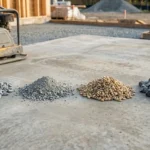
#57 crushed stone is the industry standard for concrete slab subbase in the US — angular, clean-crushed limestone or granite in the 3/4-inch to 1-inch size range. It compacts well, drains freely, and its angular faces interlock under compaction to create a stable, load-bearing surface.
#4 crushed stone is slightly larger (1–1.5 inches) — used where greater drainage capacity is needed or when local suppliers do not carry #57. Also interlocks well and drains freely.
Why angular matters: Rounded aggregate (like river gravel or pea gravel) does not interlock — the stones roll against each other under load rather than locking together. Angular crushed stone locks into a stable matrix that resists movement.
Crusher Run (Road Base)
Crusher run — also called road base, dense-grade aggregate, or processed aggregate — is a blend of crushed stone and stone dust. It compacts extremely firmly and creates a very stable base, but its fine content reduces drainage capacity compared to clean crushed stone.
Best for: Driveways, car parks, and any application where maximum stability and load bearing matter more than drainage. The dense, tightly packed surface resists rutting under vehicle loads better than open-graded crushed stone.
Not ideal for: Areas with high water table or poor drainage — the fine content retains more moisture and drains more slowly than clean crushed stone.
Pea Gravel — When Not to Use It
Pea gravel (small, rounded, naturally smooth stones, typically 3/8 inch) is widely available and often used decoratively — but it is a poor choice for concrete slab subbase.
Why pea gravel fails under concrete:
- Rounded surface means no interlocking — it shifts under load
- Concrete can bond to it but pea gravel does not form a stable compacted base
- It acts like ball bearings under the slab in extreme cases
Use pea gravel for drainage trenches, landscaping, and decorative purposes — not for load-bearing concrete subbase.
Recycled Aggregate
Recycled crushed concrete (RCA — recycled concrete aggregate) is an increasingly common subbase material — crushed from demolition concrete and graded to similar specifications as virgin crushed stone.
Advantages:
- Lower cost than virgin crushed stone in many markets
- Environmental benefit — diverts demolition waste
- Performance comparable to virgin aggregate for non-structural subbase applications
Limitations:
- Quality varies more than virgin aggregate — source matters
- Not suitable for structural or heavily loaded applications without testing
Gravel Type Quick-Reference Table
| Gravel Type | Drainage | Compaction | Load Bearing | Cost | Best For |
|---|---|---|---|---|---|
| #57 Crushed stone | Excellent | Good | Good | Medium | Patios, garage floors, general slabs |
| #4 Crushed stone | Excellent | Good | Good | Medium | Same as #57, larger drainage gaps |
| Crusher run / road base | Moderate | Excellent | Excellent | Low-Medium | Driveways, heavy load areas |
| Pea gravel | Good | Poor | Poor | Low | Not recommended for slab base |
| Recycled concrete (RCA) | Good | Good | Good | Low | General residential base |
| Bank run gravel | Variable | Variable | Variable | Low | Only if locally tested and approved |
How Deep Should Gravel Be Under a Concrete Slab?
Depth is determined by the application (what loads the slab carries), the soil conditions beneath, and the climate (frost depth).
Standard Depth by Application
| Application | Recommended Gravel Depth | Notes |
|---|---|---|
| Sidewalk / garden path | 2–4 inches | Light foot traffic only |
| Patio slab | 4 inches | Standard residential |
| Shed base | 4 inches | Light equipment |
| Residential driveway | 4–6 inches | Passenger vehicles |
| Garage floor | 4–6 inches | Vehicles + equipment |
| Commercial driveway | 6–8 inches | Heavy vehicles |
| Pool deck | 4 inches | Plus drainage consideration |
| Foundation slab | 4–6 inches | Engineer specification |
| Warehouse floor | 6–8 inches | Forklift and heavy loads |
The practical minimum: 4 inches of compacted crushed stone for any residential concrete slab. Below this depth, the subbase benefit diminishes significantly.
Adjusting Depth for Soil Conditions
Soil conditions are the primary variable that should push you toward more gravel, not less:
Dense, well-drained sandy soil or gravel: 4 inches is typically adequate.
Clay soil: Clay retains moisture, shrinks when dry, and swells when wet. On clay, use 6 inches minimum — and consider a geotextile fabric layer beneath the gravel to prevent clay migration upward into the gravel over time.
Fill or disturbed soil: Any area with fill, backfill, or recently disturbed soil needs 6 inches minimum plus proof-rolling (driving a loaded vehicle to identify soft spots before final compaction).
Organic or soft soil: If your excavation reveals dark organic soil, peat, or very soft material that deflects under foot pressure — excavate deeper until you reach stable soil, then fill with compacted gravel.
Frost Line and Gravel Depth
In freeze-thaw climates, the gravel depth interacts with frost protection. The gravel layer does not prevent frost from penetrating — but it does drain water before it can freeze beneath the slab.
Standard practice in frost climates:
- Minimum 4 inches of crushed stone for residential slabs
- 6 inches for driveways and any slab subject to vehicle loads
- Ensure positive drainage away from the slab perimeter — water must be able to exit the subbase zone
For a deeper understanding of how frost affects concrete structures below the slab, our guide on types of concrete foundations covers frost line depth and T-shaped foundation design in detail.
How Much Gravel Under a Concrete Slab — The Calculation
This is where the planning becomes an order. The calculation converts your dimensions into a volume in cubic yards and then into a weight in tons — because gravel is typically sold by the ton from aggregate suppliers.
Step 1 — Calculate Area in Square Feet
Area (sq ft) = Length (ft) × Width (ft)
For irregular shapes, break into rectangles and add areas. For circular pads: Area = π × radius².
Worked Example: A 16 ft × 24 ft garage floor.
Area = 16 × 24 = 384 sq ft
Step 2 — Convert Depth to Feet
Gravel depth is typically specified in inches — convert to feet by dividing by 12.
| Gravel Depth | In Feet |
|---|---|
| 2 inches | 0.167 ft |
| 3 inches | 0.250 ft |
| 4 inches | 0.333 ft |
| 5 inches | 0.417 ft |
| 6 inches | 0.500 ft |
| 8 inches | 0.667 ft |
Step 3 — Calculate Volume in Cubic Feet
Volume (ft³) = Area (sq ft) × Depth (ft)
Continuing the example — 4-inch gravel base:
Volume = 384 × 0.333 = 127.9 ft³
Step 4 — Convert to Cubic Yards
Volume (yd³) = Cubic feet ÷ 27
Volume = 127.9 ÷ 27 = 4.74 yd³
For a cross-check on this unit conversion, use our calculate cubic yards of concrete guide — the same conversion formula applies to gravel.
Step 5 — Convert Cubic Yards to Tons
Aggregate suppliers sell gravel by the ton. The conversion depends on the gravel type:
| Gravel Type | Tons Per Cubic Yard (loose) | Tons Per Cubic Yard (compacted) |
|---|---|---|
| #57 Crushed limestone | 1.35–1.43 | 1.50–1.60 |
| #57 Crushed granite | 1.45–1.55 | 1.60–1.70 |
| Crusher run | 1.50–1.60 | 1.70–1.80 |
| Pea gravel | 1.25–1.35 | 1.35–1.45 |
| Recycled concrete | 1.25–1.40 | 1.40–1.55 |
Tons = Cubic yards × tons per cubic yard
Continuing the example — #57 crushed limestone at 1.40 tons/yd³:
Tons = 4.74 × 1.40 = 6.64 tons
Add the Compaction Factor
Here is the step most people miss: gravel compacts when a plate compactor runs over it. A 4-inch layer of loose gravel compacts to approximately 3–3.5 inches. To achieve a compacted depth of 4 inches, you need to start with more loose material.
Compaction factor: Loose gravel volume is typically 15–25% more than the compacted volume.
Order quantity = Calculated volume × 1.20 (for 20% compaction + 10% waste combined)
Fial order for the garage example:
4.74 yd³ × 1.20 = 5.69 → order 6 cubic yards (approximately 8.4 tons of #57 limestone)
This 20% addition covers both compaction and a 10% waste factor for irregular subgrade and edge overfill — the same logic as the waste factor for concrete ordering.
Gravel Calculator Quick Reference Tables
Cubic Yards by Area and Depth
| Area (sq ft) | 3″ Deep | 4″ Deep | 6″ Deep | 8″ Deep |
|---|---|---|---|---|
| 100 sq ft | 0.93 yd³ | 1.23 yd³ | 1.85 yd³ | 2.47 yd³ |
| 200 sq ft | 1.85 yd³ | 2.47 yd³ | 3.70 yd³ | 4.94 yd³ |
| 300 sq ft | 2.78 yd³ | 3.70 yd³ | 5.56 yd³ | 7.41 yd³ |
| 400 sq ft | 3.70 yd³ | 4.94 yd³ | 7.41 yd³ | 9.88 yd³ |
| 500 sq ft | 4.63 yd³ | 6.17 yd³ | 9.26 yd³ | 12.35 yd³ |
| 600 sq ft | 5.56 yd³ | 7.41 yd³ | 11.11 yd³ | 14.81 yd³ |
| 800 sq ft | 7.41 yd³ | 9.88 yd³ | 14.81 yd³ | 19.75 yd³ |
| 1,000 sq ft | 9.26 yd³ | 12.35 yd³ | 18.52 yd³ | 24.69 yd³ |
All values before compaction factor. Multiply by 1.20 for final order quantity.
Tons Per Cubic Yard by Gravel Type
| Gravel Type | Tons/yd³ (loose) | Tons per 100 sq ft at 4″ | Tons per 100 sq ft at 6″ |
|---|---|---|---|
| #57 Crushed limestone | 1.40 | 1.73 | 2.59 |
| #57 Crushed granite | 1.50 | 1.85 | 2.78 |
| Crusher run | 1.55 | 1.91 | 2.87 |
| Recycled concrete | 1.33 | 1.64 | 2.47 |
Before compaction factor. Multiply final order by 1.20.
How to Prepare the Gravel Base — Step by Step
The calculation gives you the right quantity. This section tells you how to use it correctly.
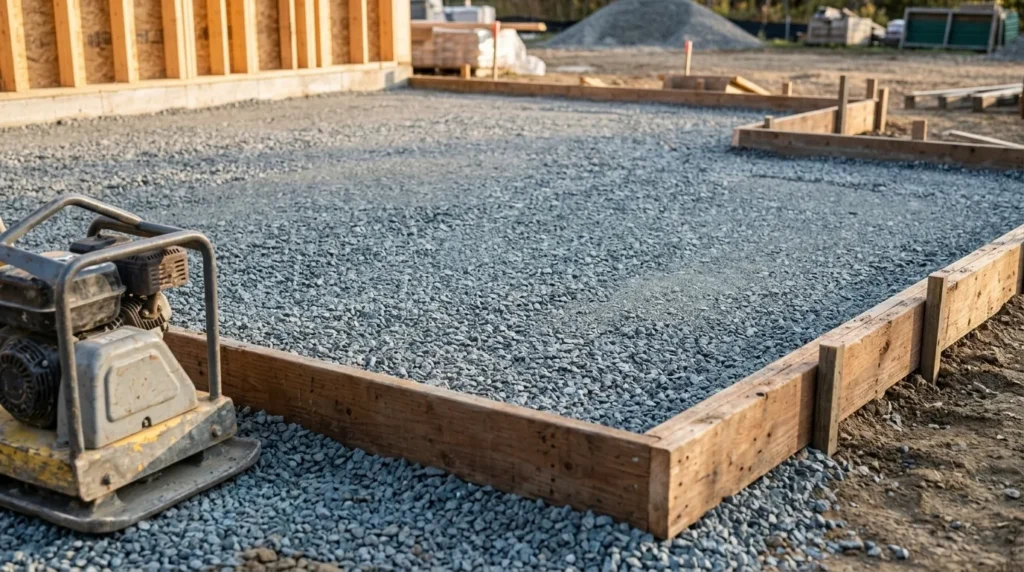
Step 1 — Excavate to the correct total depth. Your total excavation depth = slab thickness + gravel depth. For a 4-inch slab on 4 inches of gravel: excavate 8 inches below finished grade. For a 5-inch slab on 6 inches of gravel: 11 inches.
Remove all organic material, topsoil, and soft soil from the excavated area. Organic material compresses under load and causes settlement — it must be completely removed regardless of depth.
Step 2 — Proof-roll the subgrade. Before placing any gravel, drive a loaded wheelbarrow or small vehicle over the excavated subgrade. Watch for areas that deflect, rut, or feel soft underfoot. Mark any soft spots and excavate them deeper — replacing with additional compacted gravel.
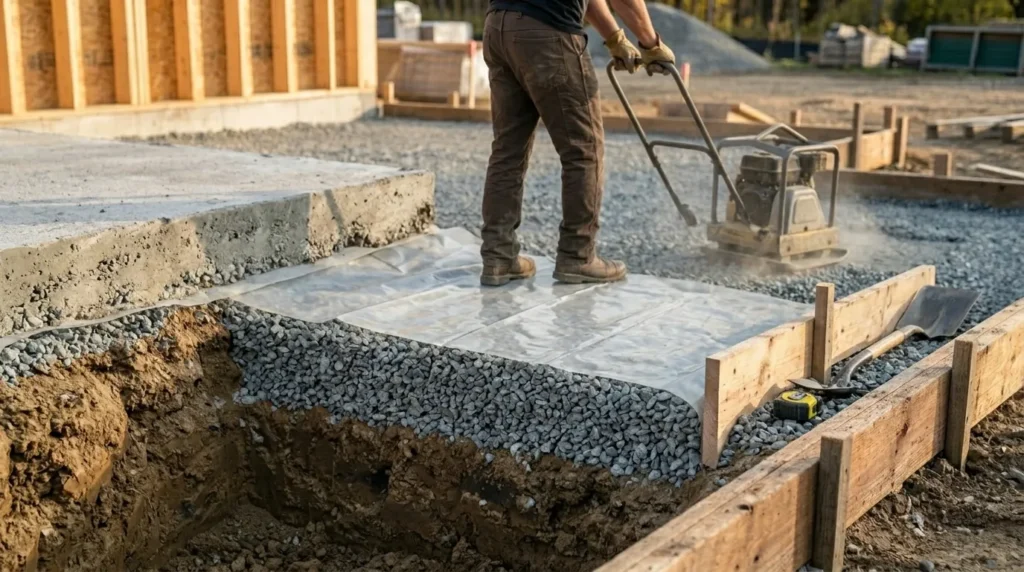
Step 3 — Install geotextile fabric if needed. On clay soils, lay a geotextile (landscape) fabric over the subgrade before placing gravel. This prevents clay from migrating upward into the gravel layer over time — maintaining drainage capacity for the life of the slab.
Step 4 — Place gravel in lifts. Never place the full depth of gravel in one lift — it will not compact properly. Place gravel in 3–4 inch lifts maximum, compacting each lift before adding the next.
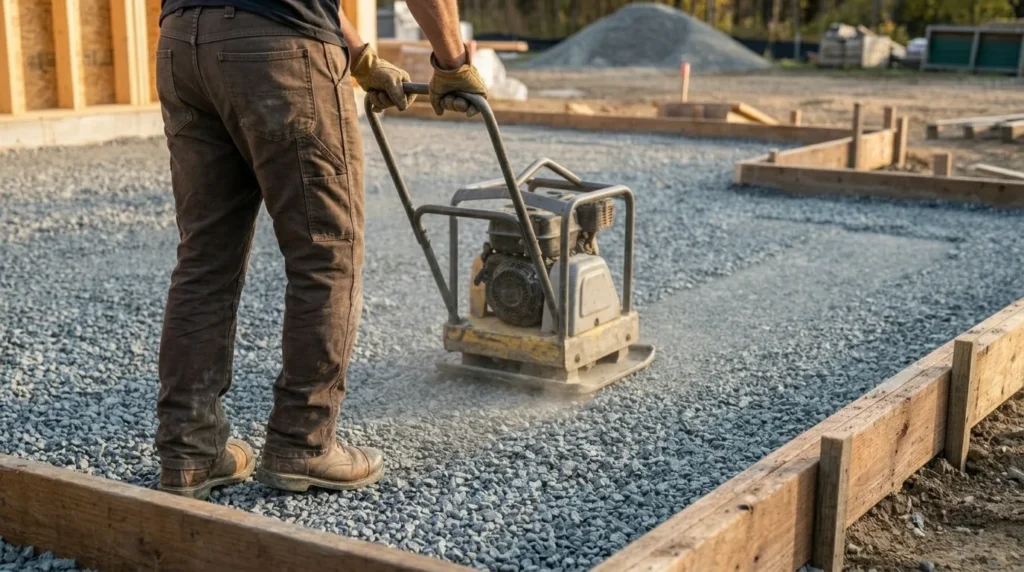
Step 5 — Compact each lift. Use a plate compactor — available at any tool rental store for $80–$150 per day. Make 3–4 passes over each lift in different directions. The surface should feel firm underfoot with no deflection — a footstep should leave barely a mark.
Step 6 — Check depth and grade. Use a level and string line to verify the gravel surface is at the correct elevation and slope. The gravel surface determines the finished slab thickness — inconsistencies here show up as thin spots in the concrete.
Worked Example — Sequence for 16×24 Garage Floor:
- Excavate to 10 inches below finished grade (4″ slab + 6″ gravel)
- Proof-roll and address soft spots
- Install geotextile on clay subgrade (garage is in clay soil area)
- First lift: place 3 inches of #57 limestone, compact with 4 passes
- Second lift: place remaining 3–4 inches, compact with 4 passes
- Final check: string line confirms gravel surface ±0.25 inch across 384 sq ft
- Result: ready for vapor barrier and concrete pour
Geotextile Fabric and Vapor Barrier — Do You Need Them?
Two separate products often confused with each other — they serve completely different purposes.
Geotextile fabric (landscape fabric under gravel):
- Goes between the subgrade soil and the gravel layer
- Prevents fine-grained soil (clay, silt) from migrating upward into gravel over time
- Maintains the drainage and load-distribution properties of the gravel layer
- Required on clay and silty soils; optional on sandy or rocky subgrades
- Use a woven geotextile rated for separation applications — not light garden fabric
Vapor barrier (plastic sheet on top of gravel, under concrete):
- Goes between the gravel layer and the concrete slab
- Prevents ground moisture from wicking up through the concrete
- Critical for any interior slab (garage floor, basement, utility building) where moisture causes flooring adhesive failure, mold under floor coverings, or efflorescence
- Use minimum 10-mil polyethylene, lapping joints minimum 12 inches
Do you need both?
- Exterior slabs (patios, driveways, sidewalks): geotextile on clay soil; no vapor barrier needed
- Interior slabs on clay soil: both geotextile under gravel AND vapor barrier on top of gravel
- Interior slabs on sandy/gravelly soil: vapor barrier only; geotextile optional
Gravel Base Cost Estimation
The gravel base is often underbudgeted because people focus on concrete cost and treat the subbase as a minor expense. For a standard garage floor, the gravel base adds $400–$800 to material costs — not trivial.
Gravel material cost:
| Gravel Type | Price Per Ton (2025 avg.) | Price Per Cubic Yard |
|---|---|---|
| #57 Crushed limestone | $25–$45/ton | $35–$65/yd³ |
| Crusher run | $20–$35/ton | $28–$50/yd³ |
| Recycled concrete | $15–$30/ton | $20–$42/yd³ |
Prices vary significantly by region — always get local supplier quotes.
Delivery cost: Most aggregate suppliers charge $50–$150 for delivery within 10–15 miles. Some include delivery in the price for large orders (typically 10+ tons).
Worked Example — Complete Gravel Base Cost: 16×24 ft garage, 6-inch gravel base, #57 limestone.
| Item | Quantity | Unit Cost | Total |
|---|---|---|---|
| #57 limestone | 8.4 tons | $35/ton | $294 |
| Delivery | 1 | $85 | $85 |
| Geotextile fabric (192 sq ft) | 200 sq ft | $0.25/sq ft | $50 |
| Vapor barrier (10-mil, 192 sq ft) | 250 sq ft (with overlaps) | $0.15/sq ft | $38 |
| Plate compactor rental | 4 hours | $40/hr | $160 |
| Total base preparation | $627 |
This $627 represents approximately 15–20% of the total concrete material cost for this pour — a meaningful but worthwhile investment that directly determines how the slab performs for its entire service life.
For the concrete cost on top of this gravel base, use our concrete slab calculator and concrete bags calculator to complete your project budget.
Frequently Asked Questions
How much gravel do I need under a concrete slab?
For most residential applications — patios, garage floors, driveways — use 4–6 inches of compacted crushed stone. Calculate volume: length × width × depth (all in feet) = cubic feet ÷ 27 = cubic yards. Multiply cubic yards by 1.20 to account for compaction and waste. Convert to tons by multiplying cubic yards by 1.35–1.55 depending on gravel type.
What type of gravel is best under a concrete slab?
#57 crushed stone (3/4-inch angular crushed limestone or granite) is the industry standard for concrete slab subbase in the US. It compacts well, drains freely, and its angular faces interlock for stability. Crusher run is better for driveways where maximum stability matters. Avoid pea gravel — it does not interlock and shifts under load.
How deep should gravel be under a concrete slab?
4 inches minimum for residential patios, garden paths, and shed bases. 4–6 inches for residential driveways and garage floors. 6–8 inches for commercial driveways and warehouse floors. On clay or expansive soil, always use the deeper end of the range. The gravel depth adds directly to your excavation depth.
Can I pour concrete directly on dirt?
Technically possible in rare cases — very stable, well-drained sandy or rocky soil in a warm climate. In practice, a gravel subbase is almost always worth the cost. Without it, differential settlement from soft spots, frost heave in cold climates, and poor drainage beneath the slab dramatically increase the risk of cracking.
How do I calculate tons of gravel from cubic yards?
Multiply cubic yards by the gravel’s weight per cubic yard. For #57 crushed limestone: 1 cubic yard × 1.40 tons/yd³ = 1.40 tons. For crusher run: 1 cubic yard × 1.55 tons/yd³ = 1.55 tons. Most aggregate suppliers can confirm the exact weight per cubic yard for their specific product.
What is the compaction factor for gravel?
Loose gravel compacts approximately 15–25% under a plate compactor. A loose depth of 5 inches typically compacts to 4 inches. To achieve a 4-inch compacted depth, start with 4.75–5 inches of loose gravel. Order 15–20% more than your calculated compacted volume to account for both compaction loss and normal spillage.
Do I need fabric under the gravel base for a concrete slab?
On clay or silty soil: yes — install a woven geotextile fabric between the subgrade and the gravel. It prevents fine soil particles from migrating into the gravel over time, maintaining drainage and stability. On sandy, gravelly, or rocky subgrades: geotextile is optional. Always use a vapor barrier (polyethylene sheet) on top of the gravel beneath any interior slab.
How much does a ton of gravel cover at 4 inches deep?
One ton of #57 crushed limestone (approximately 0.71 cubic yards) covers approximately 64–65 square feet at 4 inches of compacted depth. One ton of crusher run covers approximately 60–62 square feet at 4 inches. Divide your total area by these numbers to get a rough ton estimate — then add 15–20% for compaction and waste.
Conclusion
The gravel base under a concrete slab is not an optional extra — it is foundational to how well the slab performs over its lifetime. Four to six inches of compacted #57 crushed stone costs a fraction of what a failed slab costs to repair or replace. Calculate the volume correctly (length × width × depth ÷ 27 for cubic yards), convert to tons using your gravel’s density, add 20% for compaction and waste, and compact in lifts with a plate compactor. Once your subbase is right, calculate your concrete volume with our concrete slab calculator, figure out bags versus ready mix with our concrete bags calculator, and measure everything accurately using our how to measure for concrete guide.