
Filling concrete block cores with grout is one of those construction tasks that looks straightforward — pour concrete into the holes until they are full. But ordering the right amount of grout before you start is anything but simple. The volume calculation depends on the block size, the core geometry, the fill pattern (full fill, alternate fill, or bond beam only), and the wall dimensions — and every one of these variables can send your estimate in different directions.
A concrete calculator for block fill converts those variables into a reliable grout volume in cubic feet or cubic yards — so you can order ready mix or bagged grout with confidence and not discover mid-pour that you are 30% short.
This guide covers the complete block fill calculation process: core geometry by block size, fill pattern options and their volume implications, grout type selection, placement methods, and a complete cost estimation section. Every calculation includes a worked example you can follow directly on your project.
Before calculating, use our free concrete calculator at ConcreteCal for an instant cross-check on your grout volume. And if you need the complete block wall material estimate — including block count, mortar, and reinforcement — see our full guide on how to calculate concrete blocks needed.
Table of Contents
- What Is Block Fill and Why Does It Need Its Own Calculation?
- Understanding CMU Core Geometry
- How to Calculate Block Fill Volume — The Core Formula
- Block Fill Volume by Fill Pattern
- Block Fill Quick Reference Tables
- Types of Block Fill Concrete
- How to Place Block Fill Concrete
- Block Fill Cost Calculation
- Common Block Fill Calculation Mistakes
- Frequently Asked Questions
What Is Block Fill and Why Does It Need Its Own Calculation?
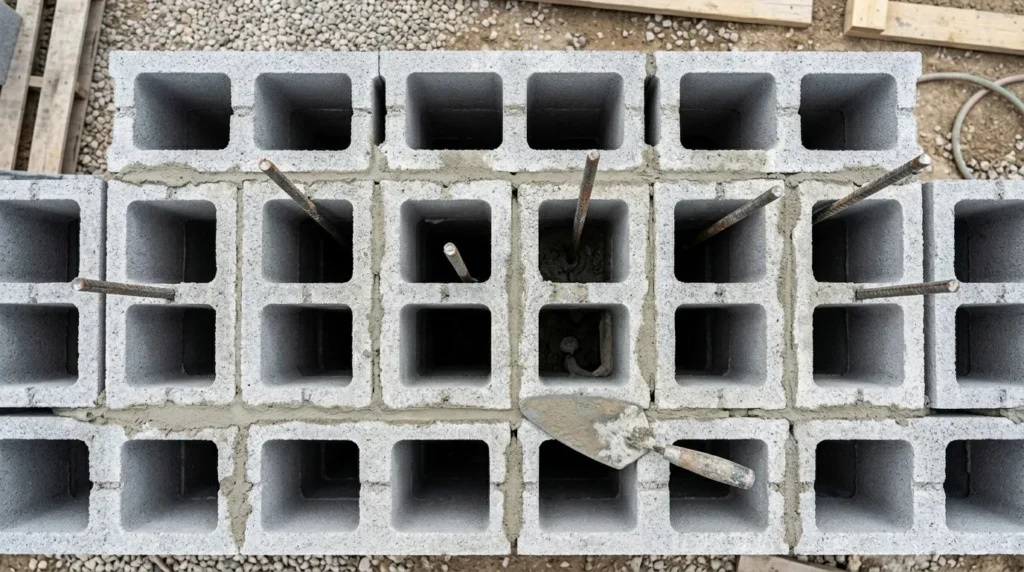
Concrete masonry units are hollow — the vertical voids running through each block are called cores or cells. In many wall applications, some or all of these cores are filled with grout concrete, typically alongside vertical steel reinforcement.
Block fill serves three structural purposes: it bonds the rebar to the surrounding masonry, creates a composite structural section that resists lateral forces, and adds mass to the wall for seismic resistance and sound attenuation.
The volume calculation for block fill is separate from the block count and mortar calculations because it follows completely different rules — it is based on the core void geometry of each block, not the wall face area.
Block Fill vs. Block Mortar — The Difference
These are two completely different materials used at different points in block wall construction — and confusing them produces significant calculation errors.
Mortar is placed in the horizontal bed joints between block courses and in the vertical head joints between blocks. It is a relatively stiff mix of masonry cement, sand, and water — applied with a trowel. Mortar binds blocks together but does not fill the cores.
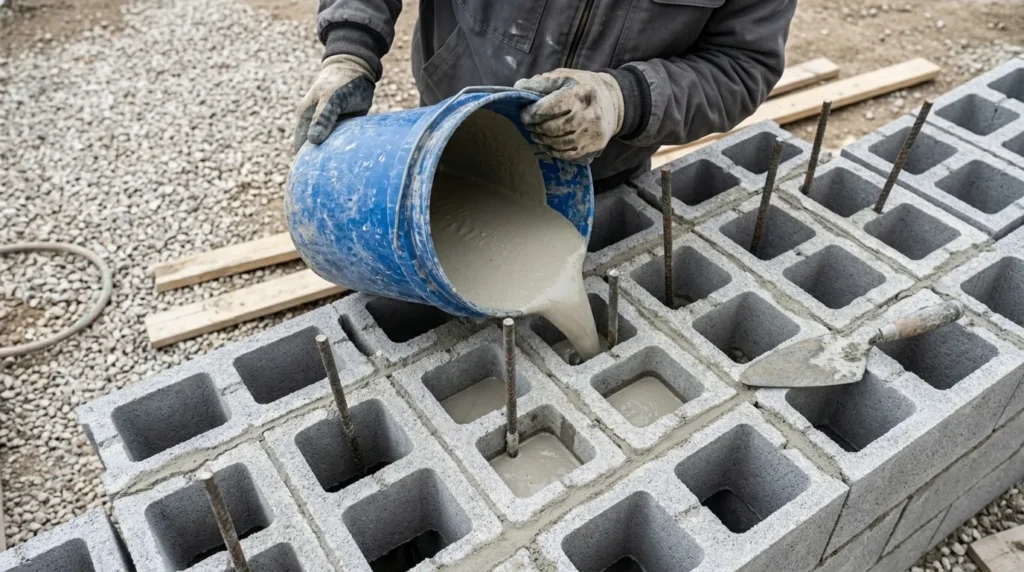
Block fill (grout) is a fluid concrete mix poured or pumped down into the hollow cores after blocks are laid. It is more fluid than mortar — enough to flow around rebar and consolidate without voids — and it is placed in vertical lifts after multiple courses are laid.
Never substitute mortar for grout or grout for mortar. They have different flow characteristics, strengths, and ASTM specifications — each designed specifically for its role.
When Block Fill Is Required
Not all CMU walls require core fill. The structural requirement depends on:
Always required:
- Seismic design categories C, D, E, F (per IBC and ASCE 7)
- Retaining walls over 3–4 feet
- Walls carrying significant vertical loads (columns, heavily loaded bearing walls)
- Any wall specified by a structural engineer to be fully or partially grouted
Typically not required:
- Non-structural partition walls in low seismic zones
- Boundary walls with no structural load
- Garden walls under 4 feet in non-seismic regions
When in doubt — particularly for any structural application — consult your local building code or a structural engineer. The cost of unnecessary grout is far less than the cost of a structural failure.
Understanding CMU Core Geometry
The block fill volume calculation starts with the geometry of the hollow core — specifically, what percentage of the block’s total volume is void space that will receive grout.
Core Volume by Block Size
Standard CMU blocks are not uniformly hollow. The face shells (the flat outer surfaces) and webs (the internal dividers) make up approximately 40–55% of the block volume, leaving 45–60% as void space.
The exact core void percentage varies by block design and manufacturer — but published ASTM C90 values provide reliable approximations for estimation purposes.
Core void volume by standard block size:
| Block Nominal Size | Total Volume (ft³) | Void % | Core Volume (ft³) | Cores Per Block |
|---|---|---|---|---|
| 4″×8″×16″ | 0.296 | 25% | 0.074 | 1 |
| 6″×8″×16″ | 0.444 | 40% | 0.178 | 2 |
| 8″×8″×16″ | 0.593 | 50% | 0.296 | 2 |
| 10″×8″×16″ | 0.741 | 52% | 0.385 | 2 |
| 12″×8″×16″ | 0.889 | 53% | 0.471 | 2–3 |
Key number to remember: A standard 8×8×16 block has approximately 0.296 cubic feet of core void — approximately 0.148 ft³ per core, with 2 cores per block.
Face Shell, Web, and Void Percentage
Understanding why the void percentage varies helps you understand why different block sizes have different fill requirements:
4-inch blocks: Only one small core — relatively low void percentage because the face shells take up proportionally more of the block thickness.
8-inch blocks: Two cores, each approximately 3 inches × 5 inches in cross-section — the standard for most structural applications.
12-inch blocks: Two or three cores with larger cross-sections — higher void percentage and significantly more grout per block.
Worked Example — Confirming Core Volume: Standard 8×8×16 block. ASTM C90 specifies minimum face shell thickness of 1¼ inches and minimum web thickness of 1 inch.
Approximate core cross-section: (8 − 2×1.25 − 1) × 5.6 inches per core = approximately 22.4 sq inches per core Core volume per block: 2 × (22.4÷144) × (15.625÷12) = 2 × 0.156 × 1.302 = 0.406 ft³
This is slightly higher than the 0.296 ft³ rule of thumb — the difference accounts for the fact that cores taper and are not perfectly rectangular. For estimation, use the 0.296 ft³ per block rule as a conservative baseline and add your waste factor to cover any shortfall.
How to Calculate Block Fill Volume — The Core Formula
Step 1 — Identify Your Fill Pattern
Before calculating any volumes, confirm the fill pattern specified on your structural drawings or required by your local building code. The fill pattern determines what fraction of your blocks will receive grout.
Fill patterns (covered in detail in the next section):
- Full fill — all cores, all courses
- Alternate fill — every other core, all courses
- Bond beam only — selected courses only
- Structural pattern — per engineering specification
Step 2 — Calculate Core Volume Per Block
Use the values from the table above for your block size.
For standard 8×8×16: 0.296 ft³ per block (full fill) For partial fill: multiply by the fraction of cores being filled.
Step 3 — Multiply by Block Count
Total grout volume (ft³) = Number of filled blocks × Core volume per block
For partial fill patterns, “number of filled blocks” means the number of blocks with at least one core being filled — adjusted for what fraction of cores per block are filled.
Step 4 — Convert to Cubic Yards
Grout volume (yd³) = Total volume (ft³) ÷ 27
Step 5 — Add Waste Factor
Grout is more fluid than mortar — it flows into small voids, slightly overfills cores, and some is always lost to spillage at the top of cores during placement. Use a 10% waste factor for grout poured from buckets, and 8% for pumped grout (more controlled placement).
Order quantity = Calculated volume × 1.10
Complete Worked Example — Standard 8×8×16, Full Fill: A 24 ft × 6 ft retaining wall. Block count: 162 blocks (from block count calculation).
Core volume per block: 0.296 ft³ Total grout volume: 162 × 0.296 = 47.95 ft³ Cubic yards: 47.95 ÷ 27 = 1.78 yd³ With 10% waste: 1.78 × 1.10 = 1.96 → order 2 cubic yards
Block Fill Volume by Fill Pattern
Full Core Fill Calculation
Full core fill means every hollow core in every block receives grout — the maximum structural configuration and the maximum grout volume.
Volume = Blocks × Core volume per block
Full fill is specified for:
- Retaining walls
- High seismic zones (SDC D, E, F)
- Heavily loaded structural walls
- Below-grade foundation walls
Volume impact: Full fill adds significant weight to the wall. A 144 sq ft wall of standard 8-inch blocks, fully grouted, weighs approximately 84–100 lbs per square foot — versus 38–55 lbs unfilled. Use our concrete weight calculator to calculate the exact dead load for your foundation design.
Alternate Cell Fill Calculation
Alternate cell fill — every other core grouted — is used for moderate structural applications where full grouting is not required but some reinforced core capacity is needed.
Volume = Blocks × (Core volume per block × 0.50)
Worked Example — Alternate Fill, 162 blocks:
Volume: 162 × (0.296 × 0.50) = 162 × 0.148 = 23.98 ft³ Cubic yards: 23.98 ÷ 27 = 0.888 yd³ With 10% waste: 0.977 → order 1 cubic yard
At under 1 cubic yard, this project is at the borderline between ready mix and bagged grout. A short-load fee from a ready mix plant ($75–$150) makes bagged grout competitive at this volume.
Bond Beam Only Fill Calculation
Bond beams are horizontal reinforced courses — typically at the top of the wall and at mid-height for walls over 6 feet. Only the bond beam course cores are filled.
Volume = Wall length (ft) × Number of bond beam courses × Core volume per linear foot
Core volume per linear foot for standard 8-inch block:
0.296 ft³ per block ÷ 1.333 ft (block length) = 0.222 ft³ per linear foot
Worked Example — Bond Beam Fill Only: 24 ft wall, 2 bond beam courses (at 4 ft and 6 ft height).
Volume: 24 × 2 × 0.222 = 10.66 ft³ Cubic yards: 10.66 ÷ 27 = 0.395 yd³ With 10% waste: 0.43 → use bagged grout
At 0.43 cubic yards, this is firmly in bagged grout territory — approximately 19 bags of 50 lb grout mix.
Seismic and Structural Fill Patterns
In seismic design categories C through F (most of the western US, parts of the south and east), the International Building Code requires specific grouting patterns that may be more extensive than alternate fill but less than full fill — depending on wall height, load, and reinforcement spacing.
These patterns are specified by the structural engineer of record and must be followed exactly — they are not field-adjustable. The calculation method is the same: identify which cores are filled, calculate volume per filled core, multiply by block count in the grouted zones.
Block Fill Quick Reference Tables
Grout Volume Per Block by Size
| Block Size | Fill Pattern | ft³ Per Block | Bags (50 lb)* | yd³ Per 100 Blocks |
|---|---|---|---|---|
| 4″×8″×16″ | Full fill | 0.074 | 0.3 | 0.274 |
| 6″×8″×16″ | Full fill | 0.178 | 0.7 | 0.659 |
| 8″×8″×16″ | Full fill | 0.296 | 1.1 | 1.096 |
| 8″×8″×16″ | Alternate fill | 0.148 | 0.6 | 0.548 |
| 10″×8″×16″ | Full fill | 0.385 | 1.4 | 1.426 |
| 12″×8″×16″ | Full fill | 0.471 | 1.7 | 1.744 |
*Based on 50 lb bag yield of approximately 0.28 cubic feet per bag
Cubic Yards Per 100 Square Feet of Wall
| Block Size | Full Fill | Alternate Fill | Bond Beam Only (2 courses) |
|---|---|---|---|
| 4″×8″×16″ | 0.31 yd³ | 0.15 yd³ | 0.05 yd³ |
| 6″×8″×16″ | 0.74 yd³ | 0.37 yd³ | 0.12 yd³ |
| 8″×8″×16″ | 1.23 yd³ | 0.62 yd³ | 0.20 yd³ |
| 10″×8″×16″ | 1.60 yd³ | 0.80 yd³ | 0.26 yd³ |
| 12″×8″×16″ | 1.96 yd³ | 0.98 yd³ | 0.32 yd³ |
All values include 10% waste factor
How to use this table:
- Find your block size in the left column
- Find your fill pattern column
- Multiply by your wall area in hundreds of square feet
- Round up to the nearest practical order increment
Example: 200 sq ft wall, 8-inch blocks, full fill:
1.23 yd³ × (200÷100) = 2.46 → order 2.5 yards
Types of Block Fill Concrete
Not all grout is the same — the mix design depends on the aggregate size, core dimensions, and whether you are pumping or pouring.
Fine Grout vs. Coarse Grout
ASTM C476 defines two types of masonry grout:
Fine grout:
- Aggregate: sand only (no coarse aggregate)
- Maximum aggregate size: No. 8 sieve (2.36mm)
- Required when cores are small (under 2 inches in any dimension after deducting rebar)
- More expensive than coarse grout
- Used for 4-inch and some 6-inch blocks
Coarse grout:
- Aggregate: sand plus coarse aggregate
- Maximum aggregate size: 3/8 inch
- Used when core dimensions allow — most 8-inch and larger blocks
- Lower cost than fine grout
- Required minimum core size: 3 inches × 3 inches (after rebar deduction)
For standard 8×8×16 blocks with one #5 rebar per core:
- Core clear dimension after rebar: approximately 3 × 5 inches → use coarse grout
For 4-inch blocks or any core where rebar reduces clear dimension below 3 inches:
- Use fine grout
Self-Compacting and Pumped Grout
Self-compacting grout (SCG) flows under its own weight without vibration — specified for walls where cores are too narrow for a vibrator and bucket-pour consolidation is insufficient.
Mix characteristics:
- High slump: 10–11 inches (very fluid)
- Water-cement ratio: 0.50–0.60
- Plasticizer/superplasticizer admixture
- Often includes fly ash for improved flow and reduced heat
Pumped grout is standard for large commercial CMU projects — a grout pump delivers material through a hose directly into cores from above. Faster than bucket pour, more uniform placement, less manual labour.
Cost premium: Self-compacting and pumped grout mixes cost $10–$25 per yard more than standard grout — justified on large projects where placement speed and consistency offset the material premium.
“Both fine and coarse masonry grout must meet the requirements of ASTM C476 — the Standard Specification for Grout for Masonry — which defines minimum compressive strength (2,000 PSI at 28 days), maximum aggregate size, and slump requirements for both grout types.”
Non-Structural Fill Options
For non-structural applications where the goal is insulation, sound attenuation, or simply closing cores against pest infiltration:
Zonolite (expanded vermiculite): Lightweight fill poured dry into cores. Provides insulation (R-2.5 to R-3.5 per 8-inch core). No structural value. Cost: approximately $0.15–$0.25 per block.
Perlite fill: Similar to Zonolite — lightweight, insulating, non-structural.
Foam fill: Spray polyurethane foam injected into cores. Highest insulation value (R-4 to R-5 per core). No structural value. Requires professional application equipment.
These non-structural fills have completely different volume calculations — they are calculated by the number of cores filled, not by concrete volume.
How to Place Block Fill Concrete
The placement method affects consolidation quality — and poor consolidation produces voids in the grout that reduce structural performance.
Bucket Pour Method
The simplest placement method for small projects and low walls.
Process:
- Lay blocks and allow mortar to achieve initial set (minimum 1 hour, ideally 4 hours)
- Ensure vertical rebar is positioned correctly in the cores before filling
- Fill cores from a bucket or wheelbarrow in one lift (for walls under 5 feet)
- Rod each core immediately after filling — insert a rod or piece of rebar and move up and down 5–10 times to consolidate
Maximum lift height for bucket pour without pumping: 5 feet (60 inches) per ASTM C476 and TMS 402 masonry code.
For walls over 5 feet: Fill in multiple lifts. Pour first lift to 5 feet, rod to consolidate, allow to stiffen for 1 hour minimum, then pour the next lift.
Pump Method
For walls over 8 feet, large wall areas, or any project where placement speed matters, a grout pump is the correct method.
Setup:
- Position grout pump adjacent to the wall
- Feed hose over the wall or through a clean-out block at the base
- Pump grout upward from the bottom of the core (preferred) or pour from the top
Bottom-up pumping pushes air out of the core ahead of the grout — producing fewer voids than top-down pouring. It requires a clean-out block at the base of the wall with a removable plug.
Production rate: A skilled pump operator fills approximately 80–120 cubic feet of core per hour — significantly faster than bucket pour (typically 20–40 cubic feet per hour with two workers).
Consolidation and Rodding
Grout must be consolidated — air voids eliminated — for the fill to achieve its specified structural performance.
Rodding: For cores under 3 inches wide and walls under 5 feet — insert a rod (3/8-inch diameter minimum) to full depth and withdraw slowly, moving in a circular motion.
Internal vibrator: For larger cores and pumped grout — insert a small-diameter vibrator (1-inch head) at maximum 18-inch intervals and 15-second dwell time per insertion.
Over-vibration risk: Excessive vibration can cause grout to segregate (coarse aggregate sinks, paste rises) — reducing strength and causing cores to be incompletely filled at the top. Use short dwell times and frequent insertions rather than long vibration at fewer points.
Block Fill Cost Calculation
Grout fill cost has three components — material, delivery, and placement labor.
Material cost:
| Grout Type | Cost Per Cubic Yard | Notes |
|---|---|---|
| Standard coarse grout (ready mix) | $140–$190/yd³ | Most economical for volume |
| Fine grout (ready mix) | $155–$210/yd³ | Premium for small aggregate |
| Self-compacting grout | $165–$230/yd³ | Includes admixture premium |
| Bagged grout mix (50 lb) | $8–$12/bag | Best for under 0.5 yd³ |
Bagged vs. ready mix crossover:
1 yd³ = 27 ft³ ÷ 0.28 ft³/bag = 96 bags of 50 lb grout mix 96 bags × $10/bag = $960 vs. ready mix at $140–$190 + delivery
At 1 cubic yard, ready mix is significantly cheaper even with delivery. The crossover where bagged grout becomes more economical is approximately 0.3–0.4 cubic yards — roughly 30–40 bags.
Worked Example — Complete Fill Cost for 2 yd³:
| Item | Quantity | Unit Cost | Total |
|---|---|---|---|
| Ready mix coarse grout | 2 yd³ | $160/yd³ | $320 |
| Delivery fee | 1 | $100 | $100 |
| Pump rental (if needed) | 4 hours | $75/hr | $300 |
| Placement labor | 4 hours | $55/hr | $220 |
| Total | $940 |
For a 144 sq ft wall needing 2 cubic yards of fill, this is approximately $6.53 per square foot of wall face — a significant additional cost that must be included in any complete wall budget.
Common Block Fill Calculation Mistakes
Mistake 1 — Using total block volume instead of core void volume. A standard 8-inch block has a total volume of 0.593 cubic feet — but only 0.296 cubic feet of that is core void. Using total block volume overestimates grout by 100%.
Mistake 2 — Forgetting that blocks in the same wall may have different fill requirements. Bond beam blocks (U-shaped) are filled differently from standard blocks. Corner blocks may have different core configurations. If your wall has multiple block types, calculate each type’s fill separately.
Mistake 3 — Not accounting for rebar displacement in the cores. A #5 rebar (5/8-inch diameter) in an 8-inch CMU core displaces approximately 0.002 cubic feet per foot of height — negligible for residential walls but measurable on commercial projects with dense rebar patterns.
Mistake 4 — Ordering grout as concrete and concrete as grout. Structural grout (ASTM C476) has specific aggregate size limits, strength requirements, and slump ranges different from regular concrete. Substituting regular concrete for masonry grout — particularly in small cores — risks incomplete consolidation and reduced bond strength between grout and block.
Mistake 5 — Skipping the waste factor on grout. Grout losses are real: spillage at the top of cores, residue in the pump, and slight overfill at each core. A 10% waste factor on grout is as important as on any other concrete material — never order the exact calculated volume.
Mistake 6 — Pouring grout before mortar achieves initial set. Grout placed against mortar that is still plastic can push the mortar joints out of position and cause block movement. Wait minimum 1 hour (4 hours preferred) after laying each course before placing grout.
Frequently Asked Questions
How do I calculate concrete for block fill?
Multiply the number of filled blocks by the core void volume per block. For standard 8×8×16 CMU full fill: blocks × 0.296 cubic feet = total cubic feet. Divide by 27 for cubic yards. Add 10% waste. For a 162-block wall, full fill: 162 × 0.296 = 47.95 ft³ ÷ 27 = 1.78 yd³ × 1.10 = 1.96 → order 2 cubic yards.
How much grout do I need to fill concrete block cores?
It depends on block size and fill pattern. A standard 8×8×16 block requires approximately 0.296 cubic feet of grout per block for full fill. For 100 blocks at full fill: 29.6 cubic feet = 1.10 cubic yards. For alternate fill (every other core): 0.55 cubic yards per 100 blocks.
What is the difference between fine grout and coarse grout for block fill?
Fine grout contains only sand as aggregate (no coarse stone) — used when core dimensions are small (under 3 inches clear after rebar). Coarse grout contains sand plus 3/8-inch maximum aggregate — used for larger cores (8-inch and larger blocks). Coarse grout is less expensive and adequate for most standard CMU applications.
Can I use regular concrete instead of grout for block fill?
Technically possible for large cores with coarse aggregate under 3/8 inch — but not recommended. Masonry grout (ASTM C476) is specifically designed for core fill: it is more fluid for complete consolidation, has controlled aggregate size for core penetration, and bonds effectively to CMU face shells. Using standard concrete mix risks incomplete core filling and reduced structural performance.
How many bags of grout mix do I need for a block wall?
A 50 lb bag of grout mix yields approximately 0.28 cubic feet. For 1 cubic yard (27 cubic feet): 27 ÷ 0.28 = 96 bags. For a 162-block wall needing 2 cubic yards: approximately 192 bags — at which point ready mix is far more economical. Use bagged grout only for volumes under 0.4 cubic yards (approximately 40 bags).
Do all concrete blocks need to be filled with grout?
No — fill requirements depend on the structural application, wall height, seismic design category, and engineering specification. Non-structural partition walls in low seismic zones typically require no fill. Retaining walls, seismic zone walls, and heavily loaded bearing walls require partial or full fill per code or engineering design.
How do I calculate grout for a retaining wall?
Retaining walls typically require full core fill. Calculate wall area (length × height), multiply by 1.125 for block count, multiply block count by 0.296 ft³ (for standard 8-inch blocks), divide by 27 for cubic yards, and add 10% waste. For a 20×6 ft retaining wall: (20×6×1.125) = 135 blocks × 0.296 = 39.96 ft³ ÷ 27 = 1.48 yd³ × 1.10 = 1.63 → order 1.75 yards.
What is the maximum lift height for grouting CMU walls?
Per ASTM C476 and TMS 402, the maximum grout lift height is 5 feet (60 inches) for standard grout poured without stopping. For self-compacting grout with demonstrated consolidation, lifts up to 12 feet may be permitted per engineer approval. For walls over 5 feet, plan multiple grout lifts with consolidation and a minimum 1-hour wait between lifts.
Conclusion
Block fill volume calculation is a separate task from block count — it uses core void geometry, not wall face area, and it must account for fill pattern, block size, rebar displacement, and placement method. The 0.296 cubic feet per standard 8×8×16 block rule covers most residential full-fill applications. Partial fill patterns reduce that volume proportionally. Always add 10% waste, always confirm grout type (fine vs. coarse) against your core dimensions, and never substitute standard concrete for specified masonry grout on structural applications. Use our free concrete calculator at ConcreteCal for instant volume cross-checks, and our complete how to calculate concrete blocks needed guide for the full wall material estimate.