
Concrete floors get unfairly overlooked in home and commercial maintenance routines — treated as an afterthought compared to hardwood, tile, or carpet. But concrete is one of the most practical and durable flooring materials available, and keeping it clean is straightforward once you understand one critical distinction: sealed concrete and unsealed concrete clean completely differently, and using the wrong approach on the wrong surface either damages the finish or fails to remove the dirt.
The best way to clean concrete floors depends on the specific surface type — sealed, unsealed, polished, painted, or raw — and the type of soil you are dealing with. Routine dust and foot traffic dirt cleans with a damp mop and pH-neutral cleaner. Oil stains on a garage floor need a degreaser and a stiff brush. Efflorescence on a basement slab needs a mild acid wash. Getting the right method matched to the right surface is what this guide delivers.
Before any cleaning project that involves resealing, calculate your concrete area accurately using the free concrete calculator at ConcreteCal to estimate sealer quantities. And if cleaning reveals damage such as cracks or surface deterioration, see our types of cracks in concrete guide to assess what repair is needed.
Table of Contents
- Assessing Your Concrete Floor Before Cleaning
- Tools and Products for Cleaning Concrete Floors
- Best Way to Clean Concrete Floor — The Core Method
- How to Clean Unsealed Concrete Floors
- How to Clean Sealed or Coated Concrete Floors
- How to Clean Stained Concrete Floors
- How to Clean Indoor Concrete Floors
- How to Clean Concrete Garage Floor
- Cleaning Frequency and Maintenance Schedule
- How to Make Concrete Floors Easier to Maintain
- Frequently Asked Questions
Assessing Your Concrete Floor Before Cleaning
Before selecting any cleaning product or method, you need to know exactly what kind of concrete surface you are dealing with. Using a degreaser on a polished floor can strip the polish. Using a steam mop on unsealed concrete can push moisture into the slab. The surface type dictates the approach.
Sealed vs Unsealed — The Most Important Distinction
This single distinction governs nearly every cleaning decision:
Unsealed concrete is porous — it absorbs water, cleaners, oils, and stains directly into the slab. Cleaning must use products that do not leave residue in the pores. Acid-based or alkaline cleaners can react chemically with the cement paste and cause surface damage if left in contact too long.
Sealed concrete has a protective coating — either a penetrating sealer (which sits within the pores) or a topical sealer (which forms a film on the surface). Topical-sealed floors clean like any hard-surface floor. The sealer absorbs the damage instead of the concrete underneath.
The critical rule: never use acidic cleaners on sealed decorative concrete — they can etch or cloud the sealer. Never use strongly alkaline cleaners on unsealed concrete — they saponify oils within the concrete and leave a grey, soapy residue.
Coated, Painted, and Polished Floors
Epoxy-coated floors: Clean like any sealed surface — pH-neutral cleaner, soft mop, avoid abrasives that scratch the coating.
Painted concrete: Clean gently — paint coatings are softer than epoxy and scratch more easily. Use soft microfiber only. Avoid pressure washing painted concrete — water pressure lifts paint from edges and cracks.
Polished concrete: The most maintenance-demanding finish — requires pH-neutral cleaners only, microfiber mop, no steam, no acidic products. Polished surfaces show every water spot and streak if the wrong cleaner is used.
Raw/unfinished concrete: The most forgiving surface for cleaning — tolerates broader range of products and mechanical scrubbing.
How to Identify Your Floor Type
The water drop test: Drop a small amount of water on the floor. If it beads and sits on the surface: the floor is sealed with a topical sealer. If it absorbs within 30 seconds: the floor is unsealed or has a penetrating sealer. If it absorbs immediately: completely unsealed and porous.
The scratch test: Drag a coin across an inconspicuous area with moderate pressure. If it leaves a white mark: the floor has a topical coating (paint, epoxy, or acrylic sealer) that can scratch. If no mark appears: either bare concrete or penetrating sealer.
| Floor Type | Water Bead Test | Scratch Test | Cleaning Approach |
|---|---|---|---|
| Topical sealed (epoxy, acrylic) | ✅ Beads | ✅ Can scratch | pH-neutral, soft mop |
| Penetrating sealed | Absorbs slowly | No scratch | pH-neutral, moderate scrub OK |
| Unsealed | Absorbs immediately | No scratch | Wider product range, scrubbing OK |
| Polished | ✅ Beads | May scratch | pH-neutral only, microfiber only |
| Painted | ✅ Beads | ✅ Scratches easily | Very gentle, soft microfiber |
Tools and Products for Cleaning Concrete Floors
Getting the right tools and products assembled before starting saves time and prevents damage from using a substitute that is not appropriate for the surface.
Essential Cleaning Tools
Dust mop or broom: The starting point for any concrete floor cleaning session — remove loose dirt, dust, and abrasive particles before any wet cleaning. Abrasive grit dragged across a sealed concrete surface scratches the finish. A microfiber dust mop picks up fine particles more effectively than a traditional broom.
Microfiber flat mop: The best tool for regular damp mopping of sealed and polished concrete. Microfiber cleans effectively with minimal water — important because excess water on concrete floors can seep under edges and cause issues with subfloor materials or contribute to efflorescence on basement slabs.
Stiff-bristle brush or deck brush: For unsealed concrete and garage floors — a stiff nylon brush provides the mechanical scrubbing action needed to break up embedded dirt and stains that a mop cannot touch.
Wet vacuum or floor squeegee: For removing dirty rinse water from a scrubbing session — particularly important for garage floors and utility spaces where the cleaning water contains dissolved oil and dirt that should not be mopped across the floor again.
Automatic floor scrubber: For large commercial or industrial concrete floors — a walk-behind or ride-on floor scrubber applies cleaning solution and scrubs simultaneously, collecting dirty water in an onboard tank. Dramatically faster than manual mopping on floors over approximately 500 sq ft.
Best Cleaning Products for Concrete
| Product Type | Use For | pH | Examples |
|---|---|---|---|
| pH-neutral floor cleaner | All sealed concrete, polished concrete | 6–8 | Dish soap diluted, pH-neutral commercial cleaners |
| Concrete degreaser | Oil and grease stains, garage floors | Alkaline (9–12) | Trisodium phosphate, commercial degreasers |
| Oxygen bleach | Organic stains, mold, mildew | Mild alkaline | OxiClean, sodium percarbonate |
| Muriatic acid (diluted) | Efflorescence, mineral deposits | Acidic | 1:10 dilution in water |
| Concrete densifier/cleaner | Deep cleaning unsealed concrete | Variable | Lithium silicate cleaners |
The universal recommendation for regular cleaning: Diluted dish soap (1–2 teaspoons per gallon of warm water) cleans most concrete floors effectively without damaging any surface type. It is pH-neutral enough for sealed and polished surfaces, effective at cutting light grease, and rinses away cleanly.
What to Avoid on Concrete Floors
Vinegar and citrus-based cleaners: Acidic — they etch cement paste on unsealed concrete and cloud sealers and polish on finished surfaces. Common household advice to use vinegar on floors does not apply to concrete.
Bleach in high concentrations: Full-strength bleach can discolor concrete and is not necessary for most cleaning tasks. Diluted oxygen bleach is safer and equally effective for biological staining.
Ammonia-based cleaners: Can degrade polyurethane and some acrylic sealers over time. Avoid on coated surfaces.
Abrasive pads or steel wool: Scratch topical coatings, polished surfaces, and painted concrete. Use only soft microfiber or nylon brush pads.
Steam mops: The high heat and moisture penetration can damage acrylic and wax sealers, and force moisture into the slab on unsealed concrete. Not recommended for any concrete floor type.
Best Way to Clean Concrete Floor — The Core Method
This four-step method applies to most concrete floors for regular cleaning. Specific modifications for different floor types follow in subsequent sections.
Step 1 — Dry Cleaning First
Always start with dry cleaning before introducing any water or cleaner. This removes the abrasive grit and particles that would otherwise be dragged across the surface by a wet mop — scratching sealed and polished surfaces, or embedding into the pores of unsealed concrete.
Method: Dust mop with a microfiber dust mop (preferred) or sweep with a soft-bristle broom. Work in one direction — from the furthest point from the door toward the exit — to avoid walking over cleaned areas. Pay attention to corners and edges where debris accumulates.
Frequency: Before every wet cleaning session, and as a standalone maintenance step between wet cleanings — particularly on high-traffic floors where grit accumulates daily.
Step 2 — Prepare Your Cleaning Solution
For most concrete floors: 1–2 teaspoons of pH-neutral dish soap per gallon of warm water. Mix in a bucket — do not apply concentrated soap directly to the floor.
Water temperature: Warm water (not hot) increases cleaning effectiveness without risking thermal shock to the concrete surface or degrading sealer materials.
Dilution matters: Concentrated cleaning solution leaves a soapy residue on the concrete surface — a residue that attracts dirt and creates a dull appearance. Always dilute to the recommended concentration and rinse with clean water after cleaning.
Step 3 — Mopping Concrete Floor Correctly
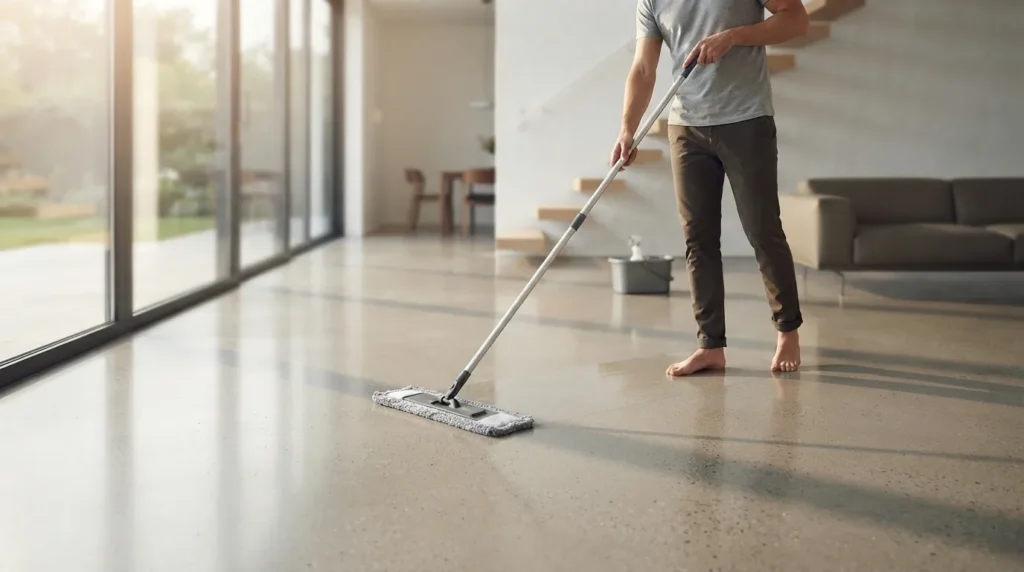
For sealed and polished floors: Use a microfiber flat mop — wrung nearly dry before each pass. Concrete floors do not require the amount of water used on ceramic tile. Excess water on a polished concrete floor leaves water marks that dull the finish.
For unsealed and garage floors: A traditional string mop or a scrub brush on a handle. More water is acceptable on unsealed surfaces — the mechanical scrubbing action is more important than moisture control.
Mopping technique: Work in sections of approximately 4×4 feet. Overlap each pass by 50% to ensure complete coverage. Change the mop water when it becomes visibly dirty — mopping with dirty water deposits soil back onto the floor rather than removing it.
Worked Example — 400 sq ft Open-Plan Living Area:
A polished concrete floor in a modern apartment, 400 sq ft. Dust mop first (5 minutes). Prepare pH-neutral solution in two buckets — one with cleaning solution, one with clean rinse water. Mop in 4×4 ft sections, first pass with cleaning solution, second pass with clean water to rinse. Change rinse water every 4–5 sections. Total cleaning time: approximately 25–35 minutes.
Step 4 — Rinse and Dry
Rinse: Follow every cleaning session with a clean-water rinse mop — particularly important for indoor living spaces where cleaning residue would be walked on and tracked through the building. For garage floors, a garden hose rinse and wet vacuum or squeegee to remove water is more practical.
Drying: Allow adequate drying time before foot traffic — polished and coated concrete shows footprints and tracking marks when wet. Increase air circulation with fans or open windows in enclosed spaces. Do not place rugs or mats on wet concrete — they trap moisture and can cause discoloration.
How to Clean Unsealed Concrete Floors
Unsealed concrete is the most common concrete floor type in utility spaces — garages, basements, workshops, and warehouses. It is also the most forgiving to clean, tolerating a wider range of products and more aggressive mechanical scrubbing.
Regular Cleaning of Unsealed Concrete
Daily/weekly maintenance:
- Sweep or vacuum to remove loose debris
- Spot clean any fresh spills immediately — concrete absorbs liquids rapidly, and immediate treatment prevents permanent staining
- Damp mop with a mild detergent solution for general dirt
The absorption challenge: Unsealed concrete begins absorbing any liquid within seconds of contact. On a weekly cleaning schedule, the floor accumulates absorbed dirt in the upper pore layer between cleanings. Regular mopping with a mild detergent helps, but does not remove deeply absorbed material.
Deep Cleaning Unsealed Concrete
Deep cleaning unsealed concrete requires more aggressive products and mechanical scrubbing to pull embedded dirt from the pore structure.
Method:
- Clear the floor completely
- Sweep thoroughly
- Pre-wet the floor with clean water
- Apply concrete degreaser or cleaning solution appropriate for the primary soil type
- Allow 5–10 minutes dwell time — do not let the product dry
- Scrub aggressively with a stiff nylon brush or floor scrubbing machine
- Rinse thoroughly with clean water — multiple rinses until water runs clear
- Remove standing water with a wet vacuum or squeegee
- Allow to dry completely before foot traffic
Worked Example — Unsealed Basement Floor:
An unfinished basement floor showing grey dirt accumulation and some white mineral deposits. Deep clean process: pre-wet, apply oxygen bleach solution at 1 cup per gallon of warm water (addresses both organic soil and some mineral deposits). Scrub with deck brush in overlapping circular passes. Rinse with garden hose. Apply diluted muriatic acid (1:10) to remaining white efflorescence patches, scrub, rinse thoroughly. Wet vacuum, allow 48 hours to dry fully.
For information on identifying and treating specific surface damage revealed during cleaning, see our types of concrete damage guide.
How to Clean Sealed or Coated Concrete Floors
Sealed concrete floors — whether topical acrylic, epoxy, polyurethane, or polished — require a gentler, more controlled approach than unsealed concrete. The goal is cleaning the sealer surface without degrading the sealer itself.
Regular Cleaning of Sealed Concrete
The critical rule for sealed concrete: pH-neutral cleaner only. Acidic cleaners etch many sealer types. Alkaline cleaners can degrade polyurethane and wax finishes over time.
Method:
- Dust mop with microfiber — critical on polished and epoxy floors where grit causes visible scratching
- Damp mop with diluted pH-neutral cleaner — barely damp for polished, moderately damp for epoxy and acrylic
- No-rinse formula: use sufficiently diluted cleaner that rinsing is unnecessary — reduces cleaning time and water on the floor
Frequency: High-traffic sealed commercial floors: daily dust mopping, weekly damp mopping. Residential sealed floors: weekly dust mopping, monthly damp mopping.
Deep Cleaning Sealed Concrete
Deep cleaning sealed concrete primarily addresses areas where cleaning solution residue has built up over multiple cleaning sessions — a common issue on floors where the cleaning solution is not adequately diluted.
Signs of residue build-up: Dull appearance despite regular cleaning, sticky surface texture, visible white film when dry.
Method:
- Identify whether the problem is soil or residue — apply a small amount of clean water and rub with a cloth. If residue comes off on the cloth without any cleaner, it is cleaning residue build-up.
- Clean with a fresh microfiber pad and warm water only — no cleaner — working in small sections, changing pads frequently
- Dry immediately with a clean dry cloth after each section
- If residue persists: use a commercial hard floor cleaner specifically formulated for sealed concrete, following manufacturer dilution precisely
How to Clean Stained Concrete Floors
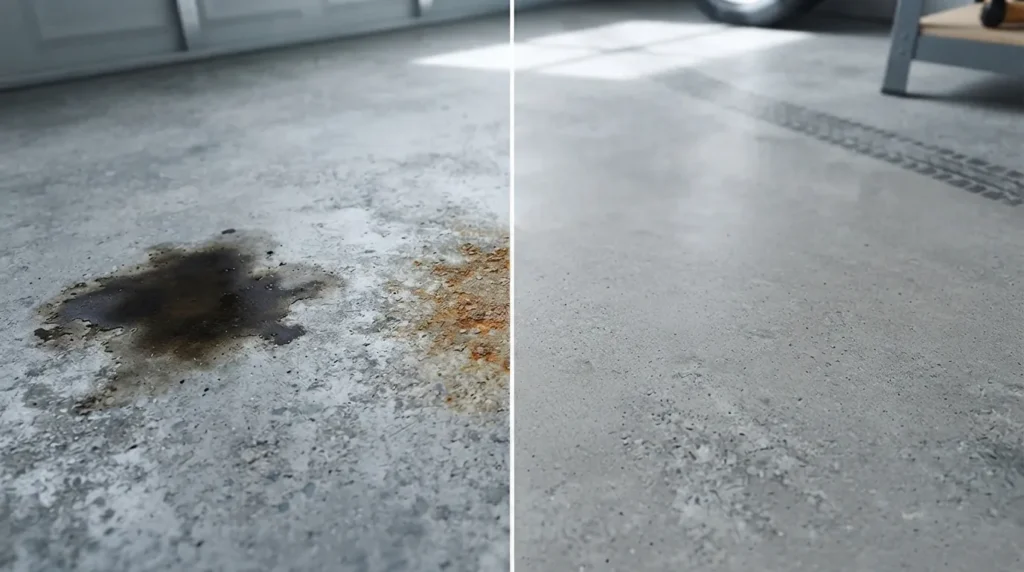
Stain removal from concrete requires matching the cleaning agent to the stain type. The wrong product may spread the stain, push it deeper into the pore structure, or damage the surface.
Oil and Grease Stains
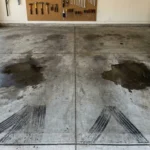
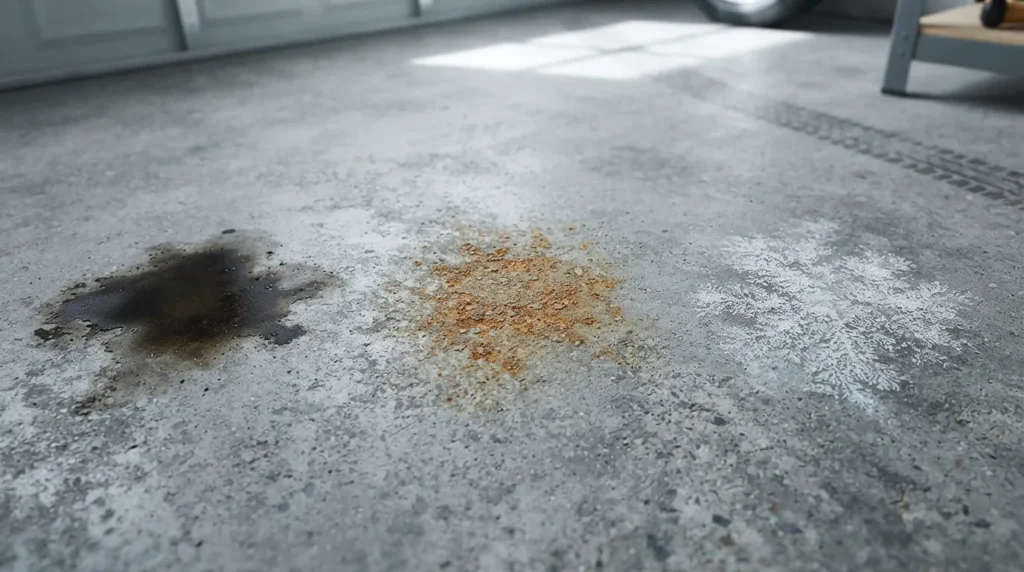
Oil and grease are the most common concrete stains — particularly on garage floors and driveways where vehicle fluids drip onto the surface.
Fresh oil spill (under 24 hours):
- Cover with absorbent material immediately — cat litter, sawdust, or commercial oil absorbent
- Allow 1–2 hours to absorb
- Sweep away absorbent
- Apply dish soap or concrete degreaser to the remaining stain
- Scrub with stiff nylon brush
- Rinse
Old or set oil stain:
- Apply commercial concrete degreaser — allow 10–15 minutes dwell time
- Scrub aggressively with stiff brush
- Rinse, repeat if necessary
- For deep-set stains: apply a poultice of powdered absorbent material (baking soda, cornstarch) mixed with mineral spirits to a paste, apply 1cm thick over the stain, cover with plastic, tape edges, leave 24–48 hours, remove and rinse
Worked Example — Garage Floor Oil Stain:
A 6-inch diameter engine oil drip stain, approximately 3 months old. Applied commercial degreaser, dwell 12 minutes, scrubbed with stiff deck brush in circular motion. First pass: 60% removal. Applied second degreaser treatment, dwell 20 minutes, scrubbed. Result: 90% removal — faint shadow remains. Applied poultice (baking soda + mineral spirits) overnight. Result after removal: virtually invisible.
Rust Stains
Rust stains come from metal objects left on concrete — tools, furniture, rebar bleeding through the surface, or metal filing from grinding.
Method:
- Apply commercial rust remover (oxalic acid-based) following manufacturer instructions
- Allow dwell time — typically 5–10 minutes
- Scrub with stiff nylon brush
- Rinse thoroughly with clean water
Important: On sealed or decorative concrete, test rust remover in an inconspicuous area first — some oxalic acid products can lighten the surrounding concrete or affect certain sealer types.
Paint and Adhesive Residue
Latex paint: Soak with warm water, then scrape with a plastic scraper. Scrub remaining residue with a nylon brush and warm water.
Oil-based paint: Apply paint stripper appropriate for concrete, follow manufacturer dwell time, scrape with plastic scraper, clean with solvent if necessary, rinse.
Adhesive/glue residue: Apply commercial adhesive remover or rubbing alcohol, allow to penetrate 5 minutes, scrape with plastic scraper, clean residue, rinse.
Efflorescence
Efflorescence is the white, chalky crystalline deposit that appears on concrete surfaces when water moves through the slab and carries dissolved minerals to the surface where they crystallise.
Method:
- Dry brush loose deposits with a stiff brush — remove as much dry material as possible
- Apply diluted white vinegar (1:1 with water) OR diluted muriatic acid (1:10 in water) to the stained area
- Scrub with stiff nylon brush
- Rinse thoroughly — multiple times until water runs neutral
- For persistent efflorescence: commercial efflorescence remover products are more effective than DIY acid solutions
Prevention: Efflorescence indicates water movement through the slab. Sealing the surface slows the process — see our types of concrete sealers guide for sealer selection. Addressing the water source (drainage, grading, or vapor barrier) prevents recurrence.
How to Clean Indoor Concrete Floors
Indoor concrete floors in living spaces — polished floors in modern homes, stained concrete in kitchens and dining areas — are the most sensitive concrete surfaces to clean. They look beautiful and require the most careful maintenance to stay that way.
Cleaning Interior Concrete in Living Spaces
The primary challenge: Concrete floors in living spaces are exposed to food and beverage spills, foot traffic from bare feet and shoes, and the aesthetic scrutiny that comes with being a design feature rather than a utility surface.
Daily maintenance: A microfiber dust mop removes the fine particles that would dull a polished surface if dragged under a wet mop. In kitchens, daily dust mopping is essential — food residue combined with dust creates a film that builds up quickly on polished concrete.
Weekly maintenance: Damp mop with a pH-neutral cleaner specifically formulated for finished concrete floors. Wring the mop nearly dry — “damp” means no dripping. Work in sections, overlapping each pass, drying each section promptly.
Spill response: Wipe up immediately — sealed indoor concrete resists spilling but the sealer is not impermeable indefinitely. Wine, coffee, and citrus juices left standing for extended periods can eventually penetrate even quality sealers.
Cleaning Polished Concrete Floors
Polished concrete requires the strictest cleaning discipline of any floor type. The high-gloss surface reveals every water mark, streak, and cleaning residue with merciless clarity.
The polished concrete cleaning rule: pH-neutral cleaner. Microfiber only. Nearly dry mop. Dry immediately.
What causes dull polished concrete:
- Acidic cleaners etching the polish
- Alkaline residue from over-concentrated cleaning solution
- Micro-scratches from abrasive particles dragged across the surface before dry cleaning
- Water marks from inadequate drying after mopping
Restoring shine to dull polished concrete: Apply a polished concrete floor conditioner (available from concrete finishing suppliers) with a microfiber mop. This refreshes the surface without requiring professional re-polishing. For severely dull or scratched polished floors, professional diamond polishing is the correct restoration — see our types of polished concrete floors guide for polishing specifications and restoration options.
How to Clean Concrete Garage Floor
The garage floor is typically the dirtiest concrete surface in a residential property — vehicle fluids, road grime, tire marks, paint spills, and general workshop mess accumulate on a surface that may not be cleaned frequently.
Scrubbing Concrete Floors in Garages
Materials needed: Concrete degreaser, stiff nylon deck brush or floor scrubbing machine, garden hose or bucket of rinse water, wet vacuum or floor squeegee.
Method:
- Remove all vehicles and items from the floor
- Sweep thoroughly — remove all loose dirt, grit, and debris
- Pre-wet the floor with clean water
- Apply degreaser solution at manufacturer’s recommended dilution
- Allow 10–15 minutes dwell time — do not allow to dry
- Scrub with stiff deck brush in overlapping circular passes, focusing on stained areas
- Use a floor scrubbing machine for large garage areas — dramatically reduces labour
- Rinse with hose or clean water, working water toward the floor drain
- Remove standing water with wet vacuum or rubber squeegee
- Allow to dry completely — 2–4 hours before vehicle entry
Worked Example — Two-Car Garage Floor:
A 480 sq ft unsealed concrete garage floor — oil drips, tire marks, and general grime accumulated over 2 years. Swept, then applied commercial degreaser at 1:10 dilution. Dwell 15 minutes. Scrubbed with long-handled stiff deck brush — first pass on oil drip areas, second pass full floor. Rinsed with garden hose, squeegeed to drain. Result: approximately 80% improvement — oil shadow areas remain. Second treatment on oil areas with full-strength degreaser and poultice applied overnight. Total cleaning time (excluding poultice dwell): approximately 2.5 hours.
Pressure Washing Garage Floors
A pressure washer is the most effective tool for deep cleaning an unsealed or penetrating-sealed garage floor — the high-pressure water jet breaks up embedded dirt and flushes it off the surface.
Pressure setting: 1,500–2,500 PSI for standard unsealed concrete. Do not exceed 3,000 PSI — high pressure can pit the concrete surface or damage any existing sealer.
Technique: Use a 25-degree fan nozzle — never a zero-degree pinpoint nozzle on concrete. Hold the wand 6–12 inches from the surface. Work in overlapping passes in one direction. Pre-apply degreaser before pressure washing for oil-contaminated floors — allow dwell time, then pressure wash.
After pressure washing: Allow the floor to dry completely (24–48 hours) before applying any sealer or coating. Pressure washing raises surface moisture levels — sealing over wet concrete causes sealer failure.
Cleaning Frequency and Maintenance Schedule
| Surface Type | Dust Mopping | Damp Mopping | Deep Clean | Reseal |
|---|---|---|---|---|
| Polished concrete (high traffic) | Daily | Weekly | Monthly | Every 1–2 years |
| Polished concrete (light traffic) | Weekly | Monthly | Quarterly | Every 2–3 years |
| Sealed decorative (high traffic) | Weekly | Weekly | Monthly | Every 1–3 years |
| Sealed decorative (light traffic) | Weekly | Monthly | Quarterly | Every 3–5 years |
| Epoxy garage floor | Weekly | Monthly | Quarterly | Every 5–10 years |
| Unsealed garage | Weekly sweep | Monthly mop | 2× per year | Seal when needed |
| Unsealed basement | Monthly | Quarterly | Annually | Seal when needed |
Key principle: The more traffic a floor receives, the more frequently each step is required. A restaurant with polished concrete floors may need daily mopping and monthly deep cleaning. A residential kitchen may need weekly mopping and quarterly deep cleaning.
How to Make Concrete Floors Easier to Maintain
The single most effective step to reduce cleaning time and frequency is also the most universally applicable: sealing the concrete surface.
Sealing After Cleaning
A sealed concrete floor is dramatically easier to clean than an unsealed one. The sealer prevents oils, moisture, and staining agents from penetrating the pore structure — instead of absorbing into the concrete, spills sit on the surface where they can be wiped up.
After deep cleaning unsealed concrete: Allow the floor to dry completely (24–48 hours for thick slabs or in humid conditions). Test moisture with the plastic sheet test — tape a 2-foot square of plastic to the floor, leave 24 hours, check for condensation underneath. If dry, apply penetrating or topical sealer following our types of concrete sealers guidance.
The concrete floor cleaning kit available here provides the pH-neutral cleaner, microfiber pads, and floor scrubber combination that covers daily and weekly maintenance for most sealed concrete floor types — a practical starting point for establishing a consistent cleaning routine.
Floor Mats and Traffic Management
Entry mats: Place absorbent entry mats at all doors — they capture grit, moisture, and road salt before they reach the concrete. Replace or clean mats frequently — a saturated or grit-laden mat causes more damage than no mat.
Anti-fatigue mats in workspaces: In garage workshops and utility areas, rubber anti-fatigue mats in work zones protect the concrete from concentrated chemical spills, dropped tools, and abrasive footwear.
Area rugs in living spaces: On polished or decorative indoor concrete, area rugs in high-traffic paths (kitchen walkways, hallways) reduce the frequency of required floor cleaning significantly. Ensure rugs have non-slip, non-staining backing — some rubber backings discolor sealed concrete over time.
Frequently Asked Questions
What is the best way to clean concrete floors?
The best way to clean concrete floors starts with identifying the floor type — sealed or unsealed — then following the appropriate method. For most concrete floors: dust mop first to remove abrasive particles, then damp mop with pH-neutral cleaner (1–2 teaspoons dish soap per gallon of warm water), rinse with clean water, and dry thoroughly. Use a stiff brush and degreaser for garage floors and unsealed utility concrete; microfiber and gentle cleaners for sealed and polished indoor surfaces.
What should I use to clean concrete floors?
For sealed and polished concrete: pH-neutral cleaner, microfiber mop. For unsealed concrete: mild detergent or concrete cleaner, stiff nylon brush. For oil stains: concrete degreaser. For rust stains: oxalic acid-based rust remover. For efflorescence: diluted white vinegar (1:1) or muriatic acid (1:10). Avoid vinegar, bleach, ammonia-based products, abrasive pads, and steam mops on most concrete surfaces.
How do I mop a concrete floor correctly?
Wring the mop nearly dry before each pass — excess water is the most common concrete mopping error. Work in sections of approximately 4×4 feet, overlapping each pass by 50%. Change mop water when visibly dirty. Follow cleaning with a clean-water rinse pass. For polished concrete, use a microfiber flat mop only; for unsealed utility floors, a traditional string mop or scrub brush is acceptable.
How do I clean an indoor concrete floor?
Indoor concrete in living spaces requires the most careful approach: daily dry dusting with a microfiber dust mop, weekly damp mopping with pH-neutral cleaner, and immediate spill response. Use only pH-neutral products — never vinegar, bleach, or acidic cleaners on polished or sealed indoor floors. These damage the sealer and polish over time, causing permanent dulling that requires professional restoration.
How do I clean a concrete garage floor?
Sweep first. Apply commercial concrete degreaser at the dilution specified on the label — allow 10–15 minutes dwell time. Scrub with a stiff deck brush or floor scrubbing machine. Rinse with a garden hose toward the floor drain, or use a pressure washer at 1,500–2,500 PSI with a 25-degree nozzle. Remove standing water with a wet vacuum or squeegee. Treat oil stains with degreaser or poultice before the main cleaning session.
How do I clean stained concrete floors?
Match the cleaner to the stain type: degreaser for oil and grease, oxalic acid for rust, diluted vinegar or muriatic acid for efflorescence, paint stripper for dried paint. For set stains, a poultice (absorbent material mixed with the appropriate solvent) applied overnight produces better results than single-application scrubbing. Test any aggressive product on an inconspicuous area before treating a visible stain location.
How often should I clean concrete floors?
Frequency depends on traffic and surface type. High-traffic polished concrete: daily dust mopping, weekly damp mopping. Standard sealed residential floors: weekly dust mopping, monthly damp mopping. Unsealed garage floors: sweep weekly, deep clean monthly or quarterly. The key indicator is the floor’s appearance — if it looks dull or dirty, clean it; do not wait for the scheduled date.
Can I use a steam mop on concrete floors?
No — steam mops are not recommended for any type of concrete floor. The high heat and moisture can degrade acrylic and wax sealers, soften epoxy coatings, and force moisture into the slab on unsealed concrete. Use microfiber flat mops with appropriate cleaning solution instead.
Conclusion
Cleaning concrete floors effectively comes down to three things: knowing your floor type before choosing any product, using the right tool for the task (microfiber for polished and sealed, stiff brush for unsealed and garage), and maintaining a consistent routine rather than reacting to visible dirt accumulation. Sealed concrete is dramatically easier to maintain than unsealed — if your concrete floor is currently unsealed and cleaning is a persistent frustration, sealing it is the highest-impact single maintenance improvement you can make. Use the ConcreteCal free concrete calculator to calculate sealer quantities before any sealing project, and see our how to maintain concrete guide for the complete annual concrete care programme beyond just floor cleaning.