
Milwaukee Tool did not enter the concrete vibrator market to compete on price. They entered it to solve a specific problem that every concrete contractor who has done a long pour day knows intimately: by hour three of continuous vibration work, your arm is finished. The motor is heavy, the shaft pulls, and the last 500 insertions of a 1,200-insertion pour get done with less precision than the first 500 — and concrete quality suffers in ways that do not show up until the forms come off.
The Milwaukee concrete vibrator lineup — built on two separate platforms, the M18 and the MX FUEL — represents Milwaukee’s answer to this problem. The M18 system integrates with the tools every Milwaukee contractor already owns. The MX FUEL Backpack system takes the motor off your hand entirely and puts it on your back, fundamentally changing the ergonomics of high-volume concrete vibration work.
This guide covers everything in Milwaukee’s concrete vibrator range — both platforms, every head size, every shaft length, the applications each is built for, and the practical setup guidance that makes the difference between good vibration and great vibration.
For concrete volume calculations before any pour, use the free concrete calculator at ConcreteCal. If you are still deciding between Milwaukee and other brands, see our DeWalt vs Milwaukee concrete vibrator comparison guide.
Table of Contents
- Why Milwaukee Built Two Separate Concrete Vibrator Systems
- Milwaukee MX FUEL Backpack Concrete Vibrator — In Depth
- Milwaukee M18 Concrete Vibrator System
- Milwaukee Concrete Vibrator Heads — Complete Size Guide
- Milwaukee Concrete Vibrator Shaft Options
- Milwaukee Concrete Vibrator — Application Guide
- Milwaukee Accessories and System Compatibility
- Milwaukee Concrete Vibrator vs Corded Alternatives
- Milwaukee Concrete Vibrator Setup and Best Practices
- Frequently Asked Questions
Why Milwaukee Built Two Separate Concrete Vibrator Systems
Most tool brands offer a single concrete vibrator platform. Milwaukee offers two — and the reasoning behind this is worth understanding before choosing which system fits your work.
M18 — Integration with Existing Tools
The M18 platform is Milwaukee’s mainstream 18V cordless system — the same battery that powers Milwaukee drills, circular saws, grinders, lights, and hundreds of other tools. The M18 concrete vibrator integrates completely into this ecosystem: same batteries, same chargers, same case system.
Why this matters practically: A contractor running 20 M18 tools across their crew does not want a separate battery management system for one tool. M18 concrete vibrator batteries charge on the same chargers as everything else, can be swapped from any M18 tool in an emergency, and integrate into Milwaukee’s existing ONE-KEY equipment tracking if the crew uses it.
The M18 system is the right starting point for Milwaukee contractors who need concrete vibration capability and pour primarily at residential to light commercial scale.
MX FUEL — Purpose-Built Industrial Power
MX FUEL is a completely separate platform — higher voltage, larger batteries, and purpose-engineered for industrial applications that exceed what 18V technology can deliver consistently. The MX FUEL Backpack Concrete Vibrator is the flagship example.
MX FUEL batteries are not M18 compatible. This is the most important practical point about the MX FUEL system — investing in MX FUEL means adding a new battery ecosystem. MX FUEL chargers and batteries are separate from M18 infrastructure entirely.
Why MX FUEL exists: Some applications genuinely need more sustained power than any 18V system can deliver at professional volume. Large commercial concrete pours — warehouse slabs, bridge decks, parking structures — require hours of continuous high-frequency vibration. MX FUEL delivers that sustained output while the backpack architecture solves the fatigue problem that limits continuous vibration work with any hand-held system.
Milwaukee MX FUEL Backpack Concrete Vibrator — In Depth
The MX FUEL Backpack Concrete Vibrator is the most innovative concrete vibrator design currently available in the cordless market. Understanding what makes it genuinely different from a standard concrete vibrator — not just a marketing claim — requires looking at the specific problem it solves.
How the Backpack Architecture Works
In a conventional concrete vibrator, the operator holds the drive unit — the motor housing — in their hand or forearm while controlling the flexible shaft. The motor is heavy (typically 4–8 lbs depending on the unit), and the operator carries this weight continuously across every insertion for the duration of the pour.
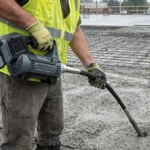
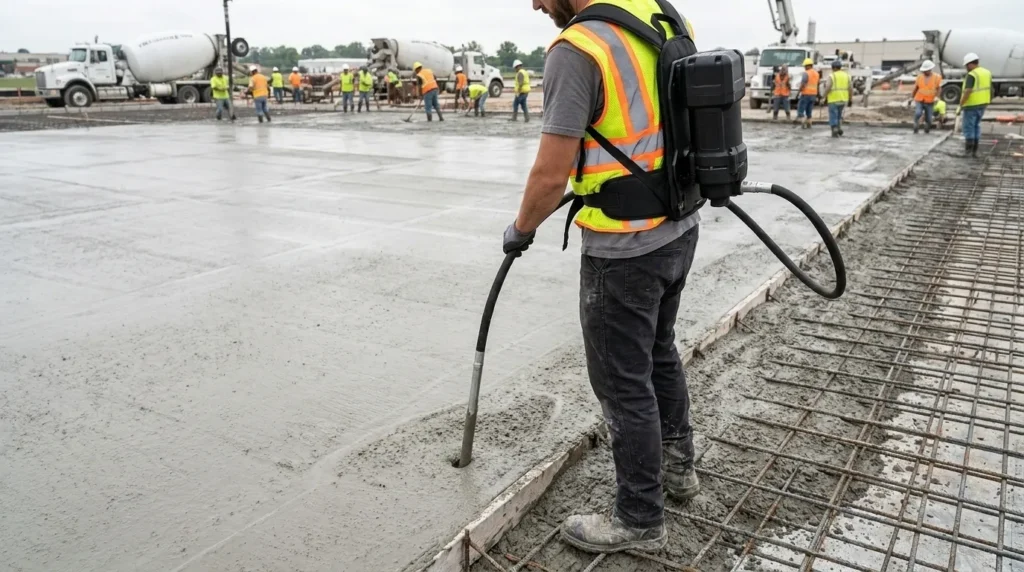
In the Milwaukee MX FUEL Backpack system, the motor and battery are housed in a backpack frame worn on the operator’s back. The operator holds only the flexible shaft assembly — dramatically lighter than any conventional vibrator unit. The backpack harness distributes the motor and battery weight across the operator’s shoulders and hips rather than concentrating it in one hand and arm.
The fatigue arithmetic:
On a commercial pour requiring 1,000 insertions at 10–15 seconds each, the operator’s hand and arm support the drive unit weight for approximately 3–4 hours of active work. Arm fatigue at hours 3–4 causes operators to reduce dwell time, reduce insertion depth, and reduce insertion spacing — all of which degrade concrete consolidation quality precisely when the operator is most tired.
The backpack eliminates this fatigue pathway. Shoulders and back muscles are significantly stronger than arm muscles for sustained load-carrying, and the distributed weight of the backpack frame is far less fatiguing over a long pour day than a hand-held motor.
MX FUEL Vibration Performance Specs
Key performance specifications:
- Vibration frequency: 14,000 VPM (approximately 233 Hz)
- Motor: High-efficiency sealed motor in backpack housing
- Battery: MX FUEL high-capacity pack
- Head compatibility: Milwaukee MX FUEL concrete vibrator heads (1.25″, 1.5″, 2″)
- Shaft compatibility: Milwaukee MX FUEL flexible shafts
Frequency consistency: One of the most important performance characteristics of any concrete vibrator is frequency stability under load — does the unit maintain its rated 14,000 VPM at the 900th insertion in a long pour at the same level as the 1st? The MX FUEL system’s motor is specifically engineered for sustained output, maintaining consistent VPM through the battery discharge cycle. This matters because frequency drop-off in the second half of a battery charge means the last sections of a pour are consolidated less effectively than the first sections.
Worked Example — 15,000 sq ft Warehouse Floor:
A concrete contractor pouring a 15,000 sq ft warehouse floor in a single day. Concrete volume: approximately 220 cubic yards. Crew: 6 people — two placing, one screeding, one checking levels, one operating the vibrator, one on logistics.
The vibrator operator makes approximately 1,800 insertions across the pour with a 1.5-inch head at 18-inch spacing. Active vibration time: approximately 5–6 hours. With the MX FUEL Backpack system, the operator maintains consistent dwell time and insertion depth through the full 5–6 hours. With a hand-held vibrator, performance typically degrades noticeably after hour 3–4. The MX FUEL advantage on this pour is measurable concrete quality in the later poured sections.
Who the MX FUEL System Is Actually For
The MX FUEL Backpack is the right choice when:
- Pour duration regularly exceeds 3 hours of active vibration
- Large commercial slabs, bridge decks, parking structures, or warehouse floors
- The operator vibrates full-time rather than sharing duties
- The $800–$1,400+ investment is justified by the volume of commercial work
- You are committed to building MX FUEL battery infrastructure
The MX FUEL is not the right choice when:
- You primarily pour residential scale (driveways, basement walls, footings)
- Pour duration is typically under 2 hours
- Budget is the primary constraint
- Your M18 ecosystem is already fully built out and you want integration
Milwaukee M18 Concrete Vibrator System
The M18 concrete vibrator is Milwaukee’s mainstream platform offering — a hand-held cordless vibrator that integrates with the M18 ecosystem used across most Milwaukee contractor crews.
M18 Vibrator Key Specifications
Core specifications:
- Platform: M18 (18V)
- Battery: M18 REDLITHIUM packs (compatible with all M18 tools)
- Motor: Sealed, designed for concrete environment
- Head compatibility: Milwaukee concrete vibrator heads
- Runtime: Approximately 30–60 minutes active vibration per 5.0Ah pack
Sealed motor design: Milwaukee’s M18 vibrator uses a sealed motor housing designed to resist concrete dust, water, and the physical abuse of construction site use. The sealed design is important for any concrete vibrator — concrete paste and dust are highly abrasive and alkaline, both of which are destructive to unsealed motor components.
Drive shaft: The M18 vibrator connects to Milwaukee’s flexible shaft system through a quick-change connection — allowing head and shaft changes without tools, relevant when switching between pours of different depths or when moving from tight-rebar residential work (smaller head) to open commercial sections (larger head).
M18 vs MX FUEL — Which to Choose
| Factor | M18 | MX FUEL Backpack |
|---|---|---|
| Battery compatibility | All M18 tools | MX FUEL only |
| Form factor | Hand-held | Backpack |
| Pour duration suitability | Up to 2–3 hours | 4+ hours |
| Best application | Residential, light commercial | Large commercial, infrastructure |
| Entry price | Lower | Significantly higher |
| Fatigue on long pours | Standard (hand-held weight) | Significantly reduced |
| Frequency output | Good | High (14,000 VPM) |
The honest recommendation: If you are a Milwaukee contractor doing mixed residential and commercial work and you want one concrete vibrator that integrates with your existing tools — M18. If you regularly do large commercial pours where operator fatigue is a real productivity issue — MX FUEL Backpack.
Milwaukee Concrete Vibrator Heads — Complete Size Guide
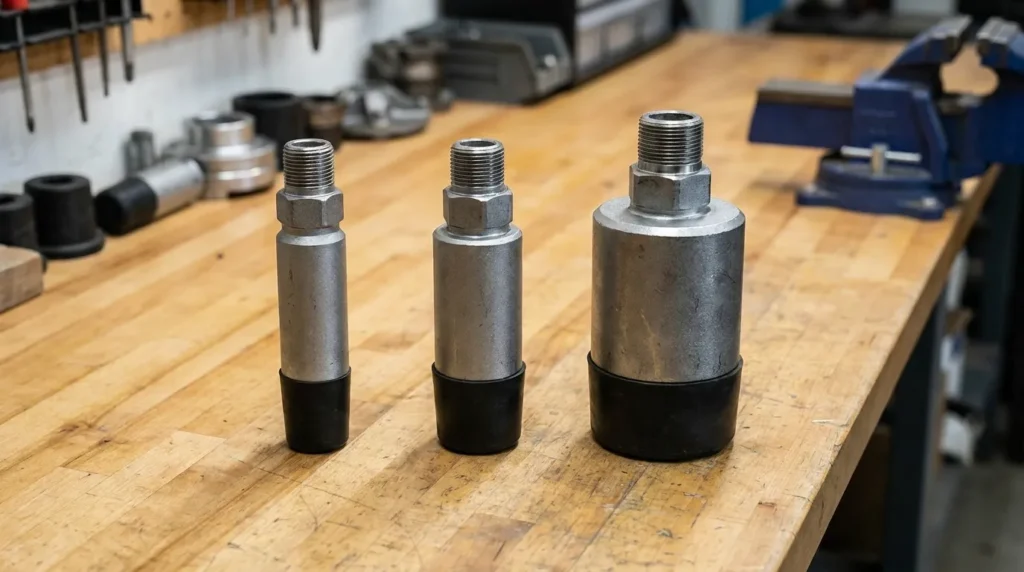
Milwaukee’s interchangeable concrete vibrator head system allows one drive unit to serve multiple applications by swapping heads. This is the most practically useful aspect of Milwaukee’s system architecture — a contractor can own one M18 or MX FUEL drive unit and carry three different head sizes for different pour types.
1-1/4 Inch Concrete Vibrator Head
The 1.25-inch (approximately 32mm) head is Milwaukee’s smallest concrete vibrator head — designed for the tightest applications where larger heads cannot fit.
Specifications:
- Diameter: 1-1/4 inch (32mm)
- Radius of effective action: approximately 7–8 inches
- Insertion spacing: approximately 14–16 inches
Best applications:
- Thin concrete sections (under 6 inches thick)
- Tight rebar spacing where 1.5-inch clearance is not available
- Decorative concrete work where precise control matters
- Precast concrete products with dense reinforcement
What it does not suit: Large open commercial pours where the tight radius of action means many more insertions to cover the same area — significantly less efficient than a 1.5 or 2-inch head on open slabs.
1-1/2 Inch Concrete Vibrator Head
The 1.5-inch (approximately 38mm) head is the most versatile and most commonly used Milwaukee concrete vibrator head — it covers the widest range of applications from residential to mid-commercial.
Specifications:
- Diameter: 1-1/2 inch (38mm)
- Radius of effective action: approximately 9–10 inches
- Insertion spacing: approximately 18–20 inches
Best applications:
- Residential foundation walls and columns
- Residential and light commercial slabs
- Standard commercial columns with normal rebar layout
- Any pour where versatility and efficiency balance is the priority
Worked Example — Residential Wall Pour:
A 10-ft tall basement perimeter wall, 10 inches thick, #4 rebar at 12-inch centres. The 1.5-inch head fits between rebar bars with adequate clearance (approximately 3.25 inches each side). Insertion spacing: 18 inches. 40 linear feet of wall at 18-inch spacing = approximately 27 insertions per course × 2 (for full depth coverage) = 54 total insertions. Active vibration time: approximately 10–12 minutes.
2 Inch Concrete Vibrator Head
The 2-inch (approximately 50mm) head is Milwaukee’s largest concrete vibrator head — designed for large commercial applications where coverage efficiency matters more than access in tight spaces.
Specifications:
- Diameter: 2 inch (50mm)
- Radius of effective action: approximately 12–13 inches
- Insertion spacing: approximately 24–26 inches
Best applications:
- Large commercial slabs (warehouse floors, parking structures)
- Mass concrete pours with open rebar layout
- Bridge deck sections with standard reinforcement
- Any application where pour speed is the priority
Coverage comparison: The 2-inch head at 24-inch insertion spacing covers the same area per insertion as 6.4 insertions of the 1.25-inch head at 14-inch spacing. On a large commercial pour, using the largest appropriate head dramatically reduces total insertion count and pour time.
Head Material — Rubber Tip vs Steel Head
Milwaukee’s standard concrete vibrator heads feature a rubber tip at the poker end. This rubber cap serves a specific purpose: it protects the formwork face from impact damage when the poker contacts the form during insertion.
When rubber tip matters: Timber formwork, plastic formwork liners for architectural concrete, and fibreglass forms all benefit from rubber tip protection. A steel-tipped poker dragged along a form face leaves visible marks that transfer to the finished concrete surface.
Steel head considerations: Some applications — very stiff, low-slump concrete mixes — benefit from a steel poker tip for penetration. The harder surface cuts through the stiffer mix more effectively than rubber. For standard residential and commercial concrete mixes (4–6 inch slump), rubber tip heads perform equivalently to steel.
Eccentric mass vibration: Milwaukee’s heads use an eccentric mass design — an offset weight within the poker cylinder that rotates and generates centrifugal vibration force. This mechanism provides high-amplitude, consistent vibration that is effective across the concrete mix slump ranges used in standard commercial construction.
Milwaukee Concrete Vibrator Shaft Options
The flexible shaft transmits rotational energy from the drive unit to the vibrator head — and its length determines how deep the operator can reach into a concrete pour.
Shaft Length by Pour Depth
The basic rule: shaft length must equal pour depth plus approximately 4–5 feet of operating clearance above the concrete surface.
| Pour Depth | Minimum Shaft Length | Notes |
|---|---|---|
| Up to 3 ft (footings, thin slabs) | 7 ft | Standard residential |
| 3–8 ft (basement walls, columns) | 10–12 ft | Most residential applications |
| 8–12 ft (commercial walls) | 16 ft | Standard commercial |
| 12–18 ft (tall columns, deep walls) | 21 ft | Commercial/infrastructure |
| Over 18 ft | 30 ft+ | Infrastructure, bridge piers |
Milwaukee shaft availability: Milwaukee offers shaft options from 7 ft through to longer configurations for MX FUEL — confirm availability with your Milwaukee supplier for specific lengths beyond 16 ft.
Flexible Shaft Construction and Durability
Milwaukee’s flexible shafts use an inner high-carbon spring wire core that transmits the rotational drive while maintaining the flexibility needed to insert and withdraw from deep pours. The outer covering is multi-layer rubber with reinforcing structure that resists concrete abrasion and the repeated flexing under operation.
Service life expectation: With proper cleaning after every use and correct storage (coiled without sharp bends), a Milwaukee flexible shaft should provide 2–4 seasons of regular commercial use before replacement is required. The most common wear points are at the coupling connections — inspect these at each use for any signs of looseness or wear.
Critical maintenance: Clean the shaft and head immediately after every pour — fresh concrete wipes clean in seconds. Cured concrete on a flexible shaft is physically difficult to remove and accelerates wear on the rubber outer. This is the single most important maintenance habit for extending shaft life.
Milwaukee Concrete Vibrator — Application Guide
Columns and Piers
Columns are one of the most demanding concrete vibration applications — deep, relatively narrow cross-sections with dense reinforcement where thorough consolidation is critical to structural performance.
Milwaukee recommendation: 1.5-inch head for standard residential and commercial columns. 1.25-inch head where rebar spacing is tight (under 8-inch centres). Shaft length: pour height plus 5 ft operating clearance.
Insertion technique for columns: Insert vertically at the centre of the column first, then at intermediate points between the centre and form face (maintaining 2-inch minimum clearance from any form). Do not insert the poker at an angle — angled insertion vibrates concrete in one direction while leaving the opposite face under-consolidated.
Walls and Large Wall Sections
Wall pours present the challenge of access — the poker must reach through the full height of the wall form while the operator works from above. For walls over 8 ft tall, a 16 ft shaft is required.
Milwaukee recommendation: 1.5-inch head for standard wall thickness (8–12 inches). 2-inch head for thick walls (over 16 inches) with open rebar layout.
The lift technique: For tall walls, do not attempt to vibrate from the top in a single pass if the pour depth exceeds the effective radius in the vertical direction. Pour in lifts — fill to 18–24 inches, vibrate thoroughly, then continue filling. This ensures the poker reaches the bottom of each lift effectively.
Footers and Slabs
Footers (strip footings and pad footings) and slabs are Milwaukee’s most commonly used applications — residential footings, driveway slabs, patio pours, and light commercial floors.
Milwaukee recommendation: M18 system with 1.5-inch head covers all standard residential footing and slab applications. Pour depths are typically shallow (4–8 inches for slabs, 8–16 inches for footings) — standard shaft lengths are adequate.
Slab vibration pattern: Work in a systematic grid — do not vibrate randomly. Mark insertion points at the specified spacing (18 inches for 1.5-inch head) on the form edges before pouring. Follow the placement crew at a consistent distance — typically vibrating 3–5 feet behind the leading edge of fresh concrete placement.
Stiff Slump and Structural Concrete
Structural concrete specified at low slump (2–4 inches) for high-strength applications is more difficult to vibrate — the stiffer mix resists consolidation and requires higher vibration amplitude and longer dwell time than standard residential mixes.
Milwaukee recommendation for stiff mixes:
- Use the largest head that fits the rebar layout — larger head = more vibration energy into the mix
- Increase dwell time to 10–15 seconds per insertion (versus 5–8 seconds for standard slump)
- Reduce insertion spacing by 15–20% — the effective radius is reduced in stiffer concrete
- The MX FUEL system’s sustained 14,000 VPM output is particularly effective on stiff structural mixes
Milwaukee Concrete Vibrator Accessories and System Compatibility
Milwaukee’s concrete vibrator accessory system uses a quick-change connection design that allows head and shaft changes without tools in the field.
Accessory compatibility:
- MX FUEL heads are compatible with MX FUEL drive units
- M18 heads are compatible with M18 drive units
- Cross-platform compatibility between MX FUEL and M18 accessories is not guaranteed — always confirm before purchasing accessories across platforms
Battery recommendations by system:
| System | Recommended Pack | Runtime (active vibration) |
|---|---|---|
| M18 (light residential) | M18 5.0Ah REDLITHIUM | 30–45 minutes |
| M18 (commercial use) | M18 HIGH OUTPUT 12.0Ah | 60–90 minutes |
| MX FUEL | MX FUEL XC406 or XC8.0 | 90–180 minutes |
The Milwaukee MX FUEL Backpack Concrete Vibrator Kit includes the backpack drive unit and battery — confirming kit contents before purchase ensures you have everything needed for a full day’s pour without additional investment.
Milwaukee Concrete Vibrator vs Corded Alternatives
The decision between Milwaukee’s cordless systems and a traditional corded concrete vibrator is not simply about price — it involves practical considerations about how and where you work.
When Milwaukee cordless wins:
- Remote sites or any location without reliable 240V power access
- Large pours where cord management across the slab is a safety and efficiency issue
- Crews already in the Milwaukee ecosystem where battery sharing adds practical value
- Any application where the backpack system’s fatigue reduction justifies the premium
When corded remains competitive:
- Fixed facilities with reliable power — precast plants, permanent construction sites
- Very high volume continuous operations where battery management overhead is impractical
- Budget constraints where a quality corded unit at $300–$500 outperforms the justification for $800–$1,400+ cordless
For a full comparison of Milwaukee against other global brands including Mikasa and Ingco, see our concrete vibrator manufacturer guide.
For complete information on all vibrator types and when each is appropriate, see our types of concrete vibrators guide.
Milwaukee Concrete Vibrator Setup and Best Practices
Insertion Depth and Spacing for Milwaukee Heads
| Head Size | Effective Radius | Insertion Spacing | Max Dwell Time |
|---|---|---|---|
| 1.25 inch | 7–8 inches | 14–16 inches | 15 seconds |
| 1.5 inch | 9–10 inches | 18–20 inches | 10–15 seconds |
| 2 inch | 12–13 inches | 24–26 inches | 10–15 seconds |
Insert to full depth — the poker must reach within 3–4 inches of the pour bottom on every insertion. Partial-depth insertion leaves the lower section of the pour under-consolidated — a failure mode that does not show up until the form strips and reveals honeycombing at the base.
Withdraw slowly — approximately 3 inches per second. Pulling the poker out quickly leaves a hole that does not close, creating a permanent void in the finished concrete.
VPM Settings and Vibration Frequency Tips
Milwaukee’s 14,000 VPM rating represents consistent output at the rated speed. To maintain this:
Battery charge: Keep batteries above 20% charge during active vibration work. Below 20%, voltage sag reduces motor output and VPM drops. Carry spare charged packs and rotate batteries rather than depleting each one fully.
Temperature management: Battery performance reduces in cold weather (below 40°F). In cold weather pours, keep spare batteries warm in a vehicle or insulated case between use cycles. Milwaukee’s REDLITHIUM battery management system has some cold-weather protection, but physical warmth of the pack maintains peak output.
Do not over-vibrate: Maximum 15 seconds per insertion for standard mixes. Over-vibration causes aggregate segregation — coarse stone sinks, paste rises — producing stratified concrete that is weaker than the original design mix.
Frequently Asked Questions
What is the Milwaukee MX FUEL concrete vibrator?
The Milwaukee MX FUEL Backpack Concrete Vibrator is Milwaukee’s industrial-grade concrete vibration system. The motor and MX FUEL battery are housed in a backpack frame worn by the operator — reducing hand-held weight to just the flexible shaft and head. It operates at 14,000 VPM (approximately 233 Hz) and is compatible with Milwaukee’s 1.25-inch, 1.5-inch, and 2-inch concrete vibrator heads. MX FUEL batteries are not compatible with Milwaukee’s M18 tool system.
What size Milwaukee concrete vibrator head should I use?
For residential applications (footings, basement walls, residential columns and slabs): 1.5-inch head. For tight rebar spacing or thin decorative sections: 1.25-inch head. For large commercial slabs and heavy structural concrete: 2-inch head. Always maintain minimum 2 inches clearance between the head and any formwork face or rebar bar on all sides — select the largest head that fits within this clearance requirement.
Is the Milwaukee MX FUEL concrete vibrator worth the price?
For contractors doing large commercial pours (5,000+ sq ft slabs, bridge decks, parking structures) where the vibration operator works continuously for 3–6 hours, yes — the fatigue reduction from the backpack architecture measurably improves concrete quality in the later portions of long pours. For residential contractors whose longest pours are 1–2 hours, the M18 system at lower cost delivers the practical performance needed. The Milwaukee MX FUEL Backpack Concrete Vibrator is the definitive choice for high-volume commercial concrete work.
Can I use M18 batteries in the MX FUEL concrete vibrator?
No — MX FUEL batteries and M18 batteries are completely separate and not cross-compatible. MX FUEL uses a physically different battery format at a higher voltage and capacity than M18. If you invest in the MX FUEL Backpack Vibrator, you need to invest in MX FUEL batteries and chargers separately from your M18 infrastructure.
How long do Milwaukee concrete vibrator batteries last per charge?
On an M18 5.0Ah REDLITHIUM pack: approximately 30–45 minutes of active vibration. On an M18 HIGH OUTPUT 12.0Ah pack: approximately 60–90 minutes. On MX FUEL XC8.0: approximately 90–180 minutes depending on head size and concrete stiffness. Plan for one battery change per hour of active vibration at M18 level, or carry the HIGH OUTPUT pack for longer uninterrupted operation.
What shaft length do I need for a Milwaukee concrete vibrator?
Calculate: pour depth in feet plus 4–5 feet of operating clearance. For a 10-ft basement wall: 10 + 5 = 15 ft minimum shaft — use a 16 ft shaft. For a standard residential footing (24 inches deep): 2 + 4 = 6 ft minimum — use a 7 ft shaft. For commercial columns 14 ft tall: 14 + 5 = 19 ft minimum — use the longest available Milwaukee shaft.
How do I clean Milwaukee concrete vibrator heads and shafts?
Immediately after completing any pour, rinse the poker head, flexible shaft, and any concrete-contact surfaces with clean water. Fresh concrete cleans in seconds — cured concrete requires mechanical removal and accelerates wear. Coil the shaft without sharp bends for storage. Inspect coupling connections at each use. Do not submerge the drive unit in water — wipe down the motor housing with a damp cloth.
Conclusion
Milwaukee’s two-platform concrete vibrator approach reflects a clear understanding of what different contractors actually need. The M18 system serves residential and light commercial contractors who want vibration capability integrated into their existing tool ecosystem — practical, accessible, battery-compatible with every other M18 tool they own. The MX FUEL Backpack system serves commercial concrete contractors who pour at scale and need sustained industrial output with fatigue reduction that makes a measurable difference on a 5-hour pour day. Choose based on your actual pour volume and duration — not the most impressive product in the range. Calculate your concrete volumes accurately before every pour using the ConcreteCal free concrete calculator, and see our complete concrete vibrator rental guide if you want to try Milwaukee equipment before committing to a purchase.