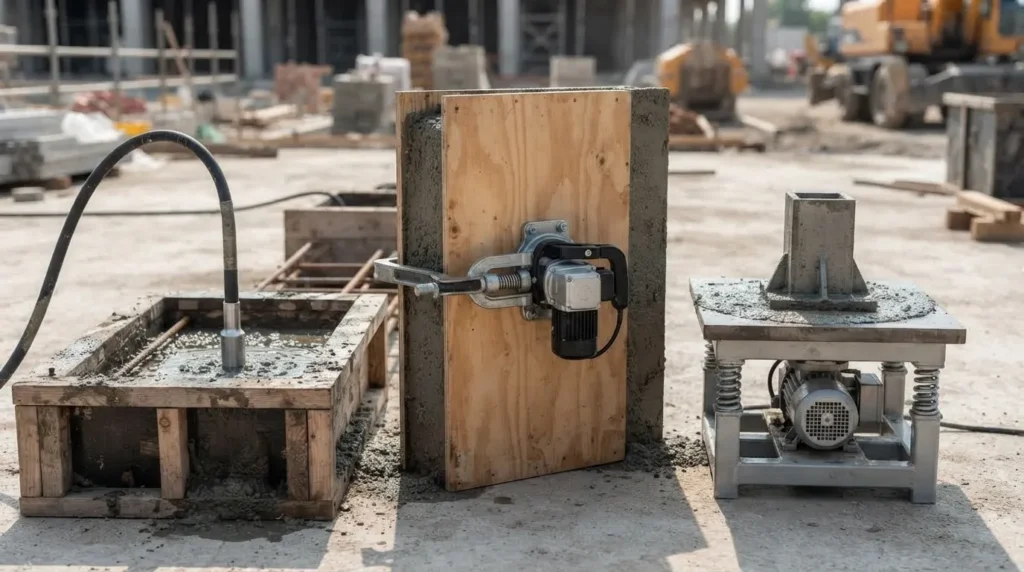

Understanding the different types of concrete vibrators is the first step to getting a strong, void-free pour — because not every vibrator suits every job. Freshly placed concrete traps air pockets and internal friction between cement aggregate particles as it settles into formwork. If that trapped air isn’t removed, the result is honeycombing, reduced concrete density, and a structure that’s weaker than its design strength.
Table of Contents
- What Are Concrete Vibrators and Why Compaction Matters
- Methods of Concrete Compaction (Manual vs Mechanical)
- Types of Concrete Vibrators
- Internal (Needle/Poker) Vibrators
- External (Formwork/Shutter) Vibrators
- Surface (Screed) Vibrators
- Vibrating Tables and Platform Vibrators
- Vibratory Rollers
- Power Source Options: Electric, Cordless, Gasoline and Pneumatic
- How to Choose the Right Vibrator for Your Project
- Vibration Force, Frequency and Amplitude Explained
- Operator Technique and Avoiding Over-Vibration
- Frequently Asked Questions
- Conclusion
What Are Concrete Vibrators and Why Compaction Matters
Vibration works by overcoming that internal friction, letting aggregate particles settle tightly together and forcing trapped air bubbles and voids to the surface. Get this step right and you get impermeable, durable concrete. Get it wrong — or use the wrong type of vibrator for the job — and you get segregation, weak surface finish, or exposed rebar.
Before diving into the types, it’s worth knowing the tool itself in more depth — our concrete vibrator guide covers general specs, usage, and pricing if you haven’t read it yet.
Worked example: A precast yard produces reinforced concrete beams with congested rebar cages. Using a standard large-diameter internal vibrator, the operator can’t get the poker between the bars. The result: visible voids along the beam faces once the formwork comes off. Switching to a smaller-diameter needle vibrator solves it — which is exactly the kind of decision this guide walks you through.
Methods of Concrete Compaction (Manual vs Mechanical)
Not every pour needs power equipment. Understanding both manual and mechanical compaction helps you know when a vibrator is actually necessary — and when it isn’t.
Manual Compaction (Hand Compaction)
Manual compaction relies on physical effort rather than machinery, and works only for small, unreinforced, low-slump pours:
- Rodding — repeatedly pushing a steel rod into the concrete to release trapped air
- Tamping — striking the surface with a tamping tool to settle aggregate
- Compaction by pressure and jolting — applying weight and controlled jolts to a mould
- Compaction by spinning — used mainly for small precast pipe sections, spinning the mould to force concrete outward by centrifugal force
These methods work for garden edging, small footings, and low-reinforcement DIY jobs. They fail on anything with rebar density, depth beyond 150mm, or a stiff concrete mix.
Mechanical Compaction by Vibration
Mechanical compaction is what real construction work requires, and it’s delivered through five main vibrator categories, covered next.
Types of Concrete Vibrators
Internal (Needle / Poker) Vibrators
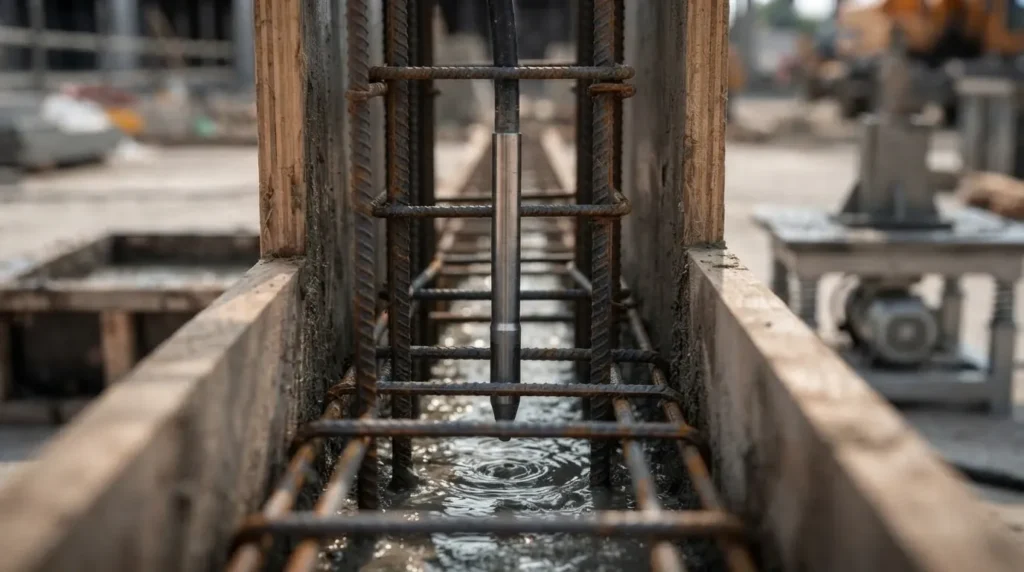
The internal vibrator — also called a needle vibrator, poker vibrator, or immersion vibrator — is the most widely used type on construction sites. It’s inserted directly into the freshly placed concrete, and the vibrating head transmits energy outward through the mix.
How internal vibrators work: An eccentric weight inside the vibrating head spins at high speed, generating vibration force that radiates through the wet concrete mix, breaking up trapped air pockets and letting aggregate particles settle into a dense, uniform structure.
Internal vibrators come in two mechanical styles:
- Flexible shaft type (external motor shaft style): Also called stick vibrators. The motor sits separately, connected to the vibrating head through a flexible tube or steel tube. This design is durable and easy to service, and it’s the standard choice for slabs, footings, and columns.
- Motor-in-hand / motor-in-head shaft style: The motor is built into the handle or directly into the head itself, with no flexible shaft. These are typically smaller and lighter, better suited for precast work and lab specimens than heavy structural pours.
Head size and concrete type considerations: Poker diameter should match the job. Thin sections and congested rebar need a slim head; thick, low-slump mixes need more diameter to push enough vibration force through the mass.
A pencil vibrator (a slim, small-diameter needle vibrator, sometimes under 25mm) exists specifically for this narrow-access problem — tight rebar cages, thin precast members, and laboratory test specimens where a standard poker simply won’t fit. If you’re regularly pouring congested reinforced concrete sections, this compact model handles it well: Pencil Vibrator on Amazon.
Worked example: A contractor pouring a reinforced concrete column with tightly spaced stirrups switches from a 50mm poker to a pencil vibrator. The slimmer head slides between the bars, eliminating the honeycombing that showed up on the previous column.
External (Formwork / Shutter) Vibrators
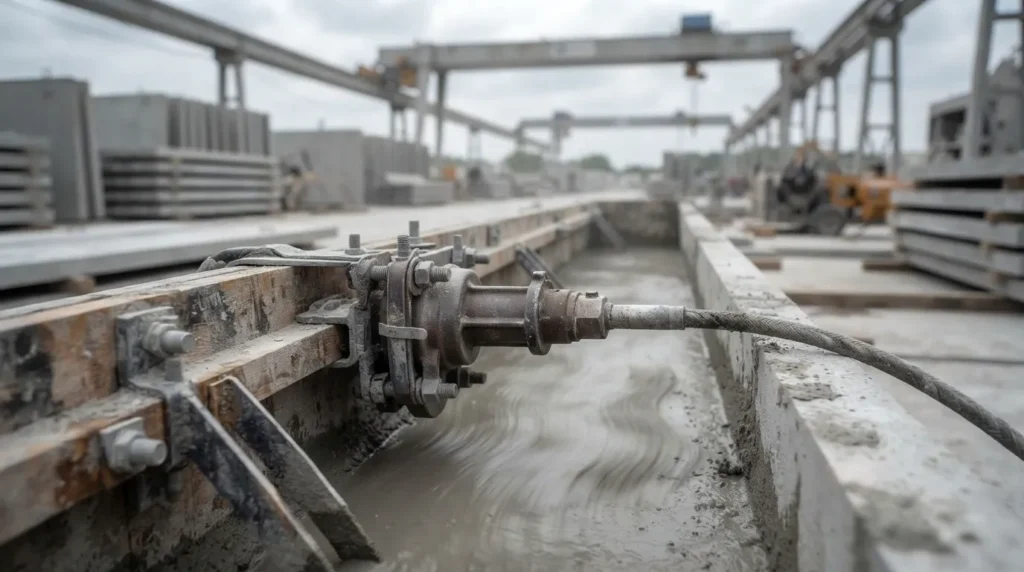
External vibrators — also called formwork vibrators or shutter form vibrators — don’t touch the concrete directly. Instead, they attach to the outside of the formwork and transmit vibration through the shutter itself into the mix.
How external vibrators work: The vibrator clamps onto the formwork panel. As it runs, vibration passes through the rigid shutter surface into the concrete behind it — useful where an internal poker can’t reach, such as very thin walls or heavily reinforced precast panels.
When to use external vibrators: Thin sections, precast concrete panels, tilt-up walls, and situations where rebar congestion makes internal vibration impossible or where surface finish quality on the formwork face is critical.
Two mounting types exist:
- Permanently mounted (bolt-on) vibrators: Fixed to the formwork for repeated, high-volume precast production.
- Moveable (quick-change bracket) vibrators: Attached via a quick-release bracket so one unit can move between multiple formwork sections on site.
Surface (Screed) Vibrators
A surface vibrator, also called a screed vibrator, works from the top of the concrete rather than inside or outside it. It’s dragged across the freshly poured surface, compacting a shallow top layer (typically up to 150–200mm deep) while also leveling it.
This is the standard tool for floor slabs, pavement, and road slabs, where a large flat surface needs even compaction and a level finish in one pass — internal pokers alone don’t achieve the flatness a screed vibrator delivers.
Vibrating Tables and Platform Vibrators
A vibrating table (also called a table vibrator or platform vibrator) is fixed equipment rather than a handheld tool. The mould — full of fresh concrete — sits directly on the vibrating platform, which shakes uniformly from below.
This is standard for precast structural members, concrete blocks, and laboratory specimens, where consistent, repeatable compaction across an entire batch matters more than manual technique. Pan vibrators are a smaller variant used specifically for compacting concrete test cubes and cylinders in laboratory settings.
Vibratory Rollers
A vibratory roller compacts large-area pavement and road slabs by driving over the surface, combining weight with vibration force. It’s not used for structural building work — it belongs almost exclusively to road construction and large paved-area projects.
Quick-Reference Table: Concrete Vibrator Types
| Vibrator Type | Contact Method | Best For | Typical Power Source |
|---|---|---|---|
| Internal (needle/poker) | Inserted into wet concrete | Slabs, footings, columns, walls | Electric, gasoline, cordless |
| Pencil vibrator | Inserted into wet concrete | Thin sections, congested rebar, lab specimens | Electric, cordless |
| External (formwork) | Mounted on formwork exterior | Thin precast panels, tilt-up walls | Electric, pneumatic, hydraulic |
| Surface (screed) | Dragged across top surface | Floor slabs, pavements, road slabs | Electric, gasoline |
| Vibrating table | Mould placed on platform | Precast blocks, pavers, lab cubes | Electric |
| Vibratory roller | Drives over surface | Roads, large paved areas | Diesel |
Power Source Options: Electric, Cordless, Gasoline and Pneumatic
The vibrator type tells you where it applies force; the power source tells you how it’s driven. This matters just as much for site planning.
Electric Concrete Vibrators
The electric motor is the default choice for internal vibrators on sites with mains power access. It’s quieter, needs less maintenance than combustion engines, and delivers consistent vibration frequency without fuel logistics. Most electric internal vibrators pair a flexible shaft with a motor unit that plugs directly into standard site power. A reliable electric internal vibrator is a solid default for most structural pours: Electric Concrete Vibrator on Amazon.
Cordless Concrete Vibrators
A cordless concrete vibrator runs on a rechargeable battery pack instead of a cable or fuel tank. It sacrifices some runtime and raw power compared to a corded electric unit, but the freedom from cables and generators makes it genuinely useful for smaller jobs, patchwork, and tight or awkward spaces where routing a cord isn’t practical. For DIY pours and small repair jobs, this is a convenient pick: Cordless Concrete Vibrator on Amazon.
Gasoline (Diesel) Engine Vibrators
Gasoline and diesel-engine vibrators remove the dependency on mains power entirely, making them the standard choice for remote sites and large foundation pours where no grid connection exists. Diesel is typically reserved for larger form vibrators and vibratory rollers rather than handheld pokers.
Compressed Air (Pneumatic) and Hydraulic Vibrators
Pneumatic vibrators run on compressed air rather than electricity or fuel, and are common as external form vibrators on precast production lines that already run compressed-air systems for other equipment. Hydraulic vibrators serve a similar niche, typically driven off an existing hydraulic power unit on larger precast or industrial sites.
How to Choose the Right Vibrator for Your Project
Matching vibrator type to project type prevents both wasted money and poor compaction.
Worked example — a mixed-use site: A contractor is pouring a reinforced concrete raft foundation (RCC raft), precast wall panels, and a driveway slab in the same week.
- For the RCC raft and footing: a standard internal vibrator with a mid-size poker handles the depth and volume.
- For the precast wall panels with congested rebar: an external formwork vibrator, or a pencil vibrator for the tightest sections.
- For the driveway slab: a surface/screed vibrator finishes and levels in one pass.
Using one “do everything” vibrator across all three jobs would either under-compact the panels or waste time on the driveway. Matching the tool to the section type is what actually separates efficient sites from ones with rework.
For congested formwork jobs, you’ll also often need to secure anchor points into cured or precast sections — our guide on types of anchor bolts for concrete is worth reading alongside this one if that’s part of your scope. And once the concrete has cured and you’re back on site drilling fixing points, what type of drill for concrete covers that next step.
If you’re still finalizing material quantities before any of this starts, run your numbers through the concrete bag calculator first.
Vibration Force, Frequency and Amplitude Explained
Two numbers determine how effectively a vibrator compacts concrete, and most buying guides skip explaining them.
- Frequency — how many vibrations occur per minute (measured in vpm or Hz). Higher frequency generally suits more fluid, self-consolidating concrete mixes.
- Amplitude — how far the vibrating head physically moves with each cycle. Higher amplitude delivers more vibration force outward, which matters more for stiff, low-slump concrete mixes that resist compaction.
Worked example: A stiff, low-slump mix used in a precast yard needs a vibrator with higher amplitude to force compaction through the mass. A self-consolidating concrete mix used for a thin decorative panel needs comparatively little vibration force — over-applying it here causes segregation rather than helping.
| Concrete Type | Recommended Vibration Profile |
|---|---|
| Self-consolidating concrete | Low amplitude, higher frequency |
| Standard slump structural concrete | Moderate amplitude and frequency |
| Stiff, low-slump precast mix | Higher amplitude |
| Thin sections / congested rebar | Slim head, moderate frequency, controlled amplitude |
Operator Technique and Avoiding Over-Vibration
The vibrator type is only half the equation — technique determines the actual result.
- Insert the vibrating head vertically and let it sink under its own weight rather than forcing it down.
- Hold each insertion point until trapped air bubbles stop surfacing — usually 5 to 15 seconds, depending on mix stiffness and vibration force.
- Withdraw slowly, at roughly the same speed as insertion, so the hole closes cleanly behind the head.
- Space insertion points based on the vibrator’s radius of influence — typically 300–500mm for standard internal pokers, less for pencil vibrators.
Over-vibration risks: Running the vibrator too long at one point causes segregation — heavier aggregate particles sink while cement paste and water rise to the surface, weakening the finished concrete and creating a weak, porous top layer. The visible cue is a glossy sheen with no more rising bubbles; that’s the signal to move on, not to keep going.
Frequently Asked Questions
What does a concrete vibrator do?
It removes trapped air pockets and voids from freshly placed concrete by transmitting vibration force through the mix, letting aggregate particles settle into a dense, uniform structure.
What are the main types of concrete vibrators?
Internal (needle/poker) vibrators, external (formwork) vibrators, surface (screed) vibrators, vibrating tables, and vibratory rollers — each suited to a different pour type.
How long should you vibrate concrete?
Roughly 5 to 15 seconds per insertion point, stopping once air bubbles stop surfacing and the surface develops a glossy sheen.
Can over-vibration damage concrete?
Yes. Extended vibration at one spot causes segregation, where aggregate sinks and cement paste rises, weakening the final structure and its surface finish.
What safety steps should you follow when using a vibrator?
Wear insulated gloves and eye protection, keep the vibrating head away from rebar and formwork edges, avoid running the motor dry (without the head inserted), and never let the flexible shaft kink sharply during use.
What’s the difference between an internal vibrator and a pencil vibrator?
A pencil vibrator is simply a slimmer, smaller-diameter internal vibrator, purpose-built for thin sections, congested rebar, and lab specimens where a standard poker doesn’t fit.
Conclusion
Picking the right type of concrete vibrator isn’t about buying the most powerful unit available — it’s about matching the tool to the section, the rebar density, and the mix stiffness in front of you. Internal vibrators handle most structural pours, external vibrators solve thin and congested formwork, surface vibrators finish slabs and pavements, and tables handle precast batches. Get that match right, and the compaction takes care of the rest.