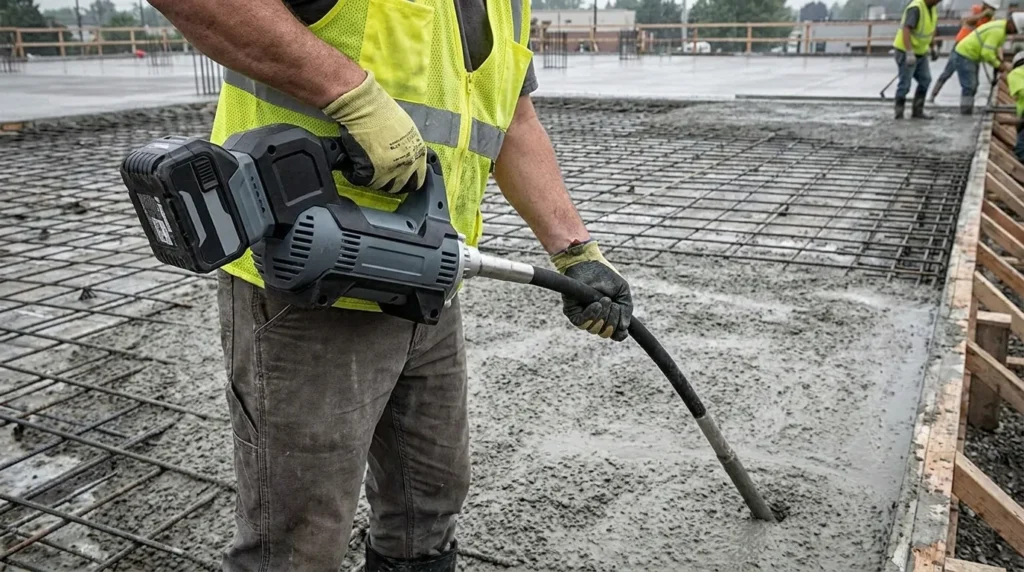

Ten years ago, the idea of a cordless concrete vibrator was a novelty — battery technology was not there yet, and the sustained power draw of high-frequency vibration drained packs too fast to be practical. That changed when DeWalt and Milwaukee both committed serious engineering resources to cordless concrete vibration. Today, both brands offer complete cordless vibrator systems that compete directly with corded electric units on every specification that matters.
The DeWalt concrete vibrator and Milwaukee concrete vibrator now sit at the top of every contractor’s shortlist when they are ready to invest in cordless vibration equipment. Both are genuinely excellent. Both integrate with battery ecosystems that most US contractors already own. And both are meaningfully different from each other in ways that matter depending on what kind of pours you do and which tool platform your crew is already running.
This guide is a direct, honest comparison — product range, specifications, performance, value, and the specific scenarios where each brand comes out ahead.
Before any pour, calculate your concrete volume accurately with the free concrete calculator at ConcreteCal. And if you are still deciding whether to buy or rent, our concrete vibrator rental guide covers the economics clearly.
Table of Contents
- Why DeWalt and Milwaukee Dominate the Cordless Vibrator Market
- DeWalt Concrete Vibrator — Full Product Range
- Milwaukee Concrete Vibrator — Full Product Range
- DeWalt vs Milwaukee — Head-to-Head Comparison
- Which Vibrator Is Right for Your Application?
- Concrete Vibrator Head and Shaft Selection Guide
- Corded vs Cordless — Is the Premium Worth It?
- Frequently Asked Questions
Why DeWalt and Milwaukee Dominate the Cordless Vibrator Market
The cordless concrete vibrator market looks different from the cordless drill or circular saw market. It is not a commodity — it is a professional tool bought by contractors who pour concrete regularly and need reliable equipment that works on a jobsite where power outlets may not be nearby, extension cord management is a safety hazard, and downtime costs real money.
The Shift from Corded to Cordless on Modern Jobsites
The practical advantages of cordless vibration are not subtle. No extension cord means no cord management, no tripping hazard, and no power quality issues from long cord runs reducing effective voltage at the motor. On a large slab pour where the vibration operator needs to move freely across a 10,000 sq ft area following the concrete placement team, cordless operation is simply faster and safer.
The argument against cordless has always been battery runtime and sustained power output. Both DeWalt and Milwaukee have addressed this — the battery technology in their current concrete vibrator systems delivers runtime adequate for commercial pours when used with the appropriate battery packs, and the sealed motor designs maintain consistent vibration performance through the battery discharge cycle.
Battery Ecosystem — The Real Buying Decision
Here is the honest truth about the DeWalt vs Milwaukee decision for most contractors: the battery platform you already own is the strongest single factor.
If your crew runs DeWalt 20V MAX tools across the board — drills, saws, lights, all on the same battery system — adding a DeWalt concrete vibrator means your existing batteries work, your existing chargers work, and your battery management system is already in place. The same logic applies to Milwaukee M18 and MX FUEL users.
Buying a vibrator from the other brand means buying into a second battery ecosystem — with its own chargers, its own battery packs, and its own management overhead. For most contractors, this is a significant practical consideration that outweighs most specification differences between the two brands.
DeWalt Concrete Vibrator — Full Product Range
DeWalt’s concrete vibrator range spans three distinct system architectures — the 20V MAX pencil vibrator for light to mid-duty work, the POWERSHIFT system for commercial applications, and the 18V XR platform for international markets.
DeWalt 20V MAX Pencil Vibrator
The DeWalt 20V MAX Pencil Vibrator (Tool Only) is the entry point into DeWalt’s cordless vibration ecosystem. It is designed for residential and light commercial applications — footings, columns, residential walls, and smaller slab sections.
Key specifications:
- Voltage: 20V MAX
- Power source: Cordless (battery not included in Tool Only version)
- Vibration head: Compatible with DeWalt 20V accessory heads
- Motor: Sealed, designed for concrete environment
- Warranty: Standard DeWalt warranty
What it does well: The pencil form factor is genuinely useful for tight access situations — between rebar, in narrow column forms, and in any pour where a standard vibrator body is awkward to position. The 20V MAX compatibility means it works with the same batteries as DeWalt’s core power tool range.
Limitation: The 20V system is optimised for light to mid-duty applications. For sustained commercial-volume vibration across a large pour, the POWERSHIFT system is the appropriate DeWalt choice.
Worked Example — Residential Foundation:
A contractor pouring a residential basement perimeter wall — 8 feet tall, 10 inches thick, standard rebar layout. The DeWalt 20V MAX pencil vibrator with 1.5-inch head and 7-foot shaft covers this application comfortably. Battery runtime on a standard 5.0Ah pack: sufficient for a typical residential pour with one battery change.
DeWalt POWERSHIFT Vibrator System
The POWERSHIFT system is DeWalt’s commercial-grade cordless vibration platform — a higher-voltage, higher-output system designed for sustained professional use on large pours.
POWERSHIFT head and shaft options:
| Configuration | Head Size | Shaft Length | Best Application |
|---|---|---|---|
| POWERSHIFT 2.25-in. Head, 7 ft. Shaft | 2.25 inches | 7 feet | Large commercial slabs |
| POWERSHIFT 2 in. Head, 16 ft. Shaft | 2 inches | 16 feet | Deep column pours |
| 1-3/4 in. Head, 16 ft. Shaft | 1.75 inches | 16 feet | Standard commercial walls |
| 1.75 in. Head, 21 ft. Shaft | 1.75 inches | 21 feet | Very deep pours |
| 1-1/2 in. Head, 40 ft. Shaft | 1.5 inches | 40 feet | Maximum depth applications |
The POWERSHIFT key advantage: The 40 ft shaft option is the longest available in any cordless vibrator system — it enables vibration at depths that were previously only achievable with corded or gasoline equipment. For bridge pier pours, tall column forms, and deep wall sections, this reach is a genuine differentiator.
Quick-change connection: POWERSHIFT uses a tool-free locking nut system that allows head and shaft changes without tools — relevant on larger pours where different sections may require different poker diameters.
DeWalt 18V XR Concrete Vibrator
The 18V XR Concrete Vibrator (Bare Tool) is DeWalt’s international platform — designed for markets where the 18V XR battery ecosystem is standard (primarily Europe, Australia, New Zealand, and other international markets where DeWalt’s 18V XR platform is the primary cordless system).
Specification similarities to 20V MAX: DeWalt’s 20V MAX and 18V XR platforms use the same battery cell technology — the voltage difference reflects measurement convention (no-load vs nominal) rather than actual performance difference. The 18V XR performs comparably to the 20V MAX in equivalent applications.
DeWalt Heads and Shafts — Size Options
DeWalt offers a complete head and shaft accessory range designed for use across their concrete vibrator platforms:
- 1-1/2 in. Vibrator Head With 40 ft. Shaft — maximum depth, residential to large commercial
- 1-3/4 in. Head, 16 ft. Shaft — standard commercial depth
- 1.75 in. Head, 21 ft. Shaft — extended commercial depth
- 2 in. Head, 16 ft. Shaft (POWERSHIFT) — large poker, commercial slab
- 2.25 in. Head, 7 ft. Shaft (POWERSHIFT) — large poker, shallow pours
The accessory system design means contractors can invest in a single DeWalt drive unit and expand their head/shaft range as project requirements dictate.
Milwaukee Concrete Vibrator — Full Product Range
Milwaukee’s approach to concrete vibration differs from DeWalt in one significant architectural decision: their flagship system uses the MX FUEL platform — a dedicated industrial-grade battery system separate from the M18 tool platform — rather than integrating with their mainstream cordless tools.
Milwaukee MX FUEL Backpack Concrete Vibrator
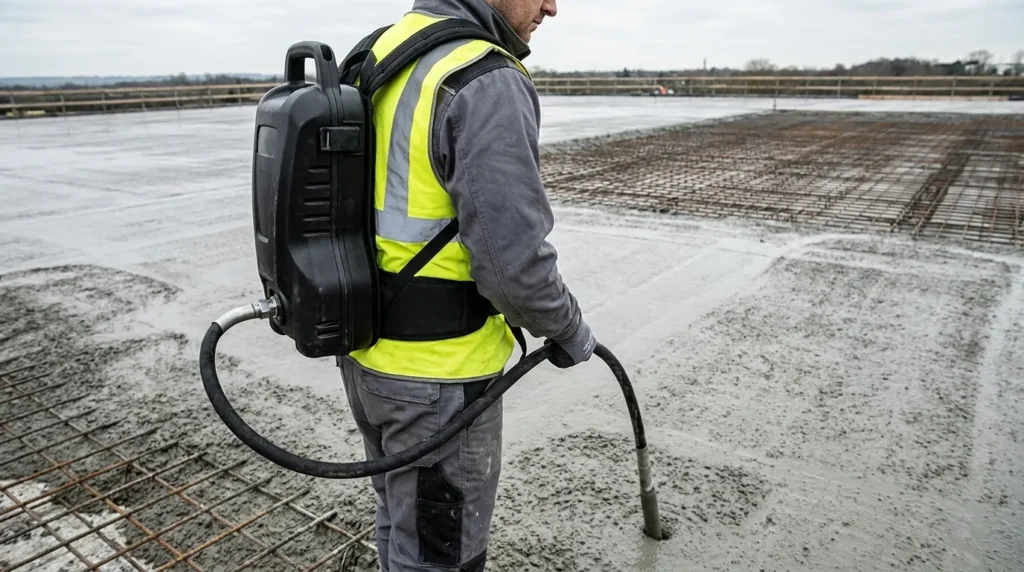
The MX FUEL Backpack Concrete Vibrator is Milwaukee’s headline concrete vibrator product — and it is genuinely different from anything DeWalt or any other brand offers in the cordless vibrator category.
The backpack architecture: Rather than a hand-held drive unit, the MX FUEL system uses a wearable backpack that contains the motor and battery system. The operator wears the power unit on their back while holding only the flexible shaft and vibrator head. This dramatically reduces the weight and fatigue of sustained vibration work — particularly relevant on large pours where the operator vibrates for 3–6 hours continuously.
Key MX FUEL specifications:
- Platform: MX FUEL (industrial, not M18)
- Motor: High-efficiency sealed motor in backpack unit
- Vibration frequency: 14,000 VPM (approximately 233 Hz)
- Compatible heads: Milwaukee concrete vibrator heads (multiple sizes)
- Power: MX FUEL battery pack
Why the backpack matters: On a large commercial pour — a 5,000 sq ft warehouse slab, a long bridge deck section — the vibration operator works continuously for hours. A hand-held drive unit adds weight and fatigue to every insertion. The backpack architecture redistributes that weight to the operator’s torso, significantly reducing arm and wrist fatigue over a long pour day. This is the strongest practical argument for the MX FUEL system over any hand-held cordless vibrator.
Worked Example — Large Commercial Slab:
A 10,000 sq ft warehouse floor pour. Operator uses Milwaukee MX FUEL Backpack system with 1.5-inch head and 16 ft shaft. Total vibration insertions: approximately 1,200 across the pour. Duration: 4 hours of active vibration. With a hand-held drive unit, operator fatigue from holding the motor would be significant by hour 2. The backpack system distributes weight across the back — operator arrives at hour 4 less fatigued, maintaining consistent vibration depth and dwell time through the complete pour.
Milwaukee Concrete Vibrator Heads — Size Options
Milwaukee offers a full range of interchangeable concrete vibrator heads compatible with their MX FUEL and M18 drive systems:
| Head Size | Radius of Action | Best Application |
|---|---|---|
| 1-1/4 inch | ~7.5 inches | Thin sections, tight rebar, decorative |
| 1-1/2 inch | ~9 inches | Residential slabs, columns, standard walls |
| 2 inch | ~12 inches | Commercial slabs, large columns |
Head construction: Milwaukee’s concrete vibrator heads use a rubber tip design on their standard heads — the rubber protects form surfaces from impact damage during insertion. The steel head option provides higher durability in abrasive concrete mixes but may mark timber or plastic form surfaces.
Eccentric mass design: Milwaukee’s head uses an eccentric mass that generates vibration force through rotation — a well-established mechanism that delivers high amplitude vibration with consistent force characteristics through the battery discharge cycle.
Milwaukee 18V Vibrator System
Milwaukee also offers a vibrator option within their M18 platform — the mainstream 18V cordless tool system that most Milwaukee-ecosystem contractors already run. This provides an entry point to Milwaukee vibration without the MX FUEL investment.
M18 vs MX FUEL trade-off: The M18 system is lighter and uses the same batteries as Milwaukee’s standard power tools — excellent for residential and light commercial work. The MX FUEL system provides higher sustained power output for extended professional use. For contractors already deep in the M18 ecosystem, the M18 vibrator is the logical starting point.
DeWalt vs Milwaukee Concrete Vibrator — Head-to-Head Comparison
Power and Vibration Performance
Both brands deliver adequate vibration frequency for standard concrete mixes. The meaningful differences emerge in sustained-load performance and in the specific applications each system handles best.
Vibration frequency:
- DeWalt POWERSHIFT: High-frequency output, consistent through battery discharge
- Milwaukee MX FUEL: 14,000 VPM (approximately 233 Hz), consistent through discharge
Both systems maintain consistent vibration performance through the battery discharge — this is important because frequency drop-off in cheaper cordless systems causes the last 20% of battery charge to consolidate concrete less effectively than the first 80%.
For stiff slump concrete mixes: High-amplitude vibration heads — available on both platforms — are required for low-slump structural concrete. Milwaukee’s 2-inch head provides strong amplitude for large commercial applications. DeWalt’s POWERSHIFT 2.25-inch head is the largest poker diameter available in any cordless system.
Head and Shaft Options
| Specification | DeWalt | Milwaukee |
|---|---|---|
| Smallest head | 1.5 inch | 1.25 inch |
| Largest head | 2.25 inch (POWERSHIFT) | 2 inch |
| Shortest shaft | 7 ft | Available options |
| Longest shaft | 40 ft | 16 ft (standard) |
| Head change | Tool-free locking nut | Standard connection |
DeWalt advantage: The 40 ft shaft option and the 2.25-inch large head — DeWalt offers more range at the extremes of both head size and shaft length. For very deep pours or applications requiring the largest poker diameter, DeWalt’s range is more comprehensive.
Milwaukee advantage: The 1.25-inch head is smaller than DeWalt’s smallest option — relevant for tight rebar spacing or thin decorative sections where even a 1.5-inch head is too large.
Battery System and Runtime
| Specification | DeWalt | Milwaukee |
|---|---|---|
| Light system voltage | 20V MAX | M18 (18V) |
| Heavy system | POWERSHIFT | MX FUEL |
| Mainstream tool compatibility | 20V MAX tools | M18 tools |
| Backpack option | No | Yes (MX FUEL) |
| Cross-platform batteries | 20V MAX compatible | M18 compatible (not MX FUEL) |
The critical practical point: MX FUEL batteries are NOT compatible with Milwaukee’s M18 tools. If you invest in the Milwaukee MX FUEL Backpack Vibrator, you are adding a separate battery system to your toolkit. DeWalt’s POWERSHIFT also uses dedicated batteries — neither brand’s heavy-duty vibrator system shares batteries with standard power tools.
For the standard (non-backpack) cordless vibrator using M18 or 20V MAX batteries, both systems do integrate with existing batteries — relevant for contractors in each ecosystem.
Price and Value
| System | Entry Price Range | Premium (Full Kit) |
|---|---|---|
| DeWalt 20V MAX (Tool Only) | $200–$350 | — |
| DeWalt POWERSHIFT | $400–$600 | $700–$900 with batteries |
| Milwaukee M18 Vibrator | $250–$400 | — |
| Milwaukee MX FUEL Backpack | $800–$1,200 | $1,400–$1,800 with batteries |
Value assessment:
- Light duty (residential): DeWalt 20V MAX and Milwaukee M18 are comparably priced. Choose based on existing battery ecosystem.
- Commercial: DeWalt POWERSHIFT offers more head/shaft range at a lower entry price than MX FUEL. Milwaukee MX FUEL’s backpack premium is justified for operators doing long continuous pours.
- Maximum capability: The Milwaukee MX FUEL Backpack is the most capable single cordless vibrator system available but at a significant price premium.
Which Concrete Vibrator Is Right for Your Application?
Residential and Light Commercial Use
Recommendation: DeWalt 20V MAX or Milwaukee M18 — whichever battery ecosystem you already own.
For residential footings, basement walls, driveway slabs, and small commercial pours, both systems perform comparably. The 1.5-inch head covers most residential applications. Runtime on standard battery packs is adequate for typical residential pour durations.
Worked Example — Residential Driveway:
A 640 sq ft residential driveway, 5 inches thick, approximately 10 cubic yards. Vibration time: approximately 45–60 minutes active insertion time. Either the DeWalt 20V MAX or Milwaukee M18 vibrator completes this pour comfortably on one or two battery packs.
Heavy Commercial and Infrastructure
Recommendation: Milwaukee MX FUEL Backpack for operators doing 4+ hour continuous pours. DeWalt POWERSHIFT for contractors who need maximum head and shaft range.
On large commercial pours — warehouse floors, parking structures, bridge decks — the Milwaukee backpack system’s fatigue reduction advantage becomes real and measurable. An operator who finishes a 5-hour pour day less fatigued makes fewer vibration errors in the final hours.
For maximum depth and maximum head diameter range, DeWalt POWERSHIFT with the 40 ft shaft or 2.25-inch head is unmatched in the cordless market.
Large Wall and Deep Column Pours
Recommendation: DeWalt POWERSHIFT with 21 ft or 40 ft shaft.
Column and wall pours that exceed 16 feet in depth require extended shaft reach. DeWalt’s 40 ft shaft option is the only cordless vibrator configuration that handles these depths. For columns up to approximately 30–35 feet tall — bridge piers, tall building columns — DeWalt POWERSHIFT is the cordless choice. Beyond 40 ft, a corded or gasoline unit is required.
Concrete Vibrator Head and Shaft Selection Guide
Head Size by Application
| Head Diameter | Radius of Action | Insertion Spacing | Recommended Application |
|---|---|---|---|
| 1.25 inch (32mm) | ~7.5 inches | ~15 inches | Tight rebar, thin sections, decorative |
| 1.5 inch (38mm) | ~9 inches | ~18 inches | Residential walls, columns, standard slabs |
| 1.75 inch (45mm) | ~10.5 inches | ~21 inches | Commercial slabs, standard commercial walls |
| 2 inch (50mm) | ~12 inches | ~24 inches | Large commercial, heavy structural elements |
| 2.25 inch (57mm) | ~13.5 inches | ~27 inches | Mass concrete, large commercial slabs |
Minimum clearance rule: Always maintain minimum 2–3 inches clearance between the poker head and any formwork face or reinforcement bar. Select the largest head that fits your rebar layout with adequate clearance.
Shaft Length by Pour Depth
| Pour Depth | Minimum Shaft Length | DeWalt Available | Milwaukee Available |
|---|---|---|---|
| Up to 4 ft | 7 ft | ✅ (7 ft POWERSHIFT) | ✅ |
| 4 to 12 ft | 16 ft | ✅ (16 ft options) | ✅ (16 ft) |
| 12 to 18 ft | 21 ft | ✅ (21 ft option) | ❌ Not standard |
| 18 to 36 ft | 40 ft | ✅ (40 ft POWERSHIFT) | ❌ Not available |
The shaft length calculation: The shaft must reach to within 6 inches of the pour bottom while allowing enough shaft length above the concrete surface for the operator to hold and control the unit. For a 12-ft wall pour, a minimum 16-ft shaft is required — 12 ft into the concrete plus 4 ft of operating clearance above the surface.
Corded vs Cordless — Is the Premium Worth It?
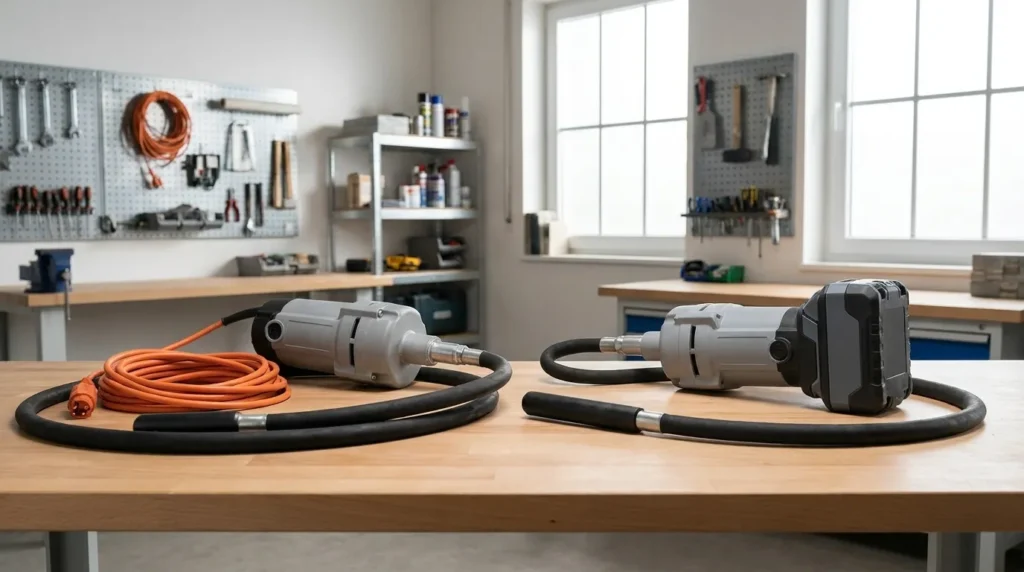
A professional-grade corded electric concrete vibrator costs $300–$600. The equivalent DeWalt or Milwaukee cordless system (with batteries) costs $600–$1,800. The cordless premium is real — and whether it is worth it depends entirely on how you use the equipment.
Cordless is worth the premium when:
- Your pour sites frequently lack accessible 240V power
- Cord management on large pours creates safety or efficiency problems
- Your crew is fully invested in DeWalt or Milwaukee battery ecosystems
- Operator fatigue on long pours is a measurable productivity issue
- You value the flexibility to use the equipment anywhere without power infrastructure
Cordless is not worth the premium when:
- You always have reliable 240V power at your pour sites
- Your pour volumes are small enough that cord management is not an issue
- Budget is the primary constraint and corded performance meets your needs
For a complete overview of all concrete vibrator types including corded, gasoline, and specialist high-frequency units, see our types of concrete vibrators guide. For brand comparison across the full global market including professional-grade Japanese and Korean brands, see our concrete vibrator manufacturer guide.
Frequently Asked Questions
What is the best DeWalt concrete vibrator?
For light to mid-duty residential work: the DeWalt 20V MAX Pencil Vibrator with a 1.5-inch head and 7 ft shaft. For commercial work requiring maximum range and depth: the DeWalt POWERSHIFT system with the 2.25-inch head and 40 ft shaft option — it offers the most extensive head and shaft range of any cordless vibrator system available. The DeWalt POWERSHIFT Concrete Vibrator kit is a well-reviewed starting point for contractors ready to invest in the full POWERSHIFT system.
Is Milwaukee or DeWalt better for concrete vibrators?
For operators doing long continuous pours (4+ hours), Milwaukee MX FUEL Backpack’s ergonomic advantage is real and measurable — the backpack architecture reduces arm and wrist fatigue significantly. For maximum shaft depth and head size range, DeWalt POWERSHIFT is more comprehensive. For battery ecosystem integration with existing tools, choose the brand you already run. Neither is universally superior — the right choice depends on your specific application.
What is the Milwaukee MX FUEL concrete vibrator?
The Milwaukee MX FUEL Backpack Concrete Vibrator is Milwaukee’s flagship concrete vibration system — the motor and battery unit is worn as a backpack, reducing hand-held weight to just the flexible shaft and poker head. It operates at 14,000 VPM (approximately 233 Hz) and is compatible with Milwaukee’s MX FUEL concrete vibrator heads in 1.25, 1.5, and 2-inch diameters. The MX FUEL platform uses dedicated batteries that are not cross-compatible with Milwaukee’s M18 tools.
What head size do I need for a concrete vibrator?
For most residential applications (footings, basement walls, driveways): 1.5-inch (38mm) head. For tight rebar or decorative thin sections: 1.25-inch (32mm). For large commercial slabs and heavy structural elements: 2-inch (50mm) or 2.25-inch (57mm). Select the largest head that maintains minimum 2-inch clearance from formwork faces and rebar on all sides.
How long does a cordless concrete vibrator battery last?
Runtime depends significantly on battery pack capacity and vibration frequency. On a standard 5.0Ah battery pack, the DeWalt 20V MAX system typically provides 30–60 minutes of active vibration — adequate for most residential pours with one or two battery changes. The Milwaukee MX FUEL system with its dedicated high-capacity pack provides longer runtime for extended commercial pours.
Can I use DeWalt 20V batteries with POWERSHIFT?
No — DeWalt’s POWERSHIFT system uses dedicated POWERSHIFT batteries that are not cross-compatible with the standard 20V MAX battery system. This is the same architecture as Milwaukee MX FUEL vs M18 — both brands use dedicated battery systems for their high-output concrete vibrator platforms.
What shaft length do I need for a 10-foot wall pour?
A 10-foot wall requires a minimum 16 ft shaft — the poker must reach the bottom of the pour (10 ft) plus approximately 4–6 ft of shaft length above the concrete surface for the operator to control the unit safely. Both DeWalt (16 ft shaft options) and Milwaukee (16 ft) cover this depth.
Is a cordless concrete vibrator as powerful as a corded one?
For standard concrete mixes at residential to light commercial volumes, yes — modern cordless systems from DeWalt and Milwaukee deliver comparable vibration frequency and amplitude to equivalent corded electric units. For sustained high-volume commercial pours in hot conditions, top-tier corded or gasoline units from professional brands like Mikasa can maintain rated frequency more consistently over very long operating periods.
Conclusion
The DeWalt vs Milwaukee concrete vibrator decision comes down to three factors: the battery ecosystem you already run, the pour scale you work at, and whether the Milwaukee backpack architecture’s ergonomic advantage is relevant to your workflow. For residential and light commercial work, choose the brand that matches your existing batteries — both perform well. For large commercial pours where operator fatigue matters, the Milwaukee MX FUEL Backpack is the most ergonomically sophisticated option in the cordless market. For maximum shaft depth and head size flexibility, DeWalt POWERSHIFT’s 40 ft shaft and 2.25-inch head range is unmatched. Calculate your pour volumes before specifying equipment with the ConcreteCal free concrete calculator — and if you are still deciding between buying and renting, our concrete vibrator rental guide covers that decision fully.