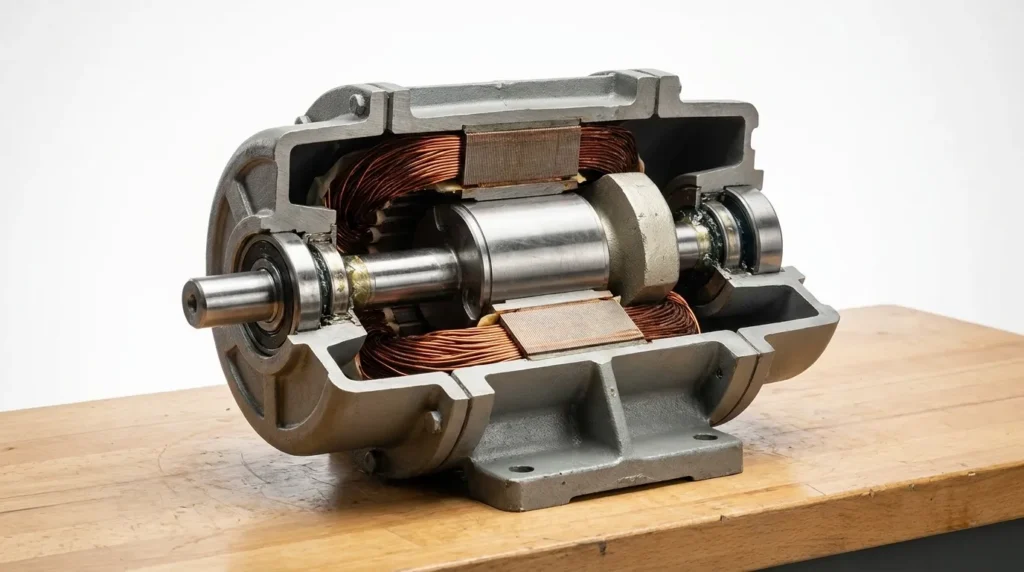

When a concrete vibrator stops performing — frequency drops, consolidation becomes inconsistent, the poker runs hot — the problem almost always originates in one component: the motor. The motor is the heart of every concrete vibrator. It converts electrical or pneumatic energy into the rotational force that drives the flexible shaft and creates the high-frequency vibration that consolidates fresh concrete.
Understanding the concrete vibration motor at the component level matters for three groups of people: contractors who maintain their own equipment and need to diagnose and replace motors, engineers specifying vibration equipment for specific pour conditions, and buyers comparing vibrator products who want to understand what the specifications on the label actually mean in practice.
This guide covers every type of concrete vibration motor — electric single-phase, three-phase, pneumatic, eccentric mass, and high-frequency — with a complete specification breakdown, a sizing guide, a comparison table, and a replacement walkthrough that tells you when and how to service the most critical component in your concrete vibration equipment.
For guidance on the complete vibrator system — not just the motor — our concrete vibrator guide covers everything from poker selection to vibration technique. For rental options before committing to equipment purchase, our concrete vibrator rental guide covers costs and availability.
Before any concrete pour, calculate your volume accurately with the free concrete calculator at ConcreteCal.
Table of Contents
- What Is a Concrete Vibration Motor and What Does It Do?
- Types of Concrete Vibration Motors
- Concrete Vibration Motor Specifications — What Each Number Means
- Concrete Vibration Motor Comparison Table
- Small Vibratory Motor vs Large Vibration Motor
- Pneumatic Vibratory Motor — When Air Power Makes Sense
- How to Read a Concrete Vibration Motor Spec Sheet
- Signs Your Concrete Vibration Motor Needs Replacement
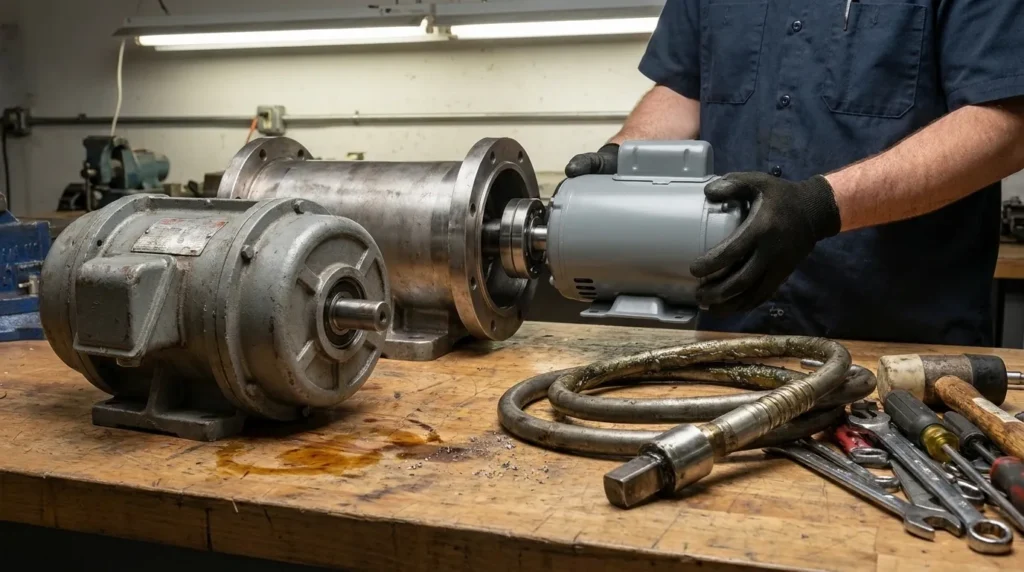
- Concrete Vibration Motor Replacement Guide
- Frequently Asked Questions
What Is a Concrete Vibration Motor and What Does It Do?
A concrete vibration motor is the power unit that generates the mechanical vibration transmitted through a flexible shaft to a poker head inserted in fresh concrete. Its job is to convert input energy — electricity or compressed air — into consistent, high-frequency rotational output that drives eccentric motion in the poker head.
How the Motor Creates Vibration
The vibration in a concrete vibrator is not created by the flexible shaft or the poker head — it is created by the motor. Two mechanisms are used depending on motor type:
Eccentric mass mechanism (most common): The motor drives a shaft with an offset weight — a mass that is not centred on the rotation axis. As this eccentric mass rotates at high speed, it generates a centrifugal force that rotates with the shaft. This rotating centrifugal force is what produces the characteristic circular vibration pattern in the poker head.
At 200 Hz (12,000 RPM): The eccentric mass completes 200 rotations per second, generating 200 vibration pulses per second in the surrounding concrete. This frequency is high enough to mobilise the concrete mix — temporarily reducing its viscosity and allowing aggregate and air bubbles to move through the paste. Air rises and exits through the surface; aggregate settles into a denser packing — eliminating voids and producing more uniform, stronger concrete.
High-frequency electromagnetic mechanism: Some specialist vibrators use electromagnets alternating at mains frequency (50 or 60 Hz) or higher electronic frequencies to generate vibration without rotating parts. These are used in precast and specialist applications where very high frequency or very precise frequency control is required.
Motor vs. Complete Vibrator — The Key Distinction
The motor is one component of a concrete vibrator system. A complete vibrator system includes:
| Component | Function |
|---|---|
| Motor (drive unit) | Generates rotational energy |
| Flexible shaft (hose) | Transmits rotation from motor to poker |
| Poker head | Converts rotation to vibration in concrete |
| Coupling connections | Links motor to shaft and shaft to poker |
When a vibrator underperforms, the motor is the most common root cause — but the flexible shaft (inner core failure) and the coupling connections (wear and looseness) are also frequent failure points. Diagnosing which component is failing before replacing the motor saves unnecessary cost.
The motor test: Disconnect the flexible shaft from the motor drive coupling. Run the motor briefly and observe the coupling speed and sound — a healthy motor runs smoothly at full speed with no irregular noise. A failing motor runs slowly, runs hot, produces grinding or humming noise, or fails to reach rated speed.
Types of Concrete Vibration Motors
Electric Vibration Motors (Single Phase)
Single-phase electric motors — operating on 220–240V, 50/60Hz household or construction site power — are the most common drive unit for portable concrete vibrators worldwide.
How they work: Single-phase AC motors use two windings (run and start) to create the rotating magnetic field that drives the rotor. The motor output shaft connects to the flexible shaft coupling, transmitting rotation at the rated motor speed.
Typical specifications:
- Voltage: 220–240V single phase
- Frequency: 50 or 60 Hz (depending on market)
- Power: 1,050W – 2,200W (1.4 HP – 3.0 HP)
- No-load speed: 12,000–18,000 RPM
- Weight: 3–8 kg depending on power rating
Key advantage: Universal availability — single-phase 220–240V power is the standard construction site supply in most markets. No special electrical infrastructure required.
Key limitation: Power factor and starting current — single-phase motors draw high starting current (typically 4–6× rated running current) which can trip circuit breakers on long extension cord runs or small generator supplies. Size the power supply for starting current, not running current.
Worked Example — Standard Job Site:
A contractor using a 1,600W single-phase electric vibrator motor on a standard 20A/240V circuit. Running current: approximately 7A. Starting current: approximately 35–40A — brief but sufficient to trip a 20A breaker if the circuit is also powering other loads at the same moment. Solution: dedicated 30A circuit for the vibrator, or start the vibrator with no other loads on the circuit.
Electric Vibration Motors (Three Phase)
Three-phase motors — requiring 380–415V three-phase industrial power — deliver higher efficiency, smoother operation, and better power factor than equivalent single-phase motors. They are standard in fixed concrete plant installations, precast factories, and large construction sites with three-phase power infrastructure.
Typical specifications:
- Voltage: 380–415V three phase
- Power: 2,200W – 5,500W+ (3.0 HP – 7.5 HP+)
- No-load speed: 12,000–20,000 RPM
- Efficiency: Higher than single-phase at equivalent power
Key advantage: At higher power levels (above 2.2 kW), three-phase motors are significantly more efficient and run cooler than single-phase alternatives. For continuous-duty applications in precast plants and large pours, three-phase is the preferred specification.
Key limitation: Requires three-phase power infrastructure — not available on most residential construction sites. Limited to commercial sites and permanent facilities.
Pneumatic Vibratory Motors
Pneumatic vibratory motors use compressed air rather than electricity to generate vibration — a turbine, piston, or ball mechanism driven by air pressure produces the rotational or oscillating output.
How they differ from electric: Instead of converting electrical energy to rotational force through electromagnetic induction, pneumatic motors convert compressed air pressure and flow into mechanical rotation. The air supply provides both the driving force and natural cooling — pneumatic motors can operate continuously without thermal overload, unlike electric motors which must be managed for heat.
Typical specifications:
- Operating pressure: 5–7 bar (70–100 PSI)
- Air consumption: 200–600 L/min depending on size
- Speed: Variable (controlled by air pressure and flow)
- Power: Equivalent to 0.5–3.0 kW electric depending on model
Applications: Covered in detail in the Pneumatic section below.
Eccentric Mass Vibration Motors
The eccentric mass vibrator motor is a specialist type — a compact motor unit with an integral offset weight that creates vibration through its own body rather than through a separate poker head. These are the motors used in vibrating tables, vibrating feeders, and external concrete vibrators (motors mounted on the outside of formwork to vibrate the form and concrete together).
How they work: The eccentric mass motor contains two shaft-mounted offset weights. When the motor spins, these weights generate centrifugal vibration force in the plane perpendicular to the shaft. The motor body itself vibrates — and transfers that vibration to whatever surface it is mounted on.
Key applications:
- Concrete vibrating tables for precast production (paving blocks, pipes, fence posts, tuff tiles)
- External formwork vibrators for wall panels and columns
- Compaction equipment for granular materials
- Industrial feeders and conveyors
Typical eccentric mass motor specifications:
| Parameter | Small Unit | Medium Unit | Large Unit |
|---|---|---|---|
| Power | 200–500W | 750–1,500W | 2,200–5,500W |
| Frequency | 50 Hz (3,000 RPM) | 50 Hz (3,000 RPM) | 50 Hz (1,500 RPM) |
| Centrifugal force | 100–500 N | 500–2,000 N | 2,000–10,000 N |
| Weight | 2–5 kg | 5–15 kg | 15–50 kg |
| IP Rating | IP54–IP65 | IP54–IP65 | IP54–IP66 |
Worked Example — Concrete Block Making:
A small concrete block production facility makes 500 paving blocks per day using a vibrating table. The table uses two synchronised eccentric mass vibration motors — one at each end of the table — producing combined centrifugal force of 800N at 3,000 RPM (50 Hz). The vibration consolidates the concrete mix in the block moulds within 8–15 seconds per batch, producing void-free, consistent blocks at production rates impractical with internal poker vibration.
High-Frequency Vibration Motors
High-frequency vibration motors — operating at 150–300 Hz rather than the standard 50/60 Hz mains frequency — are used in professional concrete vibrators where maximum consolidation efficiency is required.
How they achieve high frequency: High-frequency vibrators use an electronic inverter or converter to increase the frequency supplied to the motor above mains frequency. The motor itself is designed for the higher frequency — standard motors cannot operate at 200+ Hz without modification.
Why high frequency matters: At 200 Hz, the vibrator poker completes 200 vibration cycles per second — approximately 3× the cycle rate of a standard 50 Hz motor. This higher cycle rate mobilises concrete more effectively, particularly in stiff low-slump mixes where standard frequency vibration is less effective at moving aggregate and releasing air.
High-frequency drive options:
- High-frequency inverter: Electronic unit that converts standard mains supply to 150–300 Hz output for compatible vibrator motors
- High-frequency converter: Alternative to inverter with slightly different electronic architecture
- High-frequency engine generator: Gasoline-powered generator producing 150–300 Hz output for remote site use without grid power
Concrete Vibration Motor Specifications — What Each Number Means
Specifications on a concrete vibration motor spec sheet can be misleading if you do not know which numbers actually determine performance. Here is what each specification means in practice.
Input Power (Watts / HP)
Input power is the total electrical power the motor consumes — not the power delivered to the poker head. Motor efficiency determines how much of that input becomes useful mechanical output.
Typical efficiency: 70–85% for standard single-phase motors. A 1,600W input motor delivers approximately 1,120–1,360W of mechanical output — the rest becomes heat.
What this means practically: Higher wattage means more available vibration energy — but only if the motor efficiency is good. A 1,600W motor with 80% efficiency delivers more useful vibration than a 2,200W motor with 50% efficiency. Ask for efficiency data, not just rated wattage.
Common ratings and their applications:
| Input Power | HP Equivalent | Best Application |
|---|---|---|
| 1,050W | 1.4 HP | Light residential, 28–35mm poker |
| 1,100W | 1.5 HP | Standard residential, 35–38mm poker |
| 1,600W | 2.1 HP | Commercial, 38–50mm poker |
| 2,200W | 3.0 HP | Heavy commercial, 50–65mm poker |
| 4,000W+ | 5.5 HP+ | Industrial, large poker |
Vibration Frequency (Hz and VPM)
Frequency is the number of vibration cycles per second (Hz) or per minute (VPM). These are the same measurement expressed differently: 200 Hz = 12,000 VPM.
Standard vibration frequencies:
- 50–60 Hz (3,000–3,600 VPM): Standard mains-frequency external vibrators
- 150–200 Hz (9,000–12,000 VPM): Standard internal poker vibrators
- 200–300 Hz (12,000–18,000 VPM): High-frequency professional poker vibrators
The frequency stability question is more important than the rated frequency. A motor rated at 200 Hz that drops to 150 Hz under load in warm conditions is not a 200 Hz motor in practice. Thermal throttling — where the motor management system reduces speed to prevent overheating — is the primary cause of frequency instability in budget motors under sustained load.
Amplitude (mm)
Amplitude is the distance the poker tip moves in each vibration cycle — it determines the energy delivered to the concrete per cycle. Higher amplitude = more concrete moved per vibration cycle.
Typical amplitude ranges:
- 0.5–1.5mm: Standard internal poker vibrators
- 1.5–5mm: High-amplitude external vibrators
- 5–15mm: Large eccentric mass industrial vibrators
Amplitude × Frequency = total vibration energy: A high-frequency, low-amplitude motor can deliver equivalent concrete consolidation to a lower-frequency, higher-amplitude motor if the total energy product is equivalent. This is why specification comparison must consider both values, not either one in isolation.
Voltage and Phase Requirements
Always verify:
- Voltage: 110V, 220V, 240V, or 380–415V — must match site supply
- Phase: Single-phase or three-phase — different physical connection requirements
- Frequency: 50 Hz or 60 Hz — must match grid frequency (most modern motors tolerate both)
The 220V vs 240V question: These are effectively the same — 220V is the nominal voltage in many markets, 240V in others. Most motors rated for either will operate on both within the ±10% voltage tolerance standard in IEC standards.
Motor Weight and IP Rating
Weight affects operator fatigue for hand-held vibrators and installation requirements for fixed motor applications. Motor weight ranges from 2 kg (small portable) to 50+ kg (large industrial eccentric mass units).
IP Rating (Ingress Protection) defines how well the motor housing is sealed against dust and water:
| IP Rating | Dust Protection | Water Protection | Concrete Environment |
|---|---|---|---|
| IP44 | Partial | Splash proof | Minimum acceptable |
| IP54 | Dust protected | Splash proof | Standard for portable vibrators |
| IP65 | Dust tight | Water jet proof | Good for wet concrete environments |
| IP66 | Dust tight | Heavy water jet | Best for outdoor/wet applications |
| IP67 | Dust tight | Short immersion | Specialist applications |
For concrete vibrators: Minimum IP54 for any motor used in concrete construction — concrete dust and water spray are constant in the working environment. IP65 or higher is preferred for motors that may contact wet concrete directly.
Concrete Vibration Motor Comparison Table
| Motor Type | Power Range | Frequency | Best Application | Power Source | IP Rating |
|---|---|---|---|---|---|
| Single-phase electric | 1,050–2,200W | 150–200 Hz | Portable poker vibrators, most construction | 220–240V AC | IP54–IP65 |
| Three-phase electric | 2,200–5,500W+ | 150–200 Hz | Fixed plants, large commercial | 380–415V 3-phase | IP54–IP66 |
| Pneumatic | Variable | Variable | Hazardous areas, remote sites | Compressed air | IP65–IP67 |
| Eccentric mass | 200–5,500W | 50–100 Hz | Vibrating tables, external formwork | 220–415V AC | IP54–IP66 |
| High-frequency | 1,050–2,200W | 200–300 Hz | Low-slump, structural, precast | Via inverter/converter | IP54–IP65 |
| Cordless (lithium) | 18V–MX FUEL | 150–233 Hz | Remote sites, cordless operation | Battery | IP54 |
Small Vibratory Motor vs Large Vibration Motor
Small Vibratory Motors — Applications and Specs
Small vibratory motors — typically 100W to 750W, producing centrifugal forces from 50N to 500N — serve applications where the vibration source must be compact, lightweight, and often portable.
Common small vibratory motor applications:
- Concrete vibrating tables for small precast units (paving blocks, fence post bases, tuff tiles, decorative pieces)
- Internal poker vibrators for residential construction (28–38mm poker)
- Portable block-making equipment
- Small-scale precast production facilities
Typical small motor spec range:
- Power: 200–750W
- Voltage: 220–240V single phase
- Speed: 1,500–3,000 RPM (50–100 Hz at mains frequency)
- Centrifugal force: 50–500N
- Weight: 2–8 kg
- IP Rating: IP54–IP65
Worked Example — Paving Block Production:
A small-scale paving block maker produces 200 blocks per day using a 600W eccentric mass vibrating table motor. The motor generates 350N centrifugal force at 3,000 RPM. Vibration time per batch: 10–12 seconds. Motor duty cycle: approximately 30% (vibrating 12 seconds per 40-second production cycle). At 30% duty cycle, the 600W motor runs cool and reliably — lifetime expectancy 3–5 years at this duty level.
Large Vibration Motors — Applications and Specs
Large vibration motors — from 2,200W to 15,000W+, generating centrifugal forces from 2,000N to 50,000N+ — serve industrial and infrastructure concrete production applications.
Common large vibration motor applications:
- Large precast concrete production (bridge beams, railway sleepers, large pipes)
- External formwork vibrators for mass concrete walls and columns
- Industrial concrete mixing and compaction equipment
- Tunnel lining concrete consolidation
- Large infrastructure pours requiring external vibration
Typical large motor spec range:
- Power: 2,200–15,000W
- Voltage: 380–415V three phase
- Speed: 1,500–3,000 RPM
- Centrifugal force: 2,000–50,000N
- Weight: 15–100 kg
- IP Rating: IP55–IP66
Choosing the Right Size for Your Application
The sizing principle: Match motor power and centrifugal force to the volume of concrete that needs to be influenced per vibration cycle. Over-sizing wastes energy and can cause excessive concrete segregation. Under-sizing results in insufficient consolidation.
Rule of thumb for internal poker vibrators:
- 28–35mm poker: 1,050–1,100W motor
- 38–45mm poker: 1,100–1,600W motor
- 50mm poker: 1,600–2,200W motor
- 60mm+ poker: 2,200W+ motor
Rule of thumb for eccentric mass external vibrators:
- Vibrating table under 0.5 m²: 200–400W single motor
- Vibrating table 0.5–2 m²: 400–750W single or two-motor configuration
- Vibrating table over 2 m² or formwork panels: Two or more synchronised motors
Pneumatic Vibratory Motor — When Air Power Makes Sense
How Pneumatic Vibrators Work
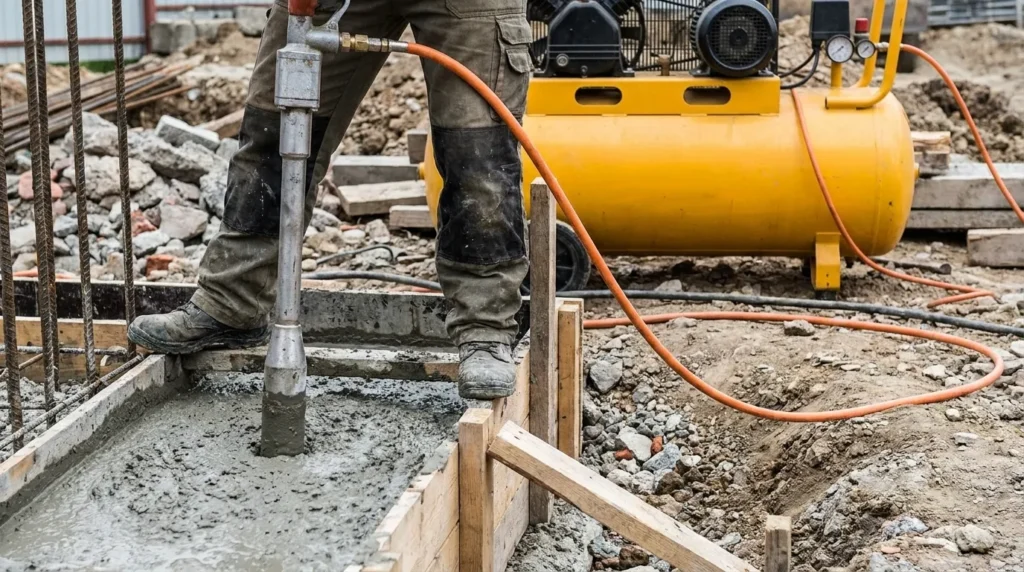
Pneumatic vibratory motors use compressed air to drive one of three internal mechanisms: a turbine (air directed through angled vanes creates rotation), a piston (air alternately pressurises each side of a piston), or a ball (air flow causes a ball to orbit within a chamber, creating vibration).
The operating requirements: Typically 5–7 bar (70–100 PSI) compressed air supply with air consumption of 200–600 litres per minute depending on motor size. A compressor rated for the continuous air demand of the vibrator is required — not just the peak pressure.
Speed control: Unlike electric motors which run at a fixed frequency determined by mains supply, pneumatic motors are speed-variable — increase air pressure and flow to increase vibration frequency. This variable control is useful in some precast applications where different concrete mixes need different vibration intensities.
Pneumatic vs Electric — The Honest Comparison
| Factor | Pneumatic Motor | Electric Motor |
|---|---|---|
| Overheating risk | Very low — air provides cooling | Moderate — thermal management critical |
| Hazardous areas (ATEX) | ✅ Safe — no electrical spark risk | ❌ Requires ATEX rating |
| Speed control | ✅ Variable (pressure/flow) | ❌ Fixed (mains frequency) |
| Infrastructure needed | Compressor + air lines | Power supply + cables |
| Running cost | Higher (compressor energy) | Lower (direct electrical) |
| Noise level | Higher | Lower |
| Cold weather performance | ❌ Moisture in lines can freeze | ✅ No freezing risk |
| Availability | Specialist | Universal |
Best Applications for Pneumatic Motors
ATEX and hazardous environments: Where flammable gases, vapours, or dusts are present — fuel storage construction, chemical plant concrete work, underground mining concrete — pneumatic motors are the safe choice. Electric motors in these environments require expensive ATEX-certified housings; pneumatic motors are inherently safe.
Remote sites with existing air infrastructure: Construction sites that already run pneumatic tools (jackhammers, drills, grinders) may find it practical to add a pneumatic vibrator to the air supply rather than running additional electrical infrastructure.
Continuous duty applications: Pneumatic motors can run continuously at full load without thermal throttling — the air supply provides constant cooling. For applications requiring uninterrupted vibration for extended periods, pneumatic avoids the duty cycle limitations of some electric motors.
How to Read a Concrete Vibration Motor Spec Sheet
Critical Specs to Verify Before Buying
When evaluating a concrete vibration motor spec sheet, these are the numbers that actually determine suitability for your application:
1. Rated power vs. input power: Some manufacturers list output power (what the motor delivers) while others list input power (what it consumes from the supply). For fair comparison, always use input power — or ask for both and calculate efficiency.
2. Duty cycle rating: Is the motor rated for continuous duty (S1) or intermittent duty (S3, S6)? A motor rated S3-40% (40% duty cycle) is not designed for continuous operation — it requires rest periods. Most portable concrete vibrators are rated for S1 (continuous) duty; verify this before purchasing a motor for sustained commercial use.
3. Insulation class: Motor winding insulation is rated by temperature tolerance:
- Class F (155°C): Standard for most construction equipment motors
- Class H (180°C): Better for high-ambient-temperature use
- Higher class = more thermal margin = longer motor life in hot conditions
4. No-load speed vs. under-load speed: Frequency drops under load in all motors. The rated speed is usually measured at no load. For concrete vibrators, the under-load speed (with the poker in concrete) is what determines actual vibration frequency at the point of use. Quality manufacturers publish both values; budget manufacturers publish only the more impressive no-load figure.
Red Flags in Motor Specifications
Suspiciously high power claims at low weight: A single-phase motor delivering genuine 2,200W output in a 3 kg housing is physically implausible — either the power figure is input power (at low efficiency), or the weight figure is inaccurate. Quality motors in the 2,200W range weigh 6–10 kg.
No IP rating listed: Any motor intended for use in a concrete environment should carry an IP rating. The absence of an IP rating means the motor has not been tested and certified for protection against dust and water — a serious concern for concrete equipment.
No insulation class listed: Reputable motor manufacturers always list insulation class. Its absence suggests either a budget winding specification or incomplete documentation.
Frequency listed in RPM only: Vibration frequency should be listed in Hz (or VPM for vibrators). A motor specification listing only RPM without conversion to vibration frequency makes comparison difficult — convert by dividing RPM by 60 to get Hz.
Signs Your Concrete Vibration Motor Needs Replacement
Performance Symptoms
Reduced frequency under load: If the vibrator runs at rated speed at no-load but slows noticeably when the poker is inserted in concrete, the motor has lost capacity — worn bearings, degraded windings, or thermal damage reducing output at rated load.
Overheating: A motor that becomes too hot to touch within 20–30 minutes of operation is either undersized for the application or has internal damage reducing its efficiency. Normal operating temperature for a quality motor in concrete work: warm to the touch (40–60°C above ambient) but not painful to hold.
Inconsistent vibration: If the poker vibration frequency changes during a pour — faster and slower without any operator input — the motor windings or bearings are failing. Inconsistent frequency produces inconsistent concrete consolidation quality.
Abnormal noise: Grinding, rattling, or squealing from the motor housing indicates bearing failure. Humming or buzzing at higher than normal volume indicates electrical issues with the windings or capacitor (single-phase motors).
Failure to reach operating speed: A motor that starts slowly and never reaches full speed has a failed start capacitor (single-phase) or damaged windings. This is repairable without full motor replacement in some cases.
Physical Inspection Points
Bearing inspection: Disconnect the flexible shaft. Rotate the motor drive coupling by hand. It should rotate smoothly with minimal resistance and no grinding sensation. Any roughness indicates bearing wear.
Winding inspection (external): Look into any ventilation openings — burnt or discoloured windings are visible as dark brown or black deposits on the copper. Burnt smell after operation is the most reliable early sign of winding degradation.
Capacitor inspection (single-phase motors): Single-phase motors use a start capacitor and sometimes a run capacitor. A bulging, leaking, or cracked capacitor is a common and easily replaced failure point — before condemning the motor, check and replace capacitors if they show any physical abnormality.
Coupling wear: Inspect the coupling between motor and flexible shaft. A loose or worn coupling loses energy to slippage rather than transmitting it to the poker — symptoms include reduced vibration frequency without motor fault and visible play in the coupling connection.
Concrete Vibration Motor Replacement Guide
DIY Replacement vs Professional Service
DIY replacement is appropriate when:
- The motor is a standard bolted assembly that separates cleanly from the vibrator housing
- Replacement motors are available from the manufacturer or a compatible supplier
- You have basic electrical competency and appropriate tools
- The replacement motor specification matches the original exactly
Professional service is required when:
- The motor is integral to the vibrator housing (common in some sealed cordless units)
- Electrical connections are non-standard or require calibration
- Warranty implications require factory-authorised service
- The failure mode is unclear and requires diagnostic testing
Motor Compatibility — What to Check
Before ordering a replacement motor, verify these specifications match your existing system exactly:
1. Frame size and mounting dimensions: The replacement motor must physically fit the vibrator housing. Take precise measurements — bolt pattern, shaft diameter, housing diameter, and motor length.
2. Shaft diameter and length: The motor output shaft must match the flexible shaft coupling. Common shaft diameters: 8mm, 10mm, 12mm — measure the original precisely.
3. Voltage and phase: Must exactly match — do not substitute a 380V three-phase motor for a 220V single-phase application.
4. Speed (RPM): Match the rated no-load speed of the original — a faster or slower motor changes the vibration frequency and may cause mechanical issues with an incompatible flexible shaft.
5. Rotation direction: Some motors are specified for clockwise or counter-clockwise rotation. Confirm the required rotation direction for your specific poker head design.
Worked Example — Motor Replacement on Commercial Vibrator:
A 1,600W commercial vibrator motor fails after 3 seasons of regular use — bearing noise and frequency instability. Diagnosis: bearing failure in the rotor assembly. Replacement motor specification required:
- Input power: 1,600W single phase
- Voltage: 220–240V, 50/60Hz
- No-load speed: 15,000 RPM (250 Hz)
- Shaft diameter: 10mm
- Frame: Standard 86mm OD housing
- IP Rating: IP54 minimum
- Insulation Class: F minimum
- Rotation: Clockwise (viewed from drive end)
A quality replacement motor for these specs costs approximately $80–$150 from a reputable supplier versus $300–$500 for a new complete vibrator unit — the motor replacement is clearly economical if the flexible shaft and poker head remain in good condition.
The replacement concrete vibrator motor available here is a well-specified option for contractors needing a direct replacement motor for standard portable concrete vibrator units — verify shaft diameter and mounting dimensions against your specific unit before ordering.
Frequently Asked Questions
What is a concrete vibration motor?
A concrete vibration motor is the drive unit that converts electrical or pneumatic energy into the high-frequency rotational output that powers a concrete vibrator. It drives the flexible shaft which transmits rotation to the poker head inserted in fresh concrete. Motor types include single-phase electric, three-phase electric, pneumatic, eccentric mass, and high-frequency variants — each suited to different applications.
What is the difference between a small vibratory motor and a large vibration motor?
Small vibratory motors (100–750W, 50–500N centrifugal force) are used in portable internal poker vibrators and small vibrating tables for residential and light commercial concrete work. Large vibration motors (2,200W+, 2,000N+ centrifugal force) are used in industrial precast production, external formwork vibrators, and infrastructure concrete applications requiring high vibration energy over large areas.
What is a pneumatic vibratory motor and when should I use one?
A pneumatic vibratory motor uses compressed air rather than electricity to generate vibration — making it intrinsically safe in hazardous environments where electrical spark risk is a concern (ATEX zones). Pneumatic motors are also used on sites with existing compressed air infrastructure and in continuous-duty applications where the air supply provides constant cooling. They are less common than electric motors due to the compressor infrastructure requirement and higher running cost.
What wattage motor do I need for a concrete vibrator?
Match motor power to poker diameter: 1,050–1,100W for 28–35mm poker, 1,100–1,600W for 38–45mm poker, 1,600–2,200W for 50mm poker, 2,200W+ for 60mm+ poker. Always choose input power ratings from reputable manufacturers with published efficiency data — two 1,600W motors with different efficiencies deliver significantly different actual vibration energy.
How do I know if my concrete vibration motor needs replacing?
Key signs: reduced vibration frequency under load (motor cannot maintain speed against the resistance of concrete), overheating within 20–30 minutes of operation, inconsistent vibration frequency during a pour, abnormal grinding or humming noise, or failure to reach operating speed. Before replacing the motor, inspect and test the start capacitor (single-phase motors) — capacitor failure is a common and inexpensive repair that mimics motor failure symptoms.
Can I replace a concrete vibrator motor myself?
For standard bolted-assembly vibrators where the motor is a discrete replaceable component — yes, with basic mechanical competency. Verify the replacement motor matches the original exactly in shaft diameter, mounting dimensions, voltage, speed, and rotation direction. For sealed cordless units or motors integral to the housing, professional service is typically required.
What IP rating should a concrete vibration motor have?
Minimum IP54 for any motor used in concrete construction — this rating protects against dust and water splash, both constant in concrete work environments. IP65 (dust tight, water jet resistant) is preferred for motors that regularly contact wet concrete or work in outdoor conditions. Never use a motor without an IP rating in concrete applications.
What is the difference between vibration frequency in Hz and VPM?
Hz (Hertz) measures cycles per second; VPM (vibrations per minute) measures cycles per minute. To convert: VPM ÷ 60 = Hz. Standard internal poker vibrators operate at 150–200 Hz (9,000–12,000 VPM). High-frequency vibrators operate at 200–300 Hz (12,000–18,000 VPM). The higher the frequency, the more vibration cycles per second and the more effective the consolidation in stiff concrete mixes.
Conclusion
The concrete vibration motor is not a commodity — it is the component that determines everything about your vibrator’s performance, durability, and total cost of ownership. Understand the type you need (single-phase for most portable applications, three-phase for fixed plant, pneumatic for hazardous areas, eccentric mass for vibrating tables), verify the critical specifications (input power, frequency stability under load, insulation class, IP rating), and replace proactively when performance symptoms appear rather than running to failure mid-pour. A well-specified, correctly maintained motor delivers years of reliable vibration. A budget motor running hot on every pour will cost more in replacements than the saving on the original purchase. Calculate your concrete volumes before every pour with the ConcreteCal free concrete calculator and see our concrete vibrator guide for the complete system picture beyond the motor component.