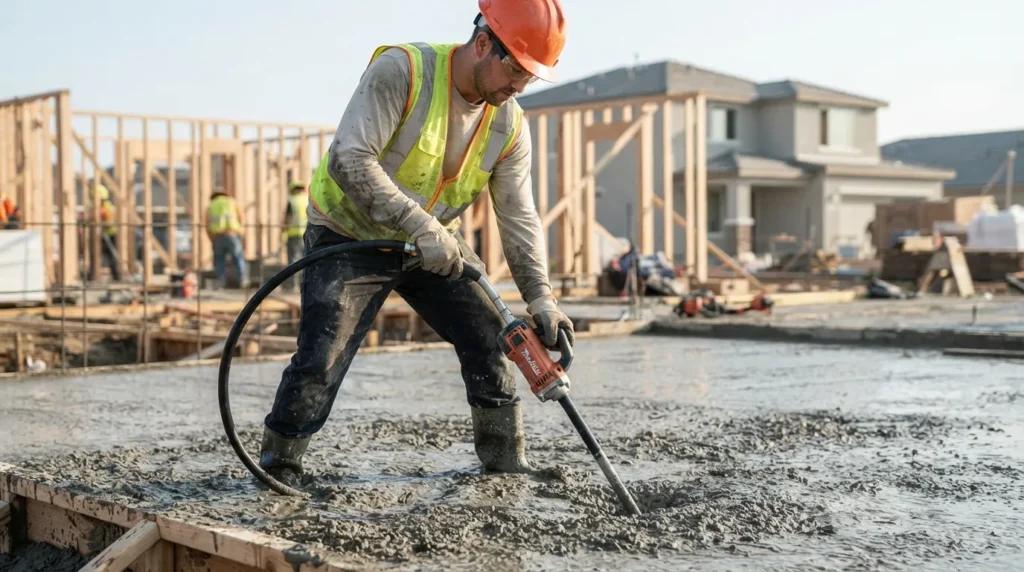

A concrete vibrator is a handheld construction tool that removes trapped air from fresh concrete as it’s poured. Wet concrete mixture naturally traps air bubbles and voids as it settles into formwork. Left unaddressed, those voids weaken the finished structure. A vibrator agitates the mix at high frequency, forcing the material to flow around reinforcement and fill every corner of the mould.
You’ll also see this equipment called a cement vibrator, concrete shaker, or concrete vibrating machine — same tool, different regional naming. Whatever the label, the job is identical: compaction.
Table of Content
- What Is a Concrete Vibrator?
- Types of Concrete Vibrators
- Concrete Vibrator Specifications Explained
- How to Use a Concrete Vibrator Correctly
- Best Use Cases for Concrete Vibrators
- Electric vs Gasoline vs Cordless Concrete Vibrators
- How to Choose the Right Concrete Vibrator
- Concrete Vibrator Price and Availability in Pakistan
- Frequently Asked Questions
- Conclusion
How Concrete Vibration Works
The core of the tool is a vibration motor connected to a poker (also called a vibrator shaft or vibration poker) via a flexible shaft or vibration hose. When switched on, an eccentric weight inside the poker spins rapidly, generating high-frequency vibration that radiates outward through the wet concrete.
Insert the poker vertically into the pour, hold it briefly, then withdraw slowly. Repeat at regular intervals across the slab, foundation, or column. The vibration frequency and amplitude determine how far the effect reaches — most industrial pokers influence concrete within a 300–500mm radius.
Why Compaction Matters
Without proper vibration, concrete strength and density suffer, and honeycombing (visible gaps and rock pockets) becomes visible once formwork is stripped. Consistent concrete compaction and consolidation directly affects:
- Long-term structural strength and load-bearing capacity
- Surface finish quality
- Resistance to water penetration and rebar corrosion
- Overall durability of slabs, walls, and columns
Worked example: A contractor pouring a 150mm-thick residential slab skips vibration to save time. Six months later, hairline surface cracking and a hollow sound when tapped reveal trapped air pockets near the rebar — a repair bill far higher than the vibrator would have cost.
Before any pour, it helps to know exactly how much material you’ll need. Run your numbers through the concrete bag calculator first — getting the mixture right is step one, and vibration is what makes that mixture actually perform as designed.
Types of Concrete Vibrators
Concrete vibrators are grouped by power source. Each type suits different job sizes and site conditions. A vibrator is just one entry in a much wider category of site equipment — if you’re building out a full toolkit rather than buying a single item, it’s worth reviewing the broader range of types of concrete tools before deciding what else you actually need.
Electric Concrete Vibrators
The most common choice for residential and mid-size commercial jobs. An electric concrete vibrator runs on standard mains power (typically 220–240V, 50/60Hz) and connects to the grid or a generator on site.
Electric motors are quieter, need less maintenance than combustion engines, and deliver consistent output. Common ratings include 1050W, 1100W, 1600W, and 2200W units, paired with 35mm or 50mm rod diameters depending on poker size. This combination of low input power and steady high-frequency vibration makes electric units the default pick for most home and small-commercial pours.
If you’d rather see a specific, ready-to-buy option instead of comparing specs from scratch, this is a reliable pick in this category: Electric Concrete Vibrator.
Gasoline (Petrol) Concrete Vibrators
A gasoline concrete vibrator uses a small petrol engine — commonly rated 4.0KW, 5.5HP, or 6.5HP — with recoil start, making it ideal for remote sites without electricity access. These units trade some portability for independence from power outlets, which matters on large foundation pours far from the grid.
Engine displacement and fuel tank size determine runtime here, not battery capacity or cable length, so gasoline units remain the go-to for continuous, all-day industrial use.
Cordless Concrete Vibrators
The newest category. A cordless concrete vibrator runs on a lithium-ion battery pack and charger instead of a cable or fuel tank. 20V cordless models are increasingly common for smaller jobs, patchwork, and DIY construction where dragging a hose or extension cord isn’t practical.
Battery-powered units sacrifice some runtime and raw power compared to electric or gasoline options, but the cordless operation is a genuine advantage for tight spaces, rooftop work, and quick top-up jobs where site power just isn’t available.
Concrete Vibration Tables
For precast work — concrete blocks, paver blocks, tuff tiles, and moulded concrete products — a vibration table is used instead of a handheld poker. The mould sits on the table, which vibrates uniformly from below, giving even compaction across an entire batch at once. This is standard equipment in block-making and paver production, not for on-site slab pours.
Concrete Vibrator Specifications Explained
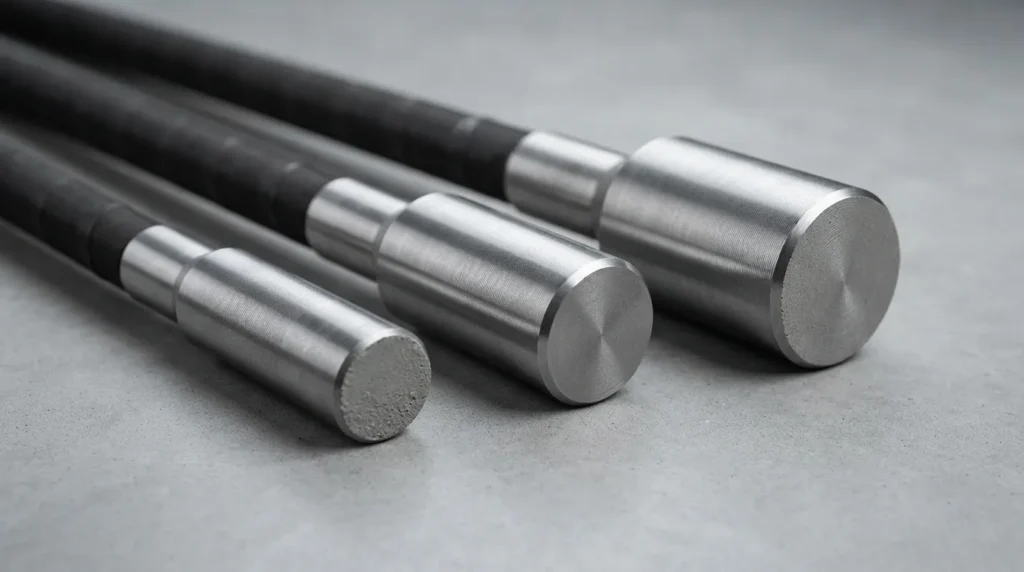
Reading a spec sheet correctly saves you from buying the wrong tool. Here’s what each figure actually tells you.
| Specification | What It Means | Typical Range |
|---|---|---|
| Rod / poker diameter | Width of the vibrating head inserted into concrete | 35mm – 60mm |
| Rod / shaft length | Reach of the flexible shaft into deep pours | 2m – 6m |
| Hose diameter | Width of the flexible vibration hose connecting motor to poker | Matches rod diameter |
| Input power | Electrical power drawn by the motor | 1050W – 2200W |
| Rated voltage | Operating voltage required | 220–240V |
| Frequency | Grid frequency compatibility | 50/60Hz |
| No-load speed | Vibrations per minute with no resistance | 8,000 – 16,000 rpm |
| Engine power (gasoline) | Combustion engine output | 4.0KW / 5.5HP / 6.5HP |
Worked example: For a standard residential slab with normal-slump concrete, a 35mm poker diameter with 1100W input power is usually sufficient. For dense, low-slump mixes or deep foundations, contractors typically step up to a 45mm or 50mm poker paired with higher input power for adequate vibration depth and coverage.
Note that rod diameter and shaft length aren’t interchangeable specs — a longer shaft gets the poker into deeper formwork, while a wider rod moves more concrete per insertion. Confusing the two is a common buying mistake.
How to Use a Concrete Vibrator Correctly
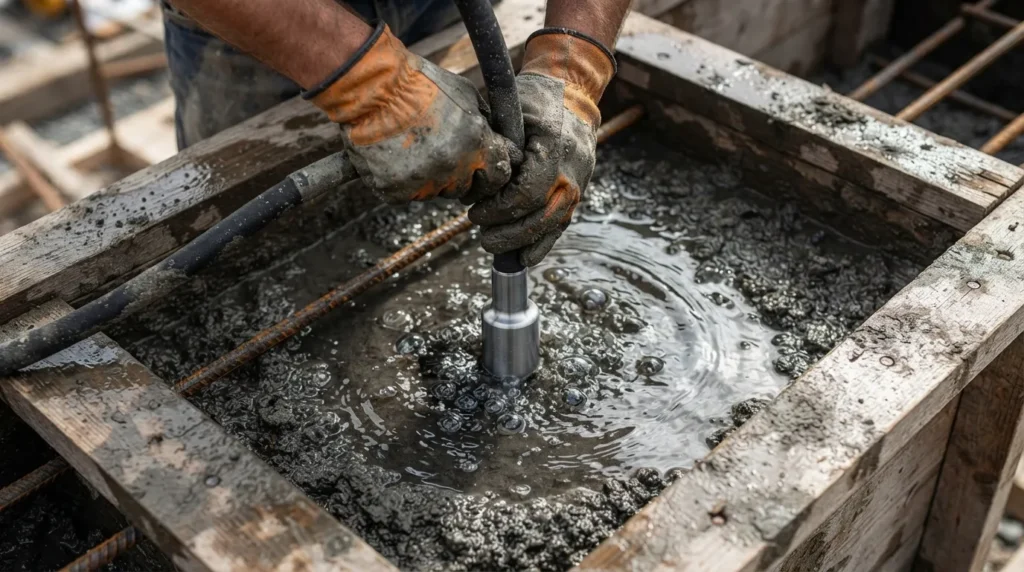
Technique matters as much as the tool itself.
Vibration Depth and Coverage
- Insert the poker vertically, not at an angle, so vibration spreads evenly in all directions.
- Push the poker into the previous layer by about 100mm when pouring in lifts, so the layers bond properly.
- Hold each insertion point for 5–15 seconds — long enough for air bubbles to stop rising, but not so long that the mix segregates.
- Withdraw slowly at the same rate you inserted, so the hole closes behind the poker instead of leaving a void.
- Space insertion points roughly 300–500mm apart, based on the poker’s effective radius.
Common Mistakes to Avoid
- Over-vibrating: causes segregation, where heavier aggregate sinks and cement paste rises, weakening the final structure.
- Dragging the poker sideways through the mix instead of lifting and reinserting — this pushes aggregate around rather than compacting it.
- Vibrating directly against rebar, anchor bolts, or formwork, which can dislodge fittings or damage the mould. If your pour involves embedded fasteners, it’s worth knowing the different types of anchor bolts for concrete beforehand, since vibration technique needs to adjust around them.
- Skipping the edges and corners of formwork, where air pockets concentrate the most.
Best Use Cases for Concrete Vibrators
Slabs, Foundations, Columns and Walls
Structural pours — concrete slabs, foundations, columns, and walls — need thorough internal vibration because reinforcement density makes air pockets more likely. Columns in particular require careful, methodical insertion since the narrow formwork traps air against the sides.
Concrete Blocks, Paver Blocks and Tuff Tiles
Precast concrete products rely on vibration tables rather than hand pokers, since block making and paver production run in high volume with standardized moulds. Uniform compaction here directly affects the compressive strength rating stamped on the finished block.
Construction Sites vs DIY Construction
Professional contractors on active construction sites typically invest in gasoline or higher-wattage electric units built for continuous daily use. DIY construction — a backyard slab, a small footing, a patio repair — is usually well served by a compact electric or cordless concrete vibrator, since the workload and runtime needed are far lower.
Worked example: A homeowner pouring a small footing for a boundary wall doesn’t need a 2200W industrial unit. A 1050W electric model with a 35mm poker gets the job done without unnecessary cost or weight.
Electric vs Gasoline vs Cordless Concrete Vibrators
| Factor | Electric | Gasoline | Cordless |
|---|---|---|---|
| Power source | Mains (220–240V) | Petrol engine | Lithium-ion battery |
| Best for | Mid-size jobs with power access | Remote sites, large pours | Small jobs, DIY, quick tasks |
| Runtime | Unlimited (while plugged in) | Limited by fuel tank | Limited by battery charge |
| Noise level | Low | Higher | Low |
| Maintenance | Minimal | Engine servicing required | Battery care, minimal |
| Portability | Limited by cable/generator | High (self-contained) | Highest |
| Typical rating | 1050W–2200W | 4.0KW / 5.5–6.5HP | 20V |
There’s no single “best” option — the right pick depends on site power access, job size, and how often the tool will actually be used.
How to Choose the Right Concrete Vibrator
Matching Power Source to Site Conditions
If your site has stable mains power, an electric concrete vibrator is usually the most cost-effective and low-maintenance choice. No grid access on a large pour? A gasoline concrete vibrator removes that dependency entirely.
Poker Diameter vs Concrete Mix
Thinner, more fluid mixes compact well with a smaller 35mm poker. Stiffer, low-slump mixes — common in precast and heavy structural work — need a larger 45mm–60mm poker diameter to transmit enough energy through the mass.
Durability and Maintenance Tips
Look for heavy-duty construction on the shaft coupling and hose, since this is the point of highest wear. High-efficiency motors that don’t overheat during extended runs are worth the extra cost if you’re using the tool daily rather than occasionally.
Building a Complete Toolkit
A vibrator solves compaction, but most jobs also need drilling into cured concrete afterward — for anchors, fixtures, or utility runs. If you’re stocking up rather than buying one tool at a time, it’s worth also checking what type of drill for concrete works best, since the two tools usually get used back-to-back on the same site.
For portable, small-job use where cord length or fuel access is a constraint, this is a solid option worth considering: Cordless Concrete Vibrator.
Concrete Vibrator Price and Availability in Pakistan
Prices for concrete machinery in Pakistan vary by power source and build quality. Entry-level electric units with 35mm pokers sit at the lower end of the market, while gasoline models with higher engine displacement and cordless lithium-ion units command a premium for their added flexibility.
Availability is strongest through construction equipment marketplaces and hardware retailers, with both new professional-grade units and used machinery from active construction sites in circulation.
Worked example: A small contracting business handling three concrete columns a month doesn’t need daily-use industrial durability — a mid-range electric vibrator amortizes faster than a heavier gasoline unit that mostly sits idle.
Frequently Asked Questions
What size concrete vibrator do I need for a residential slab?
A 35mm poker diameter with roughly 1100W input power handles most standard residential slabs and footings.
Can I use a concrete vibrator on paver blocks or tuff tiles?
Handheld pokers work for on-site slabs, but block making and paver production use dedicated vibration tables for uniform compaction across the mould.
Is a cordless concrete vibrator powerful enough for real work?
Cordless units suit small pours and DIY jobs well, but for continuous professional use, electric or gasoline models still deliver more consistent power and runtime.
How long should I vibrate concrete in one spot?
Roughly 5–15 seconds per insertion point — stop once bubbles stop surfacing and the surface takes on a glossy sheen.
What’s the difference between a concrete vibrator and a concrete shaker?
No functional difference — “concrete shaker” and “concrete vibrating machine” are just alternate regional names for the same tool.
Do I need a vibrator for a small DIY footing or patch?
For very small pours, careful tamping and rodding can substitute, but a compact electric or cordless vibrator still gives more consistent, air-free results with far less effort.
Conclusion
A concrete vibrator isn’t optional equipment for anything beyond the smallest patch job — it’s what separates a slab that lasts decades from one that cracks and honeycombs within its first year. Match the poker diameter and power source to your mix and site conditions, vibrate methodically rather than aggressively, and the concrete does the rest.