
Attaching anything to concrete — a handrail, a shelf bracket, an HVAC support, a structural railing — starts with one decision: which anchor to use. Choose wrong and the fastener pulls out under load, corrodes in a year, or cracks the concrete at the edge. Choose right and the connection outlasts the structure it’s attached to.
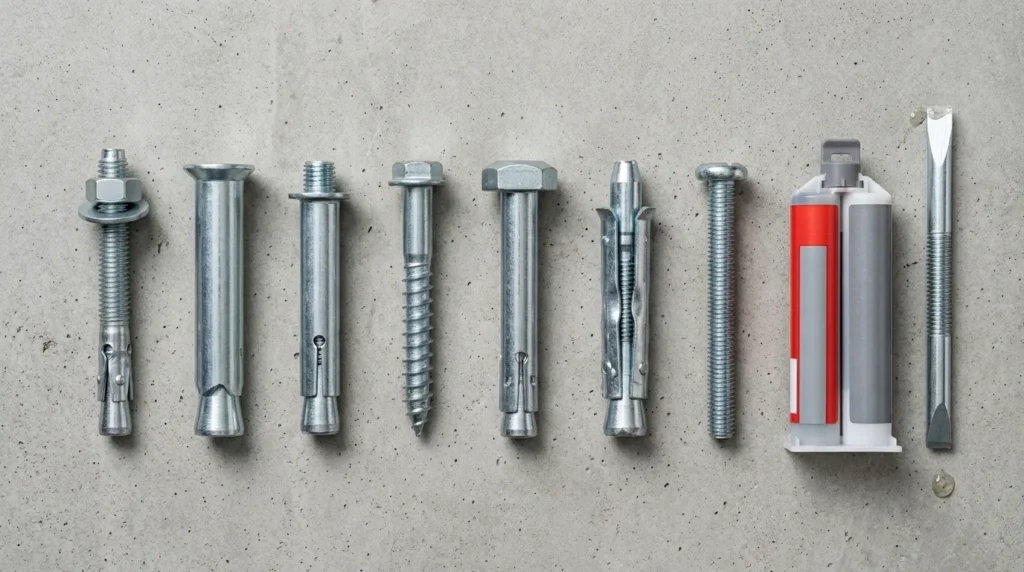
The types of concrete anchors available today range from simple hammer-drive pins for light-duty shelf brackets to large-diameter epoxy anchors for structural steel connections. Each type works through a different mechanism, suits different base materials, and has different load capacity, installation requirements, and cost.
This guide covers every major concrete anchor type — mechanical and adhesive — with a complete selection framework, load capacity reference tables, installation requirements, and a practical FAQ. Whether you’re a homeowner mounting a TV bracket or a contractor specifying anchors for a railing system, the right anchor for your application is in this guide.
Before calculating how much concrete you need for any anchored structure, use the free concrete calculator at ConcreteCal to get accurate volume and cost estimates.
Table of Contents
- What Are oncrete Anchors and How Do They Work?
- Complete List of Types of Concrete Anchors
- Mechanical Concrete Anchors
- Adhesive and Epoxy Concrete Anchors
- Anchor Bolt Materials and Corrosion Resistance
- How to Choose the Right Type of Concrete Anchor
- Concrete Anchor Installation Guide
- Common Concrete Anchor Applications
- Frequently Asked Questions
What Are Concrete Anchors and How Do They Work?
A concrete anchor is a fastener designed to transfer load from an attached fixture into a concrete, masonry, brick, or block substrate. The anchor creates a mechanical or chemical bond with the base material — allowing the attached structure to resist tensile loads (pulling away from the surface), shear loads (sliding parallel to the surface), or combined loading.
The fundamental challenge of anchoring into concrete is that concrete cannot be threaded like steel or wood. Every concrete anchor type solves this problem differently — through mechanical expansion, friction, keying, or chemical bonding.
Mechanical Anchors vs. Adhesive Anchors
Mechanical anchors work by physical interaction with the concrete — expansion against the borehole wall, friction, or mechanical interlock. They are installed quickly and reach working load immediately after installation.
Adhesive anchors bond the fastener to the concrete using epoxy, resin, or other chemical adhesive injected into the drilled hole. They offer higher load capacity, better performance in cracked concrete, and no expansion stress — but require cure time before loading.
| Factor | Mechanical | Adhesive |
|---|---|---|
| Installation speed | Fast | Slow (cure time) |
| Load capacity | Medium–High | High–Very High |
| Cracked concrete | Limited types | Most types suitable |
| Expansion stress | Yes | None |
| Edge distance sensitivity | High | Lower |
| Cost | Lower | Higher |
| Removability | Some types | Generally permanent |
Cracked vs. Uncracked Concrete — Why It Matters
Concrete in service often contains cracks — from shrinkage, loading, or thermal movement. An anchor installed in a crack behaves differently from one in uncracked concrete: the crack can open and close with load cycles, reducing the anchor’s ability to maintain expansion pressure.
Cracked concrete ratings are a formal ICC-ES (International Code Council Evaluation Service) certification — anchors rated for cracked concrete are tested specifically in pre-cracked specimens. For structural, seismic, or life-safety applications, always specify anchors with cracked concrete approval.
For general residential use in sound, uncracked concrete, standard anchors are adequate. For any safety-critical application — railings, overhead installations, seismic zones — cracked concrete rating is required.
Complete List of Types of Concrete Anchors
| Anchor Type | Mechanism | Load Rating | Best For |
|---|---|---|---|
| Wedge anchor | Expansion clip | High | Structural, heavy-duty |
| Sleeve anchor | Expansion sleeve | Medium–High | General purpose |
| Drop-in anchor | Internal expansion | Medium | Flush, removable |
| Strike anchor | Drive expansion | Low–Medium | Light fixtures |
| Hammer drive anchor | Drive nail | Low | Light-duty, quick |
| Concrete screw | Thread into concrete | Low–Medium | Light-duty, removable |
| Machine screw anchor | Internal thread | Medium | Threaded rod connections |
| Lag shield | Expansion lag | Medium | Wood-to-concrete |
| Double expansion | Dual expansion | Medium | Brick, block, weak concrete |
| Split drive | Drive anchor | Low | Light-duty masonry |
| Epoxy/adhesive | Chemical bond | Very High | Structural, rebar, threaded rod |
Mechanical Concrete Anchors
Mechanical anchors are the most widely used anchor category — fast to install, immediately loadable, and available for virtually every application from picture hooks to structural steel connections.
Wedge Anchors
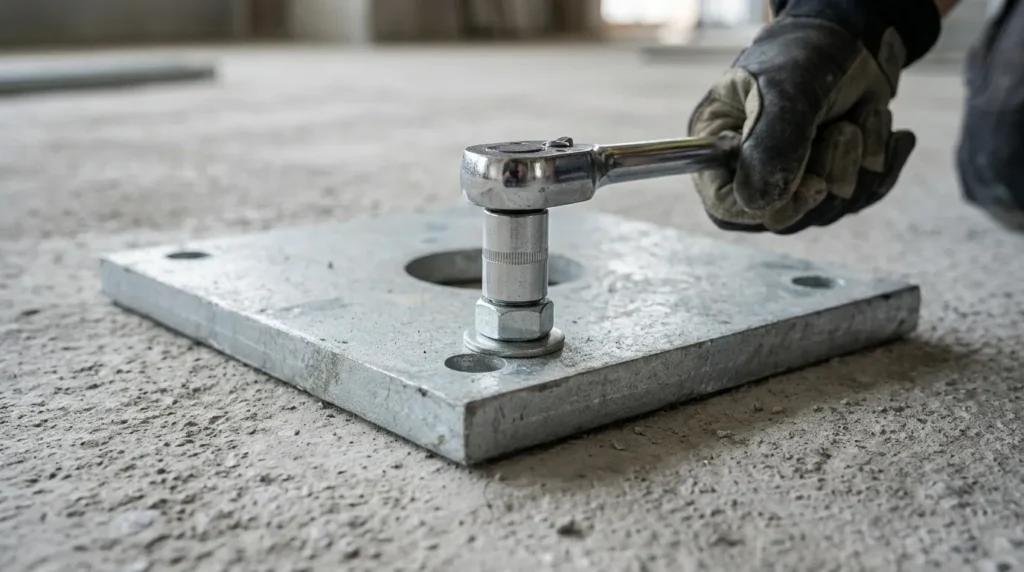
Wedge anchors are the workhorse of heavy-duty concrete fastening. A threaded bolt with a wedge-shaped clip at the bottom is driven into a pre-drilled hole — as the nut is tightened, the wedge expands against the borehole wall with enormous force.
How they work: The clip expands outward as the bolt is pulled upward by tightening the nut — the harder you pull, the harder it grips. This makes wedge anchors extremely reliable under sustained tensile load.
Specifications:
- Diameter range: 1/4 inch to 1-1/4 inch
- Embedment depth: typically 2.5 × diameter minimum
- Base material: uncracked concrete only (standard); cracked-rated versions available
- Removability: not removable — permanent installation
Worked Example: Mounting a steel equipment base to a concrete floor. Four 1/2-inch wedge anchors, 3.75-inch embedment, torqued to 50 ft-lbs. Each anchor develops approximately 6,000 lbs tensile capacity and 5,000 lbs shear capacity in 3,000 PSI concrete — providing a 4:1 safety factor for a 1,200-lb machine.
Sleeve Anchors
Sleeve anchors are the most versatile mechanical anchor — a bolt surrounded by an expansion sleeve that flares outward as the nut is tightened.
Advantages over wedge anchors:
- Work in concrete, brick, block, and stone
- Available with multiple head types (hex, flat, round, acorn)
- Easier to install in irregular substrates
- Slightly more forgiving of hole depth variation
Best for: General-purpose fastening where substrate varies — concrete block walls, brick, and standard concrete. Not the first choice for maximum structural load in solid concrete (wedge anchors outperform at equivalent diameter).
Drop-In Anchors
Drop-in anchors are internally threaded cylinders inserted into a drilled hole and expanded by driving a setting tool into the top. A threaded rod or bolt is then screwed into the anchor from above.
Key feature: The anchor sits flush with the concrete surface — nothing protrudes before the fixture is attached. This makes drop-in anchors ideal for applications where the anchor must be pre-set before the fixture arrives on site.
Common use: Suspended ceiling systems, pipe hangers, HVAC equipment — any application where threaded rod hangs downward from a concrete ceiling or slab soffit.
Installation requirement: A specific setting tool (matched to anchor diameter) is required — the tool is driven into the anchor with a hammer to expand the internal sleeve. Without the correct setting tool, the anchor is not properly expanded and will pull out.
Strike Anchors
Strike anchors are a variation of the drop-in concept — set by striking the center pin with a hammer rather than a setting tool. They’re faster to install than drop-ins but develop less expansion force.
Best for: Light-duty suspended installations — electrical conduit hangers, light pipe supports, shelf brackets on concrete ceilings.
Limitation: Lower load capacity than drop-in anchors of equivalent size. Not suitable for structural or safety-critical applications.
Hammer Drive Anchors
Hammer drive anchors (also called nail drive anchors) consist of a sleeve with a nail-like pin — the pin is driven flush with the sleeve by hammer, expanding the sleeve against the hole wall.
Installation: Drill hole, insert anchor, drive pin flush with hammer. No wrench, no setting tool.
Best for: Non-structural light-duty applications — attaching furring strips to concrete, securing electrical boxes, light conduit supports, and temporary fixings.
Load capacity: Low — typically 200–500 lbs shear for common sizes. Not for overhead or life-safety applications.
Concrete Screws (Tapcon Style)
Concrete screws cut their own threads directly into the concrete borehole wall — they work like wood screws but into concrete. No expansion component — the threaded engagement provides all load transfer.
Key advantages:
- Fully removable and reusable (within limits)
- No expansion stress — safe near edges and in thin concrete
- Fast installation — drill, blow, drive
- Available in hex head and flat head styles
Limitation: Lower load capacity than expansion anchors of equivalent diameter. Thread strips if over-torqued or if hole is too large. Not suitable for sustained high tensile loads.
Best for: Light-duty residential applications — door threshold attachment, window frame anchoring, electrical conduit clips, shelf standards.
Machine Screw Anchors
Machine screw anchors provide an internally threaded socket in concrete for machine bolt or threaded rod connections. The anchor is a split lead or zinc alloy shield that expands as the machine screw is tightened.
Best for: Light-duty applications requiring a specific machine screw thread — junction boxes, conduit fittings, equipment with pre-threaded bolt patterns.
Lag Shield Anchors
Lag shields are lead or zinc alloy expansion anchors designed specifically for lag screws — the large wood-screw-type fasteners used to connect wood members to concrete.
Application: Attaching wood sill plates to concrete foundations, mounting wood ledger boards to concrete walls, securing wood deck posts to concrete footings.
How they work: Drill hole, insert lag shield, drive lag screw into shield — the shield expands outward as the lag screw’s tapered threads advance.
Double Expansion Anchors
Double expansion anchors expand at two points along their length — providing better load distribution in weak, porous, or hollow base materials where single-point expansion would crush the substrate.
Best for: Hollow brick, lightweight block, soft stone, and any base material too weak to resist single-point expansion forces without crumbling.
Not suitable for: Solid concrete — overkill and higher cost than needed.
Split Drive Anchors
Split drive anchors are driven directly into a pre-drilled hole without any turning or setting — the split tip spreads as it contacts the bottom of the hole, gripping the sides.
Best for: Permanent, light-duty masonry attachments where speed is priority — securing base tracks, furring, and non-structural fixtures to block or brick.
Adhesive and Epoxy Concrete Anchors
Adhesive anchors bond the fastener chemically to the concrete — eliminating expansion stress entirely and providing the highest load capacities available for any anchor type.
Epoxy Anchors
Two-component epoxy adhesive is injected into a cleaned, drilled hole using a dispensing gun. The threaded rod or rebar is inserted and held in position until the epoxy cures. The result is a chemical bond between the rod and the concrete that distributes load over the full embedment length.
Load capacity: Significantly higher than mechanical anchors at equivalent diameter — a 1/2-inch epoxy anchor can develop 15,000–20,000 lbs tensile capacity with adequate embedment in 4,000 PSI concrete.
Critical installation requirements:
- Hole must be drilled with a carbide drill bit to correct diameter
- Hole must be cleaned — brush three times, blow three times — dust reduces bond strength by up to 50%
- Epoxy must be mixed correctly — initial dispense discarded until consistent color
- Rod inserted immediately after injection — no delay
- Cure time must be respected before loading — typically 24 hours at 70°F; longer at lower temperatures
Worked Example: Installing a structural steel column base plate to a concrete foundation. Four 3/4-inch threaded rods, 8-inch embedment, high-strength epoxy system. Each rod develops approximately 28,000 lbs tensile capacity — far exceeding what mechanical anchors could achieve at this diameter and embedment.
Resin Capsule Anchors
Resin capsules are pre-packaged glass or plastic capsules containing resin and hardener — inserted into the hole before the anchor rod. The rod is driven through the capsule with a rotary hammer, mixing the components and coating the rod simultaneously.
Advantage: No dispensing gun required — faster setup for single installations. Best for: Rebar doweling, post-installed rebar connections, remote locations without power tools for mixing.
When to Choose Adhesive Over Mechanical
| Situation | Choose Adhesive |
|---|---|
| High tensile load | ✅ |
| Close edge distance | ✅ (no expansion stress) |
| Cracked concrete | ✅ (most epoxy systems rated) |
| Seismic application | ✅ |
| Overhead installation with vibration | ✅ |
| Rebar connection / dowel | ✅ (only option) |
| Quick installation needed | ❌ Use mechanical |
| Temporary or removable fixing | ❌ Use mechanical |
| Low budget | ❌ Use mechanical |
Anchor Bolt Materials and Corrosion Resistance
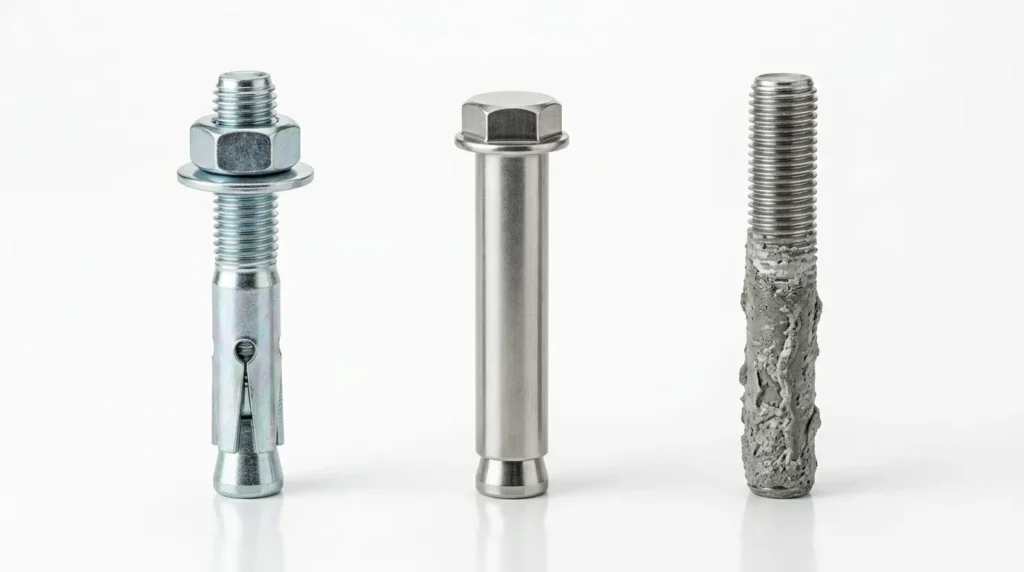
Anchor material determines service life, particularly in wet, coastal, or chemically aggressive environments.
| Material | Corrosion Resistance | Best Environment | Cost |
|---|---|---|---|
| Carbon steel (zinc-plated) | Low | Dry interior only | Lowest |
| Hot-dip galvanized | Medium | Exterior, mild exposure | Medium |
| Mechanically galvanized | Medium | Exterior, mild exposure | Medium |
| 304 Stainless steel | High | Exterior, moderate coastal | High |
| 316 Stainless steel | Very High | Marine, chemical exposure | Highest |
Key rule: Never use zinc-plated carbon steel anchors in exterior or wet applications — the zinc coating provides minimal protection and the anchor will rust and fail within a few years. For any exterior application, specify hot-dip galvanized or stainless steel minimum.
For coastal environments within 1 mile of saltwater, 316 stainless steel is the minimum specification — the chloride environment destroys 304 stainless and galvanized finishes over time.
According to the American Institute of Steel Construction (AISC), anchor bolt material specification is a critical design decision that must account for the service environment from the initial design phase — retrofitting corroded anchors in structural applications is significantly more costly than specifying correctly at the outset.
How to Choose the Right Type of Concrete Anchor
Load Type — Tensile vs. Shear
Tensile load pulls the anchor straight out of the concrete — overhead hangers, suspended equipment, uplift forces on structural connections.
Shear load pushes the anchor parallel to the concrete surface — railings, equipment bases, wall-mounted brackets.
Most anchors resist both, but their ratio of tensile-to-shear capacity varies significantly. Wedge anchors favor tensile; concrete screws favor shear. For combined loading, use the interaction formula specified in the anchor manufacturer’s technical data.
Base Material — Cracked or Uncracked
| Base Material | Recommended Anchor Types |
|---|---|
| Solid uncracked concrete | Wedge, sleeve, drop-in, epoxy |
| Cracked concrete | Cracked-rated mechanical or epoxy |
| Hollow concrete block | Sleeve, double expansion, epoxy (with screen tube) |
| Solid brick | Sleeve, double expansion, lag shield |
| Hollow brick | Double expansion, epoxy with screen tube |
| Stone | Sleeve, epoxy |
| Thin concrete (under 3″) | Concrete screw, adhesive only |
Application Quick-Selection Table
| Application | Recommended Anchor | Minimum Size |
|---|---|---|
| TV wall mount (concrete) | Concrete screw or sleeve | 3/16″ |
| Shelf bracket | Concrete screw or hammer drive | 3/16″ |
| Pipe hanger (ceiling) | Drop-in anchor | 1/4″ |
| HVAC equipment base | Wedge anchor | 1/2″ |
| Railing post base | Wedge or epoxy | 1/2″ |
| Structural steel base plate | Epoxy threaded rod | 3/4″+ |
| Handrail (life safety) | Epoxy or cracked-rated wedge | 1/2″ |
| Deck ledger to foundation | Lag shield + lag screw | 1/2″ |
| Rebar dowel / connection | Epoxy only | Per design |
Concrete Anchor Installation Guide
Drilling and Hole Preparation
Step 1 — Select the correct drill bit. Use a carbide-tipped masonry bit for standard concrete. For high-volume installation or hard aggregate concrete, use a SDS-plus or SDS-max carbide bit in a rotary hammer. Standard drill bits dull immediately in concrete and produce oversized, ragged holes.
Step 2 — Drill to correct diameter and depth. Hole diameter must match anchor diameter exactly — oversized holes reduce load capacity dramatically. Hole depth must meet the anchor’s minimum embedment requirement plus tolerance (typically add 1/2 inch beyond minimum embedment).
Step 3 — Clean the hole. For mechanical anchors: blow out dust with compressed air or a blow pump. For adhesive anchors: brush the hole three times (use a brush matching hole diameter), blow three times — repeat. Dust contamination is the primary cause of adhesive anchor failure.
Step 4 — Install anchor per manufacturer specification. Each anchor type has specific installation requirements — setting tool for drop-ins, torque value for wedge and sleeve anchors, mixing and cure procedure for adhesives. Deviation from the specification voids the load rating.
Setting and Torquing
Mechanical expansion anchors require a specified installation torque to develop full expansion and rated load capacity.
| Anchor Diameter | Typical Installation Torque |
|---|---|
| 1/4 inch | 3–5 ft-lbs |
| 3/8 inch | 10–15 ft-lbs |
| 1/2 inch | 25–35 ft-lbs |
| 5/8 inch | 45–60 ft-lbs |
| 3/4 inch | 80–110 ft-lbs |
| 1 inch | 150–200 ft-lbs |
Always verify torque values in the specific anchor manufacturer’s technical data — values vary by anchor type and material.
Use a calibrated torque wrench — not an impact driver — for final torque on structural anchors. Impact drivers cannot control torque and frequently over-torque anchors, cracking the concrete or stripping the anchor.
Common Concrete Anchor Applications
Railings and handrails: Life-safety applications — minimum 1/2-inch wedge anchors or epoxy system. Cracked concrete rating required for code compliance in most jurisdictions. Torque verification and inspection mandatory.
Pipe and conduit supports: Drop-in anchors or strike anchors in ceiling applications; sleeve or concrete screws in wall applications. Load typically low — 1/4-inch or 3/8-inch anchors adequate.
HVAC and mechanical equipment: Wedge anchors for equipment bases on concrete floors. Size per equipment weight and vibration loading — dynamic loads from vibrating equipment require larger safety factors than static loads.
Structural steel connections: Epoxy anchors with threaded rod for base plates, moment connections, and column bases. Engineer specification required — anchor diameter, embedment, epoxy type, and installation procedure all specified by the structural engineer of record.
Shelving and storage: Concrete screws or sleeve anchors — 3/16-inch or 1/4-inch adequate for most residential shelving. Do not use hammer drive anchors for overhead shelving with significant load.
Deck ledgers to concrete foundations: Lag shield anchors with lag screws, or through-bolts. International Residential Code (IRC) specifies ledger connection requirements — consult local building code for specific fastener requirements.
Frequently Asked Questions About Concrete Anchors
What are the types of concrete anchors?
The main types are wedge anchors, sleeve anchors, drop-in anchors, strike anchors, hammer drive anchors, concrete screws, machine screw anchors, lag shield anchors, double expansion anchors, split drive anchors, and adhesive/epoxy anchors. Each works through a different mechanism and suits different load requirements and base materials.
What is the strongest type of concrete anchor?
For pure tensile capacity, epoxy adhesive anchors with threaded rod are the strongest option — capable of developing 15,000–30,000+ lbs per anchor depending on rod diameter, embedment depth, and concrete strength. For mechanical anchors, large-diameter wedge anchors provide the highest tensile capacity in solid uncracked concrete.
What are the types of anchor bolts for concrete?
Anchor bolts for concrete include cast-in-place bolts (L-bolt, J-bolt, headed bolt — installed before pouring), post-installed mechanical anchors (wedge, sleeve), and post-installed adhesive anchors (epoxy threaded rod). Cast-in-place bolts offer the highest load capacity; post-installed adhesive anchors are the strongest post-installed option.
How do I choose the right concrete anchor?
Select based on: load type (tensile, shear, or combined), base material (solid concrete, block, brick), concrete condition (cracked or uncracked), embedment space available, edge distance, environment (interior or exterior), and whether the fixing is permanent or removable. Use the application selection table in this guide as a starting point.
Can concrete anchors be used in hollow block?
Standard expansion anchors should not be used in hollow block — the thin face shell crushes under expansion force. Use sleeve anchors (which distribute force over a longer length), double expansion anchors, or epoxy anchors with a screen tube that confines the adhesive within the hollow cavity.
How deep should concrete anchors be embedded?
Minimum embedment depth varies by anchor type and diameter. For wedge anchors, minimum embedment is typically 2.5 × anchor diameter. For epoxy anchors carrying structural loads, embedment of 10–20 × rod diameter is common. Always follow the anchor manufacturer’s minimum embedment specification — shallow embedment is the most common cause of anchor pull-out failure.
Do concrete anchors work in old concrete?
Yes, but with caveats. Old concrete may be lower strength than modern mixes, may contain cracks from long service life, and may have carbonated cover concrete (reduced pH near the surface). Test the concrete condition before specifying anchors for critical applications — if concrete crumbles during drilling or is visibly deteriorated, consult an engineer before anchoring structural loads.
Are concrete screws strong enough for structural use?
Concrete screws (Tapcon style) are not typically suitable for structural or life-safety applications — their load capacity is lower than expansion anchors of equivalent diameter, and the thread can strip if over-torqued or loaded beyond rating. For structural connections, specify wedge anchors or epoxy anchors per engineering design.
Conclusion
Every concrete anchoring application has a correct anchor type — and using the wrong one is not a minor inconvenience, it’s a failure waiting to happen. Match the anchor to the load type, base material, environment, and whether the concrete is cracked or uncracked. For light residential work, concrete screws and sleeve anchors cover most applications. For structural, overhead, or life-safety connections, specify wedge anchors or epoxy systems with the correct embedment and torque. Calculate your concrete project requirements accurately with the ConcreteCal free concrete calculator before starting any anchored installation.