
Here is the honest truth about concrete yardage calculation: the math is simple. Addition, multiplication, and division. What makes it confusing is that every project shape uses a slightly different formula, and one wrong unit conversion turns a correct formula into a completely wrong answer.
Knowing how to calculate yards of concrete for your specific project — whether it is a flat slab, a round footing, a set of stairs, or a curb and gutter section — is the difference between ordering correctly and either running short mid-pour or paying for concrete you cannot use.
This guide covers every major project shape with its specific formula, worked examples you can replicate directly, and a waste factor section that explains exactly why you should always order more than the formula says.
Once you have your yardage calculated, plug your dimensions into our free concrete calculator for an instant cross-check — and see our concrete bag yield guide if you need to convert yards to bags.
Table of Contents
- What Is a Cubic Yard of Concrete?
- The Core Formula — How to Calculate Yards of Concrete
- How to Calculate Concrete Yardage for Slabs and Walls
- How to Calculate Concrete Yards for Footings
- How to Calculate Concrete for Circular Slabs and Tubes
- How to Calculate Concrete Yards for Stairs
- How to Calculate Concrete for Curb and Gutter
- Concrete Yardage Quick Reference Tables
- How to Calculate Concrete Cost from Yardage
- Common Concrete Yardage Calculation Mistakes
- Frequently Asked Questions
What Is a Cubic Yard of Concrete and Why Does It Matter?
A cubic yard is the standard unit for ordering ready mix concrete in the United States. Every price quote you receive from a concrete supplier will be in dollars per cubic yard. Every ready mix truck is sized in cubic yards — a standard truck holds 8–10 cubic yards. Every short-load fee threshold is measured in cubic yards.
Understanding what a cubic yard actually is helps you visualize your pour before you calculate it.
How Many Cubic Feet in a Yard of Concrete?
One cubic yard = 27 cubic feet. This is the single most important number in concrete calculation — everything converts through it.
1 cubic yard = 27 cubic feet = 0.7646 cubic meters
Visualize it this way: a cube that is 3 feet on every side. Three feet wide, three feet deep, three feet tall. That is one cubic yard of concrete — and it weighs approximately 4,050 pounds (just over 2 tons).
At 4 inches thick, one cubic yard of concrete covers approximately 81 square feet of slab area. At 6 inches thick, one cubic yard covers approximately 54 square feet. At 8 inches thick, one cubic yard covers approximately 40 square feet.
These coverage figures are worth knowing — they give you a quick sanity check before you start the full calculation.
How Concrete Is Sold and Ordered
Ready mix concrete is ordered by the cubic yard from a batch plant. You call with your yardage, PSI specification, and pour date. The plant dispatches a truck — or multiple trucks for large orders.
Most plants have a minimum order (typically 1 yard) and a short-load fee for orders under 3–4 yards. This fee — $50 to $150 depending on the plant — compensates them for dispatching a truck that is only partially filled. If your project is just under the minimum, it sometimes makes sense to slightly increase your slab dimensions to push over the threshold.
Bagged concrete (premix) is sold by bag weight — 40, 60, or 80 pounds. Each bag produces a fixed volume: 0.30, 0.45, or 0.60 cubic feet respectively. For volumes under 1 cubic yard, bagged concrete is often the more practical and economical choice. Our concrete bag yield guide covers the bags-to-yards conversion in detail.
The Core Formula — How to Calculate Yards of Concrete
Every concrete volume calculation — regardless of shape — starts with the same three steps:
Step 1 — Convert All Dimensions to Feet
The formula requires consistent units. Length, width, and thickness must all be in feet before you multiply.
Thickness is almost always given in inches — convert by dividing by 12:
| Thickness | In Feet |
|---|---|
| 3 inches | 0.250 ft |
| 3.5 inches | 0.292 ft |
| 4 inches | 0.333 ft |
| 5 inches | 0.417 ft |
| 6 inches | 0.500 ft |
| 8 inches | 0.667 ft |
| 10 inches | 0.833 ft |
| 12 inches | 1.000 ft |
Step 2 — Multiply for Cubic Feet
Volume (ft³) = Length (ft) × Width (ft) × Thickness (ft)
Step 3 — Divide by 27 for Cubic Yards
Volume (yd³) = Cubic Feet ÷ 27
Step 4 — Add the Waste Factor
Order quantity = Volume (yd³) × 1.10 (for standard 10% waste)
Never order the exact calculated volume. Subgrade irregularities, form edge overfill, spillage during placement, and minor measurement errors all consume extra concrete. The 10% waste factor is a professional standard — not a conservative overestimate.
Full Worked Example — Before Any Specific Shape: A 10 ft × 10 ft area, 4 inches thick:
Volume: 10 × 10 × 0.333 = 33.3 ft³ Cubic yards: 33.3 ÷ 27 = 1.23 yd³ With 10% waste: 1.23 × 1.10 = 1.35 yd³ → order 1.5 yards
How to Calculate Concrete Yardage for Slabs and Walls
Slabs and walls share the same rectangular volume formula — they differ only in orientation and typical dimensions.
Rectangular Slabs and Floors
A concrete slab is the most common residential application. The formula:
Volume (yd³) = [Length (ft) × Width (ft) × Thickness (ft)] ÷ 27
Standard residential slab thicknesses:
| Application | Standard Thickness |
|---|---|
| Sidewalk / garden path | 3.5–4 inches |
| Patio slab | 4 inches |
| Residential driveway | 4–5 inches |
| Garage floor | 4–5 inches |
| Pool deck | 4 inches |
| Foundation slab | 4–6 inches |
| Commercial floor | 5–6 inches |
Worked Example — 2-Car Garage Floor: A garage floor measuring 24 ft × 24 ft, 5 inches thick.
Volume: 24 × 24 × 0.417 = 240.2 ft³ Cubic yards: 240.2 ÷ 27 = 8.90 yd³ With 10% waste: 8.90 × 1.10 = 9.79 → order 10 yards
This is a straightforward calculation — but notice how the 10% waste adds almost a full yard. On a 10-yard order at $160/yard, skipping the waste factor and ordering 9 yards instead of 10 risks running $160 short of concrete at the worst possible time — mid-pour.
Concrete Walls
Walls use the same formula — the “thickness” becomes the wall thickness and the “height” replaces what would be the slab width.
Volume (yd³) = [Length (ft) × Height (ft) × Wall Thickness (ft)] ÷ 27
Worked Example — Basement Perimeter Wall: Four walls forming a 30 ft × 40 ft basement. Each wall: 8 ft tall, 10 inches thick.
Perimeter (centreline): 2 × (30 + 40) = 140 linear feet
Volume: 140 × 8 × (10÷12) = 140 × 8 × 0.833 = 933 ft³ Cubic yards: 933 ÷ 27 = 34.6 yd³ With 10% waste: 38.1 → order 38.5 yards
At this volume, the pour requires multiple truck deliveries — a standard 10-yard truck would need 4 loads. Coordinate delivery timing with your concrete supplier to avoid cold joints between loads.
How to Calculate Concrete Yards for Footings
Footings sit below the frost line and distribute structural loads to the bearing soil. Their volume calculation is the same rectangle formula as slabs — but getting the dimensions right requires careful measurement of the actual excavated trench.
Square and Rectangular Footings
Volume (yd³) = [Length (ft) × Width (ft) × Depth (ft)] ÷ 27
For a perimeter strip footing, measure along the centreline (not the outer edge) to avoid double-counting at corners.
Worked Example — Residential Strip Footing: A house foundation with perimeter 30 ft × 40 ft. Strip footing: 16 inches wide, 10 inches deep.
Centreline perimeter: 2 × (30 + 40) = 140 ft
Volume: 140 × (16÷12) × (10÷12) = 140 × 1.333 × 0.833 = 155.5 ft³ Cubic yards: 155.5 ÷ 27 = 5.76 yd³ With 10% waste: 6.33 → order 6.5 yards
Round Footings and Columns
Circular footings — for isolated column bases, deck footings, and sign bases — use the cylinder volume formula:
Volume (ft³) = π × radius² × depth radius = diameter ÷ 2
Volume (yd³) = [π × (diameter÷2)² × depth] ÷ 27
Worked Example — Four Deck Column Footings: Four isolated round footings: 18-inch diameter, 12-inch depth.
Radius: 18 ÷ 2 = 9 inches = 0.75 ft
Volume per footing: π × (0.75)² × (12÷12) = π × 0.5625 × 1.0 = 1.77 ft³ Total for 4 footings: 4 × 1.77 = 7.07 ft³ Cubic yards: 7.07 ÷ 27 = 0.26 yd³ With 10% waste: 0.29 yd³ → use bagged concrete: approximately 13 bags of 80 lb
At 0.29 cubic yards, ordering ready mix is impractical — short-load fees alone would exceed the material cost. Bagged concrete is the right choice.
How to Calculate Concrete for Circular Slabs and Tubes
Circular Slabs
A circular slab — round patio, circular driveway feature, equipment pad — uses the circle area formula:
Area = π × radius² Volume (yd³) = [π × (diameter÷2)² × thickness] ÷ 27
Worked Example — 16-foot Diameter Circular Patio: Diameter: 16 ft. Thickness: 4 inches.
Radius: 8 ft
Area: π × 8² = π × 64 = 201.1 sq ft Volume: 201.1 × 0.333 = 66.97 ft³ Cubic yards: 66.97 ÷ 27 = 2.48 yd³ With 10% waste: 2.73 → order 3 yards
Concrete Tubes and Columns
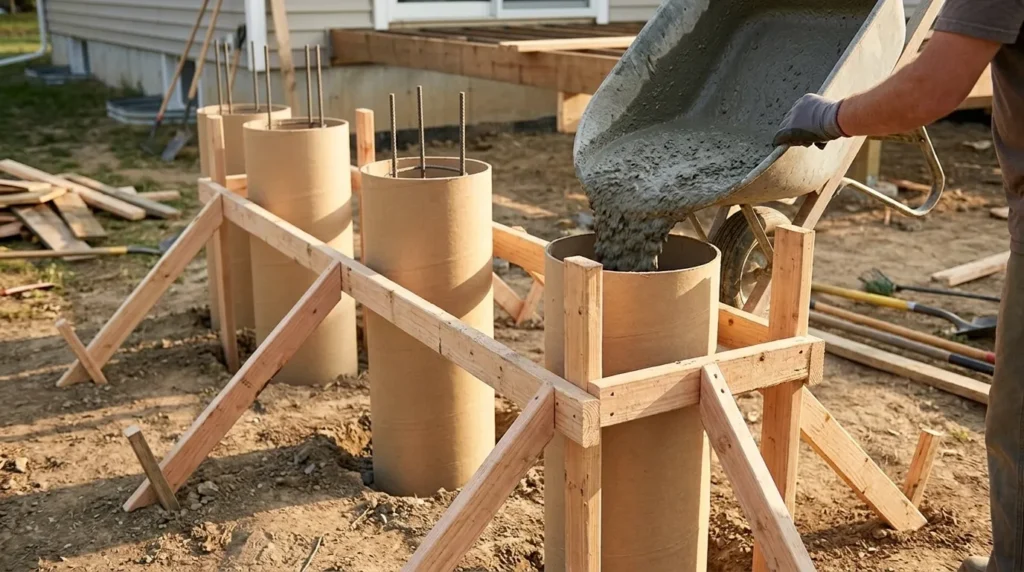
Concrete tubes — fiber tube forms (Sonotubes) for deck posts and sign bases — are cylinders. Subtract the post volume if the post occupies a significant portion of the tube.
Volume (ft³) = π × (tube radius)² × depth − π × (post radius)² × depth
Worked Example — 8 Deck Post Footings in 12-inch Tubes: 8 fiber tube forms: 12-inch diameter, 42-inch depth. Round posts: 4-inch diameter.
Tube volume per hole: π × (0.5)² × (42÷12) = π × 0.25 × 3.5 = 2.75 ft³ Post volume per hole: π × (0.167)² × 3.5 = π × 0.028 × 3.5 = 0.308 ft³ Concrete per hole: 2.75 − 0.31 = 2.44 ft³ Total for 8 holes: 8 × 2.44 = 19.5 ft³ Cubic yards: 19.5 ÷ 27 = 0.72 yd³ With 10% waste: 0.79 yd³ → 36 bags of 80 lb
How to Calculate Concrete Yards for Stairs
Concrete stairs are one of the more challenging volume calculations — each step is a combination of horizontal and vertical surfaces, and the total volume is not immediately obvious from the visual shape.
The Stair Volume Formula
The simplest approach treats the staircase as a solid rectangular block minus the empty triangular void that the stair profile creates.
Method — Solid block minus void:
Total block volume = Width × Total height × Total run depth Void volume = (Number of steps × Rise × Run × Width) ÷ 2 Concrete volume = Block volume − Void volume
But for most residential pours, the simpler approximation is to treat each step as a solid rectangular prism:
Volume per step = Width × Rise × Run Total volume = Number of steps × Width × Rise × Run
This slightly overestimates (it includes the triangular void) — but for outdoor concrete stairs poured on a compacted base, the excess is modest and helps cover the waste factor.
Worked Example — Residential Staircase
A residential front entry stair: 5 steps, 48 inches wide, 7-inch rise, 11-inch run.
Converting dimensions to feet:
- Width: 48÷12 = 4.0 ft
- Rise: 7÷12 = 0.583 ft
- Run: 11÷12 = 0.917 ft
Volume per step (treating as solid block): 4.0 × 0.583 × 0.917 = 2.14 ft³
But each step is supported by the step below it — the actual concrete added per step is just the new step volume, not a full solid block. For a poured-in-place concrete stair on a solid subgrade or on a prior concrete landing:
Practical method: Calculate total volume as if you filled a box the full height and depth of the staircase, then apply a 0.5 factor for the triangular cross-section profile:
Total box: 4.0 ft wide × (5 × 0.583 ft) high × (5 × 0.917 ft) deep = 4.0 × 2.917 × 4.583 = 53.5 ft³ Apply 0.5 factor: 53.5 × 0.5 = 26.75 ft³ Cubic yards: 26.75 ÷ 27 = 0.99 yd³ With 10% waste: 1.09 → order 1.5 yards (minimum order and short-load fee consideration)
For stairs with a concrete platform at the top, add the platform volume separately: Platform 4.0 ft × 4.0 ft × 4 inches thick = 4.0 × 4.0 × 0.333 = 5.33 ft³ = 0.20 yd³
Total including platform: 1.09 + 0.20 = 1.29 yd³ → order 1.5 yards
How to Calculate Concrete for Curb and Gutter
Curb and gutter sections have an irregular cross-section — they are not simple rectangles. The standard approach is to calculate the cross-sectional area of the curb profile and multiply by the linear length.
Standard curb and gutter cross-section components:
A typical residential curb and gutter has three zones:
- Gutter pan: Flat section (e.g., 12 inches wide × 4 inches thick)
- Curb face: Vertical section (e.g., 6 inches wide × 6 inches tall)
- Curb back: Additional depth behind the face (varies)
Formula:
Total volume = [Gutter area + Curb area] × Linear length
Worked Example — 60 Linear Feet of Residential Curb and Gutter:
Cross-section components:
- Gutter pan: 12 inches × 4 inches = (1.0 × 0.333) = 0.333 sq ft
- Curb section: 6 inches wide × 6 inches tall = (0.5 × 0.5) = 0.25 sq ft
- Total cross-section: 0.333 + 0.25 = 0.583 sq ft
”Volume: 0.583 × 60 = 35.0 ft³ Cubic yards: 35.0 ÷ 27 = 1.30 yd³ With 10% waste: 1.43 → order 1.5 yards”
For standard municipal curb and gutter specifications, the cross-section dimensions come from the engineering drawing — always use the drawing dimensions rather than assumed values.
Concrete Yardage Quick Reference Tables
Slabs — Cubic Yards Per 100 Square Feet
| Thickness | Cubic Yards per 100 sq ft |
|---|---|
| 3 inches | 0.93 yd³ |
| 3.5 inches | 1.08 yd³ |
| 4 inches | 1.23 yd³ |
| 5 inches | 1.54 yd³ |
| 6 inches | 1.85 yd³ |
| 8 inches | 2.47 yd³ |
To use: multiply by (your area ÷ 100). E.g., 400 sq ft at 4 inches: 1.23 × 4 = 4.93 yd³
“Choosing the right thickness is not just about volume — it determines how much load your slab can carry. See our detailed guides on how much weight a 4-inch concrete slab can hold and how much weight a 6-inch slab can hold before finalizing your thickness specification.”
Round Footings — Cubic Yards Per Linear Foot of Depth
| Diameter | ft³ per linear ft | yd³ per linear ft |
|---|---|---|
| 6 inches | 0.196 | 0.0073 |
| 8 inches | 0.349 | 0.0129 |
| 10 inches | 0.545 | 0.0202 |
| 12 inches | 0.785 | 0.0291 |
| 16 inches | 1.396 | 0.0517 |
| 18 inches | 1.767 | 0.0655 |
| 24 inches | 3.142 | 0.1164 |
To use: multiply by your footing depth in feet. E.g., 12-inch diameter × 3.5 ft deep: 0.0291 × 3.5 = 0.102 yd³ per footing
Bags vs. Ready Mix Crossover Point
| Volume | 80 lb Bags Needed | Ready Mix Cost | Bag Cost | Better Option |
|---|---|---|---|---|
| 0.5 yd³ | 23 bags | $80–$120 + fees | $173 | Ready mix (if no fees) |
| 1.0 yd³ | 45 bags | $130–$200 + fees | $338 | Depends on delivery fee |
| 1.5 yd³ | 68 bags | $195–$300 + fees | $510 | Ready mix |
| 2.0 yd³ | 90 bags | $260–$400 + fees | $675 | Ready mix |
| 3.0 yd³ | 135 bags | $390–$600 + fees | $1,013 | Ready mix |
How to Calculate Concrete Cost from Yardage
Once you have your cubic yardage, calculating cost is straightforward multiplication — but there are three components most people miss.
Component 1 — Material cost:
”Material cost = Cubic yards × Price per yard”
Regional averages in 2025: $115–$235 per cubic yard for standard 3,000–4,000 PSI ready mix. Higher-strength mixes add $10–$35 per yard.
Component 2 — Delivery fee: Typically $75–$200 as a flat fee, plus fuel surcharge and short-load fees if applicable.
Component 3 — Mix specification premium: Air entrainment: +$5–$15/yd. Fiber reinforcement: +$15–$30/yd. Accelerating admixture: +$8–$15/yd.
Worked Example — 10 Yard Garage Floor Pour:
| Item | Calculation | Cost |
|---|---|---|
| Material (10 yd³ × $160/yd) | 10 × $160 | $1,600 |
| 4,000 PSI upgrade | 10 × $18 | $180 |
| Delivery fee | Flat | $100 |
| Total | $1,880 |
According to the National Ready Mixed Concrete Association (NRMCA), concrete prices vary significantly by region — always get at least three supplier quotes before ordering. The NRMCA maintains a directory of member suppliers that can help you identify accredited batch plants in your area.
Common Concrete Yardage Calculation Mistakes
Mistake 1 — Not converting thickness to feet. Multiplying 10 × 10 × 4 gives 400 — but 400 what? If thickness is in inches, you get 400 cubic inch-feet, which is meaningless. Divide thickness by 12 first, always.
Example of the error and the fix:
- Wrong: 10 × 10 × 4 = 400 ÷ 27 = 14.8 yards (14× too high)
- Right: 10 × 10 × 0.333 = 33.3 ÷ 27 = 1.23 yards
Mistake 2 — Skipping the waste factor. The formula gives you the theoretical minimum. Real pours always consume more — uneven subgrade, form edge overfill, residual in the truck chute, and minor measurement errors all add up. Skipping the 10% factor is the most common cause of running short mid-pour.
Mistake 3 — Measuring the outer edge of a perimeter footing. A 30 ft × 40 ft perimeter footing measured on the outside has a perimeter of 140 feet. The centreline perimeter — what you should use — is slightly less: approximately 138 feet for a 16-inch wide footing. The difference is small on residential footings but matters on larger pours.
Mistake 4 — Using a square formula for a circular element. A 12-inch diameter footing is NOT 1.0 ft × 1.0 ft = 1.0 sq ft. It is π × (0.5)² = 0.785 sq ft. Using the square approximation overestimates volume by 27% — on a large number of post holes, this adds real cost.
Mistake 5 — Forgetting that stairs are not solid rectangles. A staircase looks like a solid block from the side, but the stepped profile means only about half the bounding box volume is actually concrete. Calculating the full box volume without the 0.5 factor overestimates by 100%.
Mistake 6 — Confusing cubic yards and cubic meters. 1 cubic yard ≠ 1 cubic meter. 1 cubic yard = 0.7646 cubic meters. If your supplier quotes in cubic meters and you calculated in cubic yards — or vice versa — your order will be wrong by 31%.
Frequently Asked Questions
How do I calculate yards of concrete?
Multiply length (ft) × width (ft) × thickness (ft) to get cubic feet. Divide by 27 to get cubic yards. Add 10% for waste. For a 10×20 ft slab at 4 inches thick: 10 × 20 × 0.333 = 66.6 ft³ ÷ 27 = 2.47 yd³ × 1.10 = 2.71 → order 3 yards.
How many cubic feet are in a yard of concrete?
Exactly 27 cubic feet. One cubic yard is a cube measuring 3 feet × 3 feet × 3 feet. To convert cubic feet to cubic yards, divide by 27. To convert cubic yards back to cubic feet, multiply by 27.
How do I calculate concrete yardage for a driveway?
Measure the length and width in feet. Convert thickness (typically 4–5 inches) to feet by dividing by 12. Multiply all three and divide by 27. For a 16 ft × 40 ft driveway at 5 inches: 16 × 40 × 0.417 ÷ 27 = 9.9 yd³. Add 10% waste: order 11 yards.
How do I calculate concrete for round footings?
Use the cylinder formula: π × (radius in feet)² × depth in feet = cubic feet. Divide by 27 for cubic yards. For a 12-inch diameter footing, 36 inches deep: π × (0.5)² × 3.0 = 2.36 ft³ ÷ 27 = 0.087 yd³ per footing.
How do I calculate concrete for stairs?
Multiply the staircase width × total run depth × total rise height to get the bounding box volume. Apply a 0.5 factor for the stepped cross-section. Add any landing or platform volume separately. For a 5-step stair, 4 ft wide, 7-inch rise, 11-inch run: approximately 1.0 cubic yard before waste.
How do I calculate concrete for curb and gutter?
Calculate the cross-sectional area of the curb profile (gutter pan area + curb section area), then multiply by the linear length in feet. Convert cubic feet to yards by dividing by 27. Add 10% waste.
How do I convert concrete from cubic feet to cubic yards?
Divide cubic feet by 27. Example: 81 cubic feet ÷ 27 = 3 cubic yards. To go the other direction (yards to feet), multiply by 27: 3 yards × 27 = 81 cubic feet.
How many bags of concrete make a cubic yard?
45 bags of 80 lb mix, 60 bags of 60 lb mix, or 90 bags of 40 lb mix equal one cubic yard. For large volumes, ready mix is significantly cheaper — see our concrete bag yield guide for the complete comparison.
How do I calculate concrete cost from yardage?
Multiply cubic yards by the price per yard (typically $115–$235 depending on region and mix). Add delivery fee ($75–$200 flat rate), mix specification premiums (air entrainment, fiber, strength upgrade), and any short-load fee if ordering under 3–4 yards. Get at least three supplier quotes before committing.
Conclusion
Calculating concrete yards is arithmetic — but it is arithmetic that has to be right. A wrong unit conversion or a skipped waste factor translates directly into either a ruined pour or an unnecessary expense. Use the formulas and worked examples in this guide for your specific shape, double-check with our free concrete calculator, and always order with the 10% waste factor included. The concrete cost of ordering correctly is always less than the cost of running short