
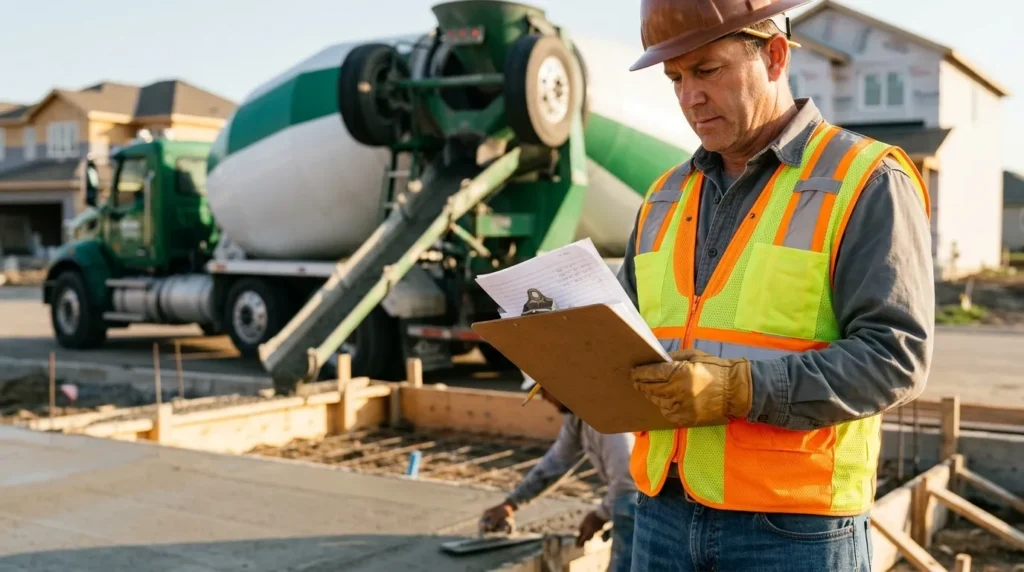

Concrete is one of the most price-variable materials in residential construction. The same cubic yard that costs $130 in a competitive urban market can run $200+ in a rural area with limited supplier access — and that’s before delivery fees, short-load charges, or pump hire enter the picture.
A concrete cost calculator cuts through that uncertainty. It takes your project dimensions, converts them to a volume, applies current per-yard pricing, and adds the fees most people forget — giving you a realistic project budget before you call a single supplier.
This guide explains every cost component, works through real project examples, and gives you the reference tables you need to sanity-check any quote you receive. If you haven’t calculated your volume yet, start with our Concrete Slab Calculator — then come back here to price it out.
Table of Contents
- What Does a Concrete Cost Calculator Include?
- How Much Does Concrete Cost Per Cubic Yard?
- How to Calculate Your Total Concrete Cost
- Concrete Cost by Project Type
- Ready-Mix Delivery Charges — What to Expect
- How to Get an Accurate Supplier Quote
- Tips to Reduce Your Concrete Project Budget
- Frequently Asked Questions
What Does a Concrete Cost Calculator Include?
Most online tools only calculate material cost — volume multiplied by price per yard. That’s a starting point, not a budget.
A complete concrete cost calculator accounts for:
- Material cost — ready-mix or bagged concrete at current regional pricing
- Delivery charges — flat fee or per-mile rate from the batch plant
- Short-load fees — penalty charges when your order falls below the truck’s minimum
- Concrete pump hire — required when the truck can’t reach the pour location directly
- Waste allowance — the 5–15% overage added to avoid running short mid-pour
- Finishing and labor — optional, but necessary for a true total project budget
Leaving any of these out produces a number that feels good on paper and causes budget overruns on site. The sections below break each component down.
How Much Does Concrete Cost Per Cubic Yard?
Concrete pricing in the US is quoted per cubic yard for ready-mix and per bag for premixed bagged product. Both fluctuate with fuel costs, cement commodity prices, and regional demand.
Ready-Mix Concrete Price by Region
| Region | Low Estimate | High Estimate | Typical Average |
|---|---|---|---|
| Northeast US | $140 | $220 | $175 |
| Southeast US | $120 | $185 | $150 |
| Midwest US | $115 | $175 | $145 |
| Southwest US | $130 | $190 | $160 |
| West Coast US | $150 | $230 | $190 |
| Rural / Remote | $160 | $250+ | $200+ |
Prices per cubic yard, ready-mix delivered, as of 2024–2025. Source: aggregated from RS Means Construction Data and regional supplier surveys.
These figures are for standard 3,000–4,000 PSI residential mix. Specialty mixes — fiber-reinforced, air-entrained for freeze-thaw climates, or high-early-strength — add $10–$40 per yard.
Bagged Concrete Cost Per Yard
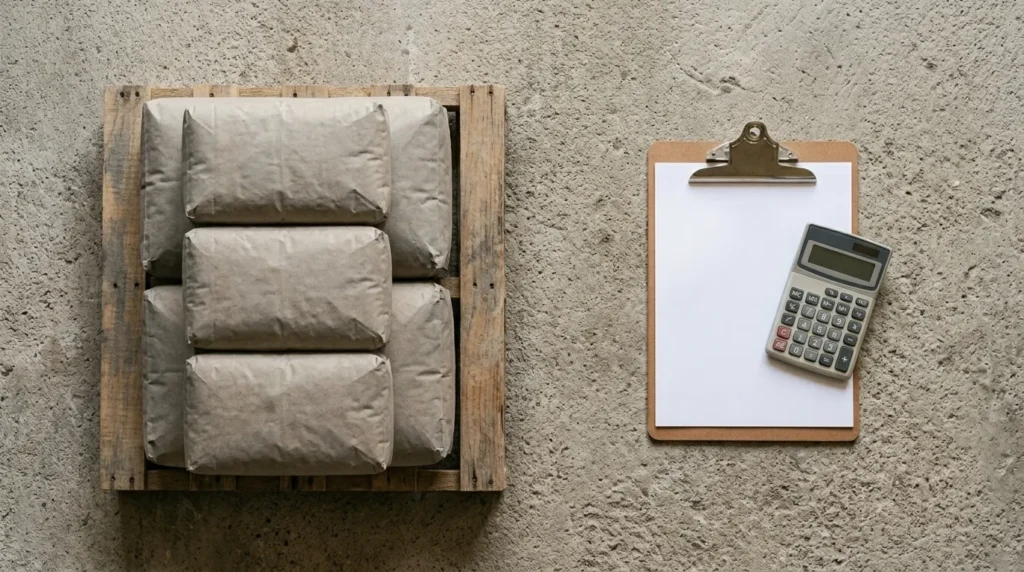
Bagged concrete costs significantly more per cubic yard than ready-mix, but has no minimum order and no delivery fee if you pick it up yourself.
| Bag Size | Price Per Bag (avg.) | Bags Per Yard | Cost Per Cubic Yard |
|---|---|---|---|
| 40 lb | $5.50 | 90 | ~$495 |
| 60 lb | $6.50 | 60 | ~$390 |
| 80 lb | $7.50 | 45 | ~$338 |
For any project over 1 cubic yard, ready-mix is almost always cheaper per unit. The breakeven point is typically around 45 bags of 80 lb mix — at that volume, a ready-mix quote is worth getting. Use our Concrete Bags Calculator to find exactly where that crossover falls for your project.
What Moves the Price Up or Down
Upward pressure on price:
- High-PSI or specialty mix design
- Air entrainment additives (required in freeze-thaw regions)
- Short-lead-time orders (same-day or next-day delivery)
- Remote site location with long haul distance
- Peak construction season (spring–summer)
Downward pressure on price:
- Ordering during off-peak season (late fall, winter)
- Larger order volumes (5+ yards)
- Multiple competing suppliers in your area
- Flexible scheduling that suits the plant’s production schedule
How to Calculate Your Total Concrete Cost
Step 1 — Estimate Your Volume
Volume is the foundation of every cost calculation. If you haven’t done this yet:
Volume (yd³) = Length (ft) × Width (ft) × Thickness (ft) ÷ 27
Example: 20 ft × 24 ft garage floor at 5 inches thick:
20 × 24 × (5÷12) ÷ 27 = 20 × 24 × 0.417 ÷ 27 = 7.41 yd³
Round up to 7.5 yards for ordering purposes.
Step 2 — Choose Ready-Mix or Bags
At 7.5 yards, ready-mix is the clear choice. Bagged concrete at this volume would require 338 bags of 80 lb mix — roughly $2,535 in materials alone, versus $975–$1,425 for ready-mix depending on region.
Step 3 — Add Delivery and Pump Charges
Delivery fee for 7.5 yards: $75–$150 (typical flat rate within 10 miles) No pump required for a garage floor with truck access: $0
Step 4 — Apply Waste Allowance to Budget
Add 10% to your volume before calculating cost:
7.5 yards × 1.10 = 8.25 yards → order 8.5 yards
Full cost estimate — 20×24 garage floor:
| Item | Quantity | Unit Cost | Total |
|---|---|---|---|
| Ready-mix concrete | 8.5 yd³ | $160/yd³ | $1,360 |
| Delivery fee | 1 | $100 | $100 |
| Reinforcement (wire mesh) | 480 sq ft | $0.20/sq ft | $96 |
| Materials Total | $1,556 | ||
| Finishing labor (if hired) | 480 sq ft | $3.50/sq ft | $1,680 |
| Full Project Total | $3,236 |
This is a realistic mid-range estimate for a standard garage floor in most US markets. Labor rates vary significantly — always get local contractor quotes for finishing work.
Concrete Cost by Project Type
Driveway Slab Cost
A standard two-car driveway (16 ft × 40 ft, 5 inches thick) requires approximately 9.9 cubic yards of concrete before waste.
| Item | Cost Range |
|---|---|
| Concrete material (10.9 yd³ with waste) | $1,415 – $2,400 |
| Delivery | $75 – $150 |
| Rebar reinforcement | $200 – $400 |
| Finishing labor | $1,800 – $3,500 |
| Driveway Total | $3,490 – $6,450 |
Driveway concrete should be 4,000–4,500 PSI with air entrainment in cold climates — budget the higher per-yard rate for this specification.
Patio Slab Cost
A 16 ft × 20 ft patio at 4 inches thick requires approximately 3.95 cubic yards before waste.
| Item | Cost Range |
|---|---|
| Concrete material (4.35 yd³ with waste) | $565 – $870 |
| Delivery | $75 – $150 |
| Wire mesh | $55 – $80 |
| Finishing labor | $700 – $1,400 |
| Patio Total | $1,395 – $2,500 |
At under 5 yards, a patio sits in the zone where bagged concrete is worth pricing too — especially if you’re willing to mix yourself. Compare both options before ordering.
Foundation and Footing Cost
Foundation slabs and footings use more concrete per square foot than surface slabs because they’re thicker — typically 8–12 inches — and often require higher-PSI mix designs.
A 30 ft × 40 ft foundation at 8 inches thick: approximately 29.6 cubic yards.
At $160/yd³ with 10% waste (32.5 yards): $5,200 in material alone.
Foundation work almost always requires a concrete pump (truck can’t pour into a narrow trench directly), adding $500–$1,500 to the project cost. For foundation projects, always consult a structural engineer — the concrete specification is as important as the quantity.
Column and Structural Concrete Cost
Columns use small volumes but high-strength mix (M25 / 4,000–5,000 PSI), which costs $10–$40 more per yard than standard residential mix. Volume per column is typically under 0.5 cubic yards, so bagged concrete or small ready-mix orders are standard.
For commercial structural concrete, pricing jumps significantly — commercial ready-mix averages $180–$280 per yard with engineered mix designs, certified batch tickets, and mandatory testing.
Ready-Mix Delivery Charges — What to Expect
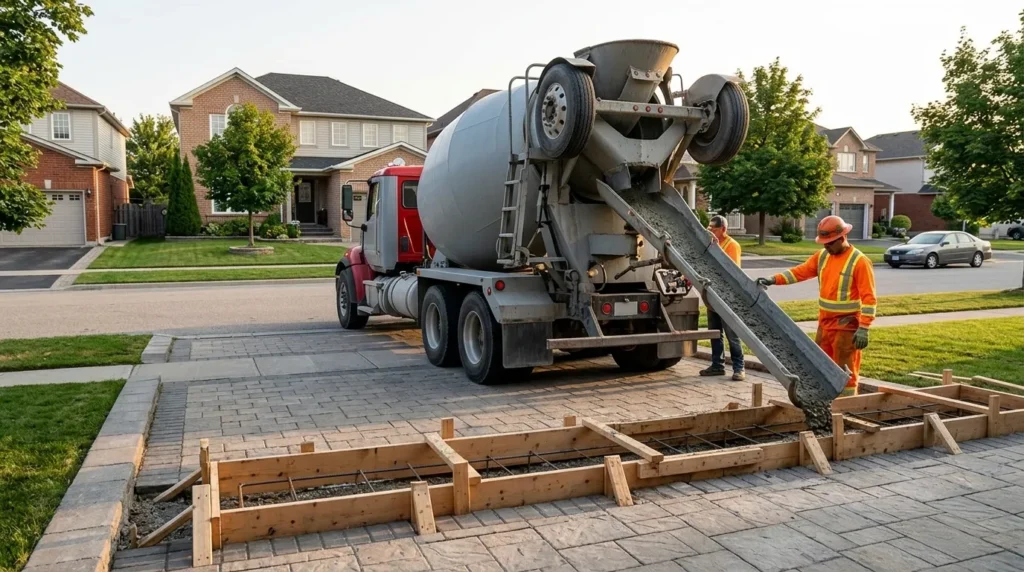
Delivery cost is one of the most misunderstood line items in concrete budgeting. It’s not just a flat fee — it has several components.
Short-Load Fees
Most ready-mix trucks hold 8–10 cubic yards. If your order falls below the plant’s minimum (typically 3–4 yards), you’ll pay a short-load fee — effectively a penalty for underusing the truck’s capacity.
| Order Volume | Typical Short-Load Fee |
|---|---|
| Under 1 yard | $100 – $200 |
| 1–2 yards | $75 – $150 |
| 2–3 yards | $50 – $100 |
| 3+ yards | Usually waived |
If your project is close to a fee threshold, consider expanding slightly — pouring a thicker slab or adding a small adjacent pad — to push your order over the minimum.
Concrete Pump Hire Cost
A concrete pump is needed when the ready-mix truck can’t position close enough to discharge directly into the forms. This happens with:
- Backyard pours with no side access
- Basement and below-grade foundation work
- Elevated slabs or second-story structural pours
Typical pump hire costs:
| Pump Type | Day Rate | Volume Range |
|---|---|---|
| Trailer/line pump | $400 – $800 | Up to 30 yards |
| Boom pump (small) | $900 – $1,500 | 30–100 yards |
| Boom pump (large) | $1,500 – $3,000+ | 100+ yards |
Pump hire is usually arranged through the ready-mix supplier or a separate pump contractor. Always confirm whether the pump operator’s labor is included in the day rate.
How to Get an Accurate Supplier Quote
A supplier quote is only as accurate as the information you give them. When you call:
Tell them:
- Total volume in cubic yards (with your waste factor already applied)
- Required PSI or mix design (3,000, 3,500, 4,000 PSI)
- Whether you need air entrainment (freeze-thaw climates)
- Pour date and time window
- Site address and any access restrictions
Ask them:
- Price per cubic yard for your specified mix
- Delivery charge and how it’s calculated (flat or per-mile)
- Short-load fee if applicable
- Slump specification and whether water reducers are available
- Cancellation or rescheduling policy
Get at least three quotes from different suppliers. Price differences of $15–$30 per yard are common even within the same city. On a 10-yard order, that’s $150–$300 in savings for a 10-minute phone call.
The National Ready Mixed Concrete Association (NRMCA) maintains a supplier directory that can help you find accredited batch plants in your region.
Tips to Reduce Your Concrete Project Budget
Order in off-peak season. November through February is the slowest period for ready-mix plants in most US regions. Suppliers are more willing to negotiate on price and more flexible on scheduling.
Combine projects. If you need a patio and a shed base, pour them on the same day. One delivery fee, one truck. The savings on a second delivery charge often pay for the concrete itself on smaller pours.
Be flexible on timing. Suppliers sometimes offer discounted rates on partial leftover loads — concrete left over from a larger commercial pour that would otherwise return to the plant. If you’re in a non-urgent situation, ask about last-minute availability.
Minimize pump use. Site prep that allows direct truck discharge eliminates a $400–$800 pump hire. A few hours of clearing access can be worth more than any other cost reduction measure.
Calculate accurately upfront. Over-ordering is expensive. Every unnecessary yard of ready-mix that gets poured in a corner or returned (most plants don’t accept returns) is money wasted. Use the ConcreteCal cost calculator to get your volume right before you pick up the phone.
Negotiate the short-load threshold. Some plants will waive the short-load fee if you’re a repeat customer or if you’re willing to accept delivery at a time convenient for them. It never hurts to ask.
Frequently Asked Questions About Concrete Cost
How much does a yard of concrete cost?
The national average for ready-mix concrete is $130–$200 per cubic yard delivered, depending on region, mix specification, and supplier. Specialty mixes, air entrainment, and high-PSI designs add $10–$40 per yard on top of the base price.
How much is 5 yards of concrete?
At $160/yd³ average: $800 in material. Add delivery ($75–$150) and a likely short-load fee ($50–$100). Total: approximately $925–$1,050 before labor or reinforcement.
How much is 8 yards of concrete?
At $160/yd³: $1,280 in material. Delivery included at this volume with most suppliers. Total material cost: approximately $1,280–$1,440 depending on mix and region.
How much does 12 yards of concrete cost?
At $160/yd³: $1,920. At this volume, most suppliers waive short-load fees and may negotiate on price. Budget $1,900–$2,500 depending on mix specification and location.
What does 400 yards of concrete cost?
At commercial volumes, pricing drops to $130–$160/yd³ with negotiated contracts. 400 yards: approximately $52,000–$64,000 in material. Commercial projects at this scale typically use unit-price contracts with certified batch tickets and mandatory slump and strength testing.
How much does ready-mix concrete delivery cost?
Delivery is typically $75–$200 as a flat fee within 10–15 miles of the plant, plus short-load fees if applicable. Beyond 15 miles, many plants charge a per-mile rate of $5–$15/mile on top of the base delivery fee.
How much is a truck of concrete?
A full truckload is 8–10 cubic yards. At $160/yd³, a full truck runs $1,280–$1,600 in material plus delivery. Most residential projects don’t need a full truck — and ordering more than you need is its own cost problem.
How much does ready-mix cost versus bagged concrete?
Ready-mix averages $130–$200/yd³. Equivalent bagged concrete (80 lb bags): $338/yd³ in materials alone, before labor for mixing. Ready-mix is cheaper per yard for any order over 1 cubic yard — the crossover point is around 45 bags of 80 lb mix.
Can a concrete cost calculator estimate commercial slab costs?
Yes, with caveats. Commercial concrete involves engineered mix designs, third-party testing, certified batch tickets, and premium PSI specifications that add significantly to the base price. Use a commercial cost calculator as a starting estimate only — get formal quotes from accredited suppliers for any commercial project.
Conclusion
Concrete cost surprises happen when people calculate material and forget everything else. Price per yard is just the start — delivery fees, short-load charges, pump hire, and waste overage routinely add 20–40% to the base material cost. Run every line item through a concrete cost calculator before you commit to a pour date, and call at least three suppliers before you commit to a price.