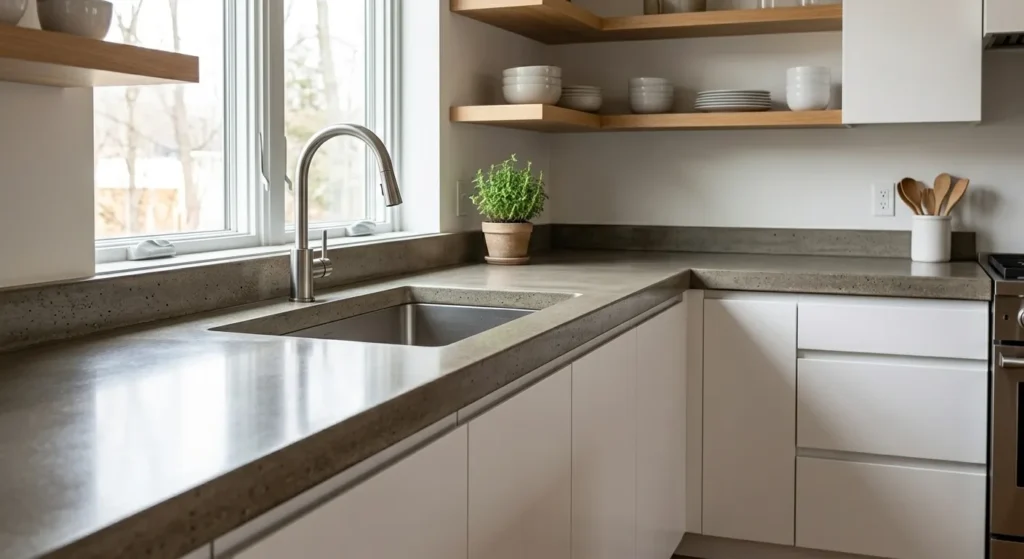

Walk through any design-forward kitchen renovation these days and you will encounter concrete countertops. They show up in farmhouse kitchens, industrial lofts, minimalist Scandinavian spaces, and high-end residential builds — and the reason is not just aesthetics. Concrete is genuinely one of the most customisable countertop materials available. You choose the color, the texture, the edge profile, the finish, and the thickness. No two concrete countertops are exactly alike, which is precisely the point.
But here is what most DIY guides skip: what type of concrete for countertops is a genuinely different question from what type of concrete for a driveway or a foundation. Standard structural concrete — the 3,000–4,000 PSI mix that goes into most residential slabs — is a poor choice for countertops. It is too coarse, too prone to cracking in thin sections, and lacks the mix properties that make a countertop surface smooth, dense, and durable at the thicknesses used in kitchens.
This guide covers every concrete mix option for countertops, what each one does well, the finish options that define how the final surface looks, and the sealing decisions that determine how well it performs for years of kitchen use.
Once you know your mix and quantities, calculate your concrete volume accurately using our free concrete calculator at ConcreteCal before any mix is ordered or batched.
Table of Contents
- Why Concrete Countertops Require a Different Approach
- What Type of Concrete for Countertops — The Main Options
- Standard Portland Cement Mix (DIY From Scratch)
- Bagged Countertop Mix — The Reliable Middle Ground
- GFRC — Glass Fiber Reinforced Concrete
- Polymer-Modified and All-Sand Mix
- What Your Mix Must Do — The Four Requirements
- Concrete Countertop Finish Options
- Sealing Concrete Countertops
- Concrete Countertops vs. Other Materials
- Cost of Concrete Countertops
- Frequently Asked Questions
Why Concrete Countertops Require a Different Approach
Most people’s mental image of concrete is the grey slab in a driveway or the foundation beneath a house. That concrete works because it is thick — 4 to 8 inches — surrounded by soil or connected to adjacent slabs, and typically reinforced with steel. It is not asked to be smooth, beautiful, or food-safe.
A kitchen countertop is none of these things. It is typically 1.5 to 2.5 inches thick. It spans unsupported distances over cabinets. It is polished to a smooth, sometimes reflective surface. It is touched, cleaned, heated, and exposed to food acids every day. And it needs to look exactly the way the designer or homeowner imagined it.
This changes almost everything about how the concrete is mixed.
What Makes Countertop Concrete Different from Structural Concrete
| Property | Structural Concrete | Countertop Concrete |
|---|---|---|
| Thickness | 4–12 inches | 1.5–2.5 inches |
| Aggregate size | Up to 3/4 inch | Maximum 3/8 inch, often sand-only |
| Surface finish | Rough, functional | Smooth, polished, decorative |
| Flexural strength | Less critical | Critical — thin sections must resist bending |
| Shrinkage | Acceptable | Must be minimised — thin sections crack easily |
| Color | Grey | Any color via pigment |
| Food safety | Not required | Sealer must be food-safe |
The most critical differences are aggregate size and flexural strength. Standard concrete with 3/4-inch aggregate cannot be polished to a smooth surface and cannot be cast at 1.5-inch thickness without cracking. Countertop mixes use fine aggregate (sand or 3/8-inch maximum) and include polymer fibers or glass fibers to improve flexural strength.
The Three Decisions That Determine Your Result
Before choosing a concrete mix, three decisions shape every other choice:
1. Cast-in-place or precast? Cast-in-place concrete is poured directly onto the cabinetry with formwork built on site. Precast is made in a workshop, cured, then installed. Most DIY projects use cast-in-place for simplicity; most professional fabricators precast for quality control.
2. Bagged mix or from scratch? Bagged countertop mixes are pre-formulated and require only water addition. DIY from-scratch mixes give maximum control but require precise batching. First-time makers almost always get better results with bagged mixes.
3. What finish and color? Integral pigment, acid stain, or topical stain? Polished, hand-troweled, or exposed aggregate? These choices determine the concrete mix specifications — some finishes require a particular mix type.
What Type of Concrete for Countertops — The Main Options
| Mix Type | Skill Level | Control | Best For | Cost |
|---|---|---|---|---|
| DIY from scratch | High | Maximum | Experienced fabricators | Low material |
| Bagged countertop mix | Low-Medium | Good | First projects, DIY | Medium |
| GFRC (glass fiber reinforced) | High | Maximum | Lightweight, large spans | Medium-High |
| All-sand mix | Medium | Good | Ultra-smooth polish | Medium |
| Polymer-modified mix | Medium | Good | Crack resistance, thin sections | Medium |
Standard Portland Cement Mix (DIY From Scratch)
Making countertop concrete from raw materials — Portland cement, sand, aggregate, and admixtures — gives the most control over every property of the final mix. This is how professional concrete countertop fabricators work when they have developed and tested their own recipes.
It is not the right starting point for a first-time maker. The variables are numerous: water-cement ratio, aggregate gradation, admixture dosage, and mixing time all affect the final result in ways that are difficult to predict without experience. A first project made from a tested bagged mix will almost always produce a better result than a first project made from a self-developed recipe.
Basic Mix Recipe
A widely used starting point for a countertop mix (adapted from the Concrete Countertop Institute’s published formulations):
| Ingredient | Quantity per 1 ft² at 1.5″ thick |
|---|---|
| Portland cement (Type I/II) | 3.5 lbs |
| Fine sand (washed, #30 mesh) | 5.25 lbs |
| Water (filtered) | 1.4 lbs (w/c ratio 0.40) |
| Superplasticiser | Per manufacturer dosage |
| Polymer fibres (polypropylene) | 0.05 lbs |
| Pigment (iron oxide) | 0–0.7 lbs depending on colour |
Water-cement ratio is the most critical variable. A w/c ratio of 0.40 produces a stiff, low-shrinkage mix. Adding more water to improve workability — tempting when the mix feels too stiff — increases shrinkage and reduces strength. Superplasticiser achieves workability without adding water.
Worked Example — Kitchen Island Countertop: A 2 ft × 6 ft kitchen island countertop, 1.75 inches thick. Area: 12 sq ft. Volume: 12 × (1.75÷12) = 1.75 cubic feet.
At the recipe above (scaled to cubic feet):
- Portland cement: 3.5 × 12 = 42 lbs
- Fine sand: 5.25 × 12 = 63 lbs
- Water: 1.4 × 12 = 16.8 lbs (approximately 2 gallons)
- Polymer fibres: 0.05 × 12 = 0.6 lbs
- Pigment: 0.35 × 12 = 4.2 lbs (for medium grey-brown tone)
Mix in a barrel mixer for minimum 5 minutes. Add superplasticiser last and mix an additional 2 minutes. The mix should be stiff enough to hold its shape when squeezed in the hand but not crumble.
Pros and Cons of DIY Mix
Pros:
- Maximum control over every mix property
- Lowest raw material cost
- Can be precisely tailored to the aggregate, finish, and colour desired
- Once a recipe is developed and tested, it is repeatable
Cons:
- Requires precise measurement — bathroom scales and graduated containers, not approximate handfuls
- No forgiveness for formulation errors
- Batch-to-batch consistency is difficult to achieve without a fixed mixing protocol
- First-time failures are common and expensive in time and material
Bagged Countertop Mix — The Reliable Middle Ground
Pre-formulated bagged concrete countertop mixes solve the formulation problem entirely. They contain Portland cement, graded fine aggregate, polymer fibres, and often a shrinkage-reducing admixture — all pre-blended in the correct proportions. You add water (and sometimes pigment), mix, and cast.
Products like Quikrete Countertop Mix and similar specialist mixes are specifically engineered to meet countertop requirements: fine aggregate for surface smoothness, higher flexural strength than standard concrete, and low-shrinkage formulation.
What Bagged Mixes Include That Standard Concrete Does Not
This is the critical point that many guides miss: big-box store standard concrete mix is not the same as countertop mix, even from the same manufacturer.
Standard Quikrete Concrete Mix contains coarse aggregate up to 3/4 inch — far too coarse for countertop casting or polishing. Standard mortar mix contains only sand but is not formulated for the strength or crack resistance countertops require. Countertop-specific mix is a genuinely different product engineered for this application.
Why standard concrete fails at countertop thickness: At 1.5 inches thick, a standard concrete mix with 3/4-inch aggregate has only two aggregate layers through the full depth. The concrete cannot develop the structural integrity or the smooth surface finish that countertops require. Polishing a standard concrete mix reveals an irregular aggregate distribution and voids that look poor on a kitchen surface.
When Bagged Mix Is the Right Choice
- First concrete countertop project
- Small to medium projects (under 30–40 square feet)
- DIY projects where mix development time is not available
- Projects where batch-to-batch consistency matters (multiple countertops in the same kitchen)
- Anyone who wants reliable results without extensive concrete knowledge
Cost: Bagged countertop mix typically runs $0.40–$0.80 per pound. A 1.5-inch-thick countertop at 12 square feet requires approximately 80–100 lbs of dry mix — roughly $40–$80 in material. Significantly more expensive per pound than raw materials, but the formulation value is real.
GFRC — Glass Fiber Reinforced Concrete
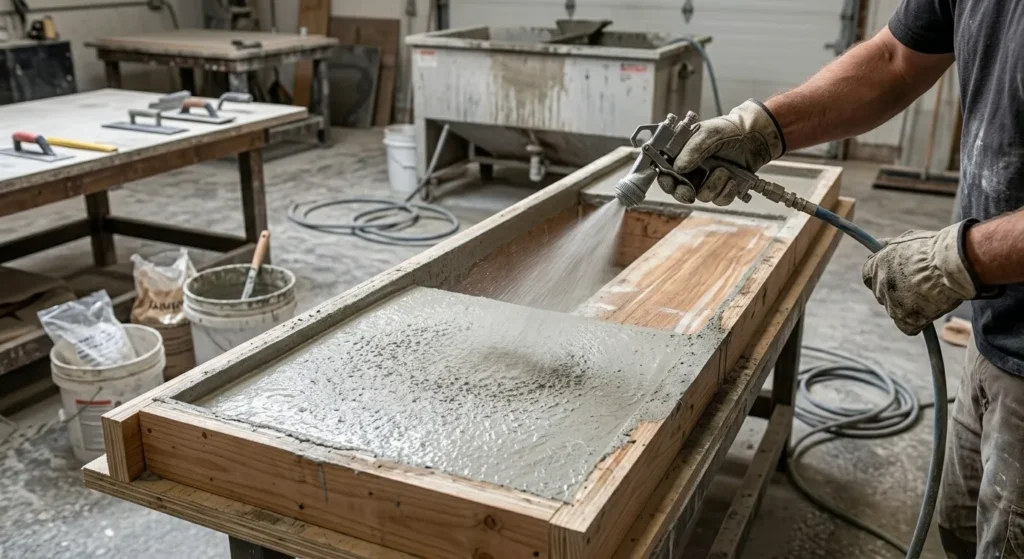
GFRC (Glass Fiber Reinforced Concrete) is the professional fabricator’s choice for large countertops, complex shapes, and any application where weight is a concern. Standard concrete countertops at 1.5 inch thickness weigh approximately 18 lbs per square foot — a 30 square foot island countertop weighs 540 lbs. GFRC countertops at 3/4-inch thickness weigh approximately 9 lbs per square foot — half the weight of standard concrete.
“The Concrete Countertop Institute — the leading professional education resource for concrete countertop fabrication — provides detailed GFRC mix formulations, spray-up technique guides, and troubleshooting resources for both beginners and experienced fabricators.”
How GFRC Works
GFRC uses alkali-resistant (AR) glass fibres dispersed throughout a fine cement-sand matrix. The fibres provide tensile and flexural reinforcement throughout the full thickness — allowing much thinner sections (3/4 inch to 1 inch) without the cracking risk of standard concrete at equivalent thickness.
GFRC mix components:
- Portland cement (Type I/II)
- Silica sand (fine, washed)
- AR glass fibres (minimum 5% by weight)
- Polymer emulsion (acrylic or PVA) — improves bonding and workability
- Water
Two casting methods for GFRC:
Spray-up: GFRC is sprayed through a chopper gun that simultaneously cuts glass rovings and mixes them into the cement slurry. Professional method — requires specialist equipment but produces the most consistent fibre distribution.
Premix: Glass fibres are mixed into the concrete by hand or mixer. Suitable for DIY — does not require spray equipment but fibre distribution is less uniform.
When to Choose GFRC
Choose GFRC when:
- The countertop exceeds 25–30 square feet (weight becomes a cabinet support issue)
- The design includes unsupported spans over 24 inches (requires maximum flexural strength)
- The project involves integrated sinks or complex three-dimensional forms
- Weight of the installation is a practical concern (upper cabinet integration, cantilever sections)
- You are a professional fabricator producing multiple pieces
GFRC is not ideal for beginners: The spray-up method requires significant equipment investment ($500–$2,000+ for a chopper gun system). Premix GFRC is more accessible but still requires precise formulation. If you are making your first concrete countertop, start with a bagged mix and work up to GFRC on subsequent projects.
Polymer-Modified and All-Sand Mix
All-Sand Mix
An all-sand concrete countertop mix uses only fine sand as aggregate — no coarse stone at all. This produces the smoothest possible surface when polished, with no large aggregate interruptions visible in the finished face.
Mix composition: Portland cement + fine washed sand (no coarse aggregate) + water + polymer fibres + superplasticiser.
Best for: High-end polished finishes where the goal is a smooth, almost glass-like surface appearance. The absence of coarse aggregate allows polishing to very fine grits (1,500–3,000) with a completely uniform surface.
The trade-off: All-sand mixes have higher shrinkage than aggregate-containing mixes — the lack of coarse aggregate means the shrinkage-restraining effect of stone is absent. Proper curing and low w/c ratio are critical to prevent cracking.
Polymer-Modified Mix
Adding polymer emulsion (typically acrylic latex) to a countertop mix improves several properties simultaneously:
- Increases adhesion to the mould face and any embedded objects
- Improves crack resistance (polymer fibres bridge micro-cracks)
- Reduces water permeability of the cured concrete
- Slightly increases flexural strength
Best for: Cast-in-place countertops where the concrete is poured onto existing surfaces, repairs and overlays of existing countertops, and any project where crack resistance is a priority.
What Your Concrete Countertop Mix Must Do — The Four Requirements
Regardless of which mix type you choose, a concrete countertop mix must meet four performance requirements that standard structural concrete does not need to satisfy. These are the criteria against which any mix — bagged or from scratch — should be evaluated.
High Compressive Strength
Minimum 5,000 PSI at 28 days. Standard residential concrete runs 3,000–4,000 PSI. The higher strength requirement for countertops comes from the thin cross-section — a 1.5-inch-thick slab at lower strength is more vulnerable to local fracture from impact or point loads (dropping a cast iron pan, for instance) than the same concrete at greater thickness.
Most quality bagged countertop mixes achieve 5,000–7,000 PSI. GFRC typically achieves 6,000–9,000 PSI depending on formulation.
High Flexural Strength
Flexural strength — the resistance to bending and breaking — is arguably more important than compressive strength for countertops. A countertop spans between cabinet supports; it must resist its own dead weight plus applied loads without cracking at the unsupported spans.
Polymer fibres and glass fibres both improve flexural strength by bridging micro-cracks before they propagate. A mix without any fibre reinforcement at countertop thicknesses is significantly more vulnerable to cracking during transport, installation, and use.
Low Shrinkage
All Portland cement concrete shrinks as it cures and dries. In a 4-inch structural slab, shrinkage is controlled by expansion joints and reinforcement — minor surface cracking is tolerated. In a 1.5-inch countertop, unconstrained shrinkage causes visible cracking that ruins the piece.
Low-shrinkage mixes use:
- Low water-cement ratio (0.35–0.42)
- Shrinkage-reducing admixtures
- Coarse aggregate (which resists paste shrinkage)
- Proper wet curing for minimum 7 days
Plastic sheeting over the countertop immediately after casting — and kept in place for at least 7 days — is the single most important shrinkage-prevention measure available to a DIY maker.
Workability for the Casting Method
The mix must be workable enough to fill the mould completely — including around reinforcement, embedded objects, and into corners — without the addition of excess water. This is why superplasticiser is used in countertop mixes: it makes the mix fluid enough to place easily while keeping the water-cement ratio low.
Slump target: 4–6 inches for vibrated mixes. 8–10 inches for self-consolidating pours (where vibration is difficult or undesirable). Adjust with superplasticiser, not water.
Concrete Countertop Finish Options
The finish is what most people notice first — and it is determined by a combination of the mix design, the casting method, and the post-cast treatment. Here is where concrete countertops truly earn their reputation for customisation: no other countertop material offers this range of surface options.
Polished or Sanded Finish
The most popular concrete countertop finish — achieved by wet-grinding and polishing the cured concrete surface through progressively finer diamond pads, from 50 grit through to 400, 800, or even 1,500 grit depending on the desired sheen level.
What it looks like: Smooth, dense, with aggregate visible at varying depths depending on how much material is removed. At 400 grit, a satin-smooth surface with subtle aggregate texture. At 1,500 grit, a near-mirror surface that shows the aggregate matrix as a design element.
Mix requirement: Fine aggregate (maximum 3/8 inch, ideally fine sand) for uniform polished surface. Coarse aggregate polished reveals large stones that may look inconsistent unless deliberately designed.
Worked Example — Kitchen Island Polish Sequence: Cast countertop cured 28 days. Polish with 50-grit diamond pad to remove form texture and expose aggregate. Progress to 100, 200, 400 grit. Apply densifier at 400 grit. Continue to 800 grit for satin finish. Apply sealer. Total polishing time for 12 sq ft: approximately 3–4 hours with an angle grinder and proper pads.
Hand-Troweled Finish
The simplest finish — the concrete surface is worked with a steel trowel during casting (cast-in-place) or immediately after demoulding (precast). No grinding or polishing required.
What it looks like: Smooth but not reflective. Slight trowel marks may be visible — some designers prefer this as a handmade quality. More texture than polished, more intentional than rough.
Best for: Cast-in-place applications where post-casting grinding would be difficult. Farmhouse and industrial kitchen aesthetics where a handmade quality is desirable.
Exposed Aggregate Finish
The concrete surface is washed with a surface retarder immediately after casting — the retarder delays surface set while the interior hardens. The next day, the surface paste is washed away to reveal the decorative aggregate beneath.
What it looks like: Textured, natural stone appearance. The aggregate chosen for the mix becomes the visual character of the countertop — coloured quartz, river pebbles, recycled glass, or marble chips.
Mix requirement: Decorative aggregate must be seeded or pre-mixed into the top layer. The aggregate type is the design decision — standard grey crushed stone produces a subdued result; coloured glass or quartz creates a striking visual.
Marbleized or Veined Finish
One of the most technically demanding but visually striking countertop finishes — multiple colours of concrete are combined in the mould to create veining patterns that mimic marble or travertine.
How it is done: Base colour concrete is cast first. Before it sets, a second colour (or multiple colours) is poured in thin streams and manipulated with a trowel or brush to create veining. The piece is then finished by polishing, which reveals the colour layers at the surface.
What it looks like: Natural stone-like colour variation — no two pieces identical. With careful technique, remarkably convincing marble alternatives at a fraction of the material cost.
Mix requirement: Multiple batches of identical mix formulation in different colours. Timing is critical — the veining must be done while the base is still plastic but stiff enough to hold the vein pattern.
Wood-Grained and Textured Finishes
Concrete can be cast against textured mould liners — rubber, foam, or fibre-glass — that imprint patterns into the concrete face. Wood grain, stone texture, geometric patterns, and custom designs can all be transferred from mould liner to concrete surface.
What it looks like: The surface reads as the texture of the mould liner — convincing wood grain requires a quality rubber liner; rough stone texture can be achieved with natural stone pressed into fresh concrete as a mould face.
Sealing Concrete Countertops — The Non-Negotiable Step
This section is not optional. Unsealed concrete countertops absorb every liquid that touches them — oil, wine, coffee, citrus — permanently. No sealer type should ever be skipped on a kitchen countertop.
The sealer choice affects appearance (gloss level), maintenance frequency, and food safety. Choose the wrong sealer and the countertop looks great for six months before staining through the worn sealer.
Penetrating Sealers
Penetrating sealers (silane, siloxane, or specialty countertop penetrating sealers) absorb into the concrete pore structure — they do not form a film on the surface. The result is stain resistance without changing the surface appearance or gloss.
Best for: Consumers who want the natural matte concrete look — no gloss, no film, but meaningful stain protection for daily kitchen use.
Limitation: Penetrating sealers are not fully stain-proof — highly pigmented liquids (beet juice, red wine) may still cause staining if left on the surface for extended periods. They provide stain resistance, not stain immunity.
Reapplication: Every 1–3 years depending on use intensity.
Topical Sealers (High-Gloss, Low-Luster)
Topical sealers form a protective film on the concrete surface — they change the appearance (adding gloss) and provide a physical barrier between the concrete and everything that touches it.
| Topical Sealer Type | Gloss | Durability | Reapplication | Food Safe When Cured? |
|---|---|---|---|---|
| Water-based acrylic | Low-Med | 1–2 years | Annually | ✅ Most brands |
| Solvent-based acrylic | Med-High | 1–3 years | Every 1–3 years | ✅ Most brands |
| Epoxy | High | 5–10 years | Rarely | ✅ When fully cured |
| Polyurethane | Med-High | 3–5 years | Every 3–5 years | ✅ When fully cured |
| Wax (food-grade) | Low | Months | Monthly-quarterly | ✅ |
The honest maintenance reality: Every topical sealer will eventually show wear in high-use areas — around the sink, where knives and dishes contact the surface daily. Plan for resealing. Budget for it. Accept it as part of owning a concrete countertop.
How Often to Reseal
The water bead test works for countertops the same way it works for driveways: pour a small amount of water on the surface. If it beads and runs off, the sealer is intact. If it absorbs, the sealer has failed and resealing is due.
For most kitchen countertops: reseal every 1–3 years depending on use intensity. High-use kitchens (cooking daily, frequent wet activity) need annual inspection and possible resealing. Light-use kitchens may go 3–4 years between full reseal applications.
Concrete Countertops vs. Other Materials
One of the most common questions when considering concrete countertops is how they compare to the alternatives. The honest answer: concrete has genuine advantages and genuine disadvantages, and the right choice depends entirely on priorities.
Compared to Granite
Granite wins on: Scratch and heat resistance (granite is harder than concrete). Lower maintenance (granite needs sealing every 1–2 years but is more stain-resistant unsealed than concrete).
Concrete wins on: Complete customisation of colour, shape, and edge profile. Integrated sinks are straightforward in concrete. Granite has limited color options determined by geology.
Cost comparison: Granite: $40–$100/sq ft installed. Concrete: $75–$150/sq ft professionally fabricated, or $15–$30/sq ft in materials for DIY.
Compared to Marble
Marble wins on: Natural veining that concrete can only approximate. Historical prestige and resale value association.
Concrete wins on: Durability — marble etches easily from acids (lemon juice, vinegar, wine). A marble countertop in a working kitchen shows etching within months. Concrete sealed correctly does not etch.
Cost comparison: Marble: $50–$150/sq ft installed. Concrete: comparable to or less than premium marble at professional fabrication prices.
Compared to Quartz
Quartz wins on: Zero maintenance — quartz engineered stone is non-porous and requires no sealing. Highly consistent appearance. Scratch and heat resistance.
Concrete wins on: Genuine handmade quality that quartz engineered surfaces cannot replicate. Warmer appearance. Custom thickness, shape, and integrated features.
The honest summary: Quartz is the better practical choice for homeowners who want a low-maintenance workhorse surface. Concrete is the better choice for homeowners who value design individuality and are willing to maintain it.
Cost of Concrete Countertops
Cost ranges vary significantly based on fabrication method:
| Method | Material Cost | Labor Cost | Total Per Sq Ft |
|---|---|---|---|
| DIY from-scratch mix | $3–$8/sq ft | $0 (your time) | $3–$8 + tools |
| DIY bagged mix | $8–$15/sq ft | $0 (your time) | $8–$15 + tools |
| Professional cast-in-place | $10–$20/sq ft | $50–$80/sq ft | $60–$100/sq ft |
| Professional precast | $15–$30/sq ft | $40–$70/sq ft | $55–$100/sq ft |
| Professional GFRC | $20–$40/sq ft | $50–$100/sq ft | $70–$140/sq ft |
What drives cost up:
- Complex edge profiles (waterfall edges, built-up profiles)
- Integrated sinks or drain boards
- Multiple colors or veining techniques
- Large unsupported spans requiring GFRC
- Remote locations with high delivery cost
What drives cost down:
- Simple rectangular shapes
- Single color, standard finish
- DIY casting with professional advice
- Standard edge profiles (eased, beveled)
A realistic DIY project cost: 12 sq ft kitchen island countertop. Bagged countertop mix: $80. Polypropylene fibres: $15. Pigment: $20. Diamond polishing pads (set): $60. Countertop sealer: $40. Form building materials: $30. Total: approximately $245 — versus $900–$1,800 for professional fabrication of the same piece.
Frequently Asked Questions
What type of concrete is used for countertops?
Countertop-specific concrete mix — either a pre-formulated bagged countertop mix or a custom recipe using Portland cement, fine sand (no coarse aggregate), polymer fibres, superplasticiser, and pigment. Standard structural concrete mix (like basic Quikrete concrete mix) is not appropriate for countertops — it contains coarse aggregate that prevents smooth surface finishing and lacks the flexural strength and low shrinkage properties countertops require.
Can I use regular concrete mix for countertops?
Not the standard concrete mix from a hardware store — it contains 3/4-inch coarse aggregate that prevents polishing and is too weak in thin sections. You need either a purpose-made countertop mix or a custom mix formulated with fine sand, low water-cement ratio, polymer fibres, and a superplasticiser admixture.
What is GFRC concrete and is it better for countertops?
GFRC (Glass Fiber Reinforced Concrete) uses alkali-resistant glass fibres dispersed throughout a fine cement-sand matrix. It allows much thinner sections (3/4 inch versus 1.5 inch for standard concrete), dramatically reduces weight, and provides superior flexural strength for large or complex countertops. It is better for professional fabrication of large or complex pieces — but requires more expertise and equipment than standard countertop mixes.
Do concrete countertops need to be sealed?
Yes — always. Unsealed concrete is highly porous and will absorb oil, wine, coffee, and any liquid it contacts permanently. The sealer type affects appearance (penetrating sealers maintain the natural matte look; topical sealers add gloss) and maintenance frequency (every 1–3 years depending on product and use). Food-safe sealer is essential for kitchen applications.
How thick should a concrete countertop be?
Standard poured concrete countertops are 1.5 to 2.5 inches thick. Thinner than 1.5 inches increases cracking risk. Thicker than 2.5 inches adds significant weight — at 3 inches, a 30 sq ft countertop weighs over 1,000 lbs. GFRC countertops can be made at 3/4 to 1 inch thickness, dramatically reducing weight while maintaining strength.
How much does it cost to make concrete countertops?
DIY material cost runs $8–$15 per square foot with a bagged countertop mix — significantly less than professional fabrication at $55–$140 per square foot. The DIY premium is time and skill — concrete countertops require precise mixing, proper curing, and polishing technique. First-time projects may not achieve the same surface quality as professional work.
How long do concrete countertops last?
A properly mixed, correctly cured, and regularly sealed concrete countertop will last the lifetime of the kitchen — 30+ years. The sealer requires periodic renewal (every 1–3 years depending on product). The concrete itself, once cured, is permanent — the maintenance commitment is to the surface protection layer, not the concrete structure.
Conclusion
Concrete countertops sit at the intersection of construction material and design object — which is why the mix, finish, and sealer choices matter far more than they do for a structural slab. Use a purpose-made countertop mix or a carefully formulated custom recipe. Reinforce with polymer or glass fibres. Keep the water-cement ratio below 0.42 and cure properly for 28 days. Choose a finish that fits both the aesthetic vision and your polishing capability. Seal with a food-safe sealer and plan to reseal every 1–3 years. Do all of that and you have a countertop that will still be drawing compliments in 20 years. Calculate your mix volumes accurately before batching using our free concrete calculator at ConcreteCal — and explore our complete types of concrete finishes guide for finish options that apply beyond countertops.