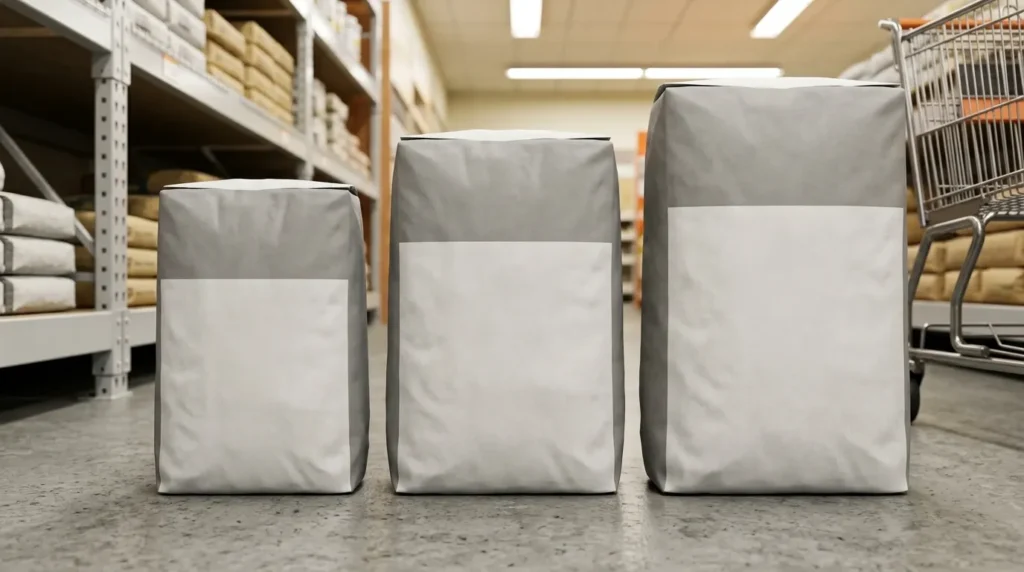

Standing in a hardware store aisle staring at stacked concrete bags is one of the most common sources of project planning confusion. The bags tell you the weight — 40 lb, 60 lb, 80 lb — but not how far that goes. Buy too few and you’re back at the store mid-pour. Buy too many and you’re stacking leftover bags in a corner where they’ll absorb moisture and harden within months.
How much a bag of concrete covers depends on two things: the bag size (which determines yield in cubic feet) and the thickness of your pour. Change the thickness and the coverage area changes dramatically — a 60 lb bag covers 3.6 sq ft at 2 inches thick but only 0.9 sq ft at 8 inches thick.
“According to Quikrete’s product specifications, standard premixed concrete bags should never be mixed with more water than specified — excess water reduces compressive strength by up to 30% and increases shrinkage cracking significantly.”
This guide gives you coverage tables for every standard bag size at every common pour thickness, a simple formula for calculating exactly how many bags your project needs, and worked examples for the most common DIY concrete applications.
For instant bag count calculation without manual math, use our free concrete bag calculator at ConcreteCal — enter your dimensions and get an exact bag count in seconds.
Table of Contents
- What Determines How Much a Bag of Concrete Covers?
- How Much Does a Bag of Concrete Cover — By Bag Size and Thickness
- How Many Bags of Concrete Do I Need?
- Bag Coverage by Common Project Type
- Bagged Concrete vs. Ready Mix
- Tips for Accurate Bag Estimation
- Frequently Asked Questions
What Determines How Much a Bag of Concrete Covers?
Two variables control everything — bag yield and pour thickness.
Bag Size and Yield
Every bag of premixed concrete produces a specific volume of mixed, poured concrete — called the yield. This is the number that determines coverage.
| Bag Weight | Yield (Cubic Feet) | Yield (Cubic Inches) |
|---|---|---|
| 40 lb bag | 0.30 cu ft | 518 cu in |
| 60 lb bag | 0.45 cu ft | 777 cu in |
| 80 lb bag | 0.60 cu ft | 1,037 cu in |
These yields are manufacturer-standard values — the same across all major brands for equivalent bag weights. The yield is what you’re actually buying when you purchase a bag of concrete — not weight, but volume of finished, mixed material.
Pour Thickness — The Biggest Variable
Thickness has an inverse relationship with coverage area — thicker pours cover less area per bag. This is the number most people underestimate when planning a concrete project.
A 60 lb bag yields 0.45 cubic feet. At 2 inches thick, that covers 2.7 square feet. At 4 inches thick — the standard residential specification — it covers only 1.35 square feet. At 6 inches, just 0.9 square feet.
Double the thickness and you halve the coverage. This relationship is linear and exact.
Shape of the Area
Coverage tables work for rectangular areas — length × width in square feet. For circular areas (post holes, round pads), you need the area formula:
Area = π × radius² (where radius = diameter ÷ 2)
For irregular shapes, break the area into rectangles, calculate each separately, and add the areas together.
How Much Does a Bag of Concrete Cover — By Bag Size and Thickness
40 lb Bag Coverage
A 40 lb bag yields 0.30 cubic feet of mixed concrete.
| Pour Thickness | Coverage Area Per 40 lb Bag |
|---|---|
| 1 inch | 3.6 sq ft |
| 2 inches | 1.8 sq ft |
| 3 inches | 1.2 sq ft |
| 3.5 inches | 1.03 sq ft |
| 4 inches | 0.9 sq ft |
| 6 inches | 0.6 sq ft |
| 8 inches | 0.45 sq ft |
The 40 lb bag is the lightest and most manageable — suitable for small repairs, post holes, and any project where carrying weight is a constraint. Its low yield makes it expensive per square foot for large projects.
Worked Example: Filling a single 10-inch diameter × 36-inch deep post hole:
- Volume: π × (5÷12)² × 3 = 1.64 cu ft
- Bags needed: 1.64 ÷ 0.30 = 5.5 → 6 bags of 40 lb
60 lb Bag Coverage
A 60 lb bag yields 0.45 cubic feet of mixed concrete.
| Pour Thickness | Coverage Area Per 60 lb Bag |
|---|---|
| 1 inch | 5.4 sq ft |
| 2 inches | 2.7 sq ft |
| 3 inches | 1.8 sq ft |
| 3.5 inches | 1.54 sq ft |
| 4 inches | 1.35 sq ft |
| 6 inches | 0.9 sq ft |
| 8 inches | 0.68 sq ft |
The 60 lb bag is the most balanced option for DIY projects — manageable weight with reasonable yield. It’s the best choice for medium projects where you’re mixing manually and need to control pace.
Worked Example: A 3 ft × 4 ft stepping stone, 3.5 inches thick:
- Area: 3 × 4 = 12 sq ft
- Coverage per 60 lb bag at 3.5″: 1.54 sq ft
- Bags needed: 12 ÷ 1.54 = 7.8 → 8 bags of 60 lb
80 lb Bag Coverage
An 80 lb bag yields 0.60 cubic feet of mixed concrete — the best yield per purchase and lowest cost per square foot of any bagged option.
| Pour Thickness | Coverage Area Per 80 lb Bag |
|---|---|
| 1 inch | 7.2 sq ft |
| 2 inches | 3.6 sq ft |
| 3 inches | 2.4 sq ft |
| 3.5 inches | 2.06 sq ft |
| 4 inches | 1.8 sq ft |
| 5 inches | 1.44 sq ft |
| 6 inches | 1.2 sq ft |
| 8 inches | 0.9 sq ft |
The 80 lb bag is the most efficient choice for any project requiring multiple bags — the math works out to 45 bags per cubic yard, versus 60 bags of 60 lb or 90 bags of 40 lb.
Worked Example: A 4 ft × 6 ft garden path section, 4 inches thick:
- Area: 4 × 6 = 24 sq ft
- Coverage per 80 lb bag at 4″: 1.8 sq ft
- Bags needed: 24 ÷ 1.8 = 13.3 → 14 bags of 80 lb
Complete Coverage Table — All Bag Sizes
| Thickness | 40 lb Bag | 60 lb Bag | 80 lb Bag |
|---|---|---|---|
| 1 inch | 3.60 sq ft | 5.40 sq ft | 7.20 sq ft |
| 2 inches | 1.80 sq ft | 2.70 sq ft | 3.60 sq ft |
| 3 inches | 1.20 sq ft | 1.80 sq ft | 2.40 sq ft |
| 3.5 inches | 1.03 sq ft | 1.54 sq ft | 2.06 sq ft |
| 4 inches | 0.90 sq ft | 1.35 sq ft | 1.80 sq ft |
| 5 inches | 0.72 sq ft | 1.08 sq ft | 1.44 sq ft |
| 6 inches | 0.60 sq ft | 0.90 sq ft | 1.20 sq ft |
| 8 inches | 0.45 sq ft | 0.68 sq ft | 0.90 sq ft |
| 10 inches | 0.36 sq ft | 0.54 sq ft | 0.72 sq ft |
| 12 inches | 0.30 sq ft | 0.45 sq ft | 0.60 sq ft |
How to use this table:
- Find your pour thickness in the left column
- Read across to your bag size
- Divide your total square footage by that number
- Round up to the nearest whole bag
- Add 10% for waste
How Many Bags of Concrete Do I Need? — The Formula
The coverage table above answers “how much does one bag cover.” This section answers the reverse question — how many bags do I need for my specific project?
Step 1 — Calculate Your Area in Square Feet
For rectangular areas:
Area = Length (ft) × Width (ft)
For circular areas:
Area = π × (Diameter ÷ 2)²
For irregular shapes: break into rectangles, calculate each, add together.
Examples:
- 10 ft × 12 ft patio: 10 × 12 = 120 sq ft
- 3 ft wide × 20 ft long path: 3 × 20 = 60 sq ft
- 12-inch diameter post hole (area of circle): π × (0.5)² = 0.785 sq ft per foot of depth
Step 2 — Choose Your Thickness
Standard thicknesses by application:
| Application | Standard Thickness |
|---|---|
| Repair patch | 1–2 inches |
| Garden path / stepping stones | 3–3.5 inches |
| Patio slab | 4 inches |
| Sidewalk | 4 inches |
| Driveway | 5–6 inches |
| Garage floor | 5–6 inches |
| Post hole fill | Full depth of hole |
| Foundation footing | 8–12 inches |
Step 3 — Find Bags Needed
Bags = Area (sq ft) ÷ Coverage per bag (from table)
Or use the volume formula directly:
Bags = [Area (sq ft) × Thickness (ft)] ÷ Yield per bag (cu ft)
Both formulas give the same result. The second is more precise for non-standard thicknesses.
Step 4 — Add Waste Allowance
Never order exactly what the math says. Spillage, uneven subgrades, slightly overfilled forms, and the fact that bags must be purchased in whole numbers all mean you need extra.
| Project Type | Waste Factor |
|---|---|
| Simple flat pour on level base | 5% |
| Standard residential slab | 10% |
| Post holes and irregular shapes | 10–15% |
| Complex or sloped areas | 15% |
Always round up to the nearest whole bag after applying the waste factor.
Full Worked Example — 10×10 ft Patio, 4 inches thick, 80 lb bags:
- Area: 10 × 10 = 100 sq ft
- Thickness: 4 inches = 0.333 ft
- Volume: 100 × 0.333 = 33.3 cubic feet
- Bags (before waste): 33.3 ÷ 0.60 = 55.5 → 56 bags
- Add 10% waste: 56 × 1.10 = 61.6 → 62 bags to purchase
At $7.50 per 80 lb bag: $465 in materials for a 10×10 patio.
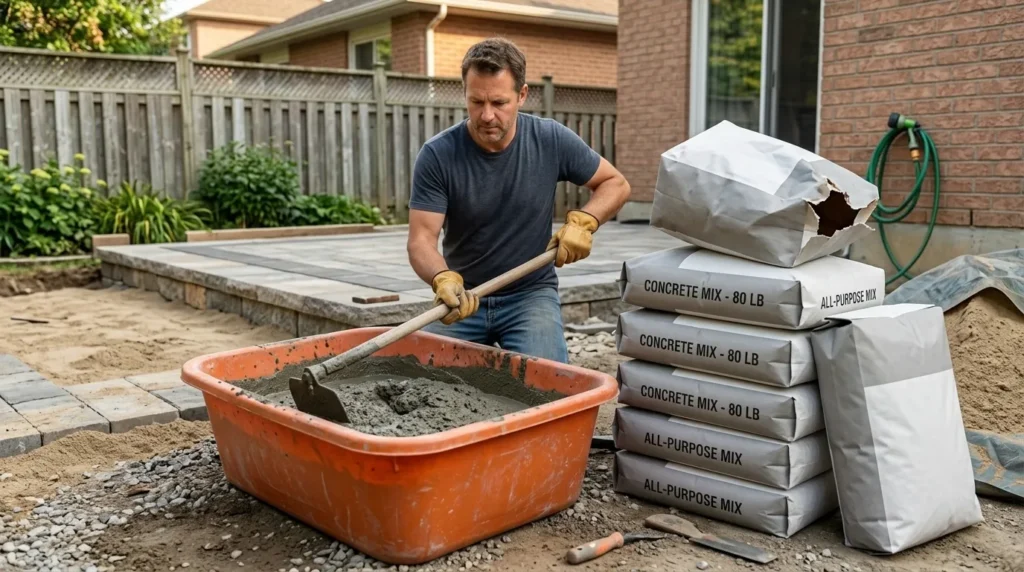
Bag Coverage by Common Project Type
Post Hole Fill
Post holes are the most common small concrete project — setting fence posts, mailbox posts, deck posts, and sign posts.
Standard post hole dimensions:
- Hole diameter: 3× post diameter (a 4-inch post needs a 12-inch hole)
- Hole depth: below frost line — typically 42–48 inches in northern US, 24–36 inches in southern US
Bags needed per post hole:
| Hole Diameter | Hole Depth | 40 lb Bags | 60 lb Bags | 80 lb Bags |
|---|---|---|---|---|
| 6 inches | 24 inches | 1 bag | 1 bag | 1 bag |
| 8 inches | 36 inches | 2 bags | 2 bags | 1 bag |
| 10 inches | 36 inches | 3 bags | 2 bags | 2 bags |
| 12 inches | 42 inches | 5 bags | 4 bags | 3 bags |
| 12 inches | 48 inches | 6 bags | 4 bags | 3 bags |
| 16 inches | 48 inches | 10 bags | 7 bags | 5 bags |
Note: Post diameter inside the hole is subtracted from the hole volume — for a 4-inch round post in a 12-inch hole, the post displaces approximately 10% of the hole volume. For practical purposes, use the full hole volume and you’ll have slight overage.
Worked Example — 6 Fence Posts: Six fence posts, 4-inch square posts, 10-inch holes, 42-inch depth.
- Hole volume each: π × (5÷12)² × (42÷12) = 1.91 cu ft
- Total volume: 6 × 1.91 = 11.46 cu ft
- 80 lb bags: 11.46 ÷ 0.60 = 19.1 → 20 bags
- With 10% waste: 22 bags of 80 lb
Sidewalk and Garden Path
Sidewalks and garden paths are typically 3–4 feet wide and 3.5–4 inches thick.
Coverage at 4 inches thick:
| Path Width | Path Length | 80 lb Bags Needed |
|---|---|---|
| 3 ft | 10 ft | 17 bags |
| 3 ft | 20 ft | 34 bags |
| 4 ft | 10 ft | 23 bags |
| 4 ft | 20 ft | 45 bags |
| 4 ft | 30 ft | 67 bags |
At 45 bags (4 ft × 20 ft sidewalk at 4 inches), you’re at exactly 1 cubic yard — the point where ready mix becomes a serious cost consideration. More on that in the comparison section below.
Patio Slab
A standard residential patio at 4 inches thick is one of the most common bagged concrete applications — large enough to be a significant project but small enough that ready mix may not be worth the minimum order and delivery fee.
Patio bag requirements at 4 inches thick, 80 lb bags:
| Patio Size | Area | Bags (before waste) | Bags (with 10% waste) |
|---|---|---|---|
| 8 ft × 8 ft | 64 sq ft | 36 bags | 40 bags |
| 10 ft × 10 ft | 100 sq ft | 56 bags | 62 bags |
| 10 ft × 12 ft | 120 sq ft | 67 bags | 74 bags |
| 12 ft × 12 ft | 144 sq ft | 80 bags | 88 bags |
| 10 ft × 16 ft | 160 sq ft | 89 bags | 98 bags |
| 12 ft × 16 ft | 192 sq ft | 107 bags | 118 bags |
Worked Example — 10×12 ft Covered Patio: A covered patio 10 ft × 12 ft, 4 inches thick. Using 80 lb bags.
- Area: 10 × 12 = 120 sq ft
- Bags needed: 120 ÷ 1.80 = 66.7 → 67 bags
- Add 10%: 67 × 1.10 = 73.7 → 74 bags
- Cost at $7.50/bag: $555
At this volume (74 bags = 1.65 cubic yards), ready mix at $160/yd³ costs approximately $264 in material — roughly half the bag cost. But the delivery fee ($100+) and short load fee (likely $75–$125 for under 2 yards) bring ready mix total to $440–$490. Bags win at this size only if you’re willing to do the mixing labor yourself.
“Before estimating bags, it helps to know how heavy your finished slab will be — especially if you’re planning a covered patio or elevated surface. See our guide on how much a slab of concrete weighs for complete weight tables by size and thickness.”
Driveway Section
Full driveways at 5–6 inches thick cross into ready mix territory quickly — but small driveway repairs, apron sections, and patches are common bagged concrete applications.
Driveway section at 5 inches thick, 80 lb bags:
| Section Size | Area | Bags (with 10% waste) |
|---|---|---|
| 4 ft × 4 ft | 16 sq ft | 16 bags |
| 6 ft × 6 ft | 36 sq ft | 35 bags |
| 8 ft × 8 ft | 64 sq ft | 63 bags |
| 10 ft × 10 ft | 100 sq ft | 97 bags |
| 10 ft × 20 ft | 200 sq ft | 194 bags |
At 97 bags (10×10 section), you’re approaching 2.2 cubic yards — ready mix is almost certainly more economical. For small driveway patches under 50 sq ft at 5 inches thick, bags are the practical choice.
Garage Floor
Garage floors at 5–6 inches thick are firmly in ready mix territory for any standard 2-car garage. Bagged concrete is only practical for very small single-car garages or partial sections.
Single-car garage (12 ft × 20 ft) at 5 inches:
- Area: 240 sq ft
- Volume: 240 × (5÷12) = 100 cu ft = 3.7 cubic yards
- 80 lb bags needed: 100 ÷ 0.60 = 167 → with waste: 184 bags
- Bag cost: 184 × $7.50 = $1,380
- Ready mix cost: 3.7 yd³ × $160 + delivery = $692–$792
Ready mix saves $588–$688 on a single-car garage floor — and eliminates the labor of mixing 184 bags. For any garage floor, specify ready mix.
Bagged Concrete vs. Ready Mix — Which Makes More Sense?
The right choice depends on volume, site access, and how much you value your time.
| Factor | Bagged Concrete | Ready Mix |
|---|---|---|
| Best for volume | Under 1 cubic yard | Over 1 cubic yard |
| Cost per yard | $338–$495 | $130–$200 |
| Minimum order | None | Usually 1 yard |
| Delivery required | No (carry yourself) | Yes |
| Site access | Any | Truck must reach site |
| Mix control | Full control | Fixed at plant |
| Timing flexibility | Complete | Scheduled delivery |
| Labor intensity | High (manual mixing) | Low |
| Quality consistency | Variable | High |
The 1-yard rule: If your project needs more than 45 bags of 80 lb concrete (= 1 cubic yard), get a ready mix quote. Above that volume, ready mix is almost always cheaper even after delivery fees — and significantly less labor.
When bags always win:
- Tight access sites where a ready mix truck cannot reach
- Projects under 10 bags total
- Remote locations far from any batch plant
- Repair and patch work where you need to mix small amounts over time
For a detailed cost comparison including delivery fees and short load charges, see our concrete bag calculator which calculates both options side by side.
Tips for Accurate Bag Estimation
1. Measure twice before calculating. A 6-inch measurement error on a 10-foot length is 5% — which gets absorbed by the waste factor. A 6-inch error on thickness (confusing 3.5 inches with 4 inches) changes your bag count by 14%. Thickness measurement is the most critical dimension to get right.
2. Use the yield number, not the bag weight. Bag weight tells you how heavy it is to carry. Yield (cubic feet) is the number that determines coverage. Always base calculations on yield: 0.30 for 40 lb, 0.45 for 60 lb, 0.60 for 80 lb.
3. Never buy exact calculated quantity. The formula gives you a theoretical minimum. Real pours always use more — spillage, overfill at edges, slightly uneven subgrades, and mixing losses all consume material. A 10% waste factor is minimum for any project.
4. Keep 2 spare bags at the site. Even with a correct calculation and waste factor, edge conditions and form variations sometimes require a little extra at the end. Two spare 80 lb bags cost $15 and save a last-minute store run.
5. Check the bag for damage before mixing. A bag with a small moisture hole has been slowly absorbing humidity. Cement that has partially hydrated produces weaker concrete — strength can be reduced by 20–30%. Squeeze the bag before buying — it should feel powder-soft throughout. Any hard lumps indicate moisture damage.
6. Match bag type to application. Standard premix is fine for most applications. Fast-setting concrete (Quikrete Fast-Setting, Sakrete Fast Set) sets in 20–40 minutes — ideal for post holes where you pour dry into the hole and add water, but wrong for large pours where you need working time. Check the label before buying.
Frequently Asked Questions
How much does a bag of concrete cover?
Coverage depends on bag size and pour thickness. At the most common residential thickness of 4 inches: a 40 lb bag covers 0.90 sq ft, a 60 lb bag covers 1.35 sq ft, and an 80 lb bag covers 1.80 sq ft. Thinner pours cover more area per bag; thicker pours cover less.
How much does an 80 lb bag of concrete cover?
An 80 lb bag yields 0.60 cubic feet of mixed concrete. At 4 inches thick it covers 1.80 sq ft. At 2 inches thick it covers 3.60 sq ft. At 6 inches thick it covers 1.20 sq ft. For a 10×10 ft patio at 4 inches, you need approximately 62 bags of 80 lb including a 10% waste allowance.
How much does a 60 lb bag of concrete cover?
A 60 lb bag yields 0.45 cubic feet. At 4 inches thick it covers 1.35 sq ft. At 2 inches thick it covers 2.70 sq ft. At 6 inches thick it covers 0.90 sq ft. The 60 lb bag is the most popular DIY size — manageable weight with decent yield for medium projects.
How many square feet does one bag of concrete cover?
It depends entirely on thickness. At 4 inches — the standard residential thickness — one 80 lb bag covers 1.80 sq ft, one 60 lb bag covers 1.35 sq ft, and one 40 lb bag covers 0.90 sq ft. Use the coverage table in this guide to find the exact figure for your specific thickness.
How many bags of concrete per square foot?
At 4 inches thick: approximately 0.56 bags of 80 lb per square foot (or about 1 bag per 1.8 sq ft). At 6 inches thick: approximately 0.83 bags per square foot. Thicker slabs need more bags per square foot — double the thickness and you double the bags needed for the same area.
How much does a 40 lb bag of concrete cover?
A 40 lb bag yields 0.30 cubic feet. At 4 inches thick it covers 0.90 sq ft — exactly half the coverage of an 80 lb bag. At 2 inches thick it covers 1.80 sq ft. The 40 lb bag is best for small repairs and post holes where you need to limit the amount mixed at one time.
How many bags do I need for a 10×10 concrete slab?
At 4 inches thick using 80 lb bags: approximately 62 bags including a 10% waste allowance. At 3.5 inches thick: approximately 54 bags. At 6 inches thick: approximately 93 bags. The thickness is the critical variable — always confirm your pour depth before calculating bag count.
Is it cheaper to use bags or order ready mix concrete?
For projects under 1 cubic yard (under 45 bags of 80 lb): bags are typically more cost-effective when you account for ready mix delivery fees and short load charges. For projects over 1 cubic yard: ready mix is almost always cheaper per cubic yard — bags cost $338–$495 per yard versus $130–$200 for ready mix. The savings on a 2-yard project can exceed $400 even after delivery fees.
Conclusion
Bag coverage comes down to two numbers — yield and thickness. Every 80 lb bag gives you 0.60 cubic feet to work with. Every inch of thickness consumes a fixed amount of that volume. Divide one by the other and you have your coverage area. Use the tables in this guide for common thicknesses, add your 10% waste factor, and always round up. For any project over 1 cubic yard, get a ready mix quote — the math almost always favors delivery over stacking bags. Calculate your exact bag count for any project with our concrete bag calculator at ConcreteCal before your next store visit.