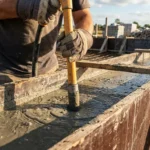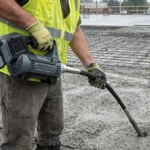
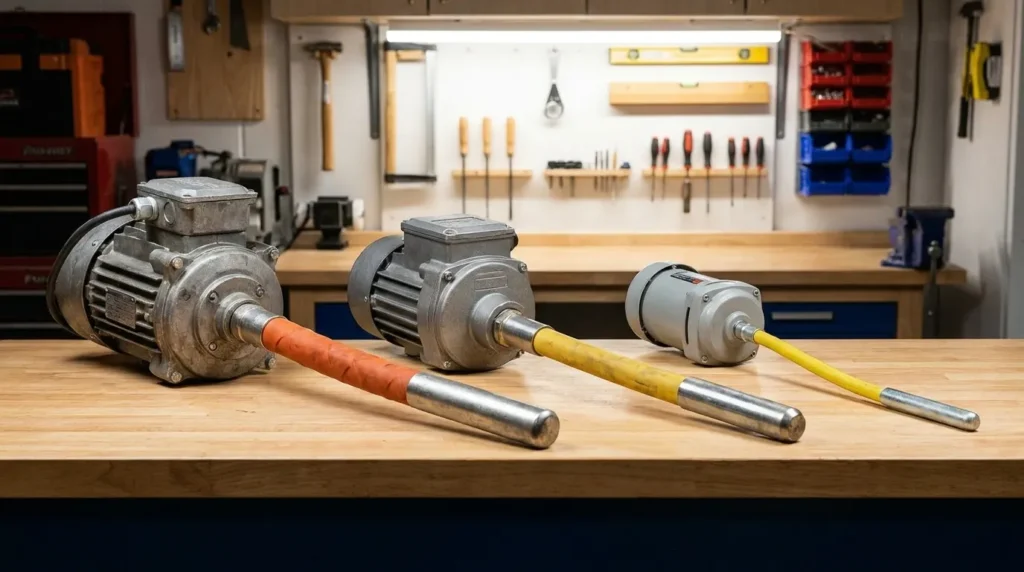

Here is something that most concrete equipment guides never say directly: two concrete vibrators with identical specifications on the box can perform completely differently on a real pour. One consolidates concrete reliably across 500 insertions on a hot summer day. The other overheats at insertion 200 and limps through the rest of the job with reduced frequency — leaving the lower half of every column underpacked.
The difference is almost always the concrete vibrator manufacturer. Motor quality, winding insulation, poker head metallurgy, rubber hose durability, and the precision of the coupling between drive unit and shaft all vary enormously between manufacturers — and none of these differences show up in a spec sheet comparison.
This guide breaks down the concrete vibrator market by manufacturer tier — professional grade, commercial grade, and budget imports — with honest assessments of each brand’s strengths, weaknesses, and the applications they actually suit. Whether you are a contractor specifying equipment for a major project or a builder looking for the best value at a sensible price point, this comparison gives you the information you need before committing to a purchase.
For rental options before committing to a purchase, see our concrete vibrator rental guide. For a full overview of how concrete vibrators work and what specifications mean, our concrete vibrator guide is the starting point.
And before your next pour, calculate your concrete volume accurately with the free concrete calculator at ConcreteCal.
Table of Contents
- Why the Manufacturer Matters More Than the Price Tag
- Tier 1 — Professional Grade Manufacturers
- Tier 2 — Commercial Grade Manufacturers
- Tier 3 — Budget and Import Manufacturers
- Concrete Vibrator Manufacturer Comparison Table
- What to Look for When Choosing a Brand
- Electric vs Gasoline — Which Manufacturer Leads Each Category?
- Frequently Asked Questions
Why the Manufacturer Matters More Than the Price Tag
A concrete vibrator is a deceptively simple piece of equipment from the outside — a motor, a flexible shaft, and a poker head. But operating at 150–300Hz under the physical stress of dense fresh concrete, in construction site conditions, repeatedly across hundreds or thousands of insertions — the engineering quality of every component determines whether the equipment lasts a season or a decade.
What Separates a Good Concrete Vibrator from a Poor One
The failure points in concrete vibrators — where cheap construction catches up with the user — cluster around four components:
Motor winding quality: The motor operates at high frequency under continuous load. Poor-quality copper windings with inadequate insulation overheat progressively — reducing vibration frequency (and therefore effectiveness) before eventually failing completely. Quality motors maintain rated frequency from the first insertion to the five-hundredth.
Rubber hose durability: The flexible shaft hose transmits the rotational energy from the motor to the poker head. It flexes continuously during use and is exposed to concrete, water, and site abrasion. Cheap rubber hoses crack, delaminate, or develop internal wire mesh failures within a season of heavy use. Quality hoses use high-carbon spring wire inner cores with multiple rubber layers and reinforcing mesh that last for years.
Poker head metallurgy: The poker head is in direct contact with fresh concrete — it experiences impact, abrasion, and the corrosive alkalinity of cement paste. Cheap poker heads wear rapidly at the tip and weld point, eventually separating from the shaft during use. Quality poker heads use hardened steel with proper welds that outlast the hose and motor.
Coupling and connection engineering: The connection between the flexible shaft and both the motor drive unit and the poker head is a mechanical stress point. Poor couplings work loose under vibration, causing energy loss and eventually complete disconnection mid-pour.
The Three Tiers of Concrete Vibrator Manufacturers
Understanding the market means understanding that concrete vibrator manufacturers divide into three distinct tiers — not by marketing claims, but by engineering specification, materials quality, and real-world durability:
Tier 1 — Professional Grade: Japanese and German manufacturers (Mikasa, Wacker Neuson) plus established US brands (Multiquip). Built for continuous professional use, long service intervals, and 10+ year service life with maintenance. Higher purchase price fully justified by durability and support.
Tier 2 — Commercial Grade: Korean brands (Ingco, Kormax) and established international brands. Built for regular professional use with good durability and reasonable after-sales support. The best value tier for contractors who pour regularly but cannot justify Tier 1 pricing.
Tier 3 — Budget Import: Chinese-manufactured brands (Gaocheng, Coofix, Prescott, and generic white-label imports). Adequate for occasional DIY use and light commercial applications where price is the primary constraint. Not suitable for continuous professional use — failure rates are higher and parts availability is inconsistent.
Tier 1 — Professional Grade Manufacturers
Mikasa (Japan)
Mikasa is the reference standard for concrete vibrators in the professional construction market — Japanese-engineered equipment with a decades-long track record on major infrastructure projects across Asia, the Middle East, and internationally.
What Mikasa does better than everyone else:
Mikasa’s high-frequency vibrators operate at genuine high frequency (300Hz+) consistently across their rated service intervals. Their motor windings use high-grade copper with superior insulation that maintains rated frequency even in high-ambient-temperature conditions — a critical performance factor on summer pours where budget motors throttle back as they heat up.
Key Mikasa product lines:
High Frequency Concrete Vibrators (FXS and FXB series):
The FXS-40K and FXS-30K are Mikasa’s flagship high-frequency units — poker diameters of 40mm and 30mm respectively, high-frequency inverter drive, with GH and GS portable concrete vibrator systems for rubber hose and steel pipe applications.
Portable Concrete Vibrators (UM series):
The UM-ZF100, UM-F23, UM-F28, UM-F32, and UM-F38 cover the full range of poker diameters from 23mm to 38mm — single-phase electric drive, robust rubber hose construction, and the motor reliability that Mikasa is known for.
GS Series (GS-28, GS-32, GS-38, GS-45, GS-60):
The GS series covers poker diameters from 28mm to 60mm — a complete professional range. The GS-60 in particular is specified for large commercial and infrastructure pours where other brands’ 60mm models show consistency issues.
Honest limitation: Mikasa equipment is not cheap. A professional Mikasa unit costs 40–80% more than an equivalent Ingco or Gaocheng product. For a contractor doing 50+ pours per year, the durability difference justifies this — for occasional use, it is harder to make the financial case.
Availability: Mikasa is distributed through specialist concrete equipment suppliers in most markets. Not widely available at general hardware stores.
Worked Example — Infrastructure Project:
A civil contractor pouring 200 reinforced concrete columns over a 6-month project in a hot climate. Specification: Mikasa GS-38, 38mm poker, high-frequency drive. The GS-38 maintains rated 300Hz frequency consistently through the full project — column 200 is consolidated as effectively as column 1. A budget vibrator on the same project would show frequency drop-off from thermal throttling by column 50–80, affecting concrete density in later pours.
Wacker Neuson (Germany)
Wacker Neuson is the European equivalent of Mikasa — German-engineered concrete vibrators with a strong reputation in European and international markets, particularly for large infrastructure and commercial construction.
Wacker Neuson strengths:
- IRFU series internal vibrators with high-frequency electric drive
- Excellent frequency stability under load — one of the best in class
- Strong global dealer and service network
- Excellent documentation and technical support
Best for: International projects, European market specifications, any application where Wacker’s global service network matters.
Pricing: Comparable to Mikasa — premium Tier 1 pricing justified by engineering quality and support infrastructure.
Multiquip (USA)
Multiquip is the dominant American professional-grade concrete vibrator brand — widely used by US contractors on commercial and infrastructure projects. Their equipment is manufactured to robust standards for American construction site conditions.
Multiquip strengths:
- Excellent availability through US equipment dealers
- Strong parts availability nationwide
- Purpose-engineered for American construction standards and electrical specifications
- Good gasoline model lineup for US remote-site construction
Best for: US-based contractors who value domestic parts availability and dealer support.
Tier 2 — Commercial Grade Manufacturers
Ingco (Korea/International)
Ingco has emerged over the past decade as the dominant commercial-grade concrete vibrator brand in developing markets — particularly South Asia, Southeast Asia, the Middle East, and Africa. Their pricing sits 30–50% below Tier 1 brands while delivering significantly better quality than budget Chinese imports.
What Ingco does well:
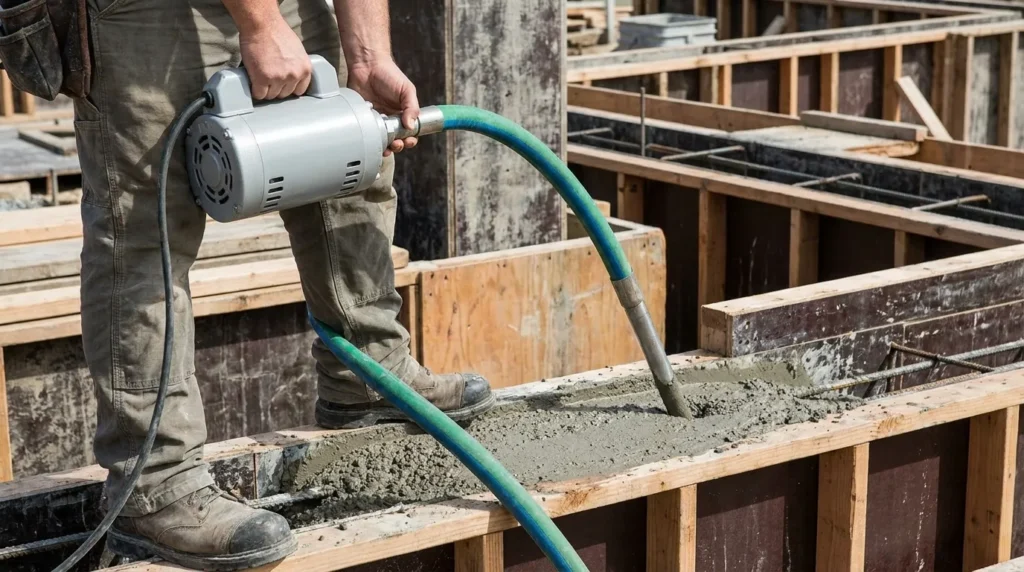
Ingco’s electric concrete vibrators — including the Cordless 20V lithium-ion model and the gasoline-powered units rated at 5.5HP and 6.5HP — offer genuine professional specification at a price point accessible to smaller contractors. Their rubber hose construction uses adequate-quality inner cores that last considerably longer than Gaocheng equivalents.
Key Ingco products:
Ingco Gasoline Concrete Vibrator: Available in 5.5HP and 6.5HP configurations, with poker diameters from 35mm to 60mm. The gasoline units are particularly popular in markets with unreliable power supply.
Ingco Cordless Concrete Vibrator (20V): A genuinely useful product for smaller pours — battery-powered, lightweight, and adequately powered for residential applications. The vibrator poker accessory sold separately allows different head sizes.
Ingco Vibrator Poker (35mm and 50mm): Compatible with Ingco drive units and some third-party motors. Good rubber hose quality for the price tier.
Honest limitation: Ingco’s high-frequency performance is not at Mikasa’s level — frequency stability under sustained load is adequate but not exceptional. For continuous high-volume commercial use, the gap with Tier 1 brands becomes noticeable over time.
Availability: Widely available through hardware and construction equipment suppliers in Asia, the Middle East, and Africa. Available online globally through major e-commerce platforms.
Kormax (Korea)
Kormax is a Korean construction equipment manufacturer with particular strength in the Pakistani and South Asian markets — their equipment is distributed through Jesco Pakistan and similar specialist importers in the region.
Kormax strengths:
- Good build quality for the price tier
- Available through specialist importers with local service capability
- Application range covers columns, slabs, raft foundations, roofs — standard civil engineering project requirements
- The Kormax range includes rubber hose type and steel pipe type portable vibrators
Worked Example — Residential Construction Site:
A Pakistani contractor building a six-storey residential building, pouring 30 columns and a raft foundation over 3 months. Specification: Kormax 45mm poker, 5m shaft, single-phase 220V electric. The Kormax delivers consistent performance through the project with one minor coupling adjustment at week 6. Total vibration time: approximately 80 hours across the project. Cost: approximately 35% less than equivalent Mikasa, with acceptable performance difference for this application.
Total Tools
Total Tools offers a range of concrete vibrators positioned in the commercial-grade tier — competitively priced with adequate specification for regular professional use in residential and light commercial construction.
Total Vibrator Poker: Interchangeable heads in standard diameters. Compatible with various Total drive units.
Total Gasoline and Lithium-Ion models: Cover the main power source options for the commercial tier.
Best for: Contractors who want reasonable quality at a price between Ingco and budget imports, with reasonable local availability in markets where Total is distributed.
Tier 3 — Budget and Import Manufacturers
Gaocheng (China)
Gaocheng is one of several Chinese manufacturers producing concrete vibrators primarily for the price-sensitive end of the market. Their products — the GC-VR15 and GC-VB50A models are their most common — represent the typical Chinese import concrete vibrator: adequate specification on paper, inconsistent real-world performance, and shorter service life than Tier 1 or Tier 2 equipment.
GC-VR15: Single-phase electric, 1,050W input power, 35mm rod, 6m shaft. A basic entry-level electric vibrator suitable for light residential use.
GC-VB50A: Higher power input, 50mm rod option. Slightly more robust than the VR15 but still Tier 3 construction quality.
Honest assessment: Gaocheng equipment works for DIY pours and infrequent contractor use. For a homeowner pouring one driveway every few years, a Gaocheng unit represents functional value. For a contractor using it daily, the higher failure rate and shorter service life mean the total cost of ownership often exceeds a Tier 2 Ingco or Kormax unit within 12–18 months.
Availability: Widely available through online marketplaces in Pakistan, South Asia, and internationally. Available through Pakistan Power Tools and similar multi-brand suppliers.
Coofix (China)
Coofix (CF-EV001 and similar models) occupies the same Tier 3 position as Gaocheng — Chinese-manufactured with competitive pricing and basic specification. The CF-EV001 electric vibrator is a standard entry-level product with single-phase operation and basic rubber hose construction.
Best for: Very light occasional use, DIY applications, or as a backup unit on a site where a primary vibrator is the main tool.
Prescott and Generic Import Brands
Prescott and similar white-label import brands — including the Vibrator Shaft 35mm×6m sold under the Prescott name — represent the lower end of the market where manufacturing quality is the least consistent.
Vibrator shafts and poker accessories from import brands are a different matter — a replacement hose or poker head from an import brand used on a Tier 1 or Tier 2 drive unit can be a cost-effective maintenance strategy, since the drive unit does the precision engineering work and the shaft is a replaceable wear item.
Concrete Vibrator Manufacturer Comparison Table
| Brand | Origin | Tier | Best For | Price Range | Availability |
|---|---|---|---|---|---|
| Mikasa | Japan | 1 — Professional | High-volume, infrastructure, hot climate | $$$$ | Specialist dealers |
| Wacker Neuson | Germany | 1 — Professional | European market, large commercial | $$$$ | International dealers |
| Multiquip | USA | 1 — Professional | US commercial, infrastructure | $$$$ | US equipment dealers |
| Ingco | Korea/Int’l | 2 — Commercial | Regular professional, developing markets | $$$ | Hardware stores, online |
| Kormax | Korea | 2 — Commercial | South Asia, regular commercial use | $$$ | Specialist importers |
| Total Tools | China/Int’l | 2 — Commercial | Light commercial, residential contractor | $$-$$$ | Hardware chains |
| Gaocheng | China | 3 — Budget | DIY, infrequent use | $$ | Online, multi-brand shops |
| Coofix | China | 3 — Budget | Occasional use, backup unit | $$ | Online |
| Prescott | China | 3 — Budget | Accessories/shafts as replacements | $ | Online |
Price key: $ = lowest, $$$$ = highest within concrete vibrator market
What to Look for When Choosing a Concrete Vibrator Brand
Motor and Power Specifications
The rated power (watts or HP) tells you about the drive unit capacity, but the quality of that motor — winding grade, insulation class, thermal protection — determines whether it actually delivers that power consistently across a long day’s work.
What to ask: Does the manufacturer publish thermal protection specifications? Does the motor have overload protection that prevents damage (not just triggers shutdown)? What is the insulation class of the motor windings?
Tier 1 manufacturers publish these specifications and build to them consistently. Tier 3 manufacturers often list specifications that reflect theoretical design values rather than consistent production reality.
Vibration Frequency and Amplitude
Vibration frequency (Hz) and amplitude (mm) together determine the effective radius of concrete consolidation. Higher frequency (300Hz+) with appropriate amplitude consolidates concrete faster and more uniformly than lower frequency equipment.
The frequency stability question: A vibrator that achieves 300Hz at no-load but drops to 220Hz under load in warm conditions is not a 300Hz vibrator in practice. Only Tier 1 manufacturers reliably maintain rated frequency under full operating conditions.
For a full explanation of frequency, amplitude, and how they affect concrete consolidation, see our types of concrete vibrators guide.
Shaft and Poker Quality
The flexible shaft is the highest-wear component — it flexes continuously under high-frequency vibration in contact with corrosive concrete. Specification points that matter:
- Inner core: High-carbon spring wire (Tier 1 and 2) vs. standard wire (Tier 3)
- Outer rubber: Multi-layer with reinforcing mesh (Tier 1) vs. single-layer (Tier 3)
- Poker tip weld: Continuous bead weld (Tier 1) vs. spot weld (Tier 3)
- Rubber head cap: Present and properly bonded on Tier 1 and 2 equipment
Worked Example — Shaft Replacement Cost Comparison:
A contractor uses a concrete vibrator for 3 years of commercial work. Tier 1 Mikasa shaft: lasts 2–3 seasons, replaced once at $150–$200. Tier 3 Gaocheng shaft: replaced twice per season at $30–$50 each = $180–$300 over 3 years. At high use, shaft replacement cost is comparable — but the Tier 3 failures happen mid-project, not at convenient service intervals.
Warranty and After-Sales Support
This is where the manufacturer tier distinction matters most for purchasing decisions:
| Tier | Typical Warranty | Parts Availability | Service Network |
|---|---|---|---|
| 1 (Mikasa, Wacker) | 12–24 months commercial | 10+ years | Dealer network globally |
| 2 (Ingco, Kormax) | 6–12 months | 3–5 years | Regional importers |
| 3 (Gaocheng, Coofix) | 3–6 months (if any) | 1–2 years max | Online only, inconsistent |
A concrete vibrator that fails on day 200 of a project with no local parts availability and no service support is an expensive problem. Tier 1 and 2 manufacturers’ dealer networks mean a replacement part is typically available within 24–72 hours.
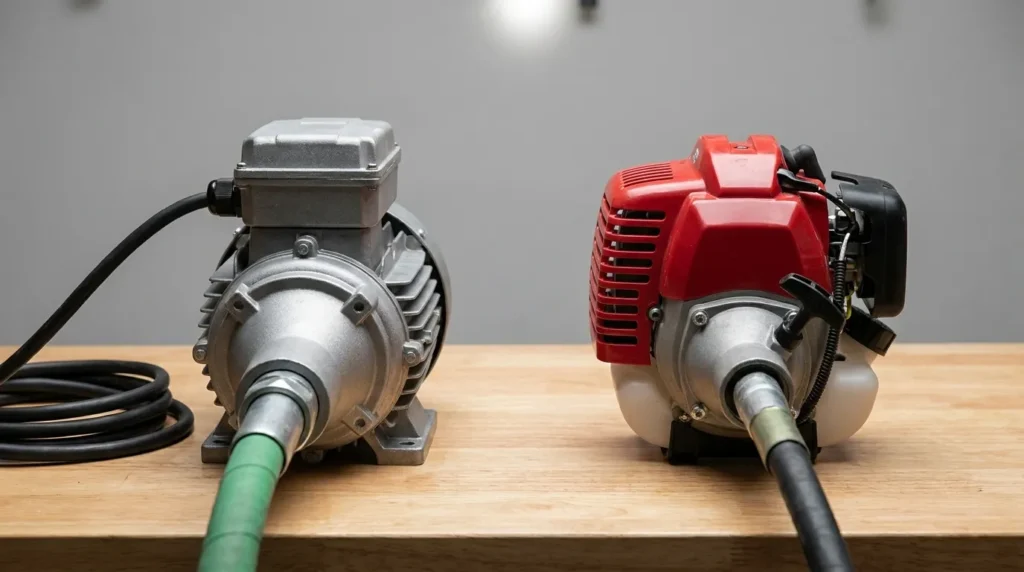
Electric vs Gasoline — Which Manufacturer Leads Each Category?
Electric Concrete Vibrators — Brand Leaders
Professional tier: Mikasa’s UM and GS series electric vibrators are the reference standard for high-frequency single-phase electric units. Wacker Neuson’s IRFU series competes at the same level for European markets.
Commercial tier: Ingco’s electric range offers the best value in this category — adequate frequency stability, good rubber hose quality, and pricing that makes commercial-grade electric vibration accessible. The Ingco 1,600W Electric Concrete Vibrator represents this tier well — a genuine commercial-grade specification at a price point that makes sense for contractors who pour regularly but cannot justify Mikasa pricing. It delivers 1,600W input power with a reliable motor, making it one of the strongest value propositions in the electric vibrator market for regular professional use.
Budget tier: Gaocheng’s GC-VR15 is the entry point — functional for infrequent use, not built for sustained professional application.
Gasoline Concrete Vibrators — Brand Leaders
Professional tier: Multiquip and Wacker Neuson lead the gasoline market for professional applications — American and European construction standards, robust engines, strong dealer support for parts and service.
Commercial tier: Ingco’s gasoline models (5.5HP and 6.5HP) offer good value for contractors in markets where the professional brands are not readily available or the price premium is not justified. Kormax gasoline models are an alternative in South Asian markets where Kormax distribution is established.
Budget tier: Gaocheng gasoline units (GC-VB50A and similar) — functional for light commercial and occasional use. Engine quality (typically Chinese OEM sourcing) is the limiting factor compared to Ingco’s more consistent engine specification.
Frequently Asked Questions
Which concrete vibrator manufacturer is best?
For professional and high-volume use, Mikasa (Japan) is the reference standard — consistent high-frequency performance, durable construction, and 10+ year service life with proper maintenance. For commercial-grade value, Ingco offers the best balance of specification and price. For occasional DIY use, Gaocheng or Coofix are functional at lower cost. The right answer depends on your usage frequency and total cost of ownership, not just purchase price.
Is Mikasa concrete vibrator worth the premium price?
For contractors doing 30+ pours per year in hot climates or on demanding infrastructure projects — yes, clearly. The frequency stability, motor durability, and parts availability justify the 40–80% price premium over Tier 2 alternatives over a 3–5 year ownership period. For contractors doing 5–10 pours per year, the Ingco or Kormax range typically delivers adequate performance at significantly lower upfront cost.
What is the difference between Japanese and Chinese concrete vibrators?
The primary differences are motor winding quality (affecting frequency stability under load), rubber hose construction (affecting service life), poker metallurgy (affecting wear resistance), and coupling engineering (affecting energy transfer efficiency). Japanese manufacturers like Mikasa consistently outperform Chinese import brands on all four parameters under sustained professional use. The gap is most visible under continuous high-ambient-temperature operation.
Where are Ingco concrete vibrators made?
Ingco is a Korean-founded international brand with manufacturing in multiple countries including China. Their concrete vibrators are manufactured to Korean-designed specifications, which is why their quality is consistently above pure Chinese import brands despite competitive pricing.
How long should a concrete vibrator last?
Tier 1 professional equipment (Mikasa, Wacker Neuson): 8–15 years with regular maintenance. Tier 2 commercial equipment (Ingco, Kormax): 3–7 years with regular maintenance. Tier 3 budget equipment: 1–3 years under professional use, longer for occasional DIY applications. The shaft (rubber hose) is always the first wear component — factor shaft replacement into total cost of ownership for any tier.
What size concrete vibrator do most manufacturers produce?
Most manufacturers offer poker diameters from 28mm to 60mm — covering the full range from decorative thin-section concrete to mass concrete infrastructure. Standard commercial diameters are 35mm, 38mm, 45mm, and 50mm. The 38mm (1.5-inch) size is the most commonly rented and sold size for residential and light commercial applications.
Can I use any brand’s shaft with a different brand’s drive unit?
Generally, no — shaft coupling dimensions and thread specifications vary between manufacturers. Mikasa shafts use Mikasa-specific couplings. Ingco shafts couple to Ingco drive units. Some Chinese import shafts use standardised “Japan type” coupling dimensions that may be cross-compatible between budget brands. Always confirm compatibility before purchasing replacement shafts from a different brand than your drive unit.
Conclusion
Choosing a concrete vibrator manufacturer is a decision about total cost of ownership, not just purchase price. Mikasa and Wacker Neuson command premium prices for engineering quality that pays for itself over years of professional use. Ingco and Kormax offer the sweet spot for contractors who need genuine commercial performance at accessible pricing. Gaocheng and Coofix serve the budget and DIY market adequately for their intended use case. Buy the tier that matches your actual usage frequency — not the most expensive equipment you can justify, and not the cheapest equipment that will cost you more in replacements and mid-project failures. For the commercial tier, the 1,600W electric concrete vibrator available on Amazon represents the kind of specification that bridges Tier 2 and professional performance at a price point that makes purchasing over renting viable for regular users.
For full guidance on how concrete vibrators work and the technical specifications behind these brand differences, start with our concrete vibrator guide. To compare vibrator types before deciding on a brand, see our types of concrete vibrators post. And for projects where rental is the right choice, our concrete vibrator rental guide covers everything you need.
Calculate your concrete pour volumes before any project with the ConcreteCal free concrete calculator.