


A concrete mix ratio tells you the proportion of each ingredient — cement, sand, and coarse aggregate — that goes into a batch of concrete. It is the recipe the mix follows. Change the ratio and you change the strength, the workability, the durability, and the cost.
Concrete mix ratios are written in the format C:S:A — cement:sand:aggregate. A 1:2:4 ratio means one part cement, two parts sand, four parts aggregate by volume. That ratio produces a different concrete than 1:1.5:3 — stronger, denser, and more cement-intensive.
Knowing which ratio to use, why it matters, and how to calculate the ingredient quantities from it is the foundation of any mix design decision — whether you are batching from raw materials or specifying a ready mix order.
Use our concrete bag calculator for bag count from your mix volume, and our companion guide on how to calculate the amount of concrete needed for the full volume-to-ingredients calculation process.
Table of Contents
- What Is a Concrete Mix Ratio?
- Standard Concrete Mix Ratios by Grade
- US Concrete Mix Ratios — PSI Equivalents
- How Mix Ratio Affects Concrete Strength
- Concrete Mix Ratios for Specific Applications
- How to Calculate Ingredient Quantities from a Mix Ratio
- Common Concrete Mix Ratio Mistakes
- Frequently Asked Questions
What Is a Concrete Mix Ratio and What Does It Tell You?
A concrete mix ratio is a shorthand description of the relative proportions of cement, fine aggregate (sand), and coarse aggregate in a concrete mix. It tells you — before a single bag is opened — what the concrete will be made of, and from that, what it will be capable of.
The ratio 1:1.5:3, for example, means:
- 1 part cement
- 1.5 parts sand
- 3 parts coarse aggregate
These are volume parts — measured by the same container (a bucket, a shovel, a cubic metre). The concrete produced by this ratio has known properties: approximately 3,000 PSI compressive strength at 28 days, adequate workability for standard residential applications, and durability suitable for driveways, floors, and footings.
Volume Ratio vs. Weight Ratio
Mix ratios can be expressed by volume or by weight. The standard nominal mixes (M10–M25) use volume ratios — the same container is used to measure each ingredient. Design mixes typically specify weight ratios because weight is more precisely measured.
For practical batching: Volume ratios are more convenient — measure each ingredient with the same bucket, wheelbarrow, or shovel. One bucket of cement, 1.5 buckets of sand, 3 buckets of aggregate for M20. Straightforward.
For structural engineering: Weight ratios are more accurate because aggregate density varies — the same volume of different aggregate types has different weights. For any engineered mix, confirm whether the ratio is by volume or weight before batching.
Nominal Mix vs. Design Mix
Nominal mix: Standard pre-specified ratios used without detailed calculation. Appropriate for residential, light commercial, and non-critical structural applications. Governed by local standards and codes.
Design mix: Engineered from scratch for specific requirements — target strength, specific aggregate, environmental exposure class, durability requirements. Requires mix design calculations, trial batches, and laboratory testing. Used for major infrastructure, high-rise construction, and any structural concrete above standard specification.
For residential and light commercial work — driveways, patios, garage floors, standard footings — nominal mixes are always adequate and are the focus of this guide.
Standard Concrete Mix Ratios by Grade
M10 Mix Ratio (1:3:6)
Ratio: 1 part cement : 3 parts sand : 6 parts aggregate Compressive strength: 10 MPa (approximately 1,450 PSI) at 28 days Water-cement ratio: 0.60–0.65
M10 is the weakest standard mix — used only for non-structural applications where concrete provides a clean working surface or fill material, not structural load capacity.
Applications:
- Blinding layer beneath structural foundations (thin layer of weak concrete covering subgrade)
- Non-structural fills and leveling courses
- Temporary works concrete
What it is not for: Any application where the concrete carries load — slabs, driveways, footings, walls. M10 is too weak for structural use in any residential application.
M15 Mix Ratio (1:2:4)
Ratio: 1 part cement : 2 parts sand : 4 parts aggregate Compressive strength: 15 MPa (approximately 2,175 PSI) at 28 days Water-cement ratio: 0.55–0.60
M15 is the lowest strength suitable for non-structural concrete elements that are not subject to significant load — plain concrete paths, decorative elements, and non-traffic surfaces.
Applications:
- Garden paths with light foot traffic only
- Non-structural partition bases
- Concrete planters and decorative elements
Still not suitable for: Vehicle traffic, structural footings, or any application requiring compressive strength above 2,175 PSI. US residential codes typically require minimum 2,500 PSI (approximately M17) for any flatwork.
Worked Example — M15 for a garden path: A 3×12 ft garden stepping stone path, 3.5 inches thick.
Volume: 3 × 12 × 0.292 = 10.5 ft³ = 0.39 yd³ With 10% waste: 0.43 yd³ → approximately 19 bags of 80 lb pre-mix
M20 Mix Ratio (1:1.5:3)
Ratio: 1 part cement : 1.5 parts sand : 3 parts aggregate Compressive strength: 20 MPa (approximately 2,900 PSI) at 28 days Water-cement ratio: 0.50–0.55
M20 is the standard residential mix — the ratio used for the overwhelming majority of residential concrete work in the US and internationally. It provides adequate strength for all standard residential applications without unnecessary cost from excess cement.
Applications:
- Residential driveway slabs
- Garage floors
- Patio slabs
- Residential footings and foundation slabs
- Garden walls and retaining walls under 4 feet
Worked Example — M20 for a garage floor: A 24×24 ft garage, 5 inches thick.
Volume: 24 × 24 × 0.417 = 240.2 ft³ ÷ 27 = 8.9 yd³ With 10% waste: 9.79 → order 10 yards of 3,000 PSI ready mix
Specifying 3,000 PSI to a ready mix supplier is the US equivalent of requesting M20 concrete.
M25 Mix Ratio (1:1:2)
Ratio: 1 part cement : 1 part sand : 2 parts aggregate Compressive strength: 25 MPa (approximately 3,625 PSI) at 28 days Water-cement ratio: 0.45–0.50
M25 is the standard for structural concrete elements in residential construction — columns, beams, structural walls, and any element carrying significant imposed loads.
Applications:
- Structural columns and beams
- Load-bearing walls
- Bridge abutments
- Driveways subject to heavy commercial vehicle traffic
- Foundation elements for multi-storey structures
Key characteristic: M25 uses a 1:1 cement-to-sand ratio — equal parts cement and sand. This higher cement content increases compressive strength but also increases cost compared to M20. Specify M25 only where the additional strength is structurally required.
M30 and Above — Design Mix Territory
M30 (approximately 4,350 PSI) and higher grades exceed what nominal mixes reliably produce — the higher cement content and lower water-cement ratio require careful mix design and quality control that goes beyond field batching.
For M30 and above: Specify a design mix from a concrete supplier or structural engineer. Provide the target strength class, exposure conditions, and required workability. The supplier batches to specification using quality-controlled ingredients and laboratory testing.
Residential DIY batching to M30 or higher is not recommended — the margin for error at high cement contents produces concrete that may fall significantly short of its intended strength without the quality control infrastructure a concrete plant provides.
“For structural concrete above M25, mix design must follow ACI 211.1 — Standard Practice for Selecting Proportions for Normal, Heavyweight, and Mass Concrete — which provides the complete methodology for engineered mix design including aggregate optimization and admixture selection.”
US Concrete Mix Ratios — PSI Equivalents
US specifications use PSI (pounds per square inch) rather than MPa or M-grade designations. The conversion:
| US Specification | PSI | Metric Grade | Mix Ratio | Common Use |
|---|---|---|---|---|
| Standard residential | 2,500 PSI | ~M17 | 1:2:3.5 | Sidewalks, light slabs |
| Standard structural | 3,000 PSI | M20 | 1:1.5:3 | Driveways, garage floors |
| Heavy residential | 3,500 PSI | ~M23 | 1:1.3:2.6 | Heavy driveways, foundations |
| Structural | 4,000 PSI | M25–M27 | 1:1:2 | Columns, structural beams |
| High strength | 5,000 PSI | M30+ | Design mix | Commercial, infrastructure |
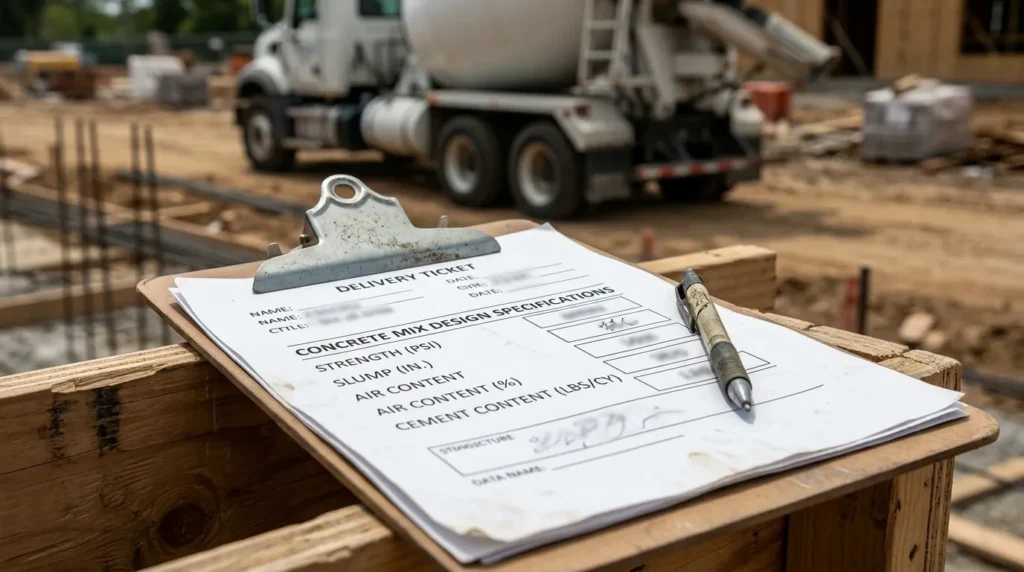
When calling a ready mix supplier: Give them the PSI specification, not the M-grade designation. “3,000 PSI with air entrainment for freeze-thaw” is the standard US residential specification — equivalent to M20 with air entrainment.
How Mix Ratio Affects Concrete Strength
Water-Cement Ratio — The Most Important Variable
Of all the variables in concrete mix design, the water-cement (w/c) ratio has the greatest impact on compressive strength. This relationship was established by Duff Abrams in 1918 and remains the fundamental principle of concrete mix design.
The rule: Lower w/c ratio = higher strength. Higher w/c ratio = lower strength.
| w/c Ratio | Approximate 28-Day Strength | Notes |
|---|---|---|
| 0.35–0.40 | 5,000–6,000+ PSI | High strength, low workability |
| 0.40–0.45 | 4,000–5,000 PSI | Structural, requires plasticizer |
| 0.45–0.50 | 3,000–4,000 PSI | Standard residential range |
| 0.50–0.55 | 2,500–3,000 PSI | Acceptable residential minimum |
| 0.55–0.65 | 2,000–2,500 PSI | Marginal — lean mixes only |
The practical implication: Never add extra water to improve workability. Adding water beyond the specified ratio reduces strength. If workability is insufficient, add a chemical plasticizer (water reducer) — it improves flow without adding water or reducing strength.
Aggregate Size and Ratio
Coarse aggregate size affects the amount of paste needed to coat each particle — smaller aggregate has more surface area per unit volume, requiring more paste and therefore more cement to achieve the same bond.
Standard aggregate sizes:
- 3/4 inch (20mm): Standard for structural concrete — slabs, beams, columns
- 3/8 inch (10mm): Used where reinforcement is congested or sections are thin
- 1.5 inch (40mm): Mass concrete — dams, large foundations
The aggregate size is specified alongside the mix ratio — 1:1.5:3 with 3/4-inch aggregate is a different mix from 1:1.5:3 with 3/8-inch aggregate, even though the ratio is identical.
Concrete Mix Ratios for Specific Applications
Driveway Mix Ratio
Specification: 1:1.5:3 (M20) with air entrainment in freeze-thaw climates PSI: 3,000–3,500 minimum; 4,000 preferred for vehicle loads Water-cement ratio: 0.45–0.50
Driveways require higher strength than patios because vehicle wheel loads create higher stress concentrations in the slab. In freeze-thaw climates, air entrainment (4–7% entrained air by volume) is non-negotiable — it provides microscopic voids that accommodate ice expansion and prevent surface scaling.
Worked Example — Driveway Mix Specification: A 16×40 ft two-car driveway, 5 inches thick, northern US climate.
Specification: 4,000 PSI, air-entrained (6%), 3/4-inch aggregate, w/c = 0.45 Equivalent ratio: approximately 1:1.3:2.6 (higher cement content for 4,000 PSI) Volume: 16 × 40 × 0.417 ÷ 27 × 1.10 = 10.9 → order 11 yards
Foundation and Structural Mix
Specification: 1:1:2 (M25) for columns and load-bearing elements PSI: 3,500–4,000 minimum; structural engineer specifies for critical elements Water-cement ratio: 0.45 maximum
Structural elements carry loads that would crack or crush weaker concrete. The higher cement content in M25 provides the compressive strength reserve needed for columns, beams, and heavily loaded foundations.
Key note: For any structural element — column bases, moment frames, retaining walls over 4 feet — a structural engineer should specify the mix. The mix ratio in this guide is a starting point for understanding, not a substitute for engineering design.
Patio and Walkway Mix
Specification: 1:1.5:3 (M20) standard; 1:2:4 (M15) acceptable for light-traffic paths PSI: 2,500–3,000 minimum Water-cement ratio: 0.50–0.55
Patios and walkways carry only foot traffic and light furniture loads — significantly less demanding than driveways or structural applications. M20 provides a generous safety margin; M15 is adequate for truly light-use paths away from vehicles.
Post Holes and Fence Posts
Specification: Fast-setting pre-mix or standard M15–M20 Special consideration: Many post installations use fast-setting concrete (Quikrete Fast-Set type) that sets in 20–40 minutes — the dry product is poured directly into the hole and water added in place. No mixing ratio calculation needed for pre-mixed products.
For post holes batched from raw materials:
- M15 (1:2:4) is adequate — the post holds the structural load, not the concrete
- The concrete’s job is to anchor the post in position, not carry loads
How to Calculate Ingredient Quantities from a Mix Ratio
Once you have your mix ratio and concrete volume, the ingredient calculation follows a standard sequence. The full detailed worked example appears in our companion post on how to calculate the amount of concrete needed — here is the quick-reference summary:
- Calculate wet concrete volume (length × width × thickness ÷ 27)
- Apply dry volume factor (multiply by 1.54)
- Calculate each ingredient fraction (ingredient parts ÷ total parts)
- Multiply fraction × dry volume = ingredient volume
- Convert to weight using bulk density (cement ~94 lbs/ft³, sand and aggregate ~100 lbs/ft³)
Quick example — M20, 1 cubic yard:
Dry volume: 1 × 1.54 = 1.54 yd³ Cement fraction: 1 ÷ 5.5 = 0.182 × 1.54 = 0.280 yd³ × 94 lbs/ft³ × 27 = 710 lbs = 7.6 bags Sand: 1.5 ÷ 5.5 = 0.273 × 1.54 × 27 × 100 = 1,135 lbs Aggregate: 3 ÷ 5.5 = 0.545 × 1.54 × 27 × 100 = 2,267 lbs
Common Concrete Mix Ratio Mistakes
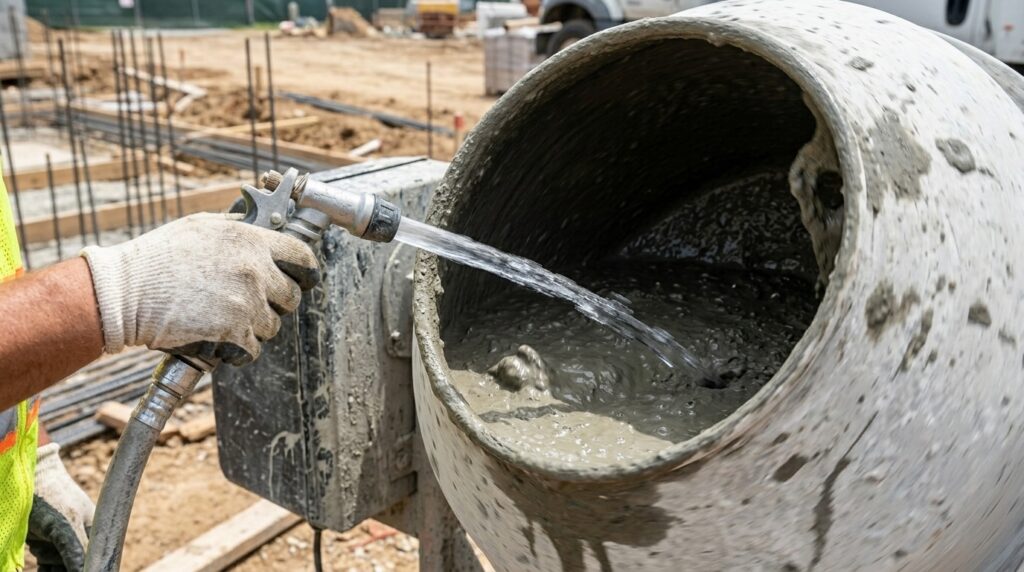
Mistake 1 — Adding too much water. The most common and most damaging error. Extra water improves workability but reduces strength. A mix designed for 0.50 w/c ratio that receives 0.65 w/c loses approximately 25–30% of its design strength. Never add water beyond the specified ratio.
Mistake 2 — Using the wrong ratio for the application. M15 for a driveway produces concrete that will crack and spall under vehicle loads within a few years. M20 for a structural column may not provide the compressive strength the load calculation assumed. Match ratio to application.
Mistake 3 — Ignoring the dry volume factor. Skipping the 1.54 factor means calculating ingredient quantities for 35% less material than you actually need. The mix will run short before the pour is complete.
Mistake 4 — Using volume ratios as weight ratios. 1:1.5:3 by volume is not the same as 1:1.5:3 by weight — cement is denser than sand, which is denser than some aggregates. If your ratio is specified by weight, measure by weight, not volume.
Mistake 5 — Not accounting for aggregate moisture. Aggregate stored outdoors absorbs moisture. Wet aggregate already contains some of the mix water — adding the full calculated water amount produces a mix that is too wet. Check aggregate moisture and reduce water accordingly.
Frequently Asked Questions
What is a 1:2:3 concrete mix used for?
A 1:2:3 ratio (1 cement:2 sand:3 aggregate) produces approximately 3,500 PSI concrete — stronger than M20 (1:1.5:3) and suitable for driveways, footings, and any residential structural application. It is a common US residential specification slightly stronger than the standard M20 mix.
What is the strongest concrete mix ratio?
Within nominal mixes, 1:1:2 (M25) is the strongest — approximately 3,600 PSI at 28 days. Beyond this, design mixes achieve higher strengths by optimising aggregate gradation, reducing water-cement ratio with plasticizers, and using supplementary materials like silica fume. High-performance concrete can exceed 10,000 PSI with engineering design.
What mix ratio should I use for a driveway?
1:1.5:3 (M20, approximately 3,000 PSI) is the minimum for a residential driveway. In freeze-thaw climates or for driveways that receive heavy vehicles, 1:1.3:2.6 (approximately 3,500–4,000 PSI) with air entrainment is better. In the US, specify “4,000 PSI air-entrained” to your ready mix supplier.
What is the difference between M20 and M25 concrete?
M20 (1:1.5:3) produces approximately 2,900 PSI — standard for residential slabs, floors, and non-critical footings. M25 (1:1:2) produces approximately 3,600 PSI — required for structural columns, beams, and heavily loaded foundations. M25 uses more cement per cubic yard, making it more expensive.
How does the water-cement ratio affect concrete strength?
The w/c ratio is the primary determinant of concrete strength — lower ratio produces stronger concrete. A w/c of 0.45 produces approximately 4,000 PSI. A w/c of 0.55 produces approximately 3,000 PSI. Every 0.05 increase in w/c ratio reduces strength by approximately 500 PSI. Never add extra water to improve workability — use a chemical plasticizer instead.
Can I mix concrete without aggregate?
Yes — this is called cement paste (cement + water) or mortar (cement + sand + water). Pure cement paste is used for some repair applications. Mortar (without coarse aggregate) is used for masonry, tile setting, and thin-section repairs. Neither is appropriate as a substitute for concrete in load-bearing applications — coarse aggregate provides the bulk strength and reduces cost.
What is the mix ratio for post-hole concrete?
For post holes, M15 (1:2:4) or fast-setting pre-mix is adequate — the structural load is carried by the post, not the concrete. For critical structural posts (deck posts carrying floor loads, gate posts), use M20 (1:1.5:3) for added security. Many contractors use fast-setting dry-pour concrete for all post holes — pour dry, add water in place, set in 20–40 minutes.
Conclusion
The mix ratio is the recipe your concrete follows — and the recipe determines everything that matters about the finished material: strength, durability, cost, and workability. M20 (1:1.5:3) covers the vast majority of residential applications. M25 (1:1:2) handles structural elements. M15 (1:2:4) works for non-structural paths and blinding. The water-cement ratio is the variable that most affects strength — keep it at 0.50 or below for any application that carries load, and never add excess water to improve workability. For ingredient quantities from your chosen ratio, use the worked examples in our guide on how to calculate the amount of concrete needed — and check bag counts with our concrete bag calculator before ordering.