
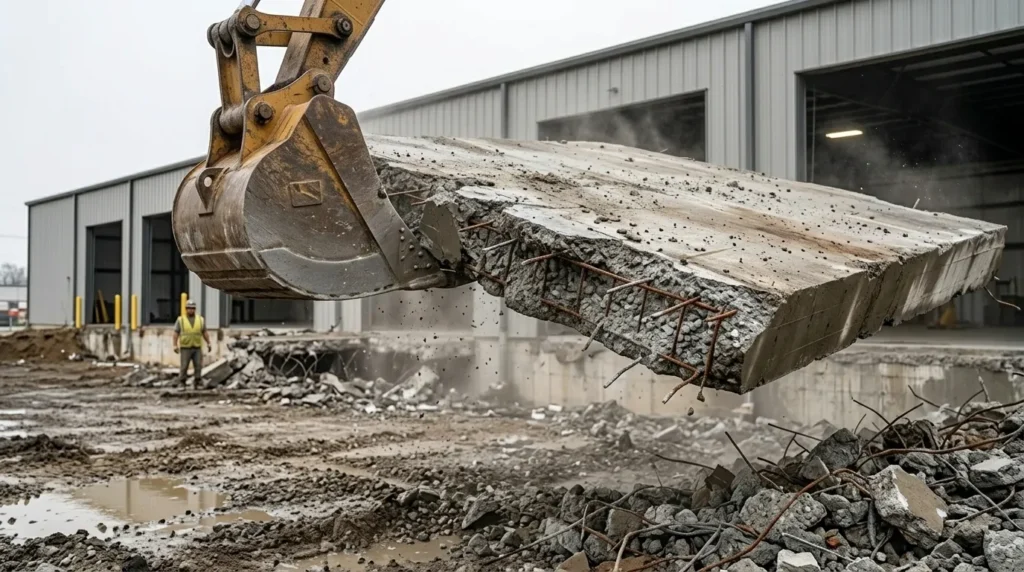

Concrete is heavier than most people expect — and underestimating slab weight creates real problems. Order a dumpster too small for a demolition job and you’ll pay overweight fees. Underestimate dead load on a structural floor and the engineering calculations are wrong. Hire a crane or telehandler without knowing the panel weight and you risk exceeding the equipment’s rated capacity.
How much a slab of concrete weighs depends on two things: its volume (length × width × thickness) and the density of the concrete mix — standardly 150 lbs per cubic foot for normal-weight concrete. Everything else is arithmetic.
This guide gives you the formula, the worked examples, and complete weight tables for every common slab size and thickness — so you can find the weight of your specific slab without manual calculation.
For weight calculations in kilograms, tons, or cubic meters, use our full concrete weight calculator — it handles all unit conversions instantly.
Table of Contents
- How to Calculate the Weight of a Concrete Slab
- How Much Does a Concrete Slab Weigh by Thickness?
- Concrete Slab Weight Tables by Common Size
- How Much Does a Concrete Slab Weigh by Application?
- Circular Slab Weight
- Why Concrete Slab Weight Matters
- Frequently Asked Questions
How to Calculate the Weight of a Concrete Slab
The formula is straightforward — the only requirement is consistent units.
The Weight Formula
Weight = Length (ft) × Width (ft) × Thickness (ft) × 150 lbs
The 150 lbs figure is the standard density of normal-weight concrete — 150 lbs per cubic foot. This is the value used by structural engineers worldwide for dead load calculations.
Step-by-step:
- Convert thickness from inches to feet: inches ÷ 12
- Multiply: Length × Width × Thickness (ft) = cubic feet
- Multiply cubic feet × 150 = weight in pounds
- Divide by 2,000 for US tons; divide by 2,204.6 for metric tons
Worked Example — 10×10 ft Patio, 4 inches thick:
- Thickness: 4 ÷ 12 = 0.333 ft
- Volume: 10 × 10 × 0.333 = 33.3 cubic feet
- Weight: 33.3 × 150 = 5,000 lbs
- In tons: 5,000 ÷ 2,000 = 2.5 US tons
Simple — and the same formula works for any rectangular slab regardless of size.
Converting Units — Feet, Inches, and Yards
The most common calculation error is mixing units. All dimensions must be in feet before multiplying.
| Measurement | Convert To Feet By |
|---|---|
| Inches | ÷ 12 |
| Yards | × 3 |
| Millimeters | ÷ 304.8 |
| Centimeters | ÷ 30.48 |
| Meters | × 3.2808 |
Common thickness conversions:
| Thickness | In Feet |
|---|---|
| 3 inches | 0.250 ft |
| 3.5 inches | 0.292 ft |
| 4 inches | 0.333 ft |
| 5 inches | 0.417 ft |
| 6 inches | 0.500 ft |
| 8 inches | 0.667 ft |
| 10 inches | 0.833 ft |
| 12 inches | 1.000 ft |
How Much Does a Concrete Slab Weigh by Thickness?
Thickness is the most important variable in slab weight — double the thickness and you double the weight.
Weight Per Square Foot by Thickness
This table tells you how much one square foot of concrete weighs at each standard thickness — multiply by your slab’s area to get total weight.
| Thickness | Weight Per sq ft | Weight Per sq yd |
|---|---|---|
| 3 inches | 37.5 lbs | 337.5 lbs |
| 3.5 inches | 43.75 lbs | 393.75 lbs |
| 4 inches | 50 lbs | 450 lbs |
| 4.5 inches | 56.25 lbs | 506.25 lbs |
| 5 inches | 62.5 lbs | 562.5 lbs |
| 6 inches | 75 lbs | 675 lbs |
| 7 inches | 87.5 lbs | 787.5 lbs |
| 8 inches | 100 lbs | 900 lbs |
| 10 inches | 125 lbs | 1,125 lbs |
| 12 inches | 150 lbs | 1,350 lbs |
Quick reference rule:
- 4-inch slab = 50 lbs per square foot
- 6-inch slab = 75 lbs per square foot
- 8-inch slab = 100 lbs per square foot
These three numbers are worth memorizing — they cover the vast majority of residential and commercial slab applications.
Why Thickness Has the Biggest Impact
A 10×10 ft slab at different thicknesses:
| Thickness | Weight | Tons |
|---|---|---|
| 3 inches | 3,750 lbs | 1.88 tons |
| 4 inches | 5,000 lbs | 2.50 tons |
| 6 inches | 7,500 lbs | 3.75 tons |
| 8 inches | 10,000 lbs | 5.00 tons |
| 12 inches | 15,000 lbs | 7.50 tons |
The same 100 sq ft footprint weighs 3,750 lbs at 3 inches or 15,000 lbs at 12 inches — a 4× difference driven entirely by thickness.
Concrete Slab Weight Tables by Common Size
Small Slabs (Under 100 sq ft)
| Slab Size | Area | 3.5″ Thick | 4″ Thick | 6″ Thick |
|---|---|---|---|---|
| 4 ft × 4 ft | 16 sq ft | 700 lbs | 800 lbs | 1,200 lbs |
| 4 ft × 8 ft | 32 sq ft | 1,400 lbs | 1,600 lbs | 2,400 lbs |
| 6 ft × 6 ft | 36 sq ft | 1,575 lbs | 1,800 lbs | 2,700 lbs |
| 8 ft × 8 ft | 64 sq ft | 2,800 lbs | 3,200 lbs | 4,800 lbs |
| 8 ft × 10 ft | 80 sq ft | 3,500 lbs | 4,000 lbs | 6,000 lbs |
| 10 ft × 10 ft | 100 sq ft | 4,375 lbs | 5,000 lbs | 7,500 lbs |
Medium Slabs (100–400 sq ft)
| Slab Size | Area | 4″ Thick | 5″ Thick | 6″ Thick |
|---|---|---|---|---|
| 10 ft × 12 ft | 120 sq ft | 6,000 lbs | 7,500 lbs | 9,000 lbs |
| 10 ft × 16 ft | 160 sq ft | 8,000 lbs | 10,000 lbs | 12,000 lbs |
| 12 ft × 16 ft | 192 sq ft | 9,600 lbs | 12,000 lbs | 14,400 lbs |
| 16 ft × 16 ft | 256 sq ft | 12,800 lbs | 16,000 lbs | 19,200 lbs |
| 16 ft × 20 ft | 320 sq ft | 16,000 lbs | 20,000 lbs | 24,000 lbs |
| 20 ft × 20 ft | 400 sq ft | 20,000 lbs | 25,000 lbs | 30,000 lbs |

Large Slabs (400+ sq ft)
| Slab Size | Area | 4″ Thick | 5″ Thick | 6″ Thick |
|---|---|---|---|---|
| 20 ft × 24 ft | 480 sq ft | 24,000 lbs (12 tons) | 30,000 lbs (15 tons) | 36,000 lbs (18 tons) |
| 24 ft × 24 ft | 576 sq ft | 28,800 lbs (14.4 tons) | 36,000 lbs (18 tons) | 43,200 lbs (21.6 tons) |
| 20 ft × 30 ft | 600 sq ft | 30,000 lbs (15 tons) | 37,500 lbs (18.75 tons) | 45,000 lbs (22.5 tons) |
| 24 ft × 30 ft | 720 sq ft | 36,000 lbs (18 tons) | 45,000 lbs (22.5 tons) | 54,000 lbs (27 tons) |
| 30 ft × 40 ft | 1,200 sq ft | 60,000 lbs (30 tons) | 75,000 lbs (37.5 tons) | 90,000 lbs (45 tons) |
| 40 ft × 60 ft | 2,400 sq ft | 120,000 lbs (60 tons) | 150,000 lbs (75 tons) | 180,000 lbs (90 tons) |
These numbers make clear why large slab demolition is a major hauling operation. A standard 24×24 ft garage floor at 5 inches thick weighs 36,000 lbs — 18 tons of debris when broken out.
How Much Does a Concrete Slab Weigh by Application?
Patio Slab Weight
A standard residential patio is typically 4 inches thick and ranges from 200 to 400 square feet.
| Patio Size | Thickness | Weight | Tons |
|---|---|---|---|
| 10 ft × 16 ft | 4 inches | 8,000 lbs | 4.0 tons |
| 12 ft × 16 ft | 4 inches | 9,600 lbs | 4.8 tons |
| 16 ft × 20 ft | 4 inches | 16,000 lbs | 8.0 tons |
| 20 ft × 20 ft | 4 inches | 20,000 lbs | 10.0 tons |
| 20 ft × 24 ft | 4 inches | 24,000 lbs | 12.0 tons |
Worked Example — 16×20 ft Patio:
16 × 20 × (4÷12) × 150 = 16 × 20 × 0.333 × 150 = 16,000 lbs = 8 tons
Eight tons of concrete for a standard patio. A 10-yard roll-off dumpster holds approximately 4,000–6,000 lbs of concrete debris — this patio requires 2–3 dumpster loads for demolition and disposal.
Driveway Slab Weight
Driveways are typically 5 inches thick for residential use — heavier per square foot than patios.
| Driveway Size | Thickness | Weight | Tons |
|---|---|---|---|
| 10 ft × 20 ft | 5 inches | 12,500 lbs | 6.25 tons |
| 12 ft × 30 ft | 5 inches | 22,500 lbs | 11.25 tons |
| 16 ft × 30 ft | 5 inches | 30,000 lbs | 15.0 tons |
| 16 ft × 40 ft | 5 inches | 40,000 lbs | 20.0 tons |
| 20 ft × 50 ft | 5 inches | 62,500 lbs | 31.25 tons |
A standard two-car driveway (16 ft × 40 ft at 5 inches) weighs 40,000 lbs — 20 tons. That is four full dump truck loads of demolition debris if the driveway is ever broken out and removed.
Garage Floor Weight
Garage floors typically run 5–6 inches thick to handle vehicle loads.
| Garage Size | Thickness | Weight | Tons |
|---|---|---|---|
| 20 ft × 20 ft | 5 inches | 25,000 lbs | 12.5 tons |
| 22 ft × 22 ft | 5 inches | 30,250 lbs | 15.1 tons |
| 24 ft × 24 ft | 5 inches | 36,000 lbs | 18.0 tons |
| 24 ft × 24 ft | 6 inches | 43,200 lbs | 21.6 tons |
| 24 ft × 30 ft | 6 inches | 54,000 lbs | 27.0 tons |
| 30 ft × 30 ft | 6 inches | 67,500 lbs | 33.75 tons |
A standard two-car garage floor (24×24 ft) at 5 inches weighs 36,000 lbs — 18 tons. At 6 inches, the same footprint weighs 43,200 lbs — 21.6 tons.
Foundation Slab Weight
Foundation slabs are the heaviest residential concrete application — typically 8 inches or thicker, covering the full footprint of the building.
| Foundation Size | Thickness | Weight | Tons |
|---|---|---|---|
| 30 ft × 40 ft | 8 inches | 60,000 lbs | 30 tons |
| 40 ft × 50 ft | 8 inches | 100,000 lbs | 50 tons |
| 40 ft × 60 ft | 8 inches | 120,000 lbs | 60 tons |
| 50 ft × 60 ft | 8 inches | 150,000 lbs | 75 tons |
| 50 ft × 80 ft | 10 inches | 250,000 lbs | 125 tons |
A modest 30×40 ft foundation slab at 8 inches weighs 60,000 lbs — 30 tons. Foundation demolition is a major operation requiring excavators, concrete crushers, and multiple truck loads for debris removal.
Circular Slab Weight — How to Calculate It
Circular slabs — round patios, circular driveways, round equipment pads — use a slightly different formula.
Formula:
Area = π × radius² Weight = Area × Thickness (ft) × 150 lbs
Worked Example — 12 ft diameter circular patio, 4 inches thick:
- Radius: 12 ÷ 2 = 6 ft
- Area: 3.1416 × 6² = 3.1416 × 36 = 113.1 sq ft
- Volume: 113.1 × (4÷12) = 113.1 × 0.333 = 37.7 cubic feet
- Weight: 37.7 × 150 = 5,655 lbs = 2.83 tons
Circular Slab Weight Table:
| Diameter | Area | 4″ Thick | 6″ Thick |
|---|---|---|---|
| 6 ft | 28.3 sq ft | 1,413 lbs | 2,120 lbs |
| 8 ft | 50.3 sq ft | 2,513 lbs | 3,770 lbs |
| 10 ft | 78.5 sq ft | 3,927 lbs | 5,890 lbs |
| 12 ft | 113.1 sq ft | 5,655 lbs | 8,483 lbs |
| 15 ft | 176.7 sq ft | 8,836 lbs | 13,254 lbs |
| 20 ft | 314.2 sq ft | 15,708 lbs | 23,562 lbs |
For instant circular slab weight calculations in any unit, use our concrete weight calculator — it handles circular, rectangular, and irregular shapes with unit conversion built in.
Why Concrete Slab Weight Matters
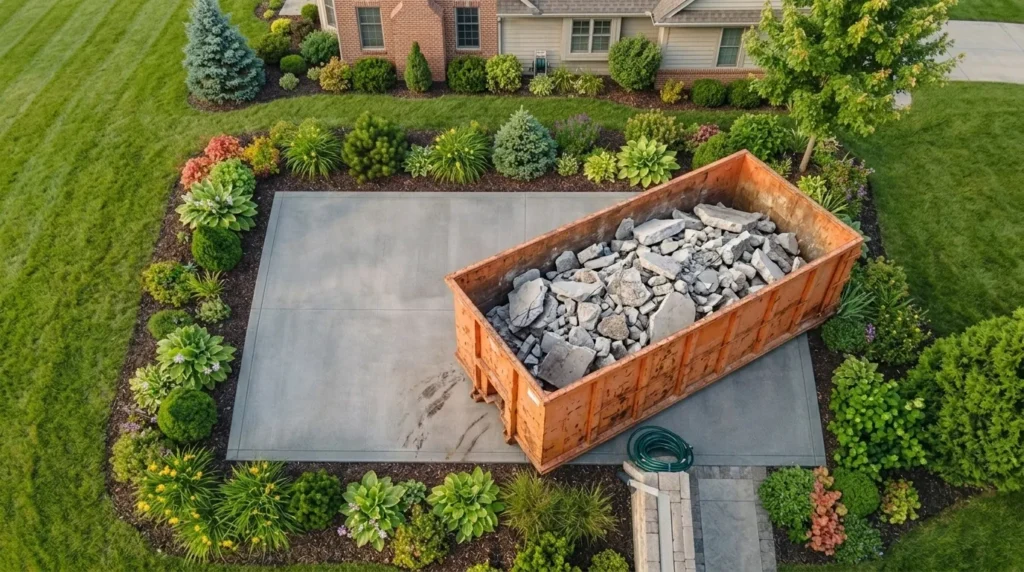
Knowing slab weight is not just a curiosity — it directly affects three practical decisions.
Demolition and Debris Hauling
Breaking out a concrete slab produces rubble at approximately the same weight as the original pour — sometimes slightly more due to trapped moisture and soil contamination on the underside.
Dumpster capacity for concrete:
| Dumpster Size | Concrete Weight Limit | Equivalent Slab Area (4″ thick) |
|---|---|---|
| 10 yard | 4,000–6,000 lbs | 80–120 sq ft |
| 15 yard | 6,000–8,000 lbs | 120–160 sq ft |
| 20 yard | 8,000–10,000 lbs | 160–200 sq ft |
| 30 yard | 10,000–14,000 lbs | 200–280 sq ft |
| 40 yard | 12,000–16,000 lbs | 240–320 sq ft |
Critical note: Dumpster weight limits for concrete are far lower than the container’s physical volume — concrete is too dense to fill a dumpster before hitting the weight limit. Always specify “concrete demolition” when ordering a dumpster — the company will right-size for weight, not volume.
Worked Example — Driveway Demolition: A 16×40 ft driveway at 5 inches thick weighs 40,000 lbs = 20 tons of debris.
At a dumpster weight limit of 6,000 lbs per 10-yard container:
40,000 ÷ 6,000 = 6.7 dumpster loads
Budget for at least 7 dumpster exchanges — or negotiate a flat-rate debris removal contract with a concrete recycler who brings their own trucks.
Structural Dead Load
Structural engineers use slab weight as a dead load in their calculations — determining how much load the beams, columns, and foundations beneath the slab must support.
The standard dead load assumption for a 4-inch concrete slab is 50 lbs per square foot — derived directly from 150 lbs/ft³ × 0.333 ft thickness. This number appears in virtually every structural engineering calculation for residential floor systems.
For elevated slabs — second floors, parking decks, bridge decks — accurate slab weight is critical to the structural design. Underestimating dead load produces under-designed supporting members.
According to the American Concrete Institute (ACI), dead load from concrete slabs must be calculated using the actual mix density — not assumed values — for any structural application where the mix design differs from standard normal-weight concrete.
Equipment and Crane Selection
Lifting precast concrete panels, steps, or structural elements requires knowing their exact weight before selecting lifting equipment.
Example: A precast concrete step unit — 4 ft wide × 3 ft deep × 6 inches thick:
4 × 3 × 0.5 × 150 = 900 lbs per step
A standard staircase of 10 steps: 9,000 lbs total. A telehandler or crane rated for 3 tons (6,000 lbs) cannot safely lift this — you need a minimum 5-ton rated machine.
The calculation takes 30 seconds. Getting it wrong risks equipment damage, load drop, and serious injury.
Frequently Asked Questions
How much does a slab of concrete weigh?
A concrete slab weighs 150 lbs per cubic foot of volume. For the most common residential thickness — 4 inches — that equals 50 lbs per square foot. A 10×10 ft patio at 4 inches weighs 5,000 lbs (2.5 tons). A 16×40 ft driveway at 5 inches weighs 40,000 lbs (20 tons). Use the weight tables above for your specific slab size.
How much does a 10×10 concrete slab weigh?
A 10×10 ft slab at 4 inches thick weighs 5,000 lbs (2.5 tons). At 6 inches thick, the same footprint weighs 7,500 lbs (3.75 tons). At 3.5 inches — the minimum residential specification — it weighs 4,375 lbs (2.19 tons).
How much does a concrete slab weigh per square foot?
It depends on thickness. At 4 inches: 50 lbs per square foot. At 6 inches: 75 lbs per square foot. At 8 inches: 100 lbs per square foot. Multiply by your slab area to get total weight.
How much does a driveway slab weigh?
A standard two-car driveway — 16 ft × 40 ft at 5 inches thick — weighs approximately 40,000 lbs (20 tons). A single-car driveway — 10 ft × 30 ft at 5 inches — weighs approximately 18,750 lbs (9.4 tons). These weights are critical for demolition dumpster sizing — plan for multiple dumpster loads.
How much does a garage floor weigh?
A standard two-car garage floor — 24×24 ft at 5 inches thick — weighs 36,000 lbs (18 tons). At 6 inches thick, the same floor weighs 43,200 lbs (21.6 tons). When breaking out a garage floor for replacement, expect to need 6–9 dumpster loads at standard concrete weight limits.
How do I calculate the weight of a concrete slab?
Multiply Length (ft) × Width (ft) × Thickness (ft) × 150. Convert thickness from inches to feet by dividing by 12 first. The result is weight in pounds — divide by 2,000 for US tons. Example: 12×20 ft slab at 4 inches = 12 × 20 × 0.333 × 150 = 12,000 lbs = 6 tons.
How much does concrete weigh for demolition planning?
Broken concrete rubble weighs approximately the same as the original pour — 150 lbs per cubic foot, or 50 lbs per square foot at 4-inch thickness. A 10-yard roll-off dumpster typically accepts 4,000–6,000 lbs of concrete before reaching its weight limit. Calculate your slab weight and divide by the dumpster’s concrete weight limit to determine how many loads you need.
Does rebar add significant weight to a concrete slab? For residential slabs with standard rebar spacing (#4 on 18-inch centers), rebar adds approximately 3–5% to the total slab weight — typically 1.5–2.5 lbs per square foot at 4-inch thickness. This is negligible for most practical calculations. For heavily reinforced structural elements with dense rebar patterns, rebar contribution should be calculated separately.
Conclusion
Concrete slab weight follows a simple formula — volume multiplied by 150 lbs per cubic foot. The 50 lbs per square foot figure for 4-inch slabs and 75 lbs for 6-inch slabs are the two numbers worth knowing by heart — they cover the majority of residential applications and give you an instant weight estimate for any slab size. For demolition planning, structural dead load calculations, or equipment selection, get the exact number using the tables in this guide or calculate it directly with our concrete weight calculator — it handles all unit conversions and slab shapes instantly.