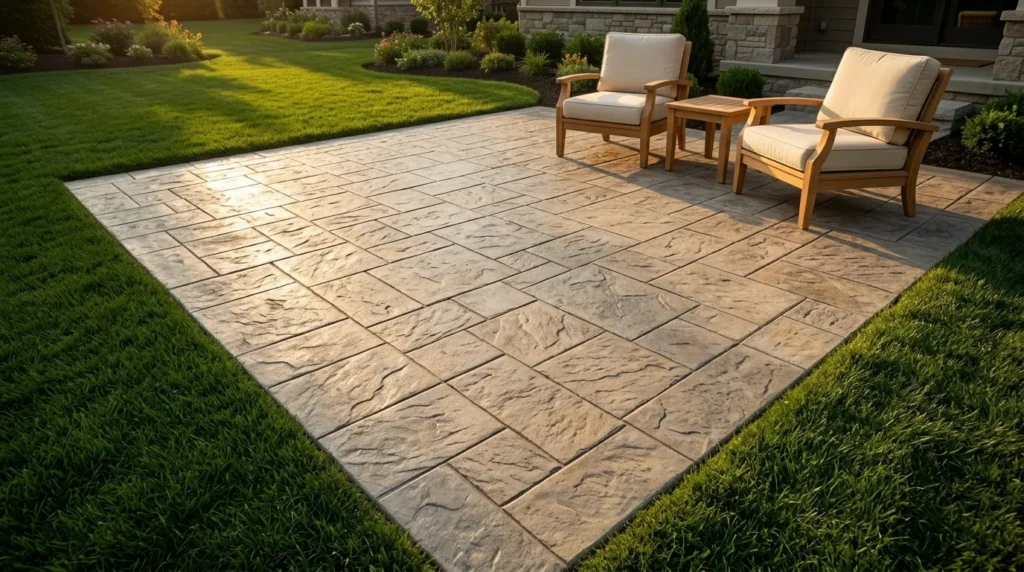

A plain grey slab does the job — but it does nothing for your home’s appearance. Stamped concrete transforms the same structural material into a surface that mimics natural stone, brick, slate, or wood — at a fraction of the cost of the real thing. It’s one of the most popular upgrades in residential outdoor construction, and for good reason: the pattern and color options are extensive, the durability matches standard concrete, and the installed cost is significantly lower than natural pavers or stone.
The types of stamped concrete differ primarily in pattern design and color technique. The right combination depends on your home’s architectural style, the application (patio, driveway, pool deck, walkway), your climate, and your budget. This guide covers every major pattern type, all three color methods, real cost figures, and a practical selection framework so you can walk into a contractor conversation knowing exactly what you want.
Once you’ve chosen your design, use the concrete calculator at ConcreteCalc to estimate how much material your project requires before requesting quotes.
Stamped concrete is one of many decorative options within the broader family of types of concrete — if you’re still deciding between structural and decorative options, start there first.”
Table of Contents
- What Is Stamped Concrete?
- Types of Stamped Concrete Patterns
- Stamped Concrete Color Options
- Stamped Concrete by Application
- How Much Does Stamped Concrete Cost?
- How to Choose the Right Pattern
- Stamped Concrete Maintenance and Sealing
- Frequently Asked Questions
What Is Stamped Concrete?
Stamped concrete is standard concrete — poured, leveled, and reinforced exactly like any other slab — that receives decorative treatment before it fully sets. While the concrete is still in its plastic (workable) state, color is applied to the surface and large rubber or polyurethane stamps are pressed into it, imprinting texture and pattern.
The result looks like natural stone, brick, slate, or wood but is actually a continuous concrete slab — with all the structural durability of concrete and none of the joint maintenance, weed growth, or settling issues associated with individual pavers or stones.
How Stamped Concrete Is Made
The stamping process follows a specific sequence:
- Pour and screed — concrete is placed and leveled like any standard slab
- Color hardener broadcast — dry color hardener is shaken onto the surface and floated in (if surface color is used)
- Release agent applied — a powder or liquid release is dusted over the surface to prevent stamps from sticking and to add subtle color variation
- Stamping — rubber stamp mats are pressed into the surface in sequence, creating the pattern
- Borders and edges — detail stamps and hand tools finish edges and transition zones
- Curing — slab cures for 24–48 hours before foot traffic
- Sealing — a penetrating or film-forming sealer is applied to protect color and surface
Timing is critical. Stamping must happen during a narrow window — after the concrete is firm enough to hold the impression but before it hardens too much to accept the stamp. In hot weather, this window can be as short as 30–45 minutes. Experienced stamped concrete contractors manage this with multiple workers and careful scheduling.
Stamped Concrete vs. Plain Concrete — Is It Worth It?
| Factor | Plain Concrete | Stamped Concrete |
|---|---|---|
| Installed cost | $4–$8/sq ft | $8–$18/sq ft |
| Appearance | Functional grey | Stone, brick, slate, wood |
| Maintenance | Low | Resealing every 2–3 years |
| Durability | High | Same (concrete base) |
| Repair complexity | Simple | Harder to match pattern/color |
| Resale value impact | Neutral | Positive |
| DIY feasibility | Moderate | Low — specialist skill required |
The premium for stamped concrete runs $4–$10 per square foot over plain concrete. On a 400 sq ft patio, that’s $1,600–$4,000 extra. Whether that’s worth it depends entirely on how much the aesthetics matter to you — the structural performance is identical.
Types of Stamped Concrete Patterns
Pattern choice is the most visible decision in a stamped concrete project. The stamp determines what the finished surface looks like from 10 feet away. Here are the main categories:
Ashlar Slate Pattern
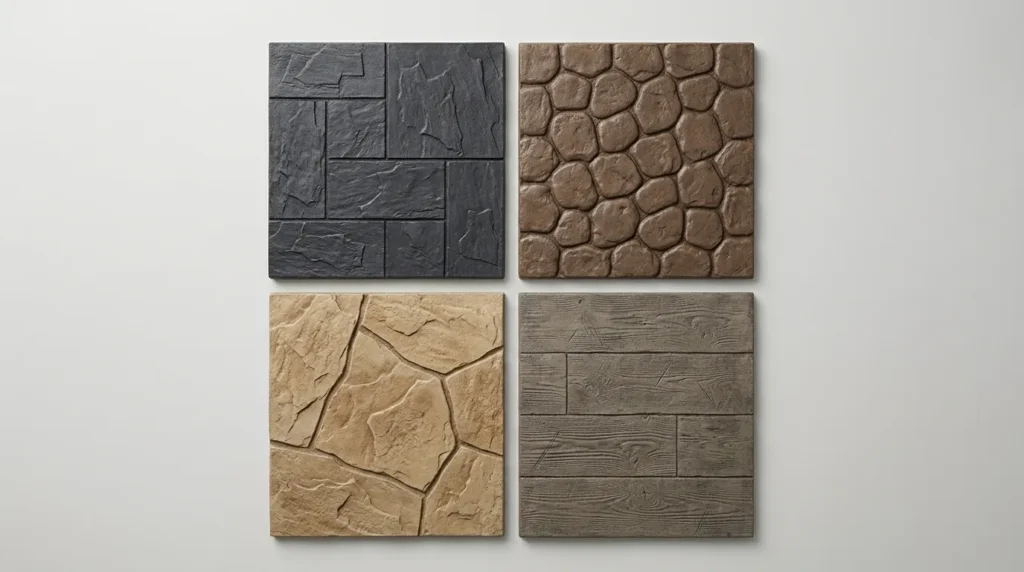
Ashlar slate is the single most popular stamped concrete pattern — a clean, rectangular stone layout with straight lines and consistent joint spacing. It mimics cut stone or large-format tile and suits modern, contemporary, and transitional architectural styles.
Best for: Patios, driveways, pool decks, interior floors Visual character: Geometric, clean, upscale Color pairing: Grey, charcoal, tan, buff
The straight lines of ashlar slate are forgiving to stamp — transitions and edges are relatively easy to manage — making it the most common choice for contractors and homeowners alike.
Cobblestone and Brick Patterns
Cobblestone stamps mimic the rounded, irregular stones of European streets and historic plazas. Brick patterns replicate the classic rectangular running bond or herringbone brick layouts.
Best for: Driveways, walkways, cottage-style patios, border accents Visual character: Traditional, warm, historic Color pairing: Red, brown, charcoal, mixed tones
Cobblestone patterns suit older homes, cottage-style architecture, and any project where the goal is a warm, textured, traditional look. Brick patterns are versatile — they work with both traditional and contemporary homes depending on color choice.
Worked Example: A 16 ft × 40 ft driveway in a traditional brick colonial neighborhood. Cobblestone stamp in a warm brown/red blend with charcoal antiquing release — the finished surface complements the brick facade and increases curb appeal measurably compared to a plain grey driveway.
Flagstone and Random Stone Patterns
Flagstone stamps mimic the irregular, organic shapes of natural flagstone — varying sizes and shapes laid in a random pattern with realistic grout lines.
Best for: Patios, garden paths, pool surrounds, naturalistic landscapes Visual character: Organic, natural, relaxed Color pairing: Buff, sandstone, terracotta, warm grey
Random stone patterns are the most naturalistic option — they don’t look like a manufactured product at any viewing distance. They suit gardens, naturalistic landscapes, and any outdoor space where the goal is to blend with the environment rather than stand apart from it.
Wood Plank Texture
Wood plank stamps create long, narrow rectangular patterns with wood grain texture — mimicking deck boards, barn wood, or timber planks.
Best for: Covered patios, indoor-outdoor transitions, contemporary spaces Visual character: Warm, residential, unique Color pairing: Brown, grey-brown, weathered grey, cedar tones
Wood plank stamped concrete is growing in popularity as an alternative to actual wood decking — it provides the warm aesthetic of wood without rot, splinters, annual sealing, or board replacement. It’s a particularly strong choice for covered patios adjacent to wood-framed structures.
Tile and Geometric Patterns
Geometric stamps include square tile, hexagonal tile, diamond patterns, and custom angular layouts. These are the most contemporary pattern options — clean lines, precise geometry, modern feel.
Best for: Modern homes, pool decks, commercial entries, interior floors Visual character: Contemporary, precise, architectural Color pairing: White, light grey, charcoal, bold accent colors
Fan and Herringbone Patterns
Fan (or European fan) patterns create sweeping curved layouts — a classic formal pattern associated with European plazas and upscale residential entries. Herringbone creates interlocking zigzag brick-like arrangements.
Best for: Circular driveways, formal entries, upscale patios Visual character: Formal, elegant, high-end Color pairing: Warm buff, cream, charcoal borders
Fan patterns are technically demanding — the curved layout requires careful stamp alignment and skilled edge work. They command premium labor costs but produce striking results in formal settings.
Pattern Quick Reference
| Pattern | Style | Best Application | Difficulty |
|---|---|---|---|
| Ashlar Slate | Modern/transitional | Patios, driveways | Low |
| Cobblestone | Traditional | Driveways, walkways | Medium |
| Brick | Traditional/versatile | Driveways, paths | Low-Medium |
| Flagstone | Natural/organic | Patios, pool decks | Medium |
| Wood Plank | Contemporary/warm | Covered patios | Medium |
| Tile/Geometric | Contemporary | Pool decks, entries | Medium |
| Fan/Herringbone | Formal/upscale | Entries, circular drives | High |
Stamped Concrete Color Options
Pattern creates the shape — color creates the realism. Natural stone gets its character from color variation, veining, and tonal depth. Stamped concrete replicates this through three coloring methods, used alone or in combination.
Integral Color
Integral color is iron oxide pigment mixed directly into the concrete batch before pouring. The color runs throughout the full depth of the slab — not just the surface.
Advantage: Color cannot wear off — if the surface is ground or damaged, the color beneath is identical Limitation: Color is uniform throughout — less natural variation than surface-applied methods Cost addition: $0.50–$1.50 per square foot over plain concrete
Integral color is the most durable coloring method and the best choice for high-traffic applications where surface abrasion is expected.
Color Hardener
Color hardener is a dry-shake product broadcast onto the fresh concrete surface and floated in before stamping. It contains cement, fine aggregate, and iron oxide pigment — it actually strengthens the surface layer while adding color.
Advantage: Stronger surface than plain concrete, excellent color depth and intensity Limitation: Surface-only — significant grinding exposes uncolored concrete beneath Cost addition: $0.75–$2.00 per square foot
Color hardener produces richer, more intense color than integral pigment and is the most common coloring method for stamped concrete flatwork.
Acid Staining and Antiquing
Acid stains react chemically with the minerals in cured concrete — producing mottled, variegated color that looks genuinely organic. No two acid-stained surfaces look identical.
Antiquing release agents — applied before stamping — leave a secondary color in the stamp recesses (the “grout lines”), creating the two-tone depth that makes stamped concrete look like real stone.
Advantage: Most natural, organic appearance — genuine color variation Limitation: Requires sealed surface to maintain; more maintenance than integral color Cost addition: $1.00–$3.00 per square foot for full acid stain treatment
For the most realistic stone appearance, contractors typically combine color hardener (base color) with an antiquing release (secondary accent color in joints) — the standard professional approach for high-end stamped work.
Stamped Concrete by Application
Stamped Concrete Patios
The patio is the most common stamped concrete application — and the one with the most pattern and color flexibility. Patios are low-traffic, protected from vehicle loads, and viewed primarily for aesthetics.
Recommended thickness: 4 inches Recommended PSI: 3,500–4,000 Best patterns: Flagstone, ashlar slate, wood plank Typical size: 200–600 sq ft Installed cost: $1,600–$10,800 depending on size and complexity
A stamped patio at $12/sq ft on 300 sq ft = $3,600 total — compared to $1,200–$2,400 for plain concrete. The $1,200–$2,400 premium for a space you’ll use daily for 20+ years is a straightforward value proposition for most homeowners.
Stamped Concrete Driveways
Driveways demand more from stamped concrete than patios — vehicle loads, tire wear, and deicer exposure all stress the surface more aggressively.
Recommended thickness: 5–6 inches Recommended PSI: 4,000–4,500 with air entrainment Best patterns: Ashlar slate, cobblestone, brick (geometric patterns wear better under tires) Avoid: Highly textured patterns with deep relief — raised edges wear faster under tires Installed cost: $10–$18 per square foot
In freeze-thaw climates, stamped driveways must use air-entrained concrete and should be resealed every 1–2 years. Deicers (salt, calcium chloride) are aggressive on stamped surfaces — sand is a safer traction alternative in winter.
Stamped Concrete Pool Decks
Pool decks are a natural fit for stamped concrete — the surface surrounds the pool visually and practically, and aesthetics matter enormously.
Key requirement: Slip resistance — patterns with moderate texture (flagstone, slate) are safer than very smooth finishes Recommended PSI: 4,000 with air entrainment Color consideration: Light colors reflect heat — important for bare feet in summer Installed cost: $8–$16 per square foot
Chlorine and pool chemicals can affect sealer longevity — pool deck stamped concrete should be resealed annually rather than every 2–3 years.
Stamped Concrete Walkways and Paths
Walkways are the most budget-friendly stamped concrete application — small area, simple layout, high visual impact relative to cost.
Typical width: 3–5 feet Best patterns: Flagstone, random stone, brick (natural-looking patterns suit garden settings) Installed cost: $8–$14 per square foot
A 4 ft × 30 ft garden path (120 sq ft) at $10/sq ft = $1,200 total — a very accessible entry point for stamped concrete that delivers significant visual impact in a garden or landscape setting.
How Much Does Stamped Concrete Cost?
Cost by Pattern Complexity
| Pattern Complexity | Installed Cost Per Sq Ft | What’s Included |
|---|---|---|
| Basic (single stamp, one color) | $8–$10 | One pattern, one base color |
| Intermediate (border + field) | $10–$14 | Two patterns, color hardener + release |
| Complex (multi-pattern, custom color) | $14–$18 | Multiple stamps, acid stain, custom work |
| Premium (custom design, artistic) | $18–$30+ | Hand-carved details, multiple colors |
Cost vs. Natural Stone and Pavers
| Material | Installed Cost Per Sq Ft | Maintenance | Lifespan |
|---|---|---|---|
| Plain concrete | $4–$8 | Low | 25–50 years |
| Stamped concrete | $8–$18 | Medium (resealing) | 25–50 years |
| Concrete pavers | $10–$20 | Low-Medium | 30–50 years |
| Natural flagstone | $15–$30 | Medium | 50+ years |
| Brick pavers | $12–$20 | Low | 25–50 years |
| Natural slate | $20–$40 | Medium-High | 50+ years |
Stamped concrete delivers natural stone aesthetics at roughly half the installed cost of actual stone — the primary reason it’s the dominant decorative concrete choice in residential construction.
According to the American Society of Concrete Contractors (ASCC), stamped concrete is among the fastest-growing segments of decorative concrete work in the US residential market, driven by its combination of design flexibility and cost efficiency versus natural materials.
How to Choose the Right Stamped Concrete Pattern
Three questions narrow the decision quickly:
1. What is your home’s architectural style?
- Traditional, colonial, craftsman → Cobblestone, brick, random flagstone
- Modern, contemporary → Ashlar slate, geometric tile, wood plank
- Mediterranean, Spanish → Fan pattern, terracotta tile
- Cottage, garden → Random stone, irregular flagstone
2. What is the application?
- Driveway → Ashlar slate or cobblestone (durability under tires)
- Patio → Any pattern — prioritize aesthetics
- Pool deck → Flagstone or slate (slip resistance + heat reflection)
- Walkway → Random stone or brick (naturalistic scale)
3. What is your maintenance commitment?
- Low maintenance → Integral color + simple pattern (fewer grout lines to clean)
- Willing to reseal regularly → Color hardener + antiquing release (best appearance)
- Minimal effort → Avoid deep-relief patterns that collect debris
Stamped Concrete Maintenance and Sealing
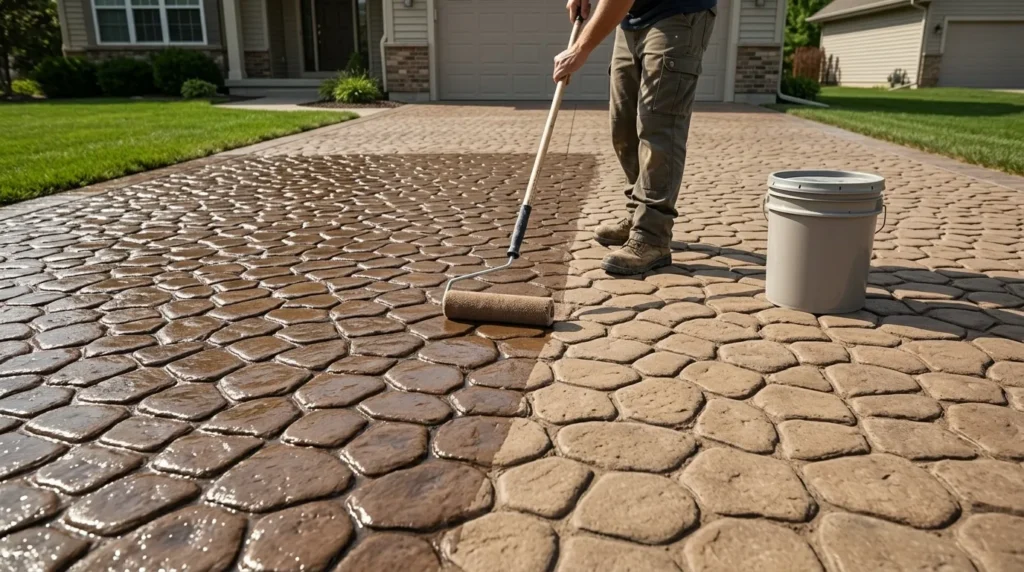
Stamped concrete requires more maintenance than plain concrete — the sealer protecting the color and surface needs periodic renewal.
Sealing schedule:
- New installation: Sealed immediately after curing (within 24–72 hours)
- Ongoing: Reseal every 2–3 years for patios and walkways; every 1–2 years for driveways and pool decks
- Signs resealing is needed: Surface looks dull or faded; water no longer beads on the surface; color appears washed out
Cleaning:
- Regular sweeping and occasional washing with mild soap and water
- Avoid pressure washing at high PSI — it can damage the sealer and erode surface color
- Never use deicing salts — use sand for winter traction instead
Crack repair: Stamped concrete cracks like any concrete — control joints and proper base preparation minimize cracking, but cannot eliminate it entirely. Small cracks can be filled with color-matched polyurethane caulk. Larger cracks or surface spalling require professional repair — matching existing pattern and color is challenging and best done by the original contractor.
Frequently Asked Questions About Stamped Concrete
What are the types of stamped concrete?
Stamped concrete types are defined by pattern and color method. Main patterns include ashlar slate, cobblestone, brick, flagstone, random stone, wood plank, tile/geometric, fan, and herringbone. Color methods include integral pigment, color hardener, and acid staining — used alone or combined for layered color depth.
How long does stamped concrete last?
With proper installation and regular sealing, stamped concrete lasts 25–50 years — the same lifespan as standard concrete. The color and surface finish require maintenance (resealing every 2–3 years) but the structural slab itself is as durable as any concrete flatwork.
Is stamped concrete slippery?
It can be, particularly when wet and sealed with a high-gloss sealer. For pool decks and areas regularly exposed to water, choose patterns with moderate surface texture (flagstone, slate) and use a sealer with added grip aggregate. Smooth, deeply stamped surfaces with glossy sealer are the most slippery combination — avoid this for pool surrounds and exterior stairs.
Can stamped concrete be repaired if it cracks?
Yes, but matching the existing pattern and color is challenging. Small cracks can be filled with color-matched flexible caulk. Larger damage requires saw-cutting a clean section, breaking out the damaged area, and pouring a new panel — which rarely matches perfectly. The best crack prevention is proper base preparation, control joint placement, and correct concrete mix specification.
What is the most popular stamped concrete pattern?
Ashlar slate is consistently the most requested pattern — its clean, geometric lines suit the widest range of architectural styles and are the most forgiving to install. Random flagstone and cobblestone are the second and third most popular choices respectively.
Can I do stamped concrete myself?
Stamping is not a practical DIY project for most homeowners. The timing window for stamping is narrow, the stamp sequence must be coordinated across the full slab, and color matching requires experience. Errors — mis-stamped sections, color blotches, or timing failures — are permanent and visible. For decorative concrete, professional installation is strongly recommended.
How much does a 400 sq ft stamped concrete patio cost?
At $10–$14 per square foot for intermediate complexity: $4,000–$5,600 installed. This includes concrete material, color hardener, release agent, stamping labor, and initial sealing. Complex custom designs at $16–$18/sq ft on 400 sq ft: $6,400–$7,200.
Conclusion
Stamped concrete turns a utilitarian material into a design element — giving patios, driveways, pool decks, and walkways the appearance of natural stone, brick, or wood at half the cost of the real thing. Pattern choice sets the style; color method determines the realism and maintenance commitment. Match both to your home’s architecture, your application’s demands, and your maintenance schedule — and you’ll have a surface that performs as well as it looks for decades. Before requesting contractor quotes, calculate your project’s concrete requirements with the ConcreteCal concrete calculator.