
Not every concrete pour needs a full-sized professional vibrator. A homeowner casting garden stepping stones, a small contractor setting fence post footings, or a DIYer pouring a small patio slab does not need a $400 gasoline vibrator with a 6-metre shaft. What they need is a concrete vibrating tool that gets the job done — removes air pockets, consolidates the mix, and produces a strong, void-free result — without the cost, weight, or complexity of professional-grade equipment.
This category of tool sits between doing nothing (just tamping with a trowel) and investing in a full commercial vibrator system. It includes drill-attachable vibrating rods, compact handheld electric cement vibrators, cordless lithium-ion models, and lightweight gasoline units — all designed for the kind of pour volume that residential and light commercial work actually involves.
This guide covers every type of concrete vibrating tool available, what the specifications actually mean, and which product suits which application — so you spend money on the right tool, not the most impressive-looking one on the shelf.
For concrete volume calculations before your pour, use the free concrete calculator at ConcreteCal. For guidance on professional-grade vibrator equipment, see our types of concrete vibrators guide.
Table of Contents
- What Is a Concrete Vibrating Tool and Who Needs One?
- Types of Concrete Vibrating Tools
- Concrete Vibrating Tool for Drill — Deep Dive
- Cement Vibrating Tool Specifications — What to Look For
- Concrete Vibrating Tool Comparison Table
- Cement Vibrating Machine — Top Products by Category
- How to Use a Concrete Vibrating Tool Correctly
- Concrete Vibrating Tool Maintenance
- Frequently Asked Questions
What Is a Concrete Vibrating Tool and Who Needs One?
A concrete vibrating tool is any handheld, portable, or drill-attachable device that creates mechanical vibration in fresh concrete during placement. The vibration temporarily reduces the concrete mix’s internal friction — allowing air bubbles to rise and escape, aggregate to settle into a denser packing, and the cement paste to flow around and bond to any reinforcement.
The result is concrete with fewer voids, higher compressive strength, and better surface finish. Without vibration, even a well-proportioned concrete mix retains air pockets that reduce strength and create surface honeycombing visible when the formwork comes off.
Concrete Vibrating Tool vs. Full Concrete Vibrator
The distinction matters because these products serve genuinely different use cases — and using the wrong one for your pour wastes money or delivers inadequate results.
| Factor | Concrete Vibrating Tool | Full Concrete Vibrator |
|---|---|---|
| Poker diameter | 25–38mm typically | 35–65mm full range |
| Shaft length | 1.0–2.0m typically | 3–8m full range |
| Power | 500–1,600W | 1,050–4,000W+ |
| Best for | Small residential pours | Commercial and large pours |
| Weight | 2–4 kg | 4–12 kg |
| Cost | $50–$300 | $200–$2,000+ |
| Portability | High | Moderate to low |
The practical boundary: A concrete vibrating tool is appropriate for pours up to approximately 1–2 cubic yards (0.75–1.5 cubic metres). Beyond that volume, the smaller poker diameter and lower power of a vibrating tool makes coverage impractically slow — a full vibrator with larger poker and greater power is more efficient.
When a Vibrating Tool Is the Right Choice
Choose a concrete vibrating tool when:
- Pour volume is under 1.5 cubic yards
- The project is residential — garden paths, small patios, fence footings, decorative concrete
- You pour concrete infrequently (once or twice per year)
- Budget is a significant constraint
- You want a drill attachment rather than a dedicated tool
- Portability and compact storage matter more than maximum performance
Choose a full concrete vibrator when:
- Pour volume exceeds 2 cubic yards
- Commercial or structural concrete is involved
- Multiple pours per month justify the investment in proper equipment
- Deep columns or walls require longer shaft reach
Types of Concrete Vibrating Tools
Concrete Vibrating Tool for Drill (Drill Attachment)
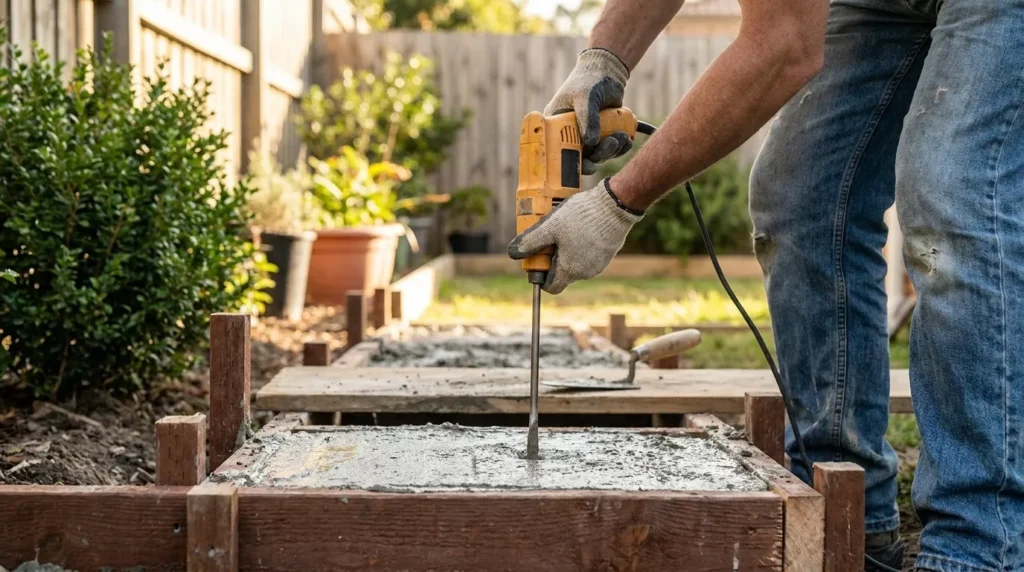
Drill attachment concrete vibrators are the most accessible entry point — a vibrating rod that chucks directly into a standard power drill. The drill’s rotational output drives an eccentric mechanism in the rod tip, generating vibration.
How they work: The drill chuck accepts the vibrating rod shank (typically SDS or standard round shank). The drill spins the rod at its full speed setting — the eccentric tip converts this rotation into vibration. No separate motor required.
Requirements: The drill must have adequate torque and speed — typically 650+ RPM for effective vibration. Corded drills are preferred for sustained use; cordless drills can be used but battery drain under concrete vibration load is significant.
Best for: Very small pours — garden ornaments, fence post footings, small decorative pads. For anything larger than approximately 0.25 cubic yards, a dedicated vibrating tool is more practical.
Handheld Electric Cement Vibrating Machine
A dedicated electric cement vibrating machine with its own motor is the most common tool in this category — a compact motor housing driving a flexible shaft and vibrating poker, all in one lightweight package.
Power range: 500W–1,600W for the tools in this category. The most common residential-grade units run at 1,050W or 1,200W.
Common poker sizes available: 35mm and 38mm — adequate for residential concrete with standard rebar layouts.
Shaft lengths: 1.5m standard for most compact tools, 3.0m for extended reach versions.
Best for: Residential slabs, footings, walls, columns, and fence bases. The most versatile tool in this category for everyday DIY concrete work.
Cordless Concrete Vibrating Tools
Cordless vibrating tools — running on 20V lithium-ion battery platforms — eliminate the cord without eliminating the power. The trade-off is runtime: approximately 30–45 minutes per standard battery charge, adequate for most residential pours.
Advantages over corded:
- Complete freedom from power outlet proximity
- No cord management on the pour site
- Faster repositioning between insertion points
Best for: Sites without convenient power outlets, outdoor pours away from structures, or users who prefer cordless tools for all construction work.
Notable in this category: The Total Lithium-Ion Concrete Vibrator and Ingco Cordless Concrete Vibrator offer 20V operation with adequate poker diameters for residential use.
Gasoline-Powered Cement Vibrators
Lightweight gasoline cement vibrators — using 5.5HP engines rather than the 6.5HP units in full-professional equipment — provide fully independent operation anywhere on site without any power supply requirement.
Best for: Remote sites, rural projects, or any pour location more than 50 feet from a power outlet where running a long extension cord is impractical.
Brands commonly available: Total Gasoline Concrete Vibrator, Ingco Gasoline Concrete Vibrator — both widely available in construction equipment markets.
Limitation: Noisier than electric, requires fuel, not appropriate for enclosed spaces without ventilation.
Lithium-Ion Concrete Vibrating Tools
Lithium-ion tools represent the premium end of the portable vibrating tool category — integrated battery management, better energy density than older cordless technology, and faster recharging.
Key difference from basic cordless: Lithium-ion battery management systems protect against over-discharge, over-charge, and thermal events — extending battery life significantly compared to older NiCad or NiMH cordless tools. For a tool that will be used regularly, the lithium-ion premium is recovered in battery longevity.
Total Cordless Concrete Vibrator: One of the more accessible lithium-ion options in regional markets — compact, adequate for residential use, reasonable runtime per charge.
Concrete Vibrating Tool for Drill — Deep Dive
The drill attachment concrete vibrator deserves a dedicated section because it is both the cheapest and most misunderstood product in this category. Done right, it works. Done wrong, it damages your drill and underperforms on the concrete.
How Drill Attachment Vibrators Work
The vibrating rod attaches to the drill chuck — standard or SDS depending on the rod design. The drill rotates the shank, which drives an eccentric ball or offset mass in the poker tip. The rotation speed determines the vibration frequency.
The frequency calculation:
At 1,000 RPM drill speed → approximately 16.7 Hz vibration frequency.
At 3,000 RPM drill speed → approximately 50 Hz vibration frequency.
Standard concrete vibrators operate at 150–200 Hz. Drill attachment vibrators operating at 16–50 Hz are significantly lower frequency — which means less efficient air void removal per unit time. The operator compensates by spending more time at each insertion point.
Practical implication: Drill attachments work for very small volumes but require patience — 15–25 seconds per insertion rather than the 5–10 seconds a proper vibrator needs. Budget more time for the vibration step when using a drill attachment.
What Drill Power You Actually Need
Not every drill handles concrete vibration load well. The vibrating rod creates significant resistance through the concrete — this resistance translates to motor load that can overheat lighter drills used beyond their duty cycle.
Minimum drill specification for concrete vibrating attachment:
- Power: 600W+ (corded) or 18V+ 5.0Ah (cordless)
- Chuck: 13mm keyed or SDS depending on rod shank
- Speed: Variable speed with 0–1,000 RPM minimum range
- Duty cycle: S2-30 minutes or better — not a light-duty drill
Drills to avoid: Compact screwdriver-style cordless drills — their motors are not designed for sustained resistance load. Light-duty corded drills under 400W — they will overheat within minutes.
Worked Example — Small Garden Slab:
A homeowner pouring a 1m × 1m × 100mm garden pad. Volume: 0.1 cubic metres (approximately 0.13 cubic yards). Using a 750W corded drill with a 35mm vibrating rod attachment:
- Total insertions at 300mm spacing: approximately 9 insertions
- Dwell time: 20 seconds per insertion
- Total vibration time: approximately 3 minutes
- Drill running time at moderate load: within duty cycle easily
For this scale, a drill attachment is entirely practical. For a 3m × 3m pad of the same thickness (0.9 m³), the 81 insertions at 20 seconds each = 27 minutes of drill operation — pushing the limits of most drills’ duty cycle and significantly beyond what a drill attachment is designed for.
Best Applications for Drill-Attachable Vibrators
- Post hole footings (single or few holes at a time)
- Garden ornament casting and decorative concrete moulds
- Small slabs under 0.25 cubic metres
- Patch repairs where thoroughness at small scale matters
- Any situation where the user does not have a dedicated vibrator and the pour is genuinely small
Cement Vibrating Tool Specifications — What to Look For
Power Rating (Watts and HP)
Power rating determines the maximum vibration energy available and the motor’s sustained output capability.
For concrete vibrating tools:
| Power Rating | Application | Limitation |
|---|---|---|
| Under 500W | Light duty, drill attachments | Very small pours only |
| 1,050–1,200W | Standard residential | Most residential applications |
| 1,600W | Heavy residential, light commercial | Larger residential slabs |
| 2,200W+ | Commercial — full vibrator territory | Beyond standard tool category |
The 1,050W sweet spot: Most dedicated compact vibrating tools in this category run at 1,050W — enough power for residential concrete, light enough to be genuinely portable, and affordable enough for occasional use.
Vibrator Poker Size — 35mm to 60mm
Poker diameter determines the effective radius of vibration action — how far from the insertion point the concrete is consolidated.
For concrete vibrating tools (smaller diameter range):
| Poker Diameter | Radius of Action | Best For |
|---|---|---|
| 25–28mm | 5–6 inches | Very tight rebar, thin sections |
| 35mm | 7–8 inches | Standard residential — most applications |
| 38mm | 8–9 inches | Slightly larger residential pours |
| 45–50mm | 10–12 inches | Lower end of commercial range |
Most compact vibrating tools come with 35mm or 38mm pokers — this is the correct size for residential concrete with standard rebar spacing. Larger poker diameters require more power to operate effectively and are territory for full concrete vibrators rather than compact tools.
Shaft Length — 1.5m to 3.0m
Shaft length determines how deep you can reach into a concrete pour. Standard compact vibrating tools typically offer 1.5m shafts — adequate for:
- Slabs up to approximately 150–200mm thick
- Footings up to approximately 1 metre deep
- Standard residential wall pours up to 1.2m per vibration pass
For deeper pours, look for tools offering 3.0m shaft options — either as an accessory or a different product variant.
The depth calculation: Shaft length must equal pour depth plus approximately 400–500mm of operating clearance above the concrete surface for the operator to hold and control the tool comfortably.
Frequency and VPM
Concrete vibrating tools typically operate at lower frequency than full professional vibrators — 9,000–12,000 VPM (150–200 Hz) for quality tools, down to 3,000–6,000 VPM for budget or drill-attachment products.
Why this matters: Higher frequency tools consolidate concrete faster per insertion — fewer seconds needed at each point. Lower frequency tools need longer dwell time to achieve equivalent consolidation. For small pour volumes this difference is less significant; for larger volumes it adds up to meaningful time differences.
Concrete Vibrating Tool Comparison Table
| Tool Type | Power | Poker Size | Shaft | Frequency | Best For | Approx. Cost |
|---|---|---|---|---|---|---|
| Drill attachment | Via drill | 25–35mm | 0.8–1.5m | 3,000–6,000 VPM | <0.25 m³ | $15–$50 |
| Electric compact (1,050W) | 1,050W | 35–38mm | 1.5m | 9,000–12,000 VPM | 0.25–1 m³ | $80–$200 |
| Electric compact (1,200W) | 1,200W | 38–45mm | 1.5–3m | 10,000–12,000 VPM | 0.5–1.5 m³ | $120–$280 |
| Cordless (20V) | 20V Li-ion | 35–38mm | 1.5m | 9,000 VPM | 0.25–0.75 m³ | $150–$350 |
| Gasoline (5.5HP) | 5.5HP | 38–50mm | 3–5m | 12,000 VPM | 0.5–2 m³ remote | $200–$400 |
| Lithium-ion (20V) | 20V | 35–38mm | 1.5m | 9,000–12,000 VPM | 0.25–1 m³ | $180–$380 |
Cement Vibrating Machine — Top Products by Category
Best Electric Cement Vibrating Tool
For most residential and light commercial users, a dedicated 1,050W–1,200W electric cement vibrating machine is the best balance of performance, cost, and practicality.
What to look for:
- Motor: 1,050W–1,200W input power
- Poker: 35mm or 38mm diameter
- Shaft: 1.5m standard (3.0m option preferred)
- Frequency: 12,000 VPM or higher
- IP rating: IP44 minimum for construction site use
Prescott Electric Concrete Vibrator and DongCheng Concrete Vibrator represent this category well in regional markets — adequate specification for residential work at accessible price points.
Best Cordless Vibrating Tool
Total Cordless Concrete Vibrator / Total Lithium-Ion Concrete Vibrator: Offers the convenience of cordless operation for residential pours where battery runtime of 30–45 minutes is adequate for the pour volume. The 20V platform is appropriate for the poker sizes in this category.
Ingco Cordless Concrete Vibrator: A step up in the cordless category — better motor specification and slightly longer runtime per charge. Well-suited for residential contractors doing regular small pours.
The concrete vibrating tool available here represents a well-specified option in this category — verify the poker diameter and shaft length against your specific project before purchasing.
Best Gasoline Cement Vibrator
Total Gasoline Concrete Vibrator and Ingco Gasoline Concrete Vibrator are the accessible gasoline options in this product tier. Both offer 5.5HP engines with adequate power for residential to light commercial pours at remote sites.
When gasoline is the right choice: Any pour more than 50 feet from a power outlet, rural construction sites, and projects where multiple pours happen at different locations requiring equipment transport between sites.
Best Budget Concrete Vibrating Tool
Gaocheng Concrete Vibrator: The most accessible price point in this category. Adequate for occasional DIY use and small residential pours where frequency of use does not justify a higher investment. Motor quality and shaft durability are below Ingco or Total equivalents — factor in potential earlier replacement when comparing total cost.
For occasional home use (one or two pours per year, small volumes): budget category tools are financially appropriate. For regular contractor use, mid-tier (Ingco, Total) delivers better total cost of ownership.
How to Use a Concrete Vibrating Tool Correctly
The tool is only half the equation. Correct technique determines whether the vibration actually consolidates the concrete or just disturbs the surface.
Insertion Technique
Insert vertically, not at an angle. The most common beginner mistake is inserting the poker at an angle to reach further or to cover more area. Angled insertion vibrates concrete in one direction only — the opposite side of the insert point receives minimal vibration.
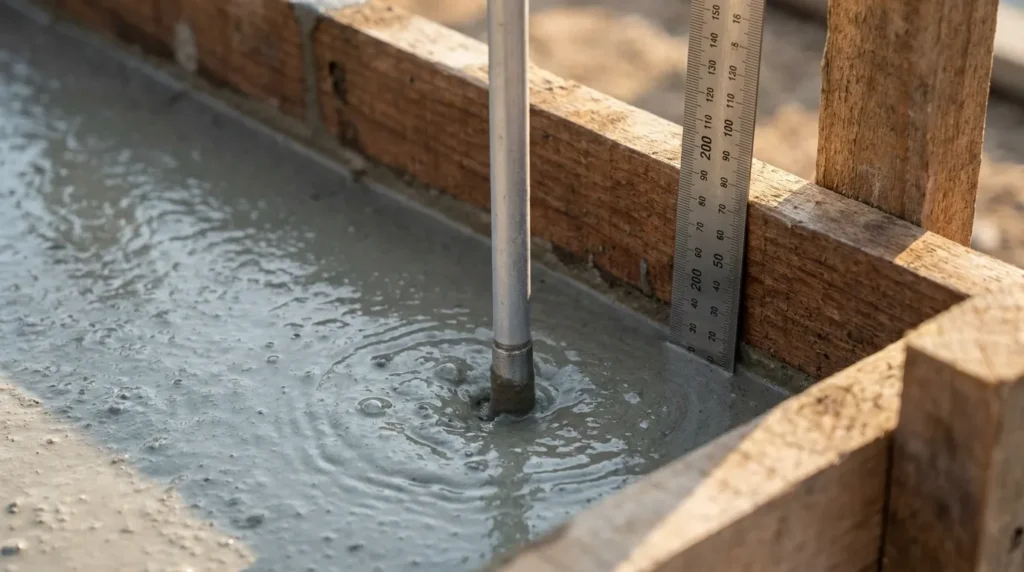
Insert to within 50–75mm of the pour bottom. The poker must reach near the base of the pour to consolidate the full depth. Shallow insertion leaves the bottom section under-consolidated — weaker than the top, with voids that are invisible until the form is removed.
Worked Example — Residential Footing:
A residential strip footing, 300mm wide × 250mm deep × 5m long. Using a compact 1,050W electric vibrating tool with 35mm poker and 1.5m shaft.
- Insertion spacing: 350mm (approximately 10× poker diameter)
- Insertions along 5m: 5,000 ÷ 350 = 14–15 insertions
- Insertion depth: 200–220mm (within 50mm of bottom)
- Dwell time: 8–10 seconds per insertion
- Total active vibration time: approximately 2.5 minutes
- Allow 5 seconds withdrawal time per insertion
Spacing and Coverage
General spacing rule: Insert the poker at intervals of approximately 8–10 times the poker diameter. For a 35mm poker: 280–350mm spacing. For a 38mm poker: 300–380mm spacing.
Coverage map: Before the pour, mentally map your insertion grid. On a rectangular slab, this means rows at the calculated spacing in both directions. Follow the concrete placement crew — vibrate 300–600mm behind the leading edge of fresh concrete, not too far behind where concrete may have started initial set.
At form edges: Keep the poker 50–75mm from any formwork face. Too close and the vibration moves the form rather than consolidating the concrete — visible as ripple marks on the finished concrete face.
Common User Mistakes
Over-vibration at one point: Maximum dwell time for most residential mixes is 10–15 seconds. Vibrating longer at the same location causes aggregate to sink and paste to rise — a stratified concrete that is weaker than the original mix design.
Using the poker to move concrete: The vibrating tool is not a pusher or spreader. Using it to move concrete sideways causes segregation along the path of movement. Place concrete close to its final position before vibrating.
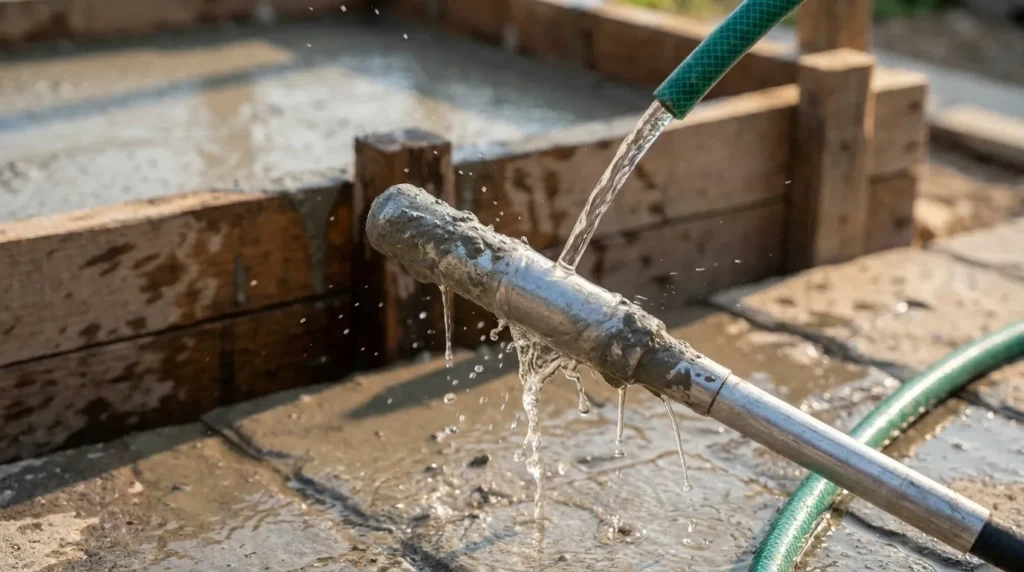
Not cleaning immediately after use: Fresh concrete cleans from a poker in seconds with water. Cured concrete on a poker is extremely difficult to remove and accelerates wear. Rinse the poker and shaft with clean water immediately after completing the pour.
Pulling out too fast: Withdraw the poker at approximately 75mm per second — slowly enough that the concrete closes behind the withdrawing poker. Pulling too fast leaves a void that does not close, visible as a small hole in the finished surface.
Concrete Vibrating Tool Maintenance
Compact concrete vibrating tools require minimal maintenance if basic care habits are established:
After every use:
- Rinse poker head and shaft with clean water immediately after use
- Wipe down the motor housing with a damp cloth — do not submerge
- Check the flexible shaft for any kinking or damage from sharp bends
- Inspect the poker-to-shaft connection for looseness
Monthly (for regular users):
- Check coupling connections between motor and shaft — tighten if any movement detected
- Inspect the power cable (electric models) for any damage or kinking
- Check battery charge level and storage charge for cordless models (store at 40–60% charge for lithium-ion longevity)
- Listen for any change in motor noise — grinding suggests bearing wear requiring service
Annual:
- Inspect the full shaft length for any deterioration of the outer rubber covering
- For gasoline models: full engine service per manufacturer schedule — spark plug, air filter, oil change
- For electric models: check motor brushes if the design uses brushed motor (less common in modern tools)
Storage:
Coil the flexible shaft loosely — no sharp bends or tight coiling that stresses the inner wire core. Store in a dry location, not in the back of a vehicle exposed to temperature extremes. For lithium-ion models, never store with a fully depleted battery — charge to 40–60% before storage.
Frequently Asked Questions
What is a concrete vibrating tool?
A concrete vibrating tool is any compact, portable device that creates mechanical vibration in fresh concrete to consolidate it — removing air voids, settling aggregate, and producing stronger, void-free finished concrete. The category includes drill attachments, handheld electric tools, cordless vibrating tools, and lightweight gasoline units — all designed for residential and light commercial pour volumes rather than large commercial applications.
Can I use a concrete vibrating tool for a drill?
Yes — drill attachment vibrating rods chuck into a standard power drill and use the drill’s rotation to drive an eccentric vibrating tip. The drill must be 600W+ (corded) or 18V+ 5.0Ah (cordless) to handle the load. Drill attachments work best for very small pours under 0.25 cubic metres — for anything larger, a dedicated vibrating tool is more practical and efficient.
What is the difference between a concrete vibrating tool and a cement vibrating machine?
The terms are often used interchangeably. Technically, a concrete vibrating tool refers to the complete portable unit (motor + shaft + poker), while a cement vibrating machine sometimes refers specifically to motorised units with dedicated vibration mechanisms. In practice both terms describe the same category of equipment — compact vibration tools for residential and light commercial concrete consolidation.
What size poker do I need on a concrete vibrating tool?
For most residential applications — footings, small slabs, residential walls — a 35mm or 38mm poker is correct. This size fits between standard rebar spacing, provides adequate radius of action for residential concrete, and is compatible with the motor power of compact vibrating tools. Larger pokers (45–50mm) require more power than most compact tools provide.
How long should I vibrate concrete at each insertion point?
For standard residential concrete mixes at typical slump (100–150mm): 8–12 seconds per insertion. Insert until the surface smooths and air bubbles stop rising at that point, then withdraw slowly at approximately 75mm per second. Do not exceed 15 seconds at any single insertion — over-vibration causes mix segregation.
Is a cordless concrete vibrating tool as effective as a corded one?
For small to medium residential pours, yes — cordless vibrating tools at 20V with a good lithium-ion battery provide adequate power and frequency for consolidating residential concrete. The limitation is runtime: typically 30–45 minutes per charge. For pours that take longer, carry an additional charged battery or choose a corded model.
What is the best concrete vibrating tool for small projects?
For genuinely small pours (under 0.25 m³): a drill attachment vibrating rod is the most cost-effective option. For residential pours up to 1 m³: a dedicated 1,050W–1,200W electric vibrating tool with 35–38mm poker and 1.5m shaft covers most projects. For sites without power: a 20V lithium-ion cordless vibrating tool or a lightweight gasoline unit. See the comparison table in this guide for a side-by-side cost and specification breakdown.
Can a concrete vibrating tool be used for cement mixing?
No — a concrete vibrating tool is for consolidating already-placed concrete, not for mixing. It should never be used as a mixing attachment — the eccentric vibration mechanism is not designed for mixing resistance and will be damaged by mixing use. Use a dedicated mixing paddle attachment or drum mixer for concrete mixing.
Conclusion
A concrete vibrating tool fills the gap between doing nothing and over-investing in professional equipment for small-scale concrete work. For pours under 1.5 cubic metres, a compact electric or cordless vibrating tool does everything a professional unit does — removes air voids, consolidates aggregate, and produces stronger concrete — at a fraction of the cost and with no learning curve on operation. Match the tool to the pour volume: drill attachment for the smallest jobs, dedicated 1,050W electric tool for most residential work, cordless for sites without power, gasoline for remote locations. Use the ConcreteCal free concrete calculator to calculate your concrete volume before the pour — knowing your volume is what determines whether a compact vibrating tool is the right choice or whether a full concrete vibrator is needed.