
There is a specific category of industrial motor that most people never think about until they need one — and then suddenly need to understand in considerable depth very quickly. The vibro motor is exactly this kind of component. It sits inside concrete vibrating tables, on the walls of bins and hoppers, beneath feeder conveyors, and on the frames of industrial screens — and when it fails or needs specifying for a new application, the engineer or contractor needs accurate, detailed information fast.
The Invicta vibro motor is one of the most widely recognised brands in this category — a British-engineered vibration motor with a strong international reputation built over decades of industrial use in concrete production, bulk materials handling, and process industries. Understanding what Invicta makes, how their products are specified, and which model suits a given application is the purpose of this guide.
Whether you are specifying a vibrating table for precast concrete production, replacing a failed motor on an existing installation, or evaluating Invicta against competitor brands, this guide gives you the technical depth and practical guidance to make the right decision.
For any concrete project requiring volume calculations before vibrating table production, use the free concrete calculator at ConcreteCal. For a broader understanding of vibration motor types beyond the Invicta brand, see our concrete vibration motor guide.
Table of Contents
- What Is an Invicta Vibro Motor?
- Invicta Vibro Motor Product Range
- Invicta Vibro Motor Technical Specifications
- Invicta Vibro Motor Specification Comparison Table
- Invicta Vibro Motor Applications
- How to Select the Right Invicta Vibro Motor
- Invicta Vibro Motor Installation Guide
- Invicta Vibro Motor Maintenance and Troubleshooting
- Invicta Vibro Motor vs Competitor Brands
- Where to Buy Invicta Vibro Motors
- Frequently Asked Questions
What Is an Invicta Vibro Motor?
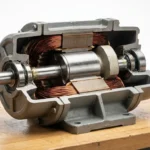
A vibro motor — in the Invicta context — is an electric motor with an integral eccentric mass on its output shaft. When the motor runs, the offset mass generates centrifugal force that vibrates the motor body and anything it is mounted to. There is no flexible shaft, no separate poker head, no external mechanism — the vibration is generated within the motor body itself and transmitted directly through the mounting bolts to the equipment it drives.
Invicta as a Brand — Background and Reputation
Invicta Vibrators is a British manufacturer — founded in the UK and with a manufacturing and engineering heritage that spans several decades in industrial vibration equipment. Their vibro motors are used internationally in construction materials production, mining, bulk materials handling, and process industries.
What distinguishes Invicta in the market:
The Invicta reputation rests on engineering consistency and documentation quality — their motors are specified with detailed technical data sheets, the centrifugal force outputs are verified through testing, and their applications engineering support has historically been strong. For engineers specifying equipment that needs to perform reliably in continuous-duty industrial applications, the availability of accurate technical data is as important as the product performance itself.
Invicta motors are also notable for their IP protection ratings — the BV and BVFL series motors carry IP65 or higher ratings as standard, reflecting the wet, dusty, and abrasive environments they typically operate in (concrete production being the most demanding common application).
How Invicta Vibro Motors Work
The operating principle is straightforward but the engineering to make it reliable under continuous industrial use is not.
The motor shaft extends beyond the motor body at each end. An eccentric weight assembly — a set of adjustable sector plates that can be rotated to change the effective eccentric mass — is bolted to each shaft extension. When the motor runs, these offset weights rotate and generate centrifugal force perpendicular to the shaft axis.
The adjustable eccentric feature is one of Invicta’s key design advantages: By rotating the eccentric weight plates relative to each other, the effective centrifugal force output can be adjusted without changing the motor. Maximum eccentricity = maximum force; reduced eccentricity = reduced force. This adjustability allows a single motor size to be tuned for different applications or different concrete mix densities without purchasing a different unit.
Force calculation:
”Centrifugal force (N) = eccentric mass (kg) × eccentricity radius (m) × (2π × frequency)²
For a typical Invicta BV series motor at 3,000 RPM (50 Hz):
”F = m × r × (2π × 50)²
Where m × r is the moment of the eccentric mass — specified directly in Invicta’s data sheets in kg·cm, allowing direct force calculation.
Where Invicta Motors Are Used
Invicta vibro motors appear across a wide range of industrial and construction applications:
- Concrete vibrating tables — the most common construction application, consolidating fresh concrete in moulds for precast products
- Concrete block and paving production — vibrating table drives for block machines
- Bins, hoppers, and silos — promoting flow of granular or cohesive materials
- Vibratory feeders and conveyors — moving bulk materials along troughed conveyors
- Industrial screens and classifiers — vibrating screens for aggregate and mineral sizing
- Compaction equipment — soil and aggregate compaction in road construction
- Precast concrete production — panels, beams, pipes, and architectural elements
Invicta Vibro Motor Product Range
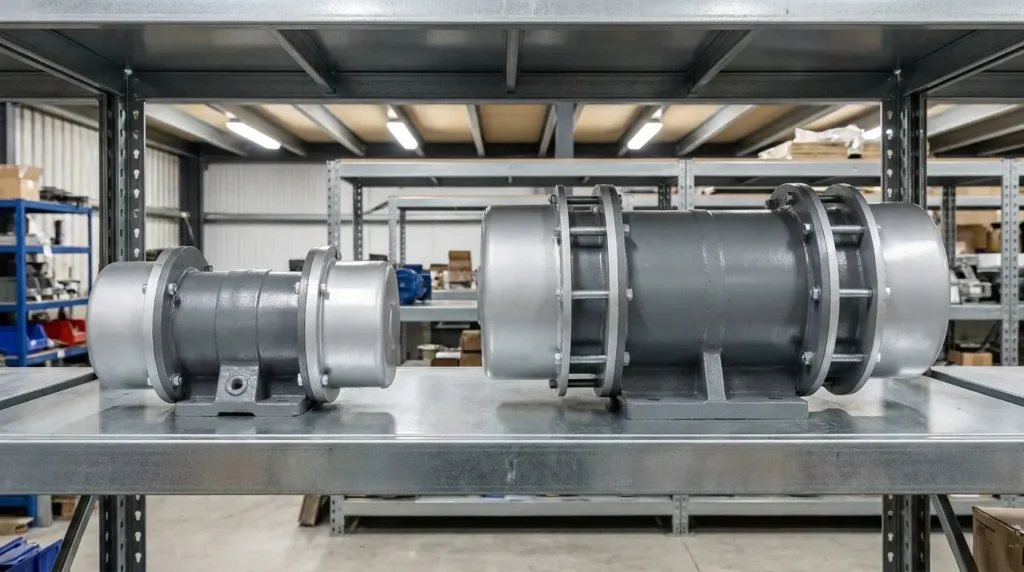
BV Series — Standard Vibro Motors
The BV series is Invicta’s core product range — the standard vibro motor lineup that covers the majority of industrial and concrete production applications. BV motors are available in a wide range of force outputs and speeds.
BV series key features:
- Foot-mount configuration — bolts to a flat surface through motor feet
- Double-ended shaft with eccentric weight assemblies at each end
- Adjustable eccentric weights — force adjustable without changing the motor
- IP65 protection as standard — dust tight and water jet resistant
- Insulation Class F — rated for sustained operation in warm environments
- Available in single-phase (for smaller sizes) and three-phase (throughout the range)
BV series force and speed range:
- Centrifugal force: Approximately 10N to 10,000N+ across the range
- Speeds: 3,000 RPM (2-pole, 50 Hz), 1,500 RPM (4-pole, 50 Hz), 1,000 RPM (6-pole, 50 Hz)
- Power: 0.03 kW to 5.5 kW+
Worked Example — Concrete Vibrating Table:
A contractor producing precast garden slabs (500mm × 500mm × 50mm) requires a vibrating table to consolidate concrete in rubber moulds. Table dimensions: 1.2m × 1.2m, steel construction, approximately 80 kg bare weight.
Specification process:
- Total mass to vibrate: 80 kg table + 40 kg concrete per batch = 120 kg
- Required frequency: 50 Hz (3,000 RPM) for general concrete
- Force requirement: Typically 3–5× table + payload weight for effective consolidation
- Required centrifugal force: approximately 120 × 10 (gravity) × 3 = 3,600N minimum
- Invicta BV motor selection: Single BV motor at 3,000 RPM producing approximately 4,000N centrifugal force — matches the application requirement.
BVFL Series — Flange Mount Vibro Motors
The BVFL series uses a face-mount (flange) configuration instead of the foot-mount of the BV series. This allows the motor to be bolted directly to a round mounting hole on equipment faces — a common mounting requirement on cylindrical silos, hoppers, and some concrete vibrating equipment.
When BVFL is specified instead of BV:
- The mounting surface is vertical or inclined rather than horizontal
- The equipment design uses a standard flange hole pattern rather than a flat foot mounting surface
- Space constraints make foot mounting impractical
Technical specifications: BVFL motors share the same electrical and vibration performance specifications as equivalent BV motors — the difference is purely in the mounting interface.
High-Frequency Invicta Models
For applications requiring vibration above the standard 50 Hz mains frequency, Invicta offers motors designed for operation with frequency inverter drives. Running these motors at 75 Hz, 100 Hz, or higher extends the vibration frequency beyond what mains-connected motors can achieve.
Applications for high-frequency Invicta motors:
- High-quality precast concrete products requiring more intensive vibration
- Architectural concrete where surface quality demands very thorough air void removal
- Stiff mix concrete that requires higher frequency for effective consolidation
Important: High-frequency operation reduces motor torque and increases thermal load — consult Invicta’s technical data and ensure the motor is rated for the intended inverter frequency before specifying.
Three-Phase vs Single-Phase Options
Invicta BV motors are available in both single-phase and three-phase versions. The selection depends on the power supply available at the installation location.
| Parameter | Single Phase | Three Phase |
|---|---|---|
| Voltage | 220–240V | 380–415V |
| Availability | Domestic and light commercial | Industrial/commercial sites |
| Efficiency | Lower at higher powers | Higher at equivalent power |
| Size range in single phase | Smaller motors (up to ~750W) | Full range |
| Starting current | High relative to running current | More manageable |
| Speed control via inverter | Possible with single-phase inverter | Standard three-phase VFD |
For most concrete production applications: Three-phase motors are preferred where three-phase supply is available — better efficiency, smoother operation, and more straightforward speed control for applications using inverter drives. Single-phase is appropriate for small vibrating tables in workshops with only single-phase supply.
Invicta Vibro Motor Technical Specifications
Centrifugal Force Output
Centrifugal force — measured in Newtons (N) or kilonewtons (kN) — is the primary performance specification of a vibro motor. It determines how much vibration energy the motor transfers to the equipment it drives.
Invicta specifies force at maximum eccentricity. Since the eccentric weights are adjustable, the catalogue maximum force assumes maximum eccentricity setting. Actual installed force may be set lower depending on application requirements.
Force selection guideline for concrete vibrating tables:
| Table + Payload Mass | Minimum Centrifugal Force | Recommended Force |
|---|---|---|
| Under 50 kg | 500N | 750–1,000N |
| 50–100 kg | 1,000N | 1,500–2,000N |
| 100–200 kg | 2,000N | 3,000–4,000N |
| 200–400 kg | 4,000N | 6,000–8,000N |
| Over 400 kg | 8,000N+ | Engineering calculation required |
Frequency and Speed
Invicta BV motors are available in three standard speeds determined by the number of poles:
- 2-pole (3,000 RPM / 50 Hz): Standard for most concrete vibrating table applications — higher frequency produces better air void removal in most standard concrete mixes
- 4-pole (1,500 RPM / 25 Hz): Used where lower frequency with higher amplitude is required — some granular material applications and large concrete elements
- 6-pole (1,000 RPM / 16.7 Hz): Low-frequency, high-amplitude vibration for applications requiring gentle but powerful vibration
The frequency-amplitude trade-off: Higher frequency (3,000 RPM) produces more vibration cycles per second but lower amplitude per cycle. Lower frequency (1,500 RPM) produces fewer cycles but higher amplitude. For concrete consolidation, 3,000 RPM is almost always the correct specification — the higher cycle rate is more effective at releasing trapped air from fresh concrete.
Power and Voltage Options
Invicta BV motor power ratings span from approximately 30W (smallest units) to 5,500W+ (largest units). Common power ratings available:
| Power | Force Range (typical) | Application |
|---|---|---|
| 30–100W | 100–500N | Small vibrating tables, laboratory |
| 100–370W | 500–2,000N | Medium tables, light hoppers |
| 370–750W | 2,000–5,000N | Commercial vibrating tables |
| 750–1,500W | 5,000–10,000N | Large tables, industrial screens |
| 1,500–5,500W | 10,000–50,000N+ | Industrial feeders, heavy screens |
IP Rating and Protection Class
All Invicta BV series motors are rated IP65 as standard — the motor housing is dust tight and protected against water jets from any direction. This is the minimum appropriate rating for concrete production environments where cement dust, water, and concrete splash are constant.
Why IP65 matters for concrete production: Cement dust is extremely fine and highly alkaline. Unprotected motor windings exposed to cement dust over time suffer accelerated insulation degradation. IP65 housing seals the critical internal components from this environment, directly extending motor service life.
Some Invicta models are available with IP66 (heavy water jet) or IP67 (temporary immersion) ratings for more demanding wash-down environments.
Insulation Class and Duty Rating
Insulation Class F (155°C): Standard on Invicta BV motors — the winding insulation is rated to withstand 155°C at the hottest point. For concrete production applications running at ambient temperatures of 20–40°C, Class F insulation provides adequate thermal margin for continuous duty.
Duty Rating S1 (continuous): Invicta BV motors are rated for S1 continuous duty — they are designed to run at full rated output indefinitely without rest periods. This is essential for production applications where the vibrating table may run for hours at a time.
Invicta Vibro Motor Specification Comparison Table
| Model Series | Mount Type | Force Range | Speed | Phase | IP Rating | Typical Application |
|---|---|---|---|---|---|---|
| BV (small) | Foot | 100–1,000N | 3,000 RPM | Single/Three | IP65 | Small tables, lab use |
| BV (medium) | Foot | 1,000–5,000N | 3,000/1,500 RPM | Three | IP65 | Commercial tables |
| BV (large) | Foot | 5,000–20,000N | 3,000/1,500/1,000 RPM | Three | IP65 | Industrial screens |
| BVFL | Flange | Same as BV | 3,000/1,500 RPM | Three | IP65 | Hoppers, silos |
| BV (HF) | Foot | Variable | Via inverter | Three | IP65 | High-quality precast |
Invicta Vibro Motor Applications
Concrete Vibrating Tables
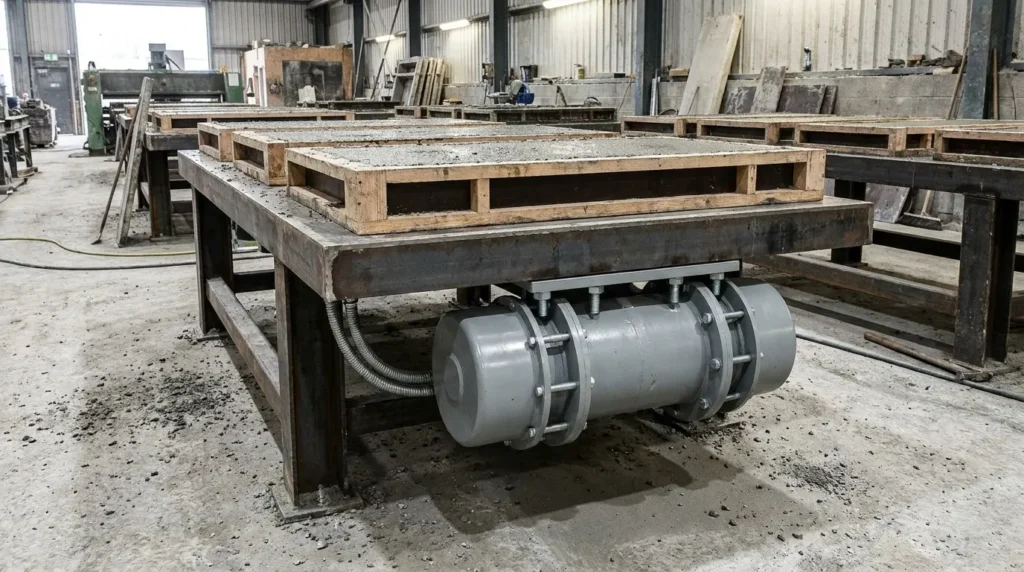
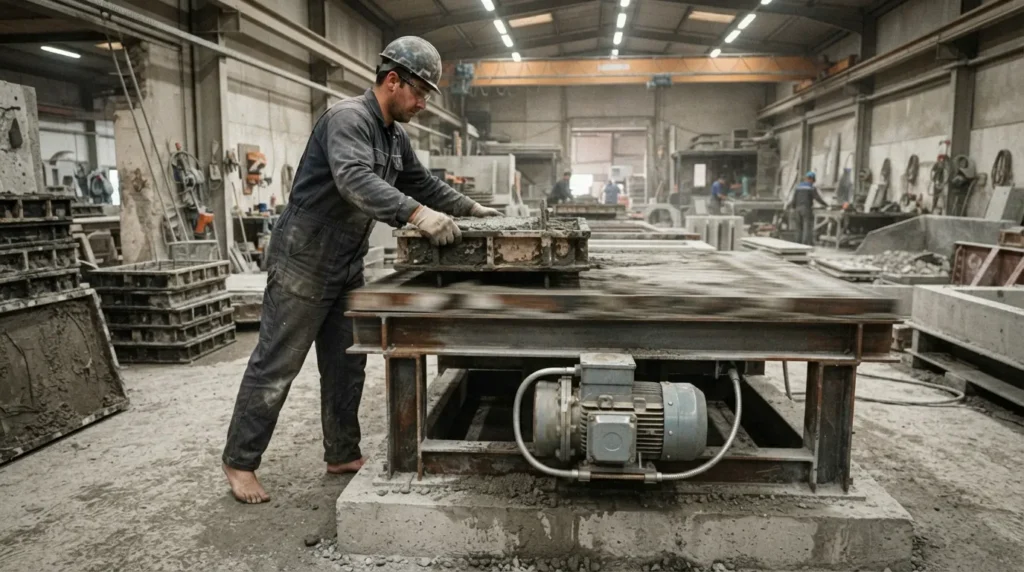
The most common construction application for Invicta vibro motors is driving concrete vibrating tables used in precast concrete production. The table surface vibrates under the influence of the eccentric mass motor, consolidating fresh concrete in moulds placed on the table.
Table design principles with Invicta motors:
The table surface is typically a steel plate or frame, sprung on rubber isolators from a fixed base. The Invicta motor mounts to the underside of the table surface. When running, the motor vibrates the table surface while the isolators prevent vibration from transmitting to the base and floor.
Motor positioning on vibrating tables: For tables up to approximately 1.5m × 1.5m, a single centrally mounted motor is typically adequate. For larger tables, two motors positioned symmetrically are used — synchronisation occurs naturally if both motors are identical and symmetrically mounted (they self-synchronise through the table structure).
Worked Example — Precast Garden Products:
A small business producing concrete garden items — stepping stones, bird baths, ornamental pieces. Table: 1.0m × 0.8m, 60 kg, rubber mould production.
- Maximum payload: 30 kg concrete per batch
- Total vibrating mass: 90 kg
- Required force: 90 × 9.81 × 3 = 2,648N minimum
- Invicta BV motor selection: 370W, 3,000 RPM, producing approximately 3,000N at maximum eccentricity
- Single-phase if single-phase workshop supply available; three-phase if industrial supply present
Precast Concrete Production
Industrial precast production — concrete pipes, railway sleepers, bridge beams, architectural panels — uses vibro motors in multiple configurations:
External vibration of steel moulds: Multiple Invicta motors mounted on the outside of steel beam or column moulds vibrate the entire mould structure during concrete placement and immediately after. This consolidates concrete in moulds that are too narrow or complex for internal poker vibration.
Vibrating casting beds: Long casting beds for prestressed concrete beams use multiple synchronised vibro motors along the length of the bed, ensuring consistent consolidation along elements up to 40 metres long.
The advantage over internal vibration for precast: External vibration does not require operators to manage poker positions during placement — the mould vibrates continuously during and after pour, and the concrete self-consolidates throughout the element.
Bin and Hopper Vibration
Cement silos, aggregate bins, and material hoppers in concrete plants suffer from bridging — where cohesive or moist material arches across the outlet and blocks flow. Invicta vibro motors mounted on the bin walls break up bridges and promote consistent material flow.
Selection for hopper applications: The motor must provide enough force to overcome the cohesive strength of the bridging material without causing the bin to walk (move across the floor) or overstress the bin structure. Typically a pulsed operation (running for 5–10 seconds at controlled intervals) rather than continuous duty.
IP rating note: Bin-mounted motors on cement silos experience continuous cement dust — IP65 minimum, IP66 preferred for this application.
Screen and Feeder Applications
Invicta vibro motors drive vibratory screens (for aggregate sizing) and vibratory feeders (for controlled material metering) in quarries, concrete plants, and bulk material handling facilities.
Two-motor screen drives: Most industrial screens use two counter-rotating vibro motors generating linear vibration — the circular vibration forces from each motor cancel in one axis and add in the other, producing a straight-line vibration vector that conveys material along the screen deck.
Invicta advantage on screens: The adjustable eccentric weights allow fine-tuning of the vibration amplitude after installation — useful for optimising screen efficiency with different feed materials or gradations.
Concrete Block and Paving Production
Block-making machines — producing concrete paving bricks, kerb stones, hollow blocks, and similar products — use vibro motors to consolidate concrete in steel moulds during pressing. The vibration reduces air voids and produces denser, stronger blocks with better surface quality.
Integration with block machine: In automated block machines, the vibro motor operates simultaneously with hydraulic pressing — vibration + pressure together achieve maximum consolidation in minimum cycle time.
How to Select the Right Invicta Vibro Motor
Matching Force to Application
The fundamental selection equation for a vibrating table application:
Required force (N) = Total vibrating mass (kg) × g (9.81 m/s²) × g-factor
G-factor by application:
| Application | Typical G-Factor | Required Acceleration |
|---|---|---|
| Dry free-flowing granular material | 2–3g | 19.6–29.4 m/s² |
| Damp or cohesive granular material | 3–5g | 29.4–49 m/s² |
| Fresh concrete (standard slump) | 3–4g | 29.4–39.2 m/s² |
| Fresh concrete (stiff mix) | 4–6g | 39.2–58.8 m/s² |
| Architectural/decorative concrete | 4–5g | 39.2–49 m/s² |
Worked Example — Block Making Table:
A concrete block making vibrating table. Table weight: 150 kg. Maximum mould and concrete payload: 80 kg. Total mass: 230 kg.
For fresh concrete (standard slump), g-factor = 3.5:
”Required force = 230 × 9.81 × 3.5 = 7,897N minimum
Add 20% safety margin:
”Design force = 7,897 × 1.20 = 9,476N
Select Invicta BV motor producing approximately 10,000N at maximum eccentricity — gives slight adjustment margin if reduced force is preferred after commissioning.
Mounting Configuration Selection
BV (foot mount): Use when:
- Mounting surface is flat and accessible for bolting through motor feet
- Horizontal or near-horizontal mounting
- Standard vibrating table or flat panel application
BVFL (flange mount): Use when:
- Mounting through a circular hole in the equipment wall
- Vertical mounting on bin or hopper walls
- Equipment design uses flange mounting as the standard interface
Power Supply Compatibility
Before ordering, confirm:
- Available voltage and phase: 220–240V single-phase or 380–415V three-phase — the motor must match
- Available current: Calculate running current (motor kW ÷ voltage × power factor) and ensure supply circuit can handle it plus starting current (typically 5–7× running current)
- Inverter drive requirement: If speed or force adjustment is needed after installation, confirm the motor is inverter-compatible and size the inverter for the motor rating
Invicta Vibro Motor Installation Guide
Mounting Position and Orientation
On vibrating tables: Mount the motor to the underside of the table surface, centred along both axes for single-motor installations. Ensure all four motor feet make firm contact with the table surface — uneven mounting creates additional bending stress on the motor shaft and mounting hardware.
Mounting bolt specification: Use the bolt diameter and grade specified by Invicta for each motor size. Vibro motor mounting hardware is subject to continuous dynamic loading — under-specified bolts will fatigue and fail. Typical specification: Grade 8.8 high-tensile bolts with spring washers or thread-locking compound.
Recheck torque after commissioning: All mounting bolts should be retorqued after the first 8 hours of operation — initial vibration can cause minor settling in the connection and bolt embedment that reduces clamping force.
Synchronisation of Twin Motors
When two Invicta vibro motors are used on a single piece of equipment (such as a large vibrating table or a vibratory screen), they must run in opposite rotation directions to achieve the correct vibration pattern.
Self-synchronisation: Identical Invicta motors mounted symmetrically on a common structure will naturally synchronise in counter-rotation after approximately 30–60 seconds of running — a phenomenon called Huygens synchronisation. No electrical inter-connection is required.
Forced synchronisation: For applications where immediate synchronisation is required or where the structure does not provide adequate coupling for self-synchronisation, Invicta motors can be electrically synchronised through phasing connections. Consult Invicta technical documentation for the specific wiring arrangement.
Direction verification: After installation, briefly run both motors individually and mark the rotation direction before connecting both together. Counter-rotation of symmetrically mounted motors produces linear vibration (desired for most table and screen applications). Co-rotation produces circular or elliptical vibration.
Electrical Connection Requirements
Terminal protection: Invicta BV motors have IP65-rated terminal boxes. Use IP65 cable glands for all cable entry — the protection rating of the terminal connection must match the motor body rating.
Cable sizing: Size supply cables for the motor full load current plus 25% safety margin for starting current duration. Consult the motor nameplate for exact current ratings.
Earth/ground connection: Always connect the motor earth terminal to the equipment earth — vibro motors on concrete production equipment are in frequent contact with water and conductive materials.
Invicta Vibro Motor Maintenance and Troubleshooting
Routine Maintenance Schedule
Invicta BV motors are designed for minimal maintenance — the sealed construction and quality bearings reduce service requirements significantly compared to open-frame motors.
Monthly checks:
- Inspect mounting bolts and retorque if any movement is detected
- Listen for any change in motor noise during operation — bearing noise develops gradually
- Check terminal box cover seals for any damage or ingress evidence
- Inspect eccentric weight guards for damage or looseness
Annual service:
- Clean exterior of motor body — accumulated concrete and dust reduce heat dissipation
- Inspect eccentric weight assemblies for wear or loosening of the locking bolts
- Verify earth connection resistance with a multimeter
- Record motor operating temperature with a contact thermometer — compare against baseline
Bearing replacement: Invicta BV motors use sealed-for-life bearings in standard configurations. Bearing replacement is the primary service requirement — typically every 3–5 years in continuous-duty concrete production applications. Bearing noise (grinding, rumbling at speed) is the primary indicator that replacement is due.
Common Faults and Solutions
| Fault | Likely Cause | Solution |
|---|---|---|
| Motor not starting | Supply voltage absent or phase failure | Check supply, fuses, contactor |
| Motor starts slowly, runs hot | Excessive eccentric weight setting | Reduce eccentricity; check supply voltage |
| Excessive vibration noise | Loose mounting bolts | Retorque all mounting fasteners |
| Bearing noise (grinding) | Bearing wear | Replace bearings — specialist service |
| Motor overheats | Duty cycle too high, or winding damage | Check duty cycle; test winding resistance |
| Reduced vibration output | Eccentric weights reset to lower setting | Verify and reset eccentric weight position |
| Terminal box water ingress | Failed cable gland seal | Replace gland seal; dry and inspect windings |
Invicta Vibro Motor vs Competitor Brands
Invicta operates in a market with several established competitors — primarily Italian manufacturers OLI and Italvibras, German manufacturer FRIEDRICH, and various Chinese import brands.
| Brand | Origin | Reputation | Force Range | Data Quality | Availability |
|---|---|---|---|---|---|
| Invicta | UK | ✅ Excellent | Full range | ✅ Excellent | UK + international |
| OLI | Italy | ✅ Excellent | Full range | ✅ Excellent | Global |
| Italvibras | Italy | ✅ Excellent | Full range | ✅ Excellent | Global |
| FRIEDRICH | Germany | ✅ Very good | Full range | ✅ Very good | European focus |
| Generic Chinese imports | China | ⚠️ Variable | Limited | ❌ Poor | Online |
Where Invicta leads:
- UK domestic availability and technical support
- Documentation quality — Invicta data sheets are detailed and reliable
- Adjustable eccentric weight design providing flexibility post-installation
- Long track record in UK construction and industrial markets
Where competitors may be preferred:
- OLI and Italvibras have larger global dealer networks — easier to source in some international markets
- Italian brands may be preferred in European markets where their distribution is stronger
- For applications requiring very large force outputs, all major brands (OLI, Italvibras, FRIEDRICH, Invicta) have equivalent ranges
Generic Chinese imports: Not recommended for continuous-duty concrete production applications. Force output claims are often unverified, IP ratings may not meet the marked standard, and bearing life in sustained operation is typically far below European equivalents. The purchase price saving is usually recovered in failure costs within one or two production seasons.
Where to Buy Invicta Vibro Motors
Invicta vibro motors are available through several channels depending on your location and the urgency of your requirement:
Invicta direct: Invicta Vibrators supply directly to engineers and contractors for custom specifications and large orders. Their technical team can assist with motor selection for specific applications.
UK electrical and industrial distributors: Invicta motors are stocked by specialist electrical and industrial component distributors throughout the UK — useful for quick delivery on standard catalogue models.
International distributors: Invicta has distributor relationships in several international markets — check their website for current distributor listings in your region.
Online marketplaces: For standard BV series motors, online procurement through industrial suppliers provides competitive pricing and fast delivery. The Invicta vibro motor available here represents a convenient procurement route for standard catalogue models — verify the specific model force output, speed, and voltage against your application requirements before ordering, as vibro motor selection is application-specific.
Important for online purchasing: Always verify the motor specification against your calculated force requirement. Do not select based on power rating alone — two motors with the same wattage can have different eccentric mass configurations producing significantly different centrifugal force outputs.
Frequently Asked Questions
What is an Invicta vibro motor?
An Invicta vibro motor is an electric motor with integral adjustable eccentric weights that generate centrifugal vibration force when the motor runs. Unlike internal concrete vibrators (which use a flexible shaft and poker head), Invicta vibro motors vibrate the equipment they are mounted to — most commonly concrete vibrating tables, hoppers, bins, feeders, and industrial screens. Invicta is a British manufacturer with a long history in industrial vibration equipment.
What is the Invicta BV motor?
The BV series is Invicta’s standard product range — foot-mounted eccentric mass vibro motors available from small units producing 100N centrifugal force to large industrial units producing 20,000N+. BV motors are the most common Invicta product for concrete vibrating table applications, rated IP65, insulation class F, and available in single and three-phase configurations.
How do I select the right Invicta vibro motor for a concrete vibrating table?
Calculate total vibrating mass (table weight + maximum payload). Multiply by gravitational acceleration (9.81 m/s²) and a g-factor of 3–4 for standard fresh concrete. Add 20% safety margin. Select the smallest Invicta BV motor with maximum force output above your calculated requirement — the adjustable eccentric weights allow force reduction if needed after installation.
What is the difference between Invicta BV and BVFL motors?
Both series offer the same vibration performance specifications. The BV series uses foot mounting (bolts through motor feet to a flat surface). The BVFL series uses flange mounting (bolts through a circular flange to a matching hole in the equipment wall). Use BV for vibrating tables and flat-surface mounting; use BVFL for hopper walls, silos, and equipment with flange-hole mounting provisions.
Can Invicta vibro motors be used with inverter drives?
Yes — Invicta BV motors can be operated with variable frequency drive (VFD) inverters to adjust vibration frequency and force output after installation. Not all motors are equally suited to all inverter types — consult Invicta technical data for the specific motor model regarding VFD compatibility and the recommended minimum and maximum operating frequency range.
How long do Invicta vibro motors last?
In well-maintained concrete production applications, Invicta BV motors typically achieve 5–10+ years of service life before major overhaul. The primary wear items are bearings (typically replaced every 3–5 years in continuous duty) and eccentric weight locking hardware (inspect annually). Motor winding life is typically 10–15+ years if the motor is correctly sized and not run at excessive temperature.
What is the IP65 rating on Invicta motors?
IP65 means the motor is dust tight (no ingress of dust) and protected against water jets from any direction. For concrete production environments with cement dust, water spray, and concrete splash, IP65 is the minimum appropriate protection level. Invicta BV series motors carry IP65 as standard — some models are available with IP66 (heavy water jet) for more demanding wash-down environments.
How do I synchronise two Invicta vibro motors?
Two identical Invicta motors mounted symmetrically on a common structure will naturally self-synchronise in counter-rotation through the vibration of the shared structure — a phenomenon that occurs without any electrical connection between the motors. Allow 30–60 seconds of operation for synchronisation to establish. For large or complex structures, verify counter-rotation direction and consult Invicta for forced synchronisation wiring if self-synchronisation is unreliable.
Conclusion
The Invicta vibro motor is one of the most reliable and well-documented vibration motor products available in the UK market and internationally. The BV series covers every concrete production application from small decorative concrete tables to large industrial precast operations. The key to getting the right result is correct selection — calculate your required centrifugal force from the total vibrating mass and the appropriate g-factor, choose the mounting configuration that suits your equipment, verify voltage and phase compatibility, and install to Invicta’s mounting specifications with correct bolt grades and torque values. Maintained correctly, an Invicta motor is a long-service industrial component that pays back its purchase price many times over in reliable production output. Calculate your concrete production volumes with the ConcreteCal free concrete calculator before specifying vibration equipment — and see our concrete vibration motor guide for a broader overview of all vibration motor types beyond the Invicta range.