
Concrete is the most widely used construction material on earth — more than 10 billion tons are produced globally every year. But “concrete” is not a single material. There are dozens of distinct types of concrete, each engineered for specific loads, environments, finishes, and structural demands. Choosing the wrong type doesn’t just waste money — it produces structures that crack, spall, corrode, or fail under conditions they were never designed to handle.
This guide covers every major type of concrete used in residential, commercial, and infrastructure construction: what each one is made of, where it performs best, and what distinguishes it from the alternatives. Whether you’re a DIYer planning a patio, a contractor specifying a structural mix, or a student studying construction materials, this reference gives you the complete picture.
Once you know which type you need, use the concrete bag calculator at ConcreteCal to calculate exactly how much material your project requires.
Table of Contents
- What Is Concrete? Composition and Core Properties
- The Main Types of Concrete — Overview
- Structural Types of Concrete
- Specialty Mix Types of Concrete
- Lightweight and Heavyweight Concrete
- Decorative and Architectural Types of Concrete
- Sustainable and Modern Concrete Types
- How to Choose the Right Type of Concrete
- Frequently Asked Questions
What Is Concrete? Composition and Core Properties
Concrete is a composite construction material made by combining a binder (cement paste) with aggregates (sand, gravel, or crushed stone) and water. When mixed, the cement and water react chemically — a process called hydration — producing a paste that binds the aggregates together and hardens into a dense, load-bearing solid.
Standard concrete contains four primary ingredients:
- Portland cement — the binder; typically 10–15% of total volume
- Fine aggregate — sand; fills voids between coarse particles
- Coarse aggregate — gravel or crushed stone; provides bulk strength
- Water — triggers hydration; the water-cement ratio controls strength
Modern mixes frequently add admixtures — chemical or mineral additives that modify workability, set time, durability, or strength. Common admixtures include plasticizers (improve flow without adding water), fly ash (replaces partial cement for sustainability), silica fume (increases density and strength), and air-entraining agents (improve freeze-thaw resistance).
Concrete vs. Cement — The Difference Explained
Cement and concrete are not interchangeable terms, though they’re used that way constantly in casual conversation.
Cement is a fine grey powder — the binder ingredient. It cannot be used alone as a structural material.
Concrete is the finished composite material: cement + aggregates + water. Cement is an ingredient in concrete, the way flour is an ingredient in bread.
This distinction matters when ordering materials, reading specifications, and understanding product labels.
Key Properties That Define Concrete Performance
| Property | Typical Range | What It Affects |
|---|---|---|
| Compressive strength | 2,500–10,000+ PSI | Load-bearing capacity |
| Tensile strength | ~10% of compressive | Crack resistance (low — needs rebar) |
| Density | 85–250 lbs/ft³ | Dead load, thermal mass |
| Workability (slump) | 1–9 inches | Ease of placement |
| Permeability | Variable | Moisture and chemical resistance |
| Durability | Variable | Freeze-thaw, abrasion, corrosion |
Compressive strength is the most referenced specification — it’s the number in PSI or MPa printed on mix designs and project drawings. Tensile strength is inherently low in all concrete types, which is why reinforcement (rebar, mesh, or fibers) is added wherever tensile or bending forces are expected.
The Main Types of Concrete — Overview
The dozens of concrete types in use today can be organized into five broad categories:
| Category | Examples | Primary Driver |
|---|---|---|
| Structural | Plain, reinforced, prestressed, precast | Load-bearing capacity |
| Specialty Mix | High-strength, self-compacting, fiber-reinforced | Performance specification |
| Weight-Modified | Lightweight, heavyweight | Density requirement |
| Decorative | Stamped, colored, exposed aggregate | Aesthetics |
| Sustainable/Modern | Pervious, roller-compacted, green concrete | Environment or efficiency |
Most residential projects use standard reinforced concrete from the structural category. Specialty mixes, decorative types, and sustainable options are chosen when standard concrete can’t meet a specific performance or aesthetic requirement.
Structural Types of Concrete
These are the foundational types used in load-bearing construction — foundations, slabs, columns, beams, walls, and bridges.
Plain Concrete
Plain concrete contains no reinforcement. It’s mixed from cement, aggregates, and water without rebar, mesh, or fibers.
Compressive strength: 2,500–3,000 PSI Use cases: Blinding layers under foundations, mass concrete fills, non-structural pads, pavement sub-bases
Plain concrete handles compression well but has virtually no tensile capacity. A plain concrete slab will crack under bending loads — which is why it’s limited to applications where only compression acts on the material. A shed base or garden path in stable, non-frost soil is a reasonable plain concrete application. A driveway or structural floor is not.
Reinforced Concrete
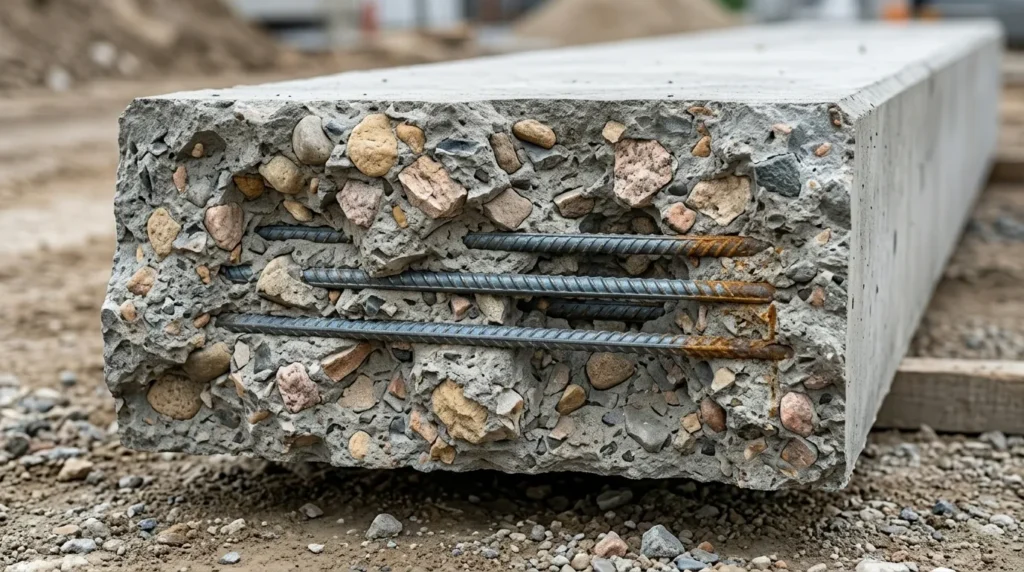
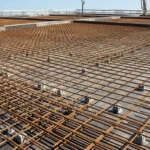
Reinforced concrete embeds steel — rebar, welded wire mesh, or steel fibers — within the concrete matrix to carry tensile forces the concrete itself cannot resist.
Compressive strength: 3,000–5,000 PSI (residential); higher for structural Use cases: Slabs, driveways, garage floors, footings, foundations, beams, columns, retaining walls
Steel and concrete have nearly identical thermal expansion coefficients — they expand and contract at almost the same rate — which is why they bond so effectively without separating under temperature changes.
Worked Example: A 20 ft × 24 ft garage floor at 5 inches thick uses reinforced concrete with #4 rebar on 18-inch centers. The rebar sits at the lower third of the slab depth, positioned to resist the tensile bending stress that develops when a vehicle drives across the surface and flexes the slab slightly. Without the rebar, the slab would crack progressively under this repeated load.
Prestressed Concrete
Prestressed concrete introduces compressive stress into the concrete before any service load is applied — by tensioning high-strength steel cables (tendons) either before casting (pre-tensioned) or after (post-tensioned).
Use cases: Long-span bridges, parking structure decks, floor systems in multi-story buildings, precast beams
Prestressing allows concrete to span much greater distances without cracking or deflecting excessively. A prestressed concrete bridge beam can span 100+ feet — something reinforced concrete alone cannot achieve at the same cross-section size.
Precast Concrete
Precast concrete is cast and cured in a controlled factory environment, then transported to the construction site and installed.
Advantages: Consistent quality, faster site construction, reduced formwork, year-round production regardless of weather Use cases: Wall panels, stairs, bridge beams, pipes, retaining wall blocks, parking structures
Precast elements are manufactured to precise dimensions and strength specifications — quality control is significantly tighter than cast-in-place work. The trade-off is transportation cost and the logistical challenge of handling large, heavy elements on site.
Specialty Mix Types of Concrete
These mixes are engineered for performance characteristics that standard concrete cannot meet.
High-Strength Concrete
High-strength concrete achieves compressive strengths above 6,000 PSI (41 MPa), and often 10,000–20,000 PSI in structural applications. It uses low water-cement ratios, silica fume, and superplasticizers to achieve density and strength impossible with standard mix proportions.
Use cases: High-rise columns, long-span bridges, heavily loaded foundations
The reduced cross-section allowed by high-strength concrete saves floor space and reduces dead load in tall buildings — a significant structural and economic advantage.
High-Performance Concrete
High-performance concrete (HPC) is defined not just by strength but by a combination of properties: durability, workability, long-term stability, and resistance to aggressive environments. All high-strength concrete is high-performance, but not all HPC is high-strength.
Use cases: Marine structures, chemical plants, infrastructure exposed to deicers or sulfates, tunnels
Self-Compacting Concrete
Self-compacting concrete (SCC) flows under its own weight, filling complex formwork and consolidating around dense reinforcement without vibration.
Use cases: Congested reinforcement, architectural concrete, precast elements, tunnel linings
Vibrating conventional concrete around tightly spaced rebar risks incomplete consolidation — honeycombing and voids that weaken the finished element. SCC eliminates that risk entirely.
Air-Entrained Concrete
Air-entrained concrete contains billions of microscopic air bubbles, intentionally introduced by an admixture. The bubbles provide relief space for water as it expands during freezing, dramatically improving freeze-thaw resistance.
Use cases: Any exterior concrete in climates with freeze-thaw cycles — driveways, sidewalks, patios, bridge decks
Air content of 4–8% is standard for freeze-thaw exposure. Without air entrainment, repeated freeze-thaw cycles cause surface scaling — the progressive flaking of the top layer — within a few winters.
Fiber-Reinforced Concrete
Fiber-reinforced concrete adds steel, polypropylene, glass, or synthetic fibers to the mix. Fibers control crack width, improve impact resistance, and reduce shrinkage cracking.
Steel fibers: Increase toughness and post-crack load capacity — used in industrial floors, shotcrete, precast elements Polypropylene fibers: Reduce plastic shrinkage cracking — common in residential slabs Glass fibers: Used in architectural panels and thin-section precast
Fibers don’t replace rebar for primary structural reinforcement — they work at the micro-crack scale, bridging fine cracks before they widen.
Polymer Concrete
Polymer concrete replaces Portland cement as the binder with a polymer resin — epoxy, polyester, or vinyl ester. The result is extremely high strength, near-zero permeability, and outstanding chemical resistance.
Use cases: Industrial flooring, drainage channels, repair mortars, precast architectural elements
Polymer concrete costs significantly more than standard concrete but outperforms it dramatically in corrosive or chemically aggressive environments.
Lightweight and Heavyweight Concrete
Lightweight Concrete
Lightweight concrete uses low-density aggregates — expanded shale, clay, slate, or pumice — to reduce density while maintaining structural adequacy.
Density: 85–115 lbs/ft³ (vs. 150 lbs/ft³ for standard) Use cases: Elevated floor slabs, roof decks, precast panels, insulating fills
Reducing dead load in elevated structures directly reduces the size and cost of the supporting beams, columns, and foundations below — a cascading structural and economic benefit.
Worked Example: A 10-story building with 40,000 ft² of floor per story. Switching from standard concrete (150 lbs/ft³) to lightweight (110 lbs/ft³) at 5-inch slab thickness saves:
(150 – 110) × (5÷12) × 40,000 = 666,667 lbs per floor = 333 tons per floor Over 10 floors: 3,330 tons of dead load reduction
That reduction directly decreases column and foundation sizes — and construction cost.
Heavyweight Concrete
Heavyweight concrete uses dense aggregates — barite, magnetite, steel shot — to achieve densities of 190–250 lbs/ft³.
Use cases: Nuclear reactor shielding, medical radiation rooms, counterweights, ballast
Heavyweight concrete’s radiation-shielding capability comes from its mass — the denser the material, the more effectively it attenuates gamma radiation and neutron flux.
Decorative and Architectural Types of Concrete
Stamped Concrete
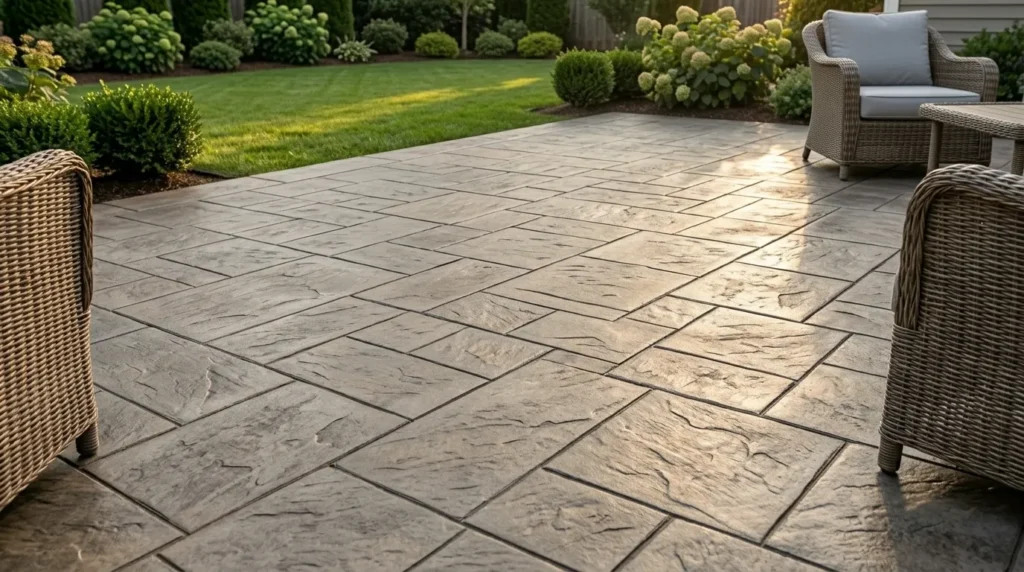
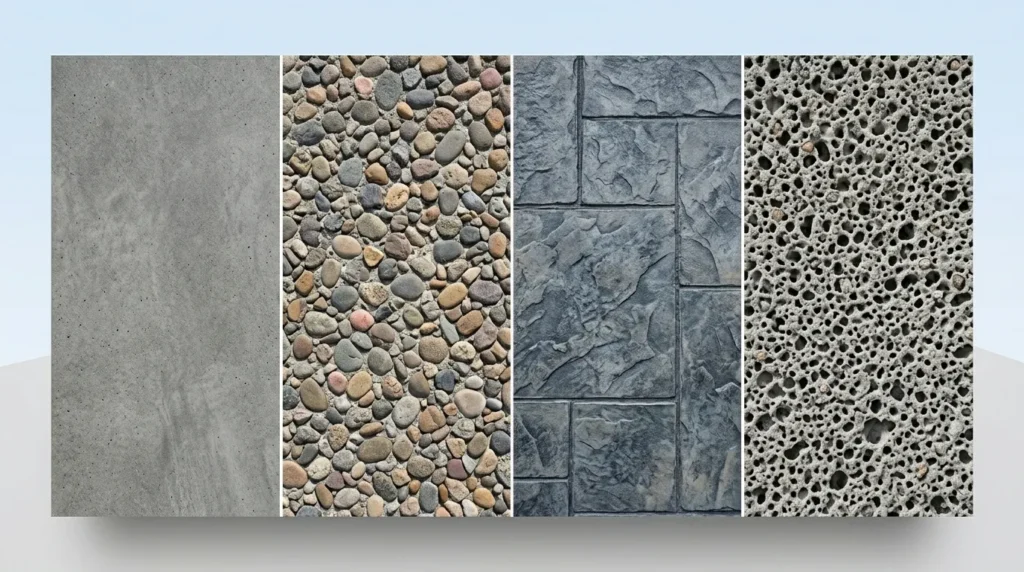
Stamped concrete is standard concrete that receives texture patterns — pressed into the surface before it sets — mimicking stone, brick, slate, tile, or wood.
Use cases: Patios, driveways, pool decks, walkways, interior floors
Stamped concrete costs $8–$18 per square foot installed, compared to $4–$8 for plain broom-finished concrete. The premium buys aesthetics — the structural properties are essentially identical to standard concrete.
Types of stamped concrete patterns:
- Ashlar slate (most popular)
- Cobblestone and brick
- Flagstone and random stone
- Wood plank texture
- Herringbone and geometric patterns
Color is typically added via integral pigment (mixed into the batch), color hardener (broadcast on the surface), or acid stain (applied after curing).
Colored and Exposed Aggregate Concrete
Colored concrete uses iron oxide pigments — either integral or surface-applied — to achieve consistent color throughout or on the surface.
Exposed aggregate concrete removes the surface cement paste (by washing before full cure, or by grinding after) to reveal the decorative aggregate beneath — a finish that provides both visual texture and slip resistance.
Use cases: Decorative driveways, architectural facades, public plazas, pedestrian areas
Sustainable and Modern Concrete Types
Pervious Concrete
Pervious concrete is intentionally porous — it contains little or no fine aggregate, creating an open void structure that allows water to drain directly through the slab.
Void content: 15–25% Flow rate: 3–8 gallons per minute per square foot Use cases: Parking lots, low-traffic driveways, pedestrian paths, stormwater management areas
Pervious concrete reduces stormwater runoff, recharges groundwater, and can eliminate the need for separate drainage infrastructure. Many municipalities now require or incentivize pervious pavement for large parking areas.
Roller-Compacted Concrete
Roller-compacted concrete (RCC) is a stiff, zero-slump mix placed by paving equipment and compacted by vibratory rollers — the same process used for asphalt.
Use cases: Dam construction, heavy industrial pavements, logging roads, airport aprons
RCC is placed and compacted far faster than conventional concrete — large dam faces and industrial yards can be paved at rates of thousands of cubic yards per day.
Green Concrete (Fly Ash, Slag, Silica Fume)
Green concrete replaces a portion of Portland cement with industrial byproducts:
- Fly ash (from coal combustion): replaces 15–30% of cement; improves workability, reduces heat of hydration
- Ground granulated blast-furnace slag: replaces 30–70% of cement; improves durability against sulfates and chlorides
- Silica fume: replaces 5–10% of cement; dramatically increases density and strength
Portland cement production accounts for approximately 8% of global CO₂ emissions. Supplementary cementitious materials (SCMs) reduce this significantly — fly ash concrete can cut the cement-related carbon footprint of a slab by 20–30%.
According to the Portland Cement Association, supplementary cementitious materials now appear in the majority of ready-mix concrete produced in the United States — making green concrete not a specialty product but the new standard.
How to Choose the Right Type of Concrete for Your Project
The right concrete type is determined by four factors: structural demand, exposure conditions, aesthetics, and budget.
| Project | Recommended Type | Minimum PSI | Key Specification |
|---|---|---|---|
| Garden path / shed base | Plain or standard reinforced | 2,500–3,000 | None special |
| Residential patio | Standard reinforced | 3,000–3,500 | Air-entrained in cold climates |
| Driveway | Reinforced, air-entrained | 4,000–4,500 | Air entrainment + rebar |
| Garage floor | Reinforced | 4,000 | Fiber addition optional |
| Decorative patio | Stamped + reinforced | 3,500–4,000 | Color + texture specification |
| Foundation slab | Reinforced | 3,500–4,000 | Engineer specification required |
| Retaining wall | Reinforced | 3,500–4,500 | Drainage + waterproofing |
| Parking lot | Reinforced or pervious | 4,000+ | Depends on stormwater requirements |
| Elevated floor | Lightweight reinforced | 3,500–4,000 | Density specification critical |
| Industrial floor | Fiber-reinforced | 4,500–5,000 | Joint spacing + surface hardener |
For most residential projects, the decision comes down to three things:
- Will this be in a freeze-thaw climate? → Specify air entrainment
- Will vehicles drive on it? → Use 4,000 PSI minimum with rebar
- Does aesthetics matter? → Stamped or exposed aggregate adds $4–$10/ft² to cost
Once you’ve identified your concrete type and dimensions, calculate your exact material requirements with the ConcreteCal bag calculator — it handles volume, bag count, and cost estimation for any project size.
Frequently Asked Questions About Types of Concrete
What are the main types of concrete?
The main categories are: plain concrete, reinforced concrete, prestressed concrete, precast concrete, lightweight concrete, high-strength concrete, self-compacting concrete, fiber-reinforced concrete, stamped concrete, pervious concrete, and roller-compacted concrete. Each is engineered for specific structural, environmental, or aesthetic requirements.
What type of mixture is concrete?
Concrete is a heterogeneous composite mixture — it consists of distinct materials (cement, water, fine aggregate, coarse aggregate) that remain physically separate at the particle level rather than chemically combining into a uniform substance. The cement paste acts as a binder that coats and bonds the aggregate particles together.
What type of rock is concrete?
Concrete is not a natural rock, but it’s sometimes called “artificial rock” because its properties — density, hardness, and compressive strength — are similar to sedimentary rocks like limestone and sandstone. The aggregate within concrete is typically crushed natural rock (limestone, granite, basalt, or gravel), but the finished composite is a manufactured material.
What are the types of reinforced concrete?
Reinforced concrete types include: conventionally reinforced (rebar or mesh), prestressed (pre-tensioned or post-tensioned), fiber-reinforced (steel, polypropylene, or glass fibers), and post-tensioned slabs. Each handles tensile forces differently — conventional rebar is passive (resists forces after cracking), while prestressed tendons are active (prevent cracking by pre-compressing the section).
What are the types of stamped concrete?
Common stamped concrete patterns include ashlar slate, cobblestone, brick, flagstone, wood plank, herringbone, and random stone. Color options include integral pigment, surface color hardener, acid staining, and water-based staining. The combination of pattern and color defines the final appearance.
Which concrete building type may be cast in larger sections?
Cast-in-place reinforced concrete allows the largest monolithic pours — entire floors, walls, or dam sections can be poured continuously. Roller-compacted concrete supports even larger placements due to its rapid placement rate. Precast, by contrast, is size-limited by transport constraints.
What is the difference between high-strength and high-performance concrete?
High-strength concrete is defined specifically by compressive strength exceeding 6,000 PSI. High-performance concrete is a broader category defined by a combination of properties — strength, durability, workability, and long-term stability — not strength alone. All high-strength concrete qualifies as high-performance, but HPC includes mixes that prioritize durability over maximum strength.
Is pervious concrete strong enough for driveways?
Yes for residential passenger vehicle driveways — pervious concrete typically achieves 2,500–4,000 PSI compressive strength, adequate for light vehicle traffic. It is not suitable for heavy trucks or high-traffic commercial areas where the open void structure can be damaged by point loads or freeze-thaw in colder climates.
Conclusion
Concrete is not one material — it’s a family of engineered composites, each optimized for a different combination of strength, weight, durability, appearance, and environmental performance. Matching the right type to your project’s actual demands is the decision that separates structures that last decades from ones that crack in seasons. Use the selection table above to identify your specification, then calculate your exact material quantities with the Concretecalc.online.
.