
Mixing units is one of the most reliable ways to ruin a concrete estimate. A supplier quotes in cubic yards. Your calculator outputs cubic meters. The bag label lists yield in cubic feet. Your engineer’s drawing specifies slab thickness in millimeters. None of these numbers talk to each other automatically — you have to convert them manually, and a wrong conversion factor at any step cascades into a wrong material order.
This guide solves that problem. It covers concrete bag yield — exactly how many cubic feet you get from a 40 lb, 60 lb, or 80 lb bag — plus every conversion you’ll encounter in a real concrete project: volume, length, thickness, area, weight, and compressive strength. Every conversion includes the factor, the formula, and a worked example you can replicate directly.
Use our concrete calculator to apply these conversions directly to your project dimensions and get instant results without manual arithmetic.
Table of Contents
- Why Concrete Unit Conversions Matter
- How Many Cubic Feet in a Bag of Concrete?
- Concrete Volume Conversions
- Concrete Length and Thickness Conversions
- Concrete Area Conversions
- Concrete Weight Conversions
- Concrete Strength Conversions — PSI to MPa
- Common Concrete Conversion Mistakes to Avoid
- Frequently Asked Questions
Why Concrete Unit Conversions Matter
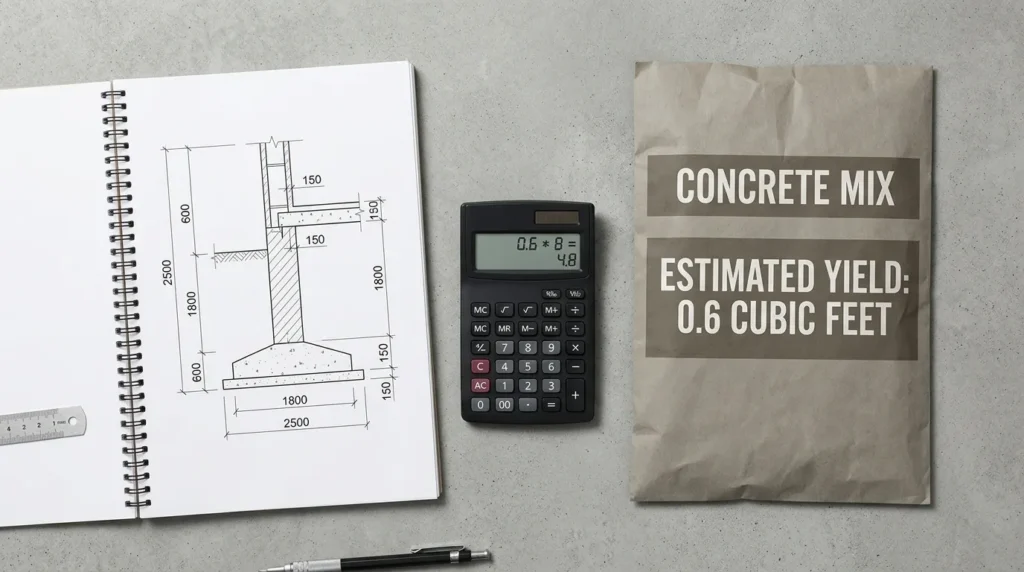
Concrete projects involve at least three different unit systems running simultaneously: imperial (inches, feet, yards, pounds, PSI) used on US job sites; metric (millimeters, meters, kilograms, MPa) used in engineering drawings and international specifications; and bag-based yield (cubic feet per bag) used on product packaging.
A contractor working from an architect’s drawing in millimeters, ordering ready-mix quoted in cubic yards, and comparing with bagged concrete labeled in cubic feet is working across all three systems at once. One missed conversion — say, treating a thickness of 150 mm as 150 inches rather than 5.9 inches — produces a volume estimate that’s off by a factor of 25.
These aren’t rare mistakes. They’re the most common source of material over-ordering and under-ordering on residential projects. The reference tables and formulas in this guide eliminate the guesswork.
How Many Cubic Feet in a Bag of Concrete?
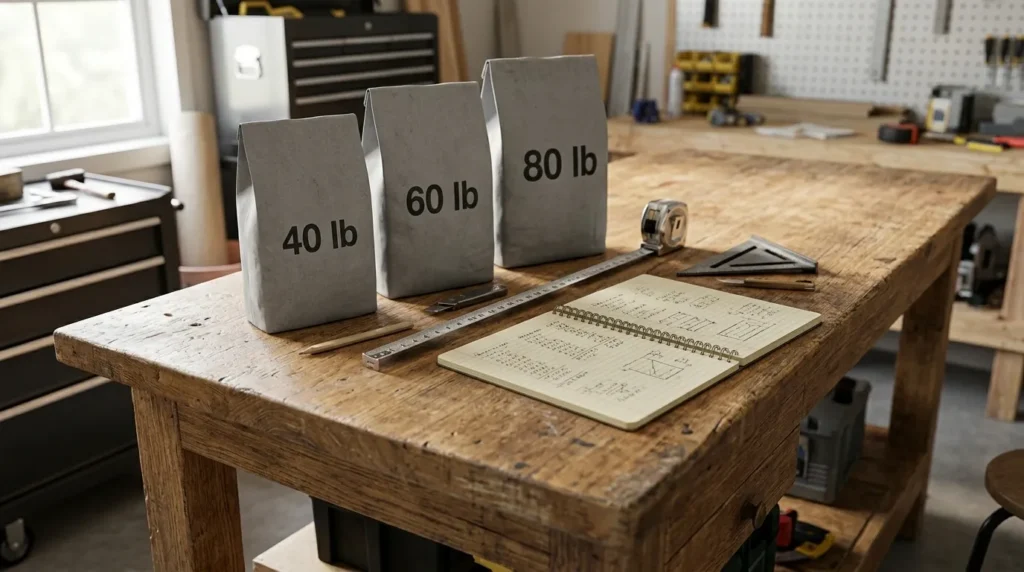
Bag yield is the volume of mixed, poured concrete produced by one bag of dry premix. It’s printed on the bag label, but the numbers vary by bag weight — and manufacturers round slightly differently.
The values below are industry-standard yields used by major manufacturers and confirmed in product data sheets published by Quikrete:
40 lb Bag Yield
0.30 cubic feet per 40 lb bag
A 40 lb bag is the lightest standard size — easy to handle but low yield. You need 3.33 bags to fill one cubic foot of formed space.
Worked Example: Filling a fence post hole: 10 inches diameter × 36 inches deep
Volume: π × (5/12)² × (36/12) = π × 0.174 × 3 = 1.64 ft³ Bags needed: 1.64 ÷ 0.30 = 5.5 → 6 bags of 40 lb
60 lb Bag Yield
0.45 cubic feet per 60 lb bag
The 60 lb bag is the most balanced option for DIY projects — manageable weight with reasonable yield. You need 2.22 bags per cubic foot.
Worked Example: A small 3 ft × 4 ft stepping stone pad, 3.5 inches thick:
Volume: 3 × 4 × (3.5÷12) = 3.5 ft³ Bags needed: 3.5 ÷ 0.45 = 7.78 → 8 bags of 60 lb
80 lb Bag Yield
0.60 cubic feet per 80 lb bag
The 80 lb bag delivers the best yield per purchase and the lowest cost per cubic foot of all bagged options. You need 1.67 bags per cubic foot.
Worked Example: A 10 ft × 10 ft shed base, 4 inches thick:
Volume: 10 × 10 × (4÷12) = 33.3 ft³ Bags needed: 33.3 ÷ 0.60 = 55.5 → 56 bags of 80 lb With 10% waste: 62 bags to purchase
Bags Per Cubic Foot — Reverse Lookup
Sometimes you know the cubic footage and need to know how many bags that equals. Use this table directly:
| Volume (ft³) | 40 lb Bags | 60 lb Bags | 80 lb Bags |
|---|---|---|---|
| 1 | 3.4 → 4 | 2.3 → 3 | 1.7 → 2 |
| 5 | 16.7 → 17 | 11.2 → 12 | 8.4 → 9 |
| 10 | 33.4 → 34 | 22.3 → 23 | 16.7 → 17 |
| 15 | 50 | 33.4 → 34 | 25 |
| 20 | 66.7 → 67 | 44.5 → 45 | 33.4 → 34 |
| 27 (1 yd³) | 90 | 60 | 45 |
All figures before waste factor. Add 10% for final purchase quantity.
Complete Bag Yield Quick Reference
| Bag Size | Yield (ft³) | Bags Per ft³ | Bags Per yd³ | Cost Per yd³ (at $7/bag) |
|---|---|---|---|---|
| 40 lb | 0.30 | 3.33 | 90 | $630 |
| 60 lb | 0.45 | 2.22 | 60 | $420 |
| 80 lb | 0.60 | 1.67 | 45 | $315 |
Concrete Volume Conversions
Volume is where most concrete conversion errors occur. The three units — cubic feet, cubic yards, and cubic meters — don’t have round conversion factors, which makes mental math unreliable.
Cubic Feet to Cubic Yards
1 cubic yard = 27 cubic feet To convert ft³ to yd³: divide by 27 To convert yd³ to ft³: multiply by 27
This is the most important conversion in US concrete work. Ready-mix is priced and delivered by the cubic yard; bag yield is in cubic feet. Every project requires this conversion.
Worked Example: Your slab calculation gives 94.5 cubic feet. Your supplier quotes per cubic yard.
94.5 ÷ 27 = 3.5 cubic yards
Cubic Yards to Cubic Meters
1 cubic yard = 0.7646 cubic meters 1 cubic meter = 1.308 cubic yards
Used when working with international specifications or metric engineering drawings.
Worked Example: A structural engineer specifies 4.5 m³ of concrete for a footing. Your supplier quotes in yards.
4.5 × 1.308 = 5.89 cubic yards → order 6 yards
Liters and Gallons
Liters and gallons appear less often in concrete volume calculations but are common for water-cement ratio calculations and small-batch mixing.
1 cubic foot = 28.317 liters = 7.481 US gallons 1 liter = 0.0353 cubic feet 1 US gallon = 0.1337 cubic feet
Complete Volume Conversion Table
| From | To | Multiply By |
|---|---|---|
| Cubic feet (ft³) | Cubic yards (yd³) | ÷ 27 |
| Cubic yards (yd³) | Cubic feet (ft³) | × 27 |
| Cubic feet (ft³) | Cubic meters (m³) | × 0.02832 |
| Cubic meters (m³) | Cubic feet (ft³) | × 35.315 |
| Cubic yards (yd³) | Cubic meters (m³) | × 0.7646 |
| Cubic meters (m³) | Cubic yards (yd³) | × 1.308 |
| Cubic feet (ft³) | Liters (L) | × 28.317 |
| Cubic feet (ft³) | US Gallons | × 7.481 |
Concrete Length and Thickness Conversions
Slab thickness is almost always specified in inches on US residential drawings but in millimeters on metric engineering documents. Mixing these up produces the most dramatic volume errors.
Inches to Millimeters and Centimeters
1 inch = 25.4 millimeters 1 inch = 2.54 centimeters 1 foot = 304.8 millimeters = 30.48 centimeters
Common Slab Thickness Conversions:
| Inches | Millimeters | Feet (decimal) |
|---|---|---|
| 3″ | 76.2 mm | 0.250 ft |
| 3.5″ | 88.9 mm | 0.292 ft |
| 4″ | 101.6 mm | 0.333 ft |
| 5″ | 127.0 mm | 0.417 ft |
| 6″ | 152.4 mm | 0.500 ft |
| 8″ | 203.2 mm | 0.667 ft |
| 10″ | 254.0 mm | 0.833 ft |
| 12″ | 304.8 mm | 1.000 ft |
This table is the most practical quick reference for converting slab thickness from engineering drawings (mm) to the decimal feet format needed in volume formulas.
Feet to Meters
1 foot = 0.3048 meters 1 meter = 3.2808 feet 1 yard = 0.9144 meters
Worked Example: A driveway specified as 4.8 m × 12 m on a metric drawing. You need dimensions in feet for your volume formula.
4.8 × 3.2808 = 15.75 ft 12 × 3.2808 = 39.37 ft Volume at 5″ thick: 15.75 × 39.37 × 0.417 = 258.6 ft³ = 9.58 yd³
Concrete Area Conversions
Area conversions are needed when calculating reinforcement coverage (wire mesh, vapor barrier) or when a supplier quotes coverage per bag in square feet but your drawing is in square meters.
| From | To | Multiply By |
|---|---|---|
| Square feet (ft²) | Square meters (m²) | × 0.0929 |
| Square meters (m²) | Square feet (ft²) | × 10.764 |
| Square feet (ft²) | Square yards (yd²) | ÷ 9 |
| Square yards (yd²) | Square feet (ft²) | × 9 |
| Square meters (m²) | Square yards (yd²) | × 1.196 |
Worked Example: Wire mesh is sold in rolls covering 750 ft². Your patio is 85 m².
85 × 10.764 = 914.9 ft² Rolls needed: 914.9 ÷ 750 = 1.22 → 2 rolls
Concrete Weight Conversions
Weight conversions appear in three concrete contexts: dead load calculations (structural), debris hauling (demolition), and transport payload (delivery logistics).
Pounds to Kilograms
1 pound (lb) = 0.4536 kilograms (kg) 1 kilogram = 2.2046 pounds
Worked Example: A concrete slab weighs 14,400 lbs. Your structural engineer needs the figure in kg.
14,400 × 0.4536 = 6,532 kg = 6.53 metric tons
US Tons to Metric Tons
1 US ton (short ton) = 2,000 lbs = 0.9072 metric tons 1 metric ton = 1,000 kg = 1.1023 US tons
This distinction matters for demolition and hauling. Dumpster companies quote weight limits in US tons; structural engineers often work in metric tons. They are not the same unit.
Complete Weight Conversion Table
| From | To | Multiply By |
|---|---|---|
| Pounds (lb) | Kilograms (kg) | × 0.4536 |
| Kilograms (kg) | Pounds (lb) | × 2.2046 |
| US Tons | Pounds (lb) | × 2,000 |
| US Tons | Metric Tons | × 0.9072 |
| Metric Tons | US Tons | × 1.1023 |
| lbs/ft³ (density) | kg/m³ (density) | × 16.018 |
| kg/m³ (density) | lbs/ft³ (density) | × 0.06243 |
The last two rows — density conversions — are critical when switching between 150 lbs/ft³ (US standard) and 2,400 kg/m³ (metric standard). Both express the same concrete density in different units.
Concrete Strength Conversions — PSI to MPa
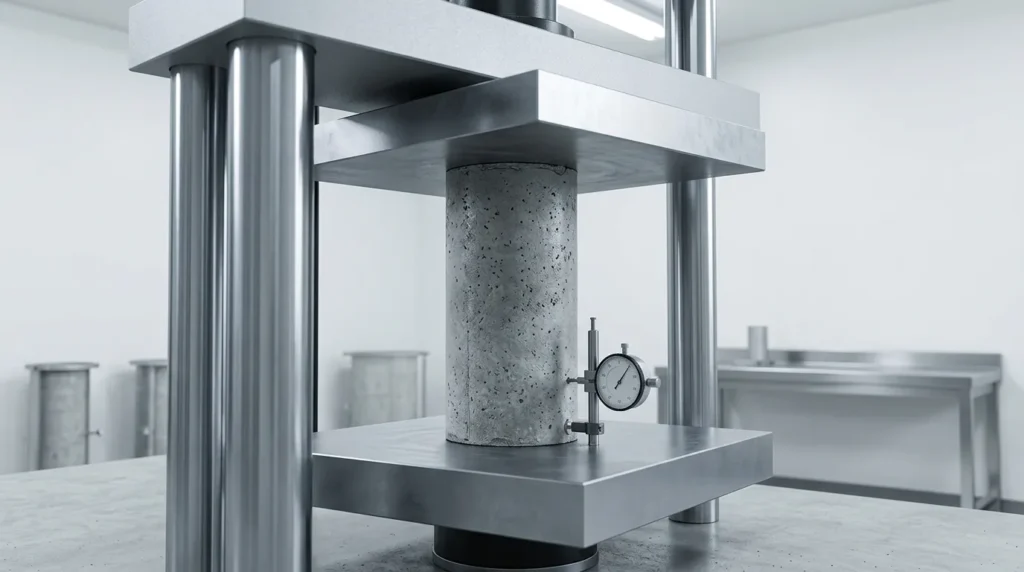
Compressive strength is specified in PSI (pounds per square inch) on US drawings and in MPa (megapascals) or N/mm² on metric or international specifications. MPa and N/mm² are numerically identical — 1 MPa = 1 N/mm².
1 PSI = 0.006895 MPa 1 MPa = 145.04 PSI
Common Concrete Grade Conversions
| US Specification | PSI | MPa | Common Use |
|---|---|---|---|
| Standard residential | 3,000 PSI | 20.7 MPa | Patios, walkways |
| Residential structural | 3,500 PSI | 24.1 MPa | Slabs, beams |
| Driveway / garage | 4,000 PSI | 27.6 MPa | Vehicle traffic |
| High-strength residential | 4,500 PSI | 31.0 MPa | Heavy driveways |
| Structural / commercial | 5,000 PSI | 34.5 MPa | Columns, foundations |
| High-performance | 6,000 PSI | 41.4 MPa | Engineered structures |
Worked Example: A UK structural engineer specifies C25/30 concrete (30 MPa characteristic strength). Your US ready-mix supplier quotes in PSI.
30 × 145.04 = 4,351 PSI → specify 4,000–4,500 PSI mix
This table is the most practical reference for anyone bridging US and international concrete specifications — a common scenario on projects with imported designs or international contractors. For a comprehensive look at international concrete grade equivalencies, the American Concrete Institute’s ACI 318 building code provides full cross-references between US and metric mix design standards.
Common Concrete Conversion Mistakes to Avoid
Mistake 1 — Forgetting to convert thickness to feet before multiplying. The volume formula requires all dimensions in the same unit. If length and width are in feet but thickness stays in inches, your volume will be 12 times too large. Always convert: inches ÷ 12 = feet.
Example of the error:
10 × 10 × 4 = 400 ft³ ← WRONG (thickness left in inches) 10 × 10 × 0.333 = 33.3 ft³ ← CORRECT
Mistake 2 — Confusing cubic yards and cubic meters. 1 cubic yard ≠ 1 cubic meter. A cubic yard is 0.7646 m³. Treating them as equal overstates your order by 31% — nearly one extra yard on a 3-yard pour.
Mistake 3 — Using US tons and metric tons interchangeably. A 10-yard dumpster rated for “5 tons” means 5 US short tons (10,000 lbs). If you calculate debris weight in metric tons and load to “5 metric tons” (11,023 lbs), you’ve overloaded the container by over half a ton.
Mistake 4 — Using PSI strength where MPa is required. 3,000 PSI sounds like a large number. 3,000 MPa would be an extraordinary material (stronger than most steel). If you accidentally enter PSI into a metric specification field, the result is either rejected outright or causes a dangerous over-specification.
Mistake 5 — Applying bag yield from one bag size to another. A 60 lb bag yields 0.45 ft³. An 80 lb bag yields 0.60 ft³. Using 0.60 for a 60 lb bag underestimates your bag count by 25%. Always verify yield against the specific bag size you’re buying.
Frequently Asked Questions About Concrete Bag Yield and Conversions
How many cubic feet in a 60 lb bag of concrete?
A standard 60 lb bag of premixed concrete yields 0.45 cubic feet of mixed, poured concrete. This is the manufacturer-standard yield used by all major brands. To fill one cubic foot, you need 2.22 bags — round up to 3 bags for any practical pour.
How many cubic feet in an 80 lb bag of concrete?
An 80 lb bag yields 0.60 cubic feet. This is the most efficient bagged option — 45 bags fill one cubic yard (27 cubic feet). At typical retail prices, the 80 lb bag delivers the lowest cost per cubic foot of any bagged size.
How many cubic feet in a 40 lb bag of concrete?
A 40 lb bag yields 0.30 cubic feet — exactly half the yield of an 80 lb bag. Use 40 lb bags for small repairs, post holes, and any application where weight handling is a constraint.
How many bags of concrete are in a cubic foot?
It depends on bag size: 3.33 bags of 40 lb, 2.22 bags of 60 lb, or 1.67 bags of 80 lb per cubic foot. In practice, always round up to whole bags — you cannot buy a fraction of a bag.
How much concrete is in a bag of Quikrete?
Quikrete’s standard yields match industry norms: 0.30 ft³ for 40 lb, 0.45 ft³ for 60 lb, and 0.60 ft³ for 80 lb bags. Quikrete’s 50 lb High Early Strength mix yields approximately 0.375 ft³. Always check the specific product label, as specialty mixes vary.
How do I convert cubic yards to cubic meters?
Multiply cubic yards by 0.7646 to get cubic meters. To convert the other way, multiply cubic meters by 1.308. Example: 5 cubic yards = 5 × 0.7646 = 3.82 cubic meters.
How do I convert PSI to MPa?
Multiply PSI by 0.006895. Example: 4,000 PSI = 4,000 × 0.006895 = 27.6 MPa. To convert MPa to PSI, multiply by 145.04.
How do I convert inches to millimeters for slab thickness?
Multiply inches by 25.4. A 4-inch slab = 4 × 25.4 = 101.6 mm. A 6-inch slab = 152.4 mm. Use the thickness conversion table in this guide for the most common values.
What is the difference between a US ton and a metric ton?
A US short ton = 2,000 lbs. A metric ton = 2,204.6 lbs. A metric ton is approximately 10% heavier than a US ton. This difference matters significantly for dumpster load limits and transport payload calculations.
How do I convert lbs/ft³ to kg/m³ for concrete density?
Multiply lbs/ft³ by 16.018. Standard concrete at 150 lbs/ft³ = 150 × 16.018 = 2,403 kg/m³ — which rounds to the standard metric density of 2,400 kg/m³.
Conclusion
Every concrete project crosses at least two unit systems — usually without warning. Bag yield, volume, thickness, weight, and strength all use different units depending on whether you’re reading a product label, an engineering drawing, or a supplier quote. The conversion factors and tables in this guide cover every transition you’ll encounter. Bookmark this page as your reference, and use the ConcreteCal calculator to apply these conversions directly to your project dimensions without manual arithmetic.