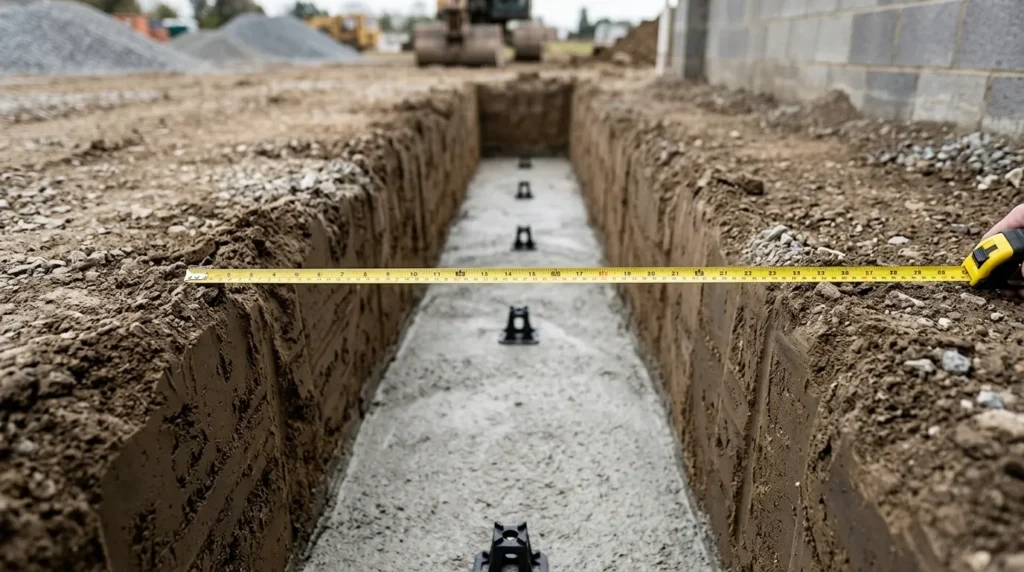

There is a particular kind of frustration that only happens on a pour day — you are halfway through filling a footing trench and you realise the concrete is running out. The truck is gone. The batch plant is 20 miles away. The concrete you already placed is setting. Whatever comes next is going to be a cold joint, a delay, or both.
This scenario happens almost exclusively because of a calculation error made days before the pour — usually a wrong unit conversion, a missed section of footing, or a forgotten waste factor. Knowing how to calculate concrete footings correctly, for every footing type and every shape, is the difference between a smooth pour and an expensive problem.
This guide covers the complete calculation method for strip footings, pad footings, round footings, and stepped footings — with worked examples you can follow directly on your own project, quick reference tables, and a clear waste factor guide.
Before starting your calculation, use our free concrete calculator at ConcreteCal to cross-check your manual figures — and see our complete guide on types of concrete foundations if you are still deciding which foundation type suits your site conditions.
Table of Contents
- Why Footing Calculations Need Their Own Approach
- The Core Formula for Concrete Footing Calculations
- How to Calculate Concrete for Strip Footings
- How to Calculate Concrete for Pad Footings
- How to Calculate Concrete for Round Footings
- How to Calculate Concrete for T-Shaped Footings
- How to Calculate Concrete for Trench Fill Foundations
- Footing Concrete Quick Reference Tables
- From Calculation to Order — Bags or Ready Mix?
- Frequently Asked Questions
Why Getting Footing Calculations Right Matters
Footings are not like surface concrete work. A short pour on a patio is inconvenient — you end up with a visible cold joint and a slightly uneven surface. A short pour on a footing trench is a structural problem. The footing must be monolithic — poured as a single continuous element — for it to perform as designed.
Cold joints in footings are planes of weakness that can allow water infiltration, reduce load-bearing capacity, and in severe cases become the initiation point for structural cracking under building load. They are difficult to remediate without significant disruption.
The Cost of Under-Ordering vs. Over-Ordering
Under-ordering: You stop the pour mid-trench. Best case — you get an emergency delivery within 30 minutes and the joint is minimal. Worst case — you wait hours, the first pour sets completely, and you have a genuine structural defect.
Over-ordering: You pay for concrete you do not use. Leftover concrete in the truck is typically charged at the full rate — most suppliers do not offer credits for unused material. At $160 per yard, one extra yard you did not need costs $160. Two extra yards: $320.
The 10% waste factor hits the sweet spot — enough buffer to cover measuring errors and real-world variation, not so much that you are routinely over-ordering by a significant margin.
What Information You Need Before You Calculate
Before any calculation, gather these measurements from your structural drawings or site survey:
- Footing length (for strip footings — measure along centreline)
- Footing width (the dimension perpendicular to the wall or column above)
- Footing depth (the thickness of the concrete footing itself)
- Bearing depth (how far below finished ground level the bottom of the footing sits)
- Number of footings (for pad and round footings)
- Footing diameter (for round post or column footings)
If you do not have structural drawings, do not guess these dimensions. For any load-bearing structure — even a simple garden wall — the footing dimensions should come from a structural calculation or a building authority table, not from estimation.
The Core Formula — How to Calculate Concrete Footings
Every footing volume calculation uses the same fundamental approach — find the cross-sectional area, multiply by the length (or depth for vertical elements), and convert to the unit your supplier uses.
Converting Dimensions to Feet
All dimensions must be in feet before multiplying. The most common error is multiplying feet by feet by inches — this produces a number that is wrong by a factor of 12.
Inch to foot conversions for common footing dimensions:
| Dimension | In Feet |
|---|---|
| 6 inches | 0.500 ft |
| 8 inches | 0.667 ft |
| 9 inches | 0.750 ft |
| 10 inches | 0.833 ft |
| 12 inches | 1.000 ft |
| 16 inches | 1.333 ft |
| 18 inches | 1.500 ft |
| 24 inches | 2.000 ft |
| 30 inches | 2.500 ft |
| 36 inches | 3.000 ft |
Convert every dimension before you multiply — not after.
From Cubic Feet to Cubic Yards
Ready mix concrete is ordered by the cubic yard. One cubic yard equals exactly 27 cubic feet.
Cubic yards = Cubic feet ÷ 27
For metric: one cubic meter = 1.308 cubic yards. Divide cubic meters by 0.7646 to get cubic yards.
Adding the Waste Factor
Footing trenches are never perfectly uniform. The excavated walls are not perfectly smooth. The bearing soil at the base has minor undulations. These variations mean the actual concrete consumed is always slightly more than the theoretical volume of a perfect rectangular prism.
Recommended waste factors for footings:
| Footing Type | Waste Factor | Reason |
|---|---|---|
| Traditional strip (formed) | 8% | Minor form variation |
| Trench fill | 10–12% | Trench wall irregularity |
| Pad footing (formed) | 5–8% | Controlled formwork |
| Round footing (tube form) | 5% | Precise tube dimensions |
| Stepped footing | 12–15% | Complex geometry |
How to Calculate Concrete for Strip Footings
A strip footing runs continuously beneath a load-bearing wall — its cross-section is a rectangle (width × depth) extended along the full length of the wall.
Traditional Strip Footing Calculation
Volume (ft³) = Length (ft) × Width (ft) × Depth (ft) Volume (yd³) = Cubic feet ÷ 27
Worked Example — Single Garage Strip Footing: A single garage (6m × 7m footprint) with 450mm wide × 225mm deep strip footings on all four sides.
Converting to feet:
- Perimeter (centreline): 2 × (19.7 + 23.0) = 85.3 ft
- Width: 450mm = 1.476 ft
- Depth: 225mm = 0.738 ft
Volume: 85.3 × 1.476 × 0.738 = 92.9 ft³ Cubic yards: 92.9 ÷ 27 = 3.44 yd³ With 8% waste: 3.44 × 1.08 = 3.72 → order 4 yards
At 4 yards, this is right at the threshold where ready mix becomes economical over bagged concrete — a single delivery with no short-load fee at most plants.
Trench Fill Footing Calculation
Trench fill concrete fills the entire excavated trench — from the bottom of the excavation to just below finished ground level. The calculation is the same rectangle formula but the depth is the full trench depth, not just the concrete layer depth.
Worked Example — Residential House Extension, Trench Fill: A 5m × 4m single-storey extension. Trench fill footings: 600mm wide, 1.0m deep (full trench depth), perimeter only (interior walls are lightweight).
Perimeter centreline: 2 × (16.4 + 13.1) = 59.1 ft Width: 600mm = 1.969 ft Depth: 1.0m = 3.281 ft
Volume: 59.1 × 1.969 × 3.281 = 381.4 ft³ Cubic yards: 381.4 ÷ 27 = 14.13 yd³ With 10% waste: 14.13 × 1.10 = 15.54 → order 16 yards
Notice how trench fill uses dramatically more concrete than traditional strip (16 yards vs. 4 yards for a similar building). This is expected — the entire trench depth is filled rather than just the lower structural layer. The trade-off is faster construction and better performance on shrinkable clay.
Perimeter Footing — Centreline Measurement
This is the most common strip footing measurement error. If you measure the outer perimeter of a building and use that for your footing length, you will over-count the corners — the footing at each corner is counted twice.
Correct approach: Measure along the centreline of the footing — the line running down the middle of the footing width.
The difference on a 10m × 8m building with 600mm wide footings:
Outer perimeter: 2 × (10 + 8) = 36.0m Centreline perimeter: 2 × (10 − 0.6) + 2 × (8 − 0.6) = 2 × 9.4 + 2 × 7.4 = 33.6m
The centreline is 2.4m shorter — on a 600mm wide × 250mm deep footing, that is: 2.4 × 0.6 × 0.25 = 0.36 m³ (approximately 0.47 cubic yards) of concrete over-ordered.
Not catastrophic — but it adds up on larger buildings and is easily avoided by measuring correctly.
How to Calculate Concrete for Pad Footings
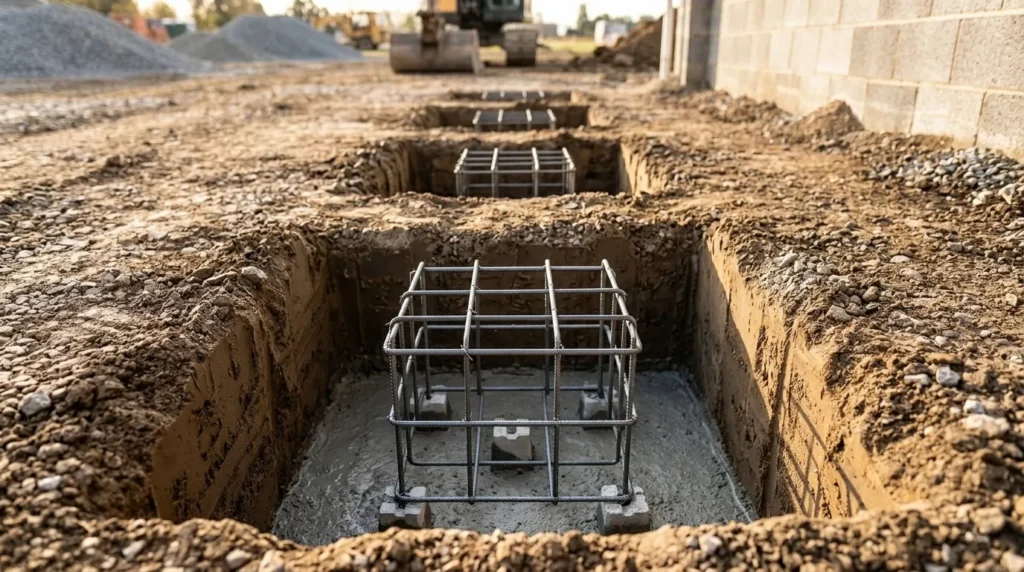
A pad footing is an isolated block of concrete beneath a single column, post, or concentrated load point. Unlike strip footings, pad footings do not run continuously — each pad is calculated individually and the totals added together.
Square and Rectangular Pad Footings
Volume per pad (ft³) = Length (ft) × Width (ft) × Depth (ft) Total volume = Volume per pad × Number of pads
Worked Example — Steel Frame Building Column Pads: An agricultural building with 8 steel columns. Each column sits on a square pad footing: 900mm × 900mm × 400mm deep.
Converting to feet:
- Length: 900mm = 2.953 ft
- Width: 900mm = 2.953 ft
- Depth: 400mm = 1.312 ft
Volume per pad: 2.953 × 2.953 × 1.312 = 11.44 ft³ = 0.424 yd³ Total for 8 pads: 8 × 0.424 = 3.39 yd³ With 8% waste: 3.39 × 1.08 = 3.66 → order 4 yards
Multiple Pad Footings — Batch Calculation
When all pads are identical (same dimensions), calculate one and multiply. When pads vary — different sizes for different column loads — calculate each separately and sum.
Mixed pad footing example:
- 4 corner pads: 1,000mm × 1,000mm × 450mm
- 4 intermediate pads: 750mm × 750mm × 400mm
Corner pads: 4 × [(3.281 × 3.281 × 1.476)] = 4 × 15.88 = 63.5 ft³ = 2.35 yd³ Intermediate pads: 4 × [(2.461 × 2.461 × 1.312)] = 4 × 7.94 = 31.8 ft³ = 1.18 yd³ Total: 2.35 + 1.18 = 3.53 yd³ With 8% waste: 3.81 → order 4 yards
How to Calculate Concrete for Round Footings
Round footings — typically used for deck posts, pergola posts, fence posts, and sign bases — use a cylinder volume formula rather than a rectangle formula.
The Cylinder Volume Formula
Volume (ft³) = π × radius² × depth
Where radius = diameter ÷ 2 (both in feet).
Or equivalently:
Volume (ft³) = π × (diameter÷2)² × depth
Volume (yd³) = Cubic feet ÷ 27
Key conversion: Always convert diameter from inches to feet before applying the formula. A 12-inch diameter hole has a radius of 0.5 feet — not 6 feet.
Worked Example — 6 Deck Post Footings: Six round footings for deck posts: 12-inch diameter, 42-inch deep, with 4-inch diameter round posts inside each.
Step 1 — Hole volume: Radius: 12÷2 = 6 inches = 0.5 ft Volume per hole: π × (0.5)² × (42÷12) = π × 0.25 × 3.5 = 2.749 ft³
Step 2 — Post volume (subtract): Post radius: 4÷2 = 2 inches = 0.167 ft Post volume per hole: π × (0.167)² × 3.5 = π × 0.0279 × 3.5 = 0.307 ft³
Step 3 — Concrete per hole: 2.749 − 0.307 = 2.442 ft³
Step 4 — Total for 6 holes: 6 × 2.442 = 14.65 ft³ = 0.543 yd³ With 5% waste: 0.543 × 1.05 = 0.570 yd³
At 0.57 cubic yards, bagged concrete is the clear choice — approximately 26 bags of 80 lb mix. No delivery, no minimum order, no short-load fee. See our concrete calculator for the exact bag count for your specific hole dimensions.
Round Footings with Round Posts — Net Volume
When the post occupies a significant portion of the hole, always subtract the post volume. For small posts in large holes (4-inch post in a 16-inch hole), the post displaces under 6% of the hole volume — negligible. For large posts in standard holes (8-inch post in a 12-inch hole), the displacement is over 40% — significant.
When to bother subtracting post volume:
| Post Diameter | Hole Diameter | Post % of Hole | Subtract? |
|---|---|---|---|
| 2 inches | 6 inches | 11% | Yes |
| 4 inches | 10 inches | 16% | Yes |
| 4 inches | 12 inches | 11% | Yes |
| 6 inches | 12 inches | 25% | Yes |
| 8 inches | 12 inches | 44% | Always |
| 4 inches | 16 inches | 6% | Optional |
Multiple Round Footings Quick Reference
Concrete volume per round footing hole (excluding post volume, in 80 lb bags):
| Hole Diameter | 24″ Deep | 30″ Deep | 36″ Deep | 42″ Deep | 48″ Deep |
|---|---|---|---|---|---|
| 6 inches | 1 bag | 1 bag | 1 bag | 1 bag | 1 bag |
| 8 inches | 1 bag | 1 bag | 1–2 bags | 2 bags | 2 bags |
| 10 inches | 1–2 bags | 2 bags | 2 bags | 2–3 bags | 3 bags |
| 12 inches | 2 bags | 2–3 bags | 3 bags | 3–4 bags | 4 bags |
| 16 inches | 3–4 bags | 4–5 bags | 5–6 bags | 6–7 bags | 7–8 bags |
| 18 inches | 5 bags | 6–7 bags | 7–8 bags | 9 bags | 10 bags |
Add 5–10% — order whole bags only. Round up always.
How to Calculate Concrete for Stepped Footings
Stepped footings are used on sloped sites where maintaining a level bearing depth requires the footing to step down in increments as the ground slopes away.
Each horizontal “step” of the footing is a separate rectangular section. Calculate each section independently and add the volumes together.
Formula for stepped footings:
Total volume = Σ (Length × Width × Depth) for each step
Worked Example — 3-Step Footing on a Slope: A strip footing on a slope requiring 3 steps. Each step section:
- Step 1: 2.5m long × 0.6m wide × 0.3m deep
- Step 2: 3.0m long × 0.6m wide × 0.3m deep (plus 0.15m step height × 0.6m wide)
- Step 3: 2.5m long × 0.6m wide × 0.3m deep (plus 0.15m step height × 0.6m wide)
Step 1 volume: 2.5 × 0.6 × 0.3 = 0.450 m³ Step 2 volume: (3.0 × 0.6 × 0.3) + (0.15 × 0.6 × 0.6) = 0.540 + 0.054 = 0.594 m³ Step 3 volume: (2.5 × 0.6 × 0.3) + (0.15 × 0.6 × 0.6) = 0.450 + 0.054 = 0.504 m³
Total: 0.450 + 0.594 + 0.504 = 1.548 m³ = 2.02 yd³ With 15% waste (complex geometry): 2.02 × 1.15 = 2.32 → order 2.5 yards
The higher waste factor for stepped footings reflects the additional formwork complexity and the increased risk of concrete loss at the step junctions.
“The waste factor recommendations in this guide are consistent with industry practice outlined by the American Concrete Institute (ACI) — which recommends accounting for placement variability and subgrade irregularity in all concrete quantity estimates for foundation work.”
Footing Concrete Volume — Quick Reference Tables
Strip Footing — Cubic Yards Per Linear Foot
| Footing Width | 6″ Deep | 9″ Deep | 12″ Deep | 18″ Deep |
|---|---|---|---|---|
| 12 inches | 0.019 | 0.028 | 0.037 | 0.056 |
| 16 inches | 0.025 | 0.037 | 0.049 | 0.074 |
| 18 inches | 0.028 | 0.042 | 0.056 | 0.083 |
| 24 inches | 0.037 | 0.056 | 0.074 | 0.111 |
| 30 inches | 0.046 | 0.069 | 0.093 | 0.139 |
| 36 inches | 0.056 | 0.083 | 0.111 | 0.167 |
To use: Multiply by footing length in feet. Add waste factor.
Example: 60 ft of 24-inch wide × 12-inch deep footing: 60 × 0.074 = 4.44 yd³ → with 10% waste = 4.88 → order 5 yards
Round Footing — Cubic Feet Per Linear Foot of Depth
| Diameter | ft³ per linear ft | yd³ per linear ft |
|---|---|---|
| 6 inches | 0.196 | 0.0073 |
| 8 inches | 0.349 | 0.0129 |
| 10 inches | 0.545 | 0.0202 |
| 12 inches | 0.785 | 0.0291 |
| 16 inches | 1.396 | 0.0517 |
| 18 inches | 1.767 | 0.0655 |
| 24 inches | 3.142 | 0.1164 |
To use: Multiply by depth in feet, then by number of holes.
Bags vs. Ready Mix for Footings — Which to Choose
The choice between bagged concrete and ready mix delivery is simpler for footings than for slabs — footings are almost always smaller volumes that suit bagged concrete, or larger volumes where ready mix is clearly more economical.
| Total Footing Volume | Best Choice | Reason |
|---|---|---|
| Under 0.5 yd³ | 80 lb bags | No delivery, no minimum |
| 0.5–1.0 yd³ | Bags or ready mix | Compare costs including short-load fee |
| 1.0–3.0 yd³ | Ready mix (if accessible) | Lower cost per yard |
| Over 3.0 yd³ | Ready mix | Always more economical at scale |
For isolated post and deck footings: Almost always bags — the volume per hole is small, the timing is flexible, and you can mix one bag at a time as needed.
For strip footings on a residential extension: Almost always ready mix — the continuous pour requirement (no cold joints), the volume, and the speed all favour delivery.
For pad footings on a steel frame: Depends on total volume. Under 1 yard — bags. Over 2 yards — ready mix.
Common Footing Calculation Mistakes to Avoid
Mistake 1 — Thickness in inches, dimensions in feet. The most common and most damaging error. If your footing is 9 inches deep and you multiply by 9 instead of 0.75, your volume is 12× too large. Always convert inches to feet before multiplying.
Mistake 2 — Outer perimeter instead of centreline. Measuring the outside perimeter of a building and using that as your strip footing length over-counts the corners. Measure the centreline — the line running along the middle of the footing width. On a standard house, this typically reduces the measurement by 1–3 metres.
Mistake 3 — Forgetting the step height in stepped footings. On sloped sites, the vertical face of each step is solid concrete too. Each step junction adds: step height × footing width × footing width (approximately). This is small per step but significant across a long sloped footing run.
Mistake 4 — Using diameter instead of radius in the circle formula. The formula is π × radius² — not π × diameter². Using the diameter without halving it gives a result that is four times too large. Always divide diameter by 2 to get radius before squaring.
Mistake 5 — Skipping the waste factor entirely. Footing trenches are not perfect rectangular prisms. Soil falls in from the sides. The bottom is not perfectly flat. The bearing soil absorbs some moisture from the concrete. A 10% waste factor is not excessive — it is realistic.
Mistake 6 — Ignoring the post displacement in round footings. For a 4-inch post in a 12-inch hole, the post displaces about 11% of the hole volume. Skip this and you order 11% less concrete than you need — across 10 post holes, that is approximately 2 bags of 80 lb mix you will run short.
Frequently Asked Questions
How do I calculate concrete for footings?
Measure the length, width, and depth of the footing in inches. Convert all to feet (divide inches by 12). Multiply: Length × Width × Depth = cubic feet. Divide by 27 = cubic yards. Add 10% waste factor. For round footings: use π × (diameter÷2)² × depth for cubic feet, then divide by 27. Always measure footing depth as the depth of concrete — not the total trench depth unless using trench fill.
How much concrete do I need for footings?
It depends entirely on the footing dimensions and type. A typical residential strip footing (24 inches wide × 9 inches deep) requires approximately 0.056 cubic yards per linear foot. A standard 12-inch round post footing 36 inches deep requires approximately 0.087 cubic yards. Use the quick reference tables in this guide or our concrete calculator for your specific dimensions.
How do I calculate cubic yards of concrete for strip footings?
Measure the centreline perimeter (not the outer perimeter) in feet. Multiply by footing width (in feet) and footing depth (in feet). Divide by 27 for cubic yards. Add 10% for waste. Example: 100 ft centreline perimeter × 2.0 ft wide × 0.75 ft deep ÷ 27 = 5.56 yd³ × 1.10 = 6.11 → order 6.5 yards.
How do I calculate concrete for round footings?
Use: π × (diameter÷2)² × depth. Convert all measurements to feet first. Then divide by 27 for cubic yards. Subtract the post volume if the post is large relative to the hole. Example: 12-inch hole, 36 inches deep: π × (0.5)² × 3.0 = 2.36 ft³ = 0.087 yd³ per footing.
How many bags of concrete do I need for post footings?
A 12-inch diameter hole, 36 inches deep requires approximately 3 bags of 80 lb mix (excluding post volume). A 10-inch hole at the same depth needs approximately 2 bags. Use the quick reference table in this guide for your specific hole size and depth.
What is the difference between footing depth and trench depth?
Footing depth is the thickness of the concrete footing element itself — typically 150–300mm (6–12 inches) for residential applications. Trench depth is the total excavation depth — the distance from finished ground level to the bottom of the excavation. For traditional strip foundations, the footing sits at the bottom of the trench and the trench depth above is left open (or backfilled). For trench fill foundations, the entire trench depth is filled with concrete.
How do I calculate concrete for stepped footings?
Divide the stepped footing into individual horizontal sections at each step level. Calculate each section as a simple rectangle (Length × Width × Depth). Add the vertical step faces as separate small rectangles. Sum all volumes. Add 15% waste factor for the additional complexity. See the worked example in this guide for a 3-step footing calculation.
Do I need to subtract post volume from round footing calculations?
Yes, if the post is large relative to the hole. For a 4-inch post in a 12-inch hole: post displaces approximately 11% — worth subtracting. For an 8-inch post in a 12-inch hole: post displaces 44% — always subtract. For a 4-inch post in a 16-inch hole: post displaces 6% — optional. Use the displacement percentage table in this guide to decide.
Conclusion
Footing calculations are straightforward once every dimension is in feet and the right formula is applied to the right shape. Strip footings — length × width × depth ÷ 27. Pad footings — same formula per pad, multiplied by count. Round footings — π × radius² × depth ÷ 27, with post displacement subtracted when significant. Add your waste factor, round up to the nearest practical order quantity, and cross-check with our free concrete calculator at ConcreteCal before calling the supplier. The calculation takes ten minutes. Getting it wrong costs significantly more than that.